Air Temperatures – The following maximum temperatures were recorded across the state of Hawaii Saturday:
Lihue, Kauai – 82
Honolulu airport, Oahu – 86 (Record high for Saturday / 89 – 1979 )
Kaneohe, Oahu – 82
Molokai airport – 82
Kahului airport, Maui – 84
Kona airport – 81
Hilo airport, Hawaii – 82
Air Temperatures ranged between these warmest and coolest spots near sea level – and on the highest mountain tops…as of 5pm Saturday evening:
Barking Sands, Kauai – 83
Kailua-kona – 77
Haleakala Crater – 57 (near 10,000 feet on Maui)
Mauna Kea – 39 (near 13,800 feet on the Big Island)
Hawaii’s Mountains – Here’s a link to the live web cam on the summit of near 13,800 foot Mauna Kea on the Big Island of Hawaii. This web cam is available during the daylight hours here in the islands…and when there’s a big moon shining down during the night at times. Plus, during the nights you will be able to see stars, and the sunrise and sunset too…depending upon weather conditions. Here's the Haleakala Crater webcam on Maui…although this webcam is not always working correctly.
Tropical Cyclone activity in the eastern and central Pacific – Here’s the latest weather information coming out of the National Hurricane Center, covering the eastern north Pacific. You can find the latest tropical cyclone information (once the season begins June 1) for the central north Pacific (where Hawaii is located) by clicking on this link to the Central Pacific Hurricane Center. A satellite image, which shows the entire ocean area between Hawaii and the Mexican coast…can be found here. Here's a tropical cyclone tracking map for the eastern and central Pacific.
Aloha Paragraphs

Gradually strengthening trades Monday, passing
windward showers at times…although generally
light and limited in coverage
As this weather map shows, we have high pressure systems located far to the northeast and northwest of the Hawaiian Islands, with an elongated connecting ridge between the two…to the north of Hawaii. At the same time, we find the tail-end of a cold front well to the north of the islands. Our local winds will continue to be from the trade wind direction, although become somewhat lighter this weekend…before picking up again by Monday onwards.
The following numbers represent the most recent top wind gusts (mph), along with directions as of Saturday evening:
14 Lihue, Kauai – NE
29 Honolulu, Oahu – NE
28 Molokai – NNE
30 Kahoolawe – NE
31 Kahului, Maui – NE
22 Lanai – NE
23 Upolu airport, Big Island – NE
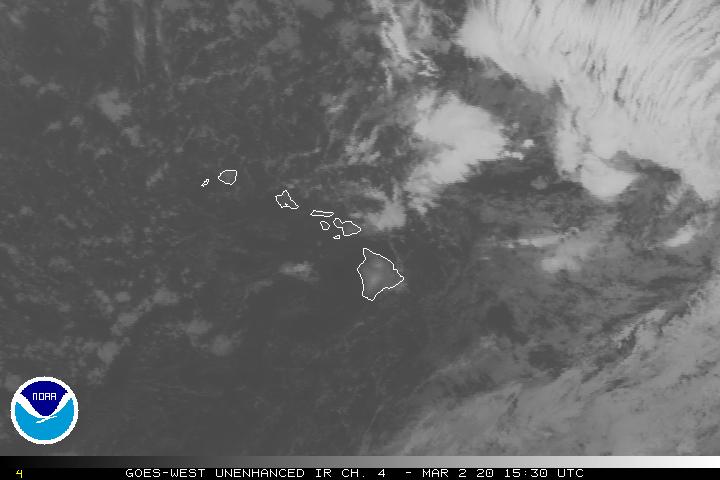
We can use the following links to see what’s going on in our area of the north central Pacific Ocean. Here's the latest NOAA satellite picture – the latest looping satellite image…and finally the latest looping radar image for the Hawaiian Islands.
Here are the latest 24-hour precipitation totals (inches) for each of the islands as of Saturday evening:
0.02 Mount Waialeale, Kauai
0.11 Punaluu Stream, Oahu
0.01 Molokai
0.00 Lanai
0.00 Kahoolawe
0.11 Puu Kukui, Maui
0.42 Kealakekua, Big Island
Sunset Commentary: The trade winds will remain relatively light through most of the day Sunday…in contrast to our typical late spring more breezy conditions. The reason for this minor faltering of our trade wind speeds, is that a cold front is moving slowly by to our north, weakening the trade wind producing high pressure ridge to our north as well. The NWS forecast office in Honolulu will raise the small craft wind advisories by Sunday night or Monday, as the current forecast continues to have our local winds picking back up again after the weekend for several days.
Here in Kula, Maui at 515pm, skies were partly cloudy to clear (although quite hazy too), along with light breezes, and an air temperature of 76.1F degrees. As far as precipitation goes, there will be a few more of those incoming showers at times, although the overlying atmosphere is generally dry and stable, which will act to limit the shower intensities and coverage. Saturday night through Sundays looks like we'll continue to see these favorably inclined weather conditions. As the somewhat lighter winds remain in place now, we'll see sea breeze activity along those trade wind sheltered beaches again Sunday. This in turn will carry moisture up the leeward slopes, triggering more afternoon clouds, along with a few light showers, although not many. This will grade off the clear morning expected in many places Sunday.
Friday evening I went to see the new film called The Avengers, starring Robert Downey Jr., Chris Evans, Mark Ruffalo, Chris Hemsworth, Scarlett Johansson, Samuel L. Jackson, Gwyneth Paltrow…among many others. The synopsis: Iron Man, The Incredible Hulk, Thor, Captain America, Hawkeye and Black Widow answer the call to action when Nick Fury, director of the international peacekeeping agency known as S.H.I.E.L.D., initiates a daring, globe-spanning recruitment effort to assemble The Avengers team to defeat an unexpected enemy threatening global safety and security. Despite pulling together the ultimate dream team, Nick Fury and longtime confidant Agent Coulson must find a way to convince the Super Heroes to work with, not against each other, when the powerful and dangerous Loki gains access to the Cosmic Cube and its unlimited power. I'd been looking forward to this one, and as I'd hoped…it was quite entertaining. I must say however, once you've seen so many of these action thrillers, they gradually begin to lose their appeal to some degree. Nonetheless, as far as these films go, this was definitely one of the better ones. It deserves a grade somewhere between a solid B and perhaps even a B+. Here's a trailer so you can see what this film is like for yourself. ~~~ I'll be back Sunday morning with your next new tropical weather narrative from paradise, and it really is! I hope you have a great Saturday night wherever you're spending it! Aloha for now…Glenn.
Partial Solar Eclipse: Sunday May 20 – partial solar eclipse (visible in Hawai‘i). A small portion of the sun will be blocked by the moon on the afternoon on May 20, as seen from the Hawaiian Islands. From Honolulu the first contact will occur at 2:03 p.m.. By 3:15 p.m., the time of deepest eclipse, about 1/10th of the sun will be blocked by the moon. The eclipse will end at 4:12 p.m..
In parts of the continental US, this May 20 eclipse will be an annular eclipse. An annular eclipse occurs when the moon is unusually distant from the earth in its orbit around the earth. At times like this, the distant moon is too small to cover the entire disk of the sun.
Even when the moon is dead-center in the middle of the solar disk, a ring of sunlight shines around the moon. Such eclipses are called “annular eclipses,” from the Latin word for “ring.” A viewer using safe viewing techniques would see a ring of sunlight surrounding the moon’s disk.
The annular eclipse will pass over the western US in the afternoon of May 20. The annular phase will touch the west coast in northern California near Eureka just after 5 p.m. local time. (While the path to see the annular eclipse is 200 miles wide, that path runs just north of San Francisco, which will see only a deep partial eclipse).
In Redding, CA, the annular phase will start at 6:26 p.m. and last for about four minutes. (That’s 3:23 p.m. HST, but we of course won’t see it as an annular eclipse in Hawai‘i). The path of the annular eclipse will proceed through the exact middle of Nevada, and then cross south Utah and Northern Arizona.
It will cross the middle of New Mexico; Albuquerque is right in its path. The annular phase will start at 7:26 p.m. on Albuquerque and last just over four minutes. Elsewhere on the planet, this annular eclipse will be visible in Hong Kong and Tokyo. Those cities are on the other side of the International Date Line, so this eclipse occurs in Asia on May 21. Hong Kong will see the annular phase from 7:05 to 7:10am on May 21. Tokyo will see the annular phase at 7:33 – 7:37 a.m. on the May 21. Please note that is never safe to view an annular partial eclipse without a proper filter.
Annular eclipses can be of particular concern, since so much of the sun’s light is blocked; but even the thin ring of the sun’s disk can do eye damage.
 Email Glenn James: