











Air Temperatures – The following maximum temperatures were recorded across the state of Hawaii Thursday:
Lihue, Kauai – 83
Honolulu airport, Oahu – 84
Kaneohe, Oahu – 82
Molokai airport – 81
Kahului airport, Maui – 84
Kona airport – 85
Hilo airport, Hawaii – 83
Air Temperatures ranged between these warmest and coolest spots near sea level – and on the highest mountain tops…as of 5pm Thursday evening:
Barking Sands, Kauai – 82
Kapalua, Maui – 73
Haleakala Crater – 50 (near 10,000 feet on Maui)
Mauna Kea – 39 (near 13,800 feet on the Big Island)
Hawaii’s Mountains – Here’s a link to the live web cam on the summit of near 13,800 foot Mauna Kea on the Big Island of Hawaii. This web cam is available during the daylight hours here in the islands…and when there’s a big moon shining down during the night at times. Plus, during the nights you will be able to see stars, and the sunrise and sunset too…depending upon weather conditions. Here's the Haleakala Crater webcam on Maui…although this webcam is not always working correctly.
Tropical Cyclone activity in the eastern and central Pacific – Here’s the latest weather information coming out of the National Hurricane Center, covering the eastern north Pacific. You can find the latest tropical cyclone information (once the season begins June 1) for the central north Pacific (where Hawaii is located) by clicking on this link to the Central Pacific Hurricane Center. A satellite image, which shows the entire ocean area between Hawaii and the Mexican coast…can be found here. Here's a tropical cyclone tracking map for the eastern and central Pacific.
Aloha Paragraphs
Gusty trade winds, passing windward showers
tonight into the morning…a few in the leeward
sections locally as well
As this weather map shows, we have high pressure systems located to the north-northeast and far northwest of the Hawaiian Islands. At the same time, we find the tail-end of a weak cold front to our north…and another further to the northwest of the islands. Our local winds will increase from the trade wind direction today through Friday…and then become somewhat lighter this weekend into early next week.
The following numbers represent the most recent top wind gusts (mph), along with directions as of Thursday evening:
25 Port Allen, Kauai – NE
32 Kuaokala, Oahu – NE
32 Molokai – NE
30 Kahoolawe – ENE
32 Kahului, Maui – NE
32 Lanai – NE
24 PTA Keamuku, Big Island – NE
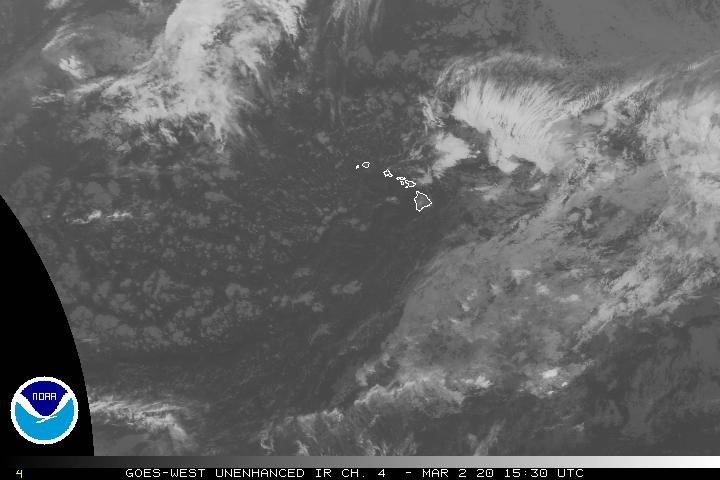
We can use the following links to see what’s going on in our area of the north central Pacific Ocean. Here's the latest NOAA satellite picture – the latest looping satellite image…and finally the latest looping radar image for the Hawaiian Islands.
Here are the latest 24-hour precipitation totals (inches) for each of the islands as of Thursday evening:
0.29 Mount Waialeale, Kauai
0.05 Ahuimanu loop, Oahu
0.00 Molokai
0.00 Lanai
0.00 Kahoolawe
0.09 Mahinahina, Maui
0.63 Kawainui Stream, Big Island
Sunset Commentary: We have one more day of locally strong and gusty trade winds at hand. This current trade wind episode will drop to light to moderately strong proportions this weekend. The reason for this upcoming brief faltering of our trade wind speeds, is that a cold front will slide by far to our north…pushing a high pressure ridge closer to the islands, thus the slowing down of our local wind speeds. The NWS forecast office in Honolulu is carrying small craft wind advisories for those windiest parts of Maui County and the Big Island at the moment, which will likely be dropped this weekend. The forecast models then suggest that these gusty winds will pick right back up as we get into early next week.
Meanwhile, the latest satellite image shows the next north to south oriented band of showery clouds over the Big Island this evening. The trade winds will carry these clouds and showers across the rest of the state tonight into Friday morning. This increase in clouds and a few showers along our windward sides, isn't going to be too big a deal, although there will be an increase in precipitation nonetheless. As we slide into later Friday and the weekend, we'll see occasional patches of showery clouds being carried our way, dropping a few more showers along those north and east facing coasts and slopes at times. The leeward sides in contrast, will have generally dry and sunny to partly cloudy weather prevailing during the days…especially during the morning hours.
Here in Kula, Maui at 530pm, skies were cloudy with light sprinkles, along with light breezes, and an air temperature of 69.8F degrees. Looking around across the island of Maui, and over towards Molokai and Lanai too, we have lots of clouds…some of which are dropping showers. As this more tightly focused satellite image shows, we have this showery cloud band mentioned above, moving through the state now. As I was mentioning above as well, this north/south oriented band of clouds will increase our clouds, but since our overlying air mass is fairly dry and stable…this won't become too much of a showery issue through the night. As we push into the weekend time frame, the lighter winds will prompt more of that afternoon cloudiness in the upcountry areas , with a few showers falling here and there, along with those common windward showers of course. ~~~ I'll be back early Friday morning with your next new weather narrative, I hope you have a great Thursday night either here in the islands, or elsewhere! Aloha for now…Glenn.
Tropical cyclone activity: We find the first tropical cyclone of the 2012 hurricane season…well offshore from the mainland Mexican coast Thursday evening. It's weakened from a tropical storm, down to a tropical depression called Aletta, and is located approximately 705 miles south-southwest of the southern tip of Baja California. Here's the NHC graphical track map for Aletta (1E), along with this satellite image. Aletta is forecast to continue this weakening trend through the remainder of her life cycle. There is absolutely no threat to the Hawaiian Islands, as this system turns back towards Mexico. Meanwhile, there's an area of disturbed weather (92E) further to the east of Aletta, several hundred miles south of Acapulco, Mexico. It's being given a 40% chance of developing into a tropical cyclone during the next 48 hours. Here's a satellite image showing both Aletta, and second area circled in orange.
Extra: Youtube video…the Sea Lion
Interesting: Earth’s ecosystems keep soaking up more carbon as greenhouse gases accumulate in the atmosphere, new measurements find. The research contradicts several recent studies suggesting that “carbon sinks” have reached or passed their capacity. By looking at global measurements of atmospheric carbon dioxide, the new work calculates instead that total sinks have increased roughly in line with rising emissions.
“The sinks have been more than able to keep up with emissions,” said Pieter Tans, an atmospheric scientist at the National Oceanic and Atmospheric Administration’s Earth System Research Laboratory in Boulder, Colo. Tans presented the findings May 15 at an annual conference on global monitoring hosted by the lab.
Careful measurements of atmospheric carbon dioxide taken in the rarefied air atop Mauna Loa, Hawaii, and elsewhere have established that levels of the gas are rising steadily, from 316 parts per million in 1959 to 392 parts per million today. The question is how Earth’s great ecosystems respond to that increase.
Forests can suck down carbon dioxide through photosynthesis, whereas oceans take it up proportionally as levels rise in the air. Previous work has relied on carbon inventories that gather data from multiple sources to try to estimate how much is being put into the atmosphere and how much is being taken out every year.
For the new study, Tans and his colleagues went back to basics, choosing 42 marine sites where carbon dioxide levels have been measured for decades. The researchers then analyzed how much carbon dioxide was in the atmosphere above each of these sites over time. “Less carbon dioxide has remained in the atmosphere, relative to the amount of fossil fuel emissions, today compared to 50 years ago,” Tans said.
Even including the effects of land use change, which may alter carbon sinks, produced no measurable trend, he added. Exactly where the sinks are isn’t clear. One possibility is that forests are regrowing in parts of the world more than scientists had thought, sucking up carbon in the process.
Or the oceans may be taking up significantly more carbon than researchers had estimated. Ralph Keeling, an atmospheric scientist at the Scripps Institution of Oceanography in San Diego, agrees that both land and the oceans aren’t yet done absorbing all the carbon they can.
“The land is responding in a big way” to increasing fossil fuel emissions, he says. Both Keeling and Tans warn that society shouldn’t get complacent just because carbon is still being absorbed. Rising levels of atmospheric greenhouse gases are triggering other planet-wide changes, such as alterations to the oceans’ chemistry. “The situation is bad enough,” Keeling says, “even with the sinks hanging in there.”
 Email Glenn James:


Steve Says:
Hello Glenn! Do we have a solar eclipse coming? Maybe I can use a little less sunscreen here on Ala Moana Beach! Much mahalos,
Steve~~~Hi Steve, yes we have a solar eclipse coming up this weekend, I’ll write more about it soon. Aloha, Glenn