











Air Temperatures – The following maximum temperatures were recorded across the state of Hawaii Wednesday:
Lihue, Kauai – 82
Honolulu airport, Oahu – 82
Kaneohe, Oahu – 82
Molokai airport – 81
Kahului airport, Maui – 85 (Record highest temperature for Wednesday / 91 – 1951)
Kona airport – 84
Hilo airport, Hawaii – 83
Air Temperatures ranged between these warmest and coolest spots near sea level – and on the highest mountain tops…as of 5pm Wednesday evening:
Honolulu, Oahu – 82
Princeville, Kauai – 77
Haleakala Crater – 52 (near 10,000 feet on Maui)
Mauna Kea – 39 (near 13,800 feet on the Big Island)
Hawaii’s Mountains – Here’s a link to the live web cam on the summit of near 13,800 foot Mauna Kea on the Big Island of Hawaii. This web cam is available during the daylight hours here in the islands…and when there’s a big moon shining down during the night at times. Plus, during the nights you will be able to see stars, and the sunrise and sunset too…depending upon weather conditions. Here's the Haleakala Crater webcam on Maui…although this webcam is not always working correctly.
Tropical Cyclone activity in the eastern and central Pacific – Here’s the latest weather information coming out of the National Hurricane Center, covering the eastern north Pacific. You can find the latest tropical cyclone information (once the season begins June 1) for the central north Pacific (where Hawaii is located) by clicking on this link to the Central Pacific Hurricane Center. A satellite image, which shows the entire ocean area between Hawaii and the Mexican coast…can be found here. Here's a tropical cyclone tracking map for the eastern and central Pacific.
Aloha Paragraphs

Strengthening trades, fewer windward showers…
although more sighted on our eastern horizon
As this weather map shows, we have high pressure system located to the northeast of the Hawaiian Islands. At the same time, we find a weak cold front just to our north…which is pulling slowly away from Kauai. Our local winds will increase from the trade wind direction today through the next few days.
The following numbers represent the most recent wind gusts (mph), along with directions as of Wednesday evening:
25 Port Allen, Kauai -NW
21 Kahuku, Oahu – ESE
23 Molokai – NE
31 Kahoolawe – NE
23 Kaupo Gap, Maui – SE
36 Lanai – NE
25 Puu Mali, Big Island – NE
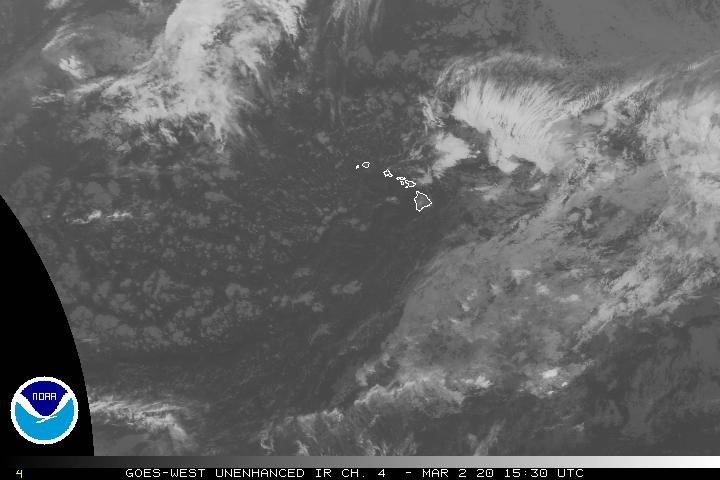
We can use the following links to see what’s going on in our area of the north central Pacific Ocean. Here's the latest NOAA satellite picture – the latest looping satellite image…and finally the latest looping radar image for the Hawaiian Islands.
Here are the latest 24-hour precipitation totals (inches) for each of the islands as of Wednesday evening:
0.39 Mount Waialeale, Kauai
0.05 Moanalua RG, Oahu
0.03 Molokai
0.02 Lanai
0.00 Kahoolawe
0.20 Puu Kukui, Maui
0.38 Kawainui Stream, Big Island
Sunset Commentary: As the recent low level cloud band, which brought cloudy skies and a few windward showers to the islands today, moves westward away from the state, as well as the recent late season cold front…our trade winds have increased in their wake. These trade winds will remain rather strong and gusty, at least over the eastern islands. The NWS forecast office in Honolulu has issued a small craft wind advisory for those windiest parts of Maui County and the Big Island in response. The forecast models suggest that these gusty winds will drop off some this weekend into early next week.
Meanwhile, the latest satellite image shows relatively clear skies upstream of the islands Wednesday evening. Looking a bit further to the east however, we see another more or less north to south oriented band of showery clouds well to the east of the state. The trade winds will carry these clouds and showers our way, arriving first on the Big Island's windward side…and then on the other islands with time too. As we saw with this most recent band of showers, the next showery area will bring limited precipitation…due to the generally stable and dry atmospherics over the Aloha state at this time.
Here in Kula, Maui at 540pm, skies were partly cloudy, with light breezes, and an air temperature of 69.4F degrees. As this more tightly focused satellite image shows, we have that next showery cloud band mentioned above, which will arrive over the windward sides in the increasingly strong trade winds later tonight into Thursday…first on the Big Island. The leeward sides will see more sunshine than the windward sides during the days for the time being. As we push into weekend time frame, we should see fewer showers in general. ~~~ The cloud band that came through the island chain today brought quite a few clouds, and some showers too. Here in Kula it clouded up early, and we saw a few light showers at mid-day into the afternoon hours. I went with my neighbors over to the Kula Hospital in Keokea, where there was Hawaiian music and Hula dancing too. I saw some old friends there, and greatly appreciated the dancing too. I'm not sure exactly why, but I often feel emotions arise inside myself when I hear Hawaiian music and see Hula dancing performed together. I'll be back early Thursday morning with your next new weather narrative, I hope you have a great Wednesday night until then! Aloha for now…Glenn.
Tropical cyclone activity: We find the first tropical cyclone of the 2012 hurricane season…well offshore from the mainland Mexican coast Wednesday afternoon. It's called tropical storm Aletta, and is located approximately 830 miles south-southwest of the southern tip of Baja California. Here's the NHC graphical track map for tropical storm Aletta (1E), along with this satellite image. Aletta has peaked in strength now, and will weaken steadily into Thursday. There is absolutely no threat to the Hawaiian Islands, as the storm turns back towards the northeast and east through the remainder of its life cycle. Meanwhile, there's an area of disturbed weather (92E) further to the east of Aletta, 500 miles south of Acapulco, Mexico. It's being given a 30% chance of developing into a tropical cyclone during the next 48 hours. Here's a satellite image showing both Aletta, and this new area circled in orange.
Interesting: All are aware of the tragic loss of biodiversity that this planet is current going through in various ecosystems. However, a new National Oceanic and Atmospheric Administration (NOAA) report shows that when good policies are in place, natural ecosystems can sustain themselves and thrive.
NOAA has released its annual report, stating that a record six fish populations have been rebuilt to healthy levels in 2011. This brings the number of rebuilt US marine fish populations to 27 since the start of the 21st century, showing that great strides have been made to end overfishing thanks to all interested parties.
The NOAA report, Status of U.S. Fisheries, detailed the comeback of the following species:
– Bering Sea snow crab
– Atlantic coast summer flounder
– Gulf of Maine haddock
– Northern California coast Chinook salmon
– Washington coast coho salmon
– Pacific coast widow rockfish
"With annual catch limits in place this year for all domestic fish populations and the continued commitment of fishermen to rebuild the stocks they rely on, we're making even greater progress in ending overfishing and rebuilding stocks around the nation," said Samuel Rauch, acting assistant NOAA administrator for fisheries.
"Healthy and abundant fish populations and marine ecosystems support seafood for Americans, create lasting jobs, and enhance saltwater recreational fishing opportunities." However, overfishing is not the only factor that holds down fish populations.
There are also environmental factors, disease, invasive species, and degraded fish habitat. Many of these may be indirectly attributable to a changing climate, which affects temperature, salinity, and potentially the spread of pathogens.
NOAA researchers predict that fully rebuilt fisheries could add over $30 billion to the economy and add 500,000 new jobs. At the moment, commercial and recreational fishing generates $183 billion per year and supports over 1.5 million full and part-time jobs.
 Email Glenn James: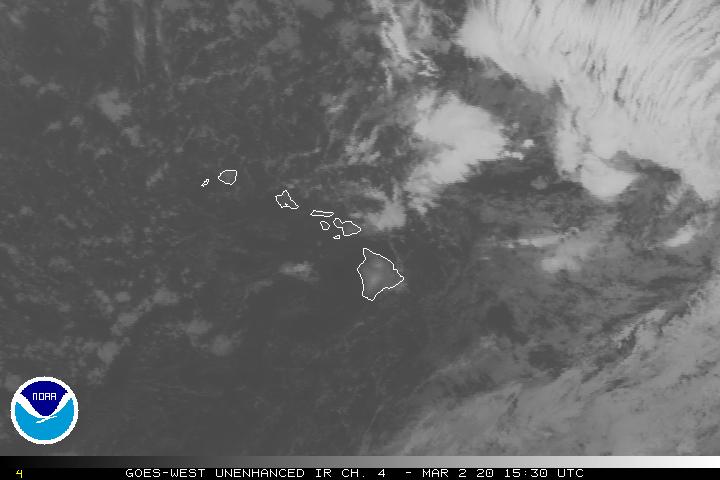


Linda baker Says:
Anyway to send that Aloha picture? I just love that picture. Thanks.
~~~Will send it to you Linda, Aloha, Glenn
Jeff King Says:
Hi Glenn,
Season's starting early this year. Aletta looked pretty impressive for a while. I'm a little confused about the other system. Why would it be EP92 and named "Invest" instead of EP02 and named with a "B?"~~~Hi Jeff, this second potential system to the east is being referred to as 92E. Aloha, Glenn