











Air Temperatures – The following maximum temperatures were recorded across the state of Hawaii Monday:
Lihue, Kauai – 81
Honolulu airport, Oahu – 83 (Record high temperature for Monday – 89 / 1990)
Kaneohe, Oahu – 81
Molokai airport – 79
Kahului airport, Maui – 82
Kona airport – 83
Hilo airport, Hawaii – 80
Air Temperatures ranged between these warmest and coolest spots near sea level – and on the highest mountain tops…as of 5pm Monday evening:
Barking Sands, Kauai – 81
Princeville, Kauai – 73
Haleakala Crater – 45 (near 10,000 feet on Maui)
Mauna Kea – 32 (near 13,800 feet on the Big Island)
Hawaii’s Mountains – Here’s a link to the live web cam on the summit of near 13,800 foot Mauna Kea on the Big Island of Hawaii. This web cam is available during the daylight hours here in the islands…and when there’s a big moon shining down during the night at times. Plus, during the nights you will be able to see stars, and the sunrise and sunset too…depending upon weather conditions. Here's the Haleakala Crater webcam on Maui…although this webcam is not always working correctly.
Aloha Paragraphs

Kauai
Locally strong trades – some windward showers
through Tuesday, with localized leeward
showers too…depending upon available
moisture in both cases
Wind advisory atop the Haleakala Crater on Maui,
and the summits on the Big Island too
As this weather map shows, we have a near 1032 millibar high pressure system is nearly stationary to the northeast of Hawaii. At the same time, there's a low pressure systems with their associated cold fronts to the north-northwest and west of the islands. Our local winds will remain locally strong and gusty into mid-week.
The following numbers represent the most recent wind gusts (mph), along with directions as of Monday evening:
17 Lihue, Kauai – NE
28 Wheeler AFB, Oahu – NE
31 Molokai – NE
42 Kahoolawe – ESE
33 Kahului, Maui – SE
06 Lanai – NE
28 Kawaihae, Big Island – SE
We can use the following links to see what’s going on in our area of the north central Pacific Ocean. Here's the latest NOAA satellite picture – the latest looping satellite image…and finally the latest looping radar image for the Hawaiian Islands.
Here are the latest 24-hour precipitation totals (inches) for each of the islands as of Monday evening:
0.35 Mount Waialeale, Kauai
0.11 Luluku, Oahu
0.00 Molokai
0.00 Lanai
0.00 Kahoolawe
1.08 Puu Kukui, Maui
2.44 Island Dairy, Big Island
Sunset Commentary: A near 1032 millibar high pressure system remains in place to the northeast of the state Monday evening…and is stationary for the time being. Two low pressure systems with their associated cold fronts are located to our west and north-northwest. Our winds are blowing from the trade wind direction, and will remain locally strong and gusty through the next several days. These trade winds will carry showers into the windward sides at times. The leeward sides in contrast should remain generally dry, although a few showers will sneak over into those areas on the smaller islands on the gusty trade flow…especially during the cooler night hours.
As mentioned above, high pressure will continue its normal presence to our northeast and north, thus keeping our springtime trade winds blowing. They will be strongest around Maui County and the Big Island, although the entire state will be rather windy for the time being. Small craft wind advisory flags remain active over almost all of our coastal and channel marine zones. The summit of the Haleakala Crater on Maui, in addition to the summits on the Big Island, will experience gusty winds as well, where a wind advisory has been posted in those areas by the National Weather Service in Honolulu.
~~~ Here in Kula, Maui at 515pm, skies were mostly clear with light winds, and a warm air temperature of 77.7F degrees. Our weather was near perfect today, that is if one enjoys sunny and warm conditions…and who doesn't like that! The winds were the most notable feature, with some gusts in those windiest areas topping 40 mph at times. Our winds will remain rather robust through Tuesday, with a gradual and modest tapering off Wednesday through the rest of the week. All this wind is causing rough and choppy conditions along our east facing shores, although the rest of the beaches in other areas will have small to very small surf through the rest of this work week. It looks like smooth sailing in terms of favorably inclined weather conditions well into the future! I'll be back early Tuesday morning with your next new tropical weather narrative from paradise. I hope you have a fabulous time between now and then! Aloha for now…Glenn.
Interesting: The Yellowstone Caldera is the volcanic caldera located in Yellowstone National Park in the United States, sometimes referred to as the Yellowstone Supervolcano. The caldera is located in the northwest corner of Wyoming, in which the vast majority of the park is contained. Researchers at Washington State University and the Scottish Universities Environmental Research Center say the biggest Yellowstone eruption, which created the 2 million year old Huckleberry Ridge deposit, was actually two different eruptions at least 6,000 years apart.
Their results paint a new picture of a more active volcano than previously thought and can help recalibrate the likelihood of another big eruption in the future. Before the researchers split the one eruption into two, it was the fourth largest known to science.
The Huckleberry Ridge Tuff is a tuff formation created by the Huckleberry Ridge eruption that formed the Island Park Caldera that lies partially in Yellowstone Park, Wyoming and stretches westward into Idaho into a region known as Island Park.
This eruption of 2,500 km³ of material was thought to be the largest known eruption in the Yellowstone Hotspot's history and the third largest known explosive volcanic eruption in Earth's history, next to the Toba eruption and the Fish Canyon eruption that formed La Garita Caldera in Colorado.
"The Yellowstone volcano's previous behavior is the best guide of what it will do in the future," says Ben Ellis, co-author and post-doctoral researcher at Washington State University's School of the Environment. "This research suggests explosive volcanism from Yellowstone is more frequent than previously thought."
The new ages for each Huckleberry Ridge eruption reduce the volume of the first event to 2,200 cubic kilometers, roughly 12 percent less than previously thought. A second eruption of 290 cubic kilometers took place more than 6,000 years later. That first eruption still deserves to be called "super," as it is one of the largest known to have occurred on Earth and darkened the skies with ash from southern California to the Mississippi River.
By comparison, the 1980 eruption of Mount St. Helens produced 1 cubic kilometer of ash. The larger blast of Oregon's Mount Mazama 6,850 years ago produced 116 cubic kilometers of ash. The study, funded by the National Science Foundation and published in the June issue of the Quaternary Geochronology, used high-precision argon isotope dating to make the new calculations.
The radioactive decay rate from potassium 40 to argon 40 serves as a "rock clock" for dating samples and has a precision of .2 percent. Darren Mark, co-author and a post-doctoral research fellow at the SUERC, recently helped fine tune the technique and improve it by 1.2 percent—a small-sounding difference that can become huge across geologic time.
The project asks the question: Might super-eruptions actually be products of multiple, closely spaced eruptions through time? With improved temporal resolution, in times to come, maybe super-eruptions will be not quite so super.
Interesting2: Climate scientists at the Harvard School of Engineering and Applied Sciences (SEAS) have discovered that particulate pollution in the late 20th century created a "warming hole" over the eastern United States — that is, a cold patch where the effects of global warming were temporarily obscured. While greenhouse gases like carbon dioxide and methane warm Earth's surface, tiny particles in the air can have the reverse effect on regional scales.
"What we've shown is that particulate pollution over the eastern United States has delayed the warming that we would expect to see from increasing greenhouse gases," says lead author Eric Leibensperger (Ph.D. '11), who completed the work as a graduate student in applied physics at SEAS.
"For the sake of protecting human health and reducing acid rain, we've now cut the emissions that lead to particulate pollution," he adds, "but these cuts have caused the greenhouse warming in this region to ramp up to match the global trend."
At this point, most of the "catch-up" warming has already occurred. The findings, published in the journal Atmospheric Chemistry and Physics, present a more complete picture of the processes that affect regional climate change. The work also carries significant implications for the future climate of industrial nations, like China, that have not yet implemented air quality regulations to the same extent as the United States.
Interesting3: Flying around the Southern Ocean is one of the largest bird species on Earth, the Wandering Albatross, also known as the Snowy Albatross or White-winged Albatross. They are a predator and keystone species of their circumpolar range. Like all polar species, they are feeling the effects of a warming climate, and it is beginning to cause some very fundamental changes to their behavior.
Typically, the Wandering Albatross lay their eggs between December 10 and January 5, at the start of the Southern Summer. A new study from the British Antarctic Survey (BAS) has shown that these breeding times have been slowly inching back. Breeding habits for this bird have been cemented over time through many generations of evolution.
Every other year, the Wandering Albatross return to one of several colonies on isolated islands in the Southern Ocean. These include the South Georgia Islands, Prince Edward Islands, Marion Island, Crozet Islands, Kergulen Islands, and even Macquarie Island. There are an estimated 26,000 in the wild. The monogamous adults lay one egg between December 10 and January 5, of which only 30 percent survive to breeding age.
These birds typically do not breed until age 11-15. The BAS study found that the average egg laying date has moved back by 2.2 days earlier within the last 30 years. Specific reasons for this change remain unclear. According to lead author, Dr. Sue Lewis at the University of Edinburgh's School of Biological Sciences, "Our results are surprising.
Every year we can determine when the birds return to the island after migration, and the exact day they lay their egg. We knew that some birds were laying earlier — those who were older or had recently changed partner – but now we see that those which haven't bred successfully in the past are also laying earlier, and these birds are effectively driving this trend in earlier laying."
BAS researchers monitored nest sites on Bird Island, part of South Georgia during pre-laying, laying, hatching, and fledging periods. The birds have taken a special interest of late. Their numbers have been dropping because they swallow baited hooks from fishing vessels, are dragged under and drowned. Reasons for the shift in behavior include a wide range of environmental changes.
However, the BAS researchers are unsure if this is related to changing weather, changing oceanographic conditions, or changes in food availability. This study was funded by the Natural Environment Research Council (NERC) and published in the journal, Oikos.
 Email Glenn James: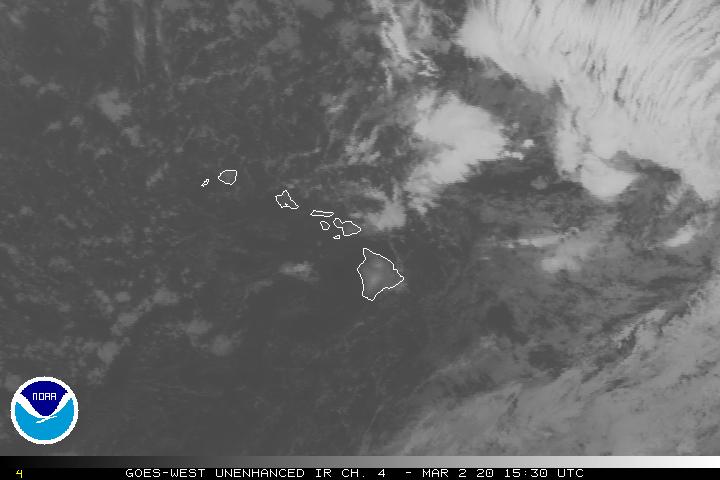
Zoe Says:
Thanks, Glenn. Good to know that June is the driest month and that May can be pretty dry, too. Ideal would be a series of days with no rain. But even knowing which individual days will have a period of 6-8 hours without rain would be very useful since they can cover the roof overnight with a tarp or can lay down the roofing paper over the newly exposed wood before leaving for the night. Your website lists predictions for the whole north shore — all the way to Hana — which is too broad an area to be useful for our needs right now. And even Haiku tends to have a broad range of rain patterns. Do the sugar or pineapple companies have good weather data that might be helpful — and, if so, is it available to the public? When I look at various weather sites for Haiku, I am likely to get predictions ranging from 10-90% probability for any particular day. And I've not yet been able to figure out which sites are better predictors or more specifically related to Haiku. Interesting that Haiku can have showers just about any time the trade winds are blowing. However, I've also noted that there are often periods without rain even when the trades are blowing. What determines whether there is rain when the trades are blowing? I know it is more likely to rain at higher elevations and more towards Hana. And lately, we seem to have had a pattern of night and morning showers — and if this holds, it would be OK for roofing in the afternoon. The roofer was supposed to come yesterday, but it has now been postponed to Friday. I wouldn't be so concerned if I hadn't read so much about how moisture can lead to mold issues….~~~Zoe, I see…you are wanting to have dry weather right now, rather than waiting for a more reliably dry time, like June sometimes is. To be honest, I wouldn’t feel comfortable trying to get too specific in terms of rainfall for Haiku. Like that batch of showers that kept things wet overnight into this morning, and that next area of showers not too far off your north coast at this time…its tough to be exact. With that said, the trade winds will be blowing through the rest of this week into next week…and as we both know…showers will be arriving at times. As you accurately point out though, nights and mornings are the most frequent times for those passing showers to arrive. Again, best of luck! Aloha, Glenn
bruce Says:
I notice that your weather forecasts regarding the wind speed tend to be differen tsometimes from most of the other forecasts from various weather forecasts. I like to see how strong the wind will be because I stand up paddleboard. any idea why yours tend to be different than the others? ~~~Hi Bruce, likely because I use the gust figures rather than the sustained wind speeds. Aloha, Glenn
Zoe Says:
Glenn, what is the best way for me to predict weather conditions in Haiku? We are ready to get a new roof, and I would love to be able to put it on during dry days. Thanks, Zoe~~~Hi Zoe, that is a very good question! I suppose it depends upon how many days it takes to put a new roof on, whether they can cover up the parts of the house that are exposed, and of course when will it be that we have a series of days that no rain falls. Those are all the questions that I’d be thinking of at least, and perhaps someone else could chime in here as well. I will say this, from a climatological point of view, June is the driest month of the year, although May can be pretty dry too. I don’t have much more to offer you, because as you and I know both know, Haiku can have showers falling just about any time the trade winds are blowing, and this time of year…is pretty much most of the time! Best of luck to you, Aloha, Glenn