Air Temperatures – The following maximum temperatures were recorded across the state of Hawaii Thursday:
Lihue, Kauai – 81
Honolulu airport, Oahu – 81
Kaneohe, Oahu – 81
Molokai airport – 81
Kahului airport, Maui – 85 (Record high temperature for Thursday – 89 / 1952)
Kona airport – 82
Hilo airport, Hawaii – 80
Air Temperatures ranged between these warmest and coolest spots near sea level – and on the highest mountain tops…as of 5pm Thursday evening:
Kahului, Maui – 81
Hilo, Hawaii – 74
Haleakala Crater – 48 (near 10,000 feet on Maui)
Mauna Kea – 39 (near 13,800 feet on the Big Island)
Hawaii’s Mountains – Here’s a link to the live web cam on the summit of near 13,800 foot Mauna Kea on the Big Island of Hawaii. This web cam is available during the daylight hours here in the islands…and when there’s a big moon shining down during the night at times. Plus, during the nights you will be able to see stars, and the sunrise and sunset too…depending upon weather conditions. Here's the Haleakala Crater webcam on Maui…although this webcam is not always working correctly.
Aloha Paragraphs

Localized windward showers…a few afternoon
interior showers this afternoon. Strengthening
trades and windward showers will return later
this weekend into next week
Nice surf along our south and west facing beaches
As this weather map shows, we have a near 1025 millibar high pressure system to the northeast of Hawaii…moving further away to the northeast. At the same time, there's a cold front approaching the state from the northwest, which won't arrive, although will weaken our local winds as it pushes a ridge of high pressure closer to the islands. Our trade winds will be easing up some Friday, then…then gradually increasing again this weekend.
The following numbers represent the most recent wind gusts (mph), along with directions as of Thursday evening:
08 Barking Sands, Kauai – SSW
10 Honolulu, Oahu – SE
06 Molokai – NW
33 Kahoolawe – ESE
29 Lipoa, Maui – E
10 Lanai – NW
25 South Point, Big Island – NE
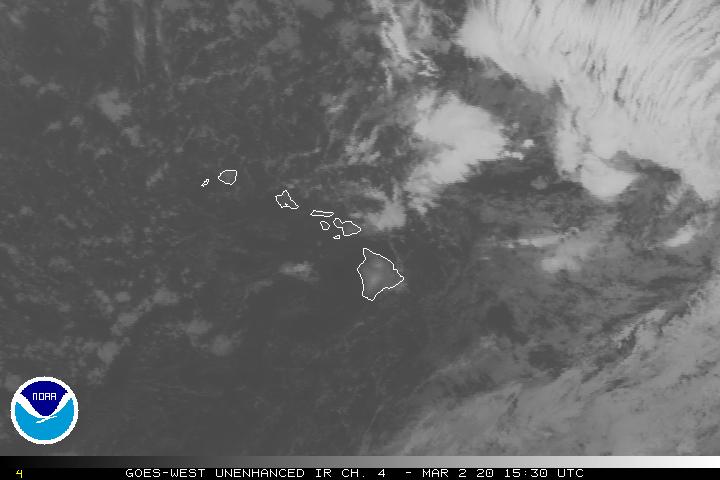
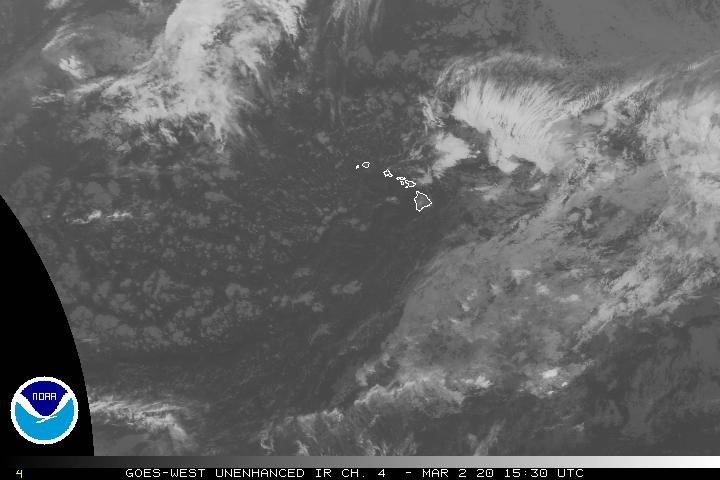
We can use the following links to see what’s going on in our area of the north central Pacific Ocean. Here's the latest NOAA satellite picture – the latest looping satellite image…and finally the latest looping radar image for the Hawaiian Islands.
Here are the latest 24-hour precipitation totals (inches) for each of the islands as of Thursday evening:
1.03 Mount Waialeale, Kauai
0.70 Wilson Tunnel, Oahu
0.00 Molokai
0.03 Lanai
0.00 Kahoolawe
0.30 Puu Kukui, Maui
0.63 Kealakekua, Big Island
Sunset Commentary: A near 1025 millibar high pressure system has now moved eastward, and is located to the northeast of the state Thursday evening. This high pressure cell will gradually move further as it shifts towards the west coast over the next few days. An approaching cold front is shifting this high away, thereby bringing this lighter wind pattern over us into Saturday. Our local winds will veer to the southeast near Kauai, and perhaps Oahu, although will likely remain light to moderately strong trade winds over Maui County and the Big Island. These trade winds will carry showers into the windward sides on those eastern islands tonight into Friday morning…as shown on this satellite image. Friday afternoon will turn cloudy in many areas again, although with a stable atmosphere, showers will be rather limited for the most part. Our weather will return to near normal, with trade winds rebounding again later this weekend through next week.
Here in Kula, Maui at 530pm, skies were cloudy with light showers, and an air temperature a cool 63.5F degrees. As mentioned above, a late season cold front is approaching the state from the northwest, as shown on this satellite image. The high pressure system to our northeast will be moved further northeastward by the cold front, thus the weakening of our local winds, at least temporarily. As the trade winds will continue to blow over the eastern islands, we'll likely see a few windward showers during the nights. The western islands, closer to the ridge, will have east to southeast breezes, with a better chance of afternoon showers over the interior sections through Friday evening. Then, we'll move into a well established trade wind weather pattern later this weekend through all of next week. Small craft wind advisories likely be needed already by Sunday, as the trade winds become stronger.
~~~ Meanwhile, in the marine environment, south swell waves coming up from the southern hemisphere will bring rising surf along our south and west facing leeward beaches into the upcoming weekend…although not large enough to trigger a high surf advisory.
~~~ I'll be back early Friday morning with your next new weather narrative, I hope you have a great Thursday night until then! Aloha for now…Glenn.
Interesting: A fire-free farming method practiced by early inhabitants of the Amazonian savannahs could help inform efforts to conserve and rehabilitate these important ecosystems around the world, a study has found. The research provides greater historic context for findings presented at a conference earlier this year (26 January), which suggested that slash-and-burn — in which trees are felled, left to dry and then burned to prepare land for farming — provides better growing conditions for valuable trees such as mahogany.
This latest study, published in Proceedings of the National Academy of Sciences (9 April), found that 800 years ago, prior to European settlement of Latin America, indigenous farmers had developed a technique known as 'raised-field' farming to manage land sustainably without using fire. The method involved constructing small agricultural 'mounds' which promoted drainage, soil aeration and moisture retention. It conserved soil nutrients and organic matter, and preserved soil structure.
The ancient technique was studied by researchers, who have created the first detailed picture of land use by documenting the very low frequencies of charcoal particles — an indicator of fire — in the savannahs of French Guyana. "Modern indigenous groups living in savannah environments regularly burn the savannahs. From there paleoecologists extrapolated that all savannahs have been burned regularly in the past.
But this was not the case," José Iriarte, researcher at the University of Exeter, United Kingdom, and leader of the study, told SciDev.Net. "Building small mounds was the only way that they could cultivate these seasonally flooded savannahs. They were creating an elevated, dry, fertile platform," Iriarte said.
The researchers say that the study gives a unique perspective on land-use before as well as after the first Europeans arrived, and reveals that the high fire incidence in Amazonian savannas was a post-settlement phenomenon.
Iriarte says raised-field and slash-and-burn are techniques developed to suit different environments, but commented that burning resulted in the long-term depletion of soil nutrients. "In the long run, if [land] is not left fallow for a long period [of up to 20 years, it] is impoverished," he said.
The authors say their findings suggest that raised-field agriculture could also provide better water infiltration and storage in soil and crop roots, and promote crop growth. They also say their findings may apply in savannah settings elsewhere in the world.
"We think that raised-field agriculture, which would require careful management of organic matter, could be applicable in all seasonally flooded savannas," said Doyle McKey, professor at the Université de Montpellier II, in France, who also participated in the study.
 Email Glenn James: