











Air Temperatures – The following maximum temperatures were recorded across the state of Hawaii Wednesday:
Lihue, Kauai – 80
Honolulu airport, Oahu – 81
Kaneohe, Oahu – 77
Molokai airport – 80
Kahului airport, Maui – 84 (Record high temperature for Wednesday – 89 / 1951)
Kona airport – 81
Hilo airport, Hawaii – 77
Air Temperatures ranged between these warmest and coolest spots near sea level – and on the highest mountain tops…as of 5pm Wednesday evening:
Kailua-kona – 79
Hilo, Hawaii – 74
Haleakala Crater – M (near 10,000 feet on Maui)
Mauna Kea – 45 (near 13,800 feet on the Big Island)
Hawaii’s Mountains – Here’s a link to the live web cam on the summit of near 13,800 foot Mauna Kea on the Big Island of Hawaii. This web cam is available during the daylight hours here in the islands…and when there’s a big moon shining down during the night at times. Plus, during the nights you will be able to see stars, and the sunrise and sunset too…depending upon weather conditions. Here's the Haleakala Crater webcam on Maui…although this webcam is not always working correctly.
Aloha Paragraphs

Just a few windward showers…lighter winds with
cool mornings and a few afternoon showers Thursday
through Saturday…followed by strengthening trades
and a few showers later this weekend through next week
As this weather map shows, we have a near 1025 millibar high pressure system to the north-northeast of Hawaii…moving to the east. At the same time, there's a cold front approaching the state from the northwest, which won't arrive, although will weaken our local winds. Our trade winds will gradually be easing up some into Thursday and Friday.
The following numbers represent the most recent wind gusts (mph), along with directions as of Wednesday evening:
14 Lihue, Kauai – E
18 Kaneohe, Oahu – ESE
23 Molokai – NE
42 Kahoolawe – ENE
27 Kahului, Maui – NE
12 Lanai – NW
28 South Point, Big Island – NE
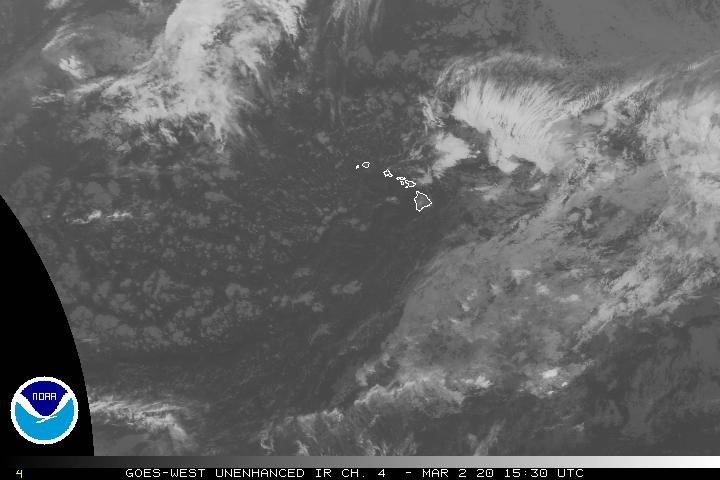
We can use the following links to see what’s going on in our area of the north central Pacific Ocean. Here's the latest NOAA satellite picture – the latest looping satellite image…and finally the latest looping radar image for the Hawaiian Islands.
Here are the latest 24-hour precipitation totals (inches) for each of the islands as of Wednesday evening:
0.42 Mount Waialeale, Kauai
0.25 Manoa Lyon Arboretum, Oahu
0.02 Molokai
0.00 Lanai
0.00 Kahoolawe
0.12 Puu Kukui, Maui
0.51 Kawainui Stream, Big Island
Sunset Commentary: A near 1025 millibar high pressure system remains in place to the north-northeast of the state Wednesday evening, which continued to provide gusty trade winds today. This high pressure cell will gradually weaken further as it shifts eastward over the next few days. An approaching cold front will shove the high away from us, thereby bringing this lighter wind convective weather pattern into play Thursday and Friday. The NWS has pulled the small craft wind advisory for all the marine zones here in the islands. The cold front won't reach our islands, although will cause our winds to veer to the southeast near Kauai, and perhaps Oahu …along with a few afternoon interior showers locally around the state into Saturday. Maui County and the Big Island will likely stay in a lighter easterly trade wind flow through Friday into Saturday. The mornings should be clear to partly cloudy with slightly cooler than normal air temperatures. Our weather will return to near normal, with trade winds rebounding again later this weekend through next week.
Here in Kula, Maui at 515pm, skies were cloudy, with light winds, and an air temperature of 67.8F degrees. As mentioned above, a late season cold front is approaching the state from the northwest, as shown on this satellite image. The high pressure system to our north-northeast will be moved eastward by the front, thus the weakening of our local winds. We may yet see some volcanic haze coming into our weather picture over the next few days, stay tuned. Meanwhile, despite the fact that we'll shift into a modified convective weather pattern, the atmosphere will remain too dry and stable to produce many afternoon showers. Then, we'll move into a well established trade wind weather pattern later this weekend through all of next week. This will bring summery weather to our island chain. Speaking of summer, we're going to see some rising south swell over the next couple of days, which won't be large enough to trigger a high surf advisory, although will definitely be large enough to spark some fun wave riding for our surfing community! ~~~ I'll be back early Thursday morning with your next new weather narrative, I hope you have a great Wednesday night until then! Aloha for now…Glenn.
Interesting: How Mammals came to Rule the Earth: it was not always as such. The world used to belong to reptilian species, the dinosaurs. They grew to a grand stature, dominating all others by leaps and bounds. In the end, they were undone by a cataclysmic event that dramatically shifted the Earth's climate. Now on top of the world's pecking order are mammals, of which humans are a part. How did these once furry little creatures beat out the competition, and why didn't reptiles return to their state of dominance?
A new study out of Vanderbilt University sheds some light on how this occurred in North America. Mammals were able to thrive due to their adaptability and their diversity. They were able to change faster than others as the environment changed. They could dramatically alter their diet, size, shift their range with temperature changes, and regulate their internal body heat.
This glimpse into mammal adaptability in the past will help scientists predict the future of mammals in our new era of climate change. The study examined how mammals in North America adapted to climate change in "deep time", from 56 million years ago, the beginning of the Eocene Era to 12,000 years ago, the end of the Pleistocene Era, when the mammoths, saber-toothed tigers, giant sloths, and other megafauna went extinct.
It was directed by Larisa R. G. DeSantis, assistant professor of earth and environmental studies at Vanderbilt. "Before we can predict how mammals will respond to climate change in the future, we need to understand how they responded to climate change in the past," said DeSantis.
"It is particularly important to establish a baseline that shows how they adapted before humans came on the scene to complicate the picture." Much of the study focused on the examination of fossil remains. However, it is extremely difficult to differentiate closely related species from their fossils. It is even difficult to tell members of different genera apart.
What the researchers did was analyze the fossils at the family level, covering a total of 35 different families. For example, they looked at Bovidae (bison, sheep, antelopes), Cricetidae (rats, mice, hampsters), Equidae (horses, donkeys), Ursidae (bears), Mammutidae (mammoths), Leporidae (rabbits, hares), and many others.
The researchers concluded that the relative range and distribution of the mammalian families remained consistent throughout major climate changes over the past 56 million years. They were also able to correlate a family's diversity and its range. Families with greater diversities were more stable and had larger ranges.
Today, mammals around the world are facing increasingly stressed conditions, and they are going extinct in record numbers. Studies of mammalian adaptability in the past will aid in this modern age of extinction and climate change, sometimes dubbed the Anthropocene. It is perhaps the mammals' wide ranges and striking diversity that will help them survive on land and sea during this chaotic period of the Earth's history.
 Email Glenn James: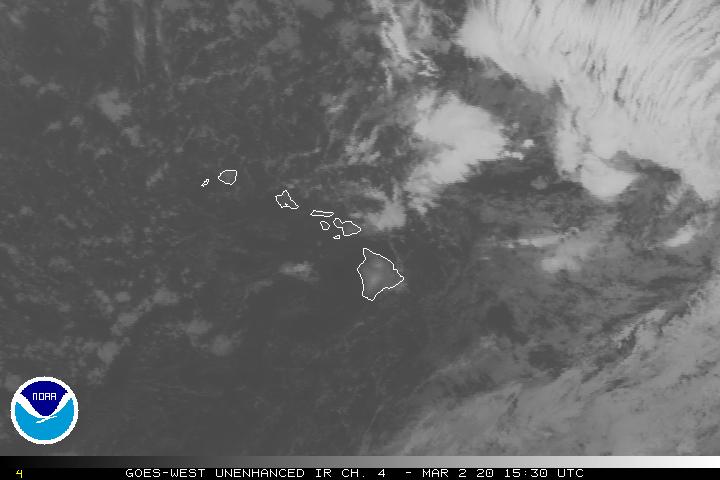
Lono Says:
That's the best photo ever. That's the 20 mile beach from Moloka'i looking at beautiful Maui. Aloha from Moloka'i to all the good people of Maui. ~~~ Hi Lono, thanks for checking in from Molokai! Aloha, Glenn