Air Temperatures – The following maximum temperatures were recorded across the state of Hawaii Tuesday:
Lihue, Kauai – 80
Honolulu airport, Oahu – 82 (record high for the date – 87 – 1977)
Kaneohe, Oahu – 78
Molokai airport – 79
Kahului airport, Maui – 78
Kona airport – 78
Hilo airport, Hawaii – 74
Air Temperatures ranged between these warmest and coolest spots near sea level – and on the highest mountain tops…as of 5pm Tuesday evening:
Barking Sands, Kauai – 79
Hilo, Hawaii – 68
Haleakala Crater – 36 (near 10,000 feet on Maui)
Mauna Kea – 27 (near 13,800 feet on the Big Island)
Hawaii’s Mountains – Here’s a link to the live web cam on the summit of near 13,800 foot Mauna Kea on the Big Island of Hawaii. This web cam is available during the daylight hours here in the islands…and when there’s a big moon shining down during the night at times. Plus, during the nights you will be able to see stars, and the sunrise and sunset too…depending upon weather conditions. Here's the Haleakala Crater webcam on Maui.
Aloha Paragraphs

Gradually lighter trade winds, still
gusty atop the Haleakala Crater on Maui…
and over the Big Island summits too – showers on
the windward sides at times…occasionally elsewhere –
snowy winter weather atop Big Island summits –
partly cloudy, a few showers…leeward beaches
As this weather map shows, we have a large near 1037 millibar high pressure system to the northeast of the islands. This high has a long ridge that extends southwest from its center…which runs by to the north of Hawaii. Our winds will gradually relax in strength as a cold front approaches from the northwest.
The following numbers represent the strongest wind gusts (mph), along with directions Tuesday afternoon:
18 Lihue, Kauai – E
28 Bellows, Oahu – NE
20 Molokai – NE
45 Kahoolawe – ENE
37 Lipoa, Maui – ESE
14 Lanai – NE
36 South Point, Big Island – NE
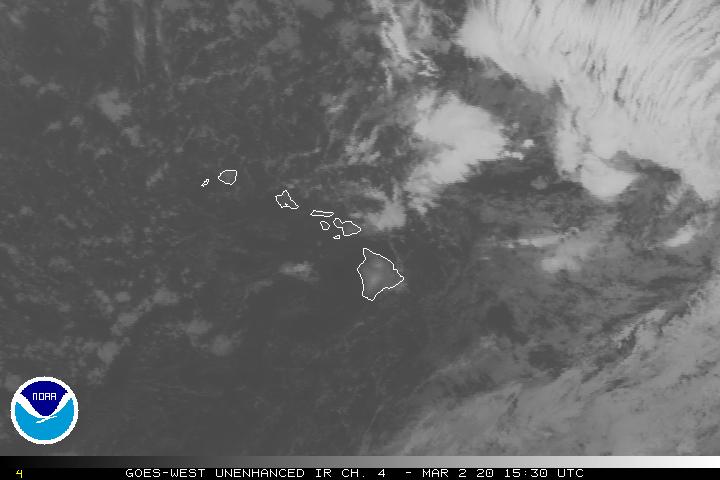
We can use the following links to see what’s going on in our area of the north central Pacific Ocean Tuesday evening. Looking at this NOAA satellite picture we see a large area of high and middle level clouds over the Big Island and Maui. We can use this looping satellite image to see those brighter white clouds to the southeast, and another large area of clouds to the northwest…associated with an approaching cold front. At the same time we see lower level clouds being carried our way by the lower level southeast to easterly wind flow. Checking out this looping radar image we see light to moderate showers, with a few heavy showers mixed in, being carried into the islands…along the windward sides from Oahu down through Maui and the Big Island for the most part.
Here are the 24-hour precipitation totals (inches) for each of the islands as of Tuesday evening:
1.27 Mount Waialeale, Kauai
0.30 Punaluu Stream, Oahu
0.03 Molokai
0.00 Kahoolawe
1.62 Kaupo Gap, Maui
3.00 Glenwood, Big Island
Sunset Commentary: Our trade winds will remain blustery, at least locally. The forecast continues to suggest that these trade winds will ease up some, shifting to the east-southeast and southeast into mid-week…in response to an approaching cold front. Some of the computer models continue to show our winds veering all the way around the south to south-southwest later Thursday into Friday. If this were to happen, and its still not exactly a sure thing, that would suggest that we could see a cold front digging into state later Friday into the weekend. This in turn suggests that we may see wet weather, some of which could be locally heavy.
Meanwhile, the gusty trades, which are now somewhat south of east, are bringing windward biased showers our way at times. We continue to find a cold pool of air aloft not far to the southeast of the state, which will keep our atmosphere destabilized and more shower prone than usual…especially around the Big Island and possibly east Maui. The chance for more than the normal amount of windward biased showers will stretch into mid-week, and then dry out temporarily Thursday and Friday.
Here in Kula, Maui at 440pm HST, we had light winds, with an air temperature of 65.8F degrees. As noted above, the trade winds will remain active now…although ease up a bit and turn more southeast. There will be enough blocking of these winds by the Big Island however, that there should be lighter winds on the smaller islands over the next couple of days. We'll see periodic showers, as we have an upper level low pressure system near the state now, with the heaviest of these impacting the Big Island side of the chain. In sum, gusty east to southeast winds, with off and on passing showers for the east to southeast sides, and elsewhere in places too…with the gradually relaxing wind speeds. There remains a good chance of the weekend turning locally wet again.
This satellite image shows that there are lots of clouds to our east through south, some of them are packing locally heavy showers near the Big Island and almost around east Maui too. Meanwhile, this radar image shows where our showery weather is occurring, most of which continues to be taking aim on the Big Island side of the chain. The air aloft over the state is colder than normal over that way, which will likely cause more snow to fall atop the summits on the Big Island at times, here's the webcam for the Mauna Kea summit…with clouds or fog hiding the view at times. The air temperature at 440pm this evening atop Mauna Kea was an usually chilly 25 degrees! ~~~ I'll be back a bit later with a few more updates, after my walk. I hope you have a great Tuesday night wherever you're spending it! Aloha for now…Glenn.
Interesting: Astronomers have confirmed the existence of a new class of planet: a waterworld with a thick, steamy atmosphere. The exoplanet GJ 1214b is a so-called "Super Earth" – bigger than our planet, but smaller than gas giants such as Jupiter. Observations using the Hubble telescope now seem to confirm that a large fraction of its mass is water. The planet's high temperatures suggest exotic materials might exist there.
"GJ 1214b is like no planet we know of," said lead author Zachory Berta, from the Harvard Smithsonian Center for Astrophysics. The planet was discovered in 2009 by ground-based telescopes. It is about 2.7 times the Earth's diameter, but weighs almost seven times as much.
It orbits its red-dwarf star at a distance of just two million km, meaning temperatures on GJ 1214b probably reach above 200C. In 2010, astronomers released measurements of its atmosphere. These suggested that GJ 1214b's atmosphere was probably made up of water, but there was another possibility – that the planet was covered in a haze, of the type that envelopes Saturn's moon Titan.
Hot ice Mr Berta and his colleagues used the Hubble Space Telescope's wide-field camera to study the planet as it crossed in front of its star – a transit. During these transits, the star's light is filtered through the planet's atmosphere, giving clues to the mixture of gases present.
The researchers said their results are more consistent with a dense atmosphere of water vapour, than one with a haze. Calculations of the planet's density also suggest that GJ 1214b has more water than Earth. This means the internal structure of this world would be very different to that of our own.
"The high temperatures and pressures would form exotic materials like 'hot ice' or 'superfluid water', substances that are completely alien to our everyday experience," said Dr Berta. The planet's short distance from Earth makes it a likely candidate for follow-up observations with the James Webb Space Telescope, which may launch by the end of this decade.
Interesting2: Sharks have a reputation for being ruthless, solitary predators, but evidence is mounting that certain species enjoy complex social lives that include longstanding relationships and teamwork. A new study, published in the latest Animal Behaviour, documents how one population of blacktip reef sharks is actually organized into four communities and two subcommunities.
The research shows for the first time that adults of a reef-associated shark species form stable, long-term social bonds. The image contrasts with usual reports on this species, which mistakenly sinks its sharp teeth into surfers and swimmers from time to time.
Lead author Johann Mourier told Discovery News that "other species, such as grey reef sharks and scalloped hammerheads form polarized groups where individuals have a specific place, and such species may also have complex social organization."
Mourier, a scientist at the Center for Island Research and Environmental Study (CNRS-EPHE), and colleagues Julie Vercelloni and Serge Planes conducted the study at Moorea Island in the Society archipelago, French Polynesia. A total of seven sites were surveyed on a regular basis along just over 6 miles of the north shore of Moorea.
The surveys included nearly hour-long dives at a depth close to 50 feet, with the diver photographing nearby sharks. Analysis of the gathered data determined that the sharks were not within non-random collections, but rather had organized themselves into meaningful social groups.
 Email Glenn James: