Air Temperatures – The following maximum temperatures were recorded across the state of Hawaii Saturday:
Lihue, Kauai – 78
Honolulu airport, Oahu – 82
Kaneohe, Oahu – 79
Molokai airport – 79
Kahului airport, Maui – 83 (record high for the date – 88 1953)
Kona airport – 80
Hilo airport, Hawaii – 76
Air Temperatures ranged between these warmest and coolest spots near sea level – and on the highest mountain tops…as of 5pm Saturday evening:
Kalaeloa, Oahu – 79
Princeville, Kauai – 73
Haleakala Crater – 54 (near 10,000 feet on Maui)
Mauna Kea – 34 (near 13,800 feet on the Big Island)
Hawaii’s Mountains – Here’s a link to the live web cam on the summit of near 13,800 foot Mauna Kea on the Big Island of Hawaii. This web cam is available during the daylight hours here in the islands…and when there’s a big moon shining down during the night at times. Plus, during the nights you will be able to see stars, and the sunrise and sunset too…depending upon weather conditions. Here's the Haleakala Crater webcam on Maui.
Aloha Paragraphs

Active surf on our north and west shores –
Gusty trade winds Sunday –
a few showers locally –
volcanic haze in places
As this weather map shows, we have low pressure systems far to the northwest through northeast of the islands, with an associated cold front far to our northwest of the islands….moving towards the offshore waters to the northwest of Kauai. At the same time, we have a high pressure system to the east-northeast…with its associated ridge running west to the north of Hawaii. Our winds will be strong and gusty trade winds this weekend, then easing up and turning southeast during the first half of the upcoming new work week.
The following numbers represent the strongest wind gusts (mph), along with directions Saturday evening:
14 Lihue, Kauai – NE
25 Honolulu, Oahu – NE
28 Molokai – NE
36 Kahoolawe – E
31 Kahului, Maui – E
17 Lanai
10 Hilo, Big Island – E
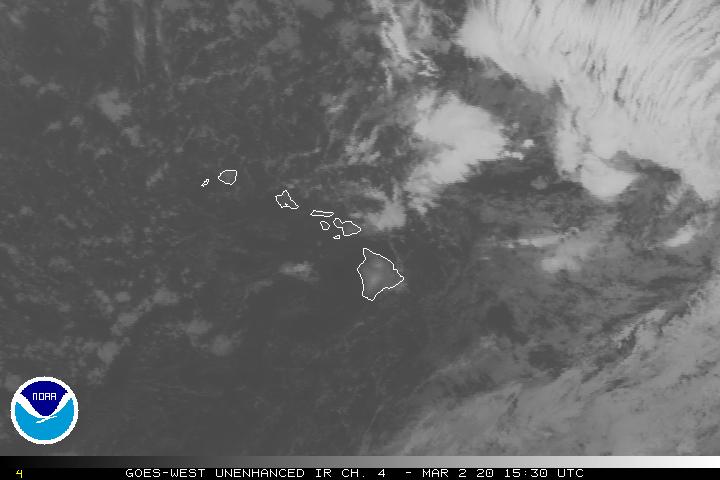
We can use the following links to see what’s going on in our area of the north central Pacific Ocean Saturday evening. Looking at this NOAA satellite picture we see a few low clouds upwind of the islands, impacting the windward sides locally. We can use this looping satellite image to see an area of high and middle level clouds just to the southeast and east of Hawaii…which will stay close by for the time being. Checking out this looping radar image we see some showers, being carried into the windward sides on our gusty trade winds, and light to moderate showers moving by to the south of the Big Island over the ocean…which may move into the southeast side of that island at times.
Here are the 24-hour precipitation totals (inches) for each of the islands as of Saturday evening:
0.09 Mount Waialeale, Kauai
0.03 Hakipuu Mauka, Oahu
0.00 Molokai
0.00 Kahoolawe
0.21 Puu Kukui, Maui
1.12 Laupahoehoe, Big Island
Sunset Commentary: The trade winds will remain on the gusty side through the rest of this weekend. We can look for generally nice mid-winter weather conditions to prevail through Sunday into Monday, supported by this trade wind weather pattern. There will be at least some windward biased showers at times, although showers will be at a minimum on our south and west facing leeward beaches. Satellite imagery continues to show an area of high and middle level clouds just to the southeast and east of the Big Island…which now seem to be slipping away again..
Looking ahead, after the weekend, a cold front will approach the state from the northwest. It will cause our trade winds to give way to lighter southeast breezes later Monday. This will likely bring cooler mornings to our islands again, although with nice warm afternoons in turn. There is a chance that we could see some volcanic haze appearing in our skies locally during the Tuesday through Wednesday time frame. Those generally clear cool mornings will allow the daytime heating of the islands to prompt afternoon clouds to form over and around the mountains, with perhaps a few showers here and there. The cold front is forecast to stall before arriving, with the trade winds returning again soon thereafter…around Thursday into next weekend. These trades late in the week will likely increase in our windward biased showers to some degree.
Friday evening I drove down to Kahului with a friend to see a new film. This was one that I've been looking forward to seeing, ever since I first saw the trailer. Let me warn you that this isn't, I repeat is not, one that will appeal to all that many folks who frequent this site. It's being rated R, with action, adventure, and yes, violence. Oh yeah, it's called Haywire, starring Gina Carano, Michael Douglas, Channing Tatum, Antonio Banderas, Dennis Quaid, and Ewan McGregor…among others. The synopsis: Mallory Kane is a highly trained operative who works for a government security contractor in the dirtiest, most dangerous corners of the world. After successfully freeing a Chinese journalist held hostage, she is double crossed and left for dead by someone close to her in her own agency. Suddenly the target of skilled assassins who know her every move, Mallory must find the truth in order to stay alive. Using her black-ops military training, she devises an ingenious – and dangerous – trap. But when things go haywire, Mallory realizes she'll be killed in the blink of an eye unless she finds a way to turn the tables on her ruthless adversary. Let me warn you again, this trailer shows probably way more fighting and such, than what many of you care to see, so please keep kids, and those not accustomed to seeing violent trailers…from clicking on it. I know, I know, this is a Hawaiian weather website, how could he? What can I say? I can't resist these action films, and this one especially, one that a woman kicks, well, beats up guys! ~~~ Well, did I like it? Oh yeah, very much, it definitely met my expectations, and then a bit more than that at times. This film, for what it was, and for what this Academy award-winning director Steven Soderbergh set out to do, was near perfect. He combined intrigue and suspense, complex characters and glamorous international settings with bone-crunching action, real world specials ops techniques, and a charismatic female hero. It was more of a drama with action in it, than it was a wall to wall action movie. I give it a double thumbs up, edging up towards an A grade.
Here in Kula, Maui at 515pm HST, we had calm winds, with rather thick haze, and an air temperature of 64.2F degrees. The atmosphere continues to exhibit hazy conditions here on Maui, which seems to be volcanic in origin, despite the fact that trade winds are blowing. It may be that this vog is being blown in our direction on the directly easterly trades. During the afternoon, we had a rather thick canopy of clouds that developed over the slopes of the Haleakala Crater, which dropped a couple of light showers. I anticipate that these clouds will disperse after dark, although it appears that the haze, which has been around for several days, may carry right on into Sunday. At any rate, I'll be back with your next new weather narrative Sunday morning. I hope you have a great Saturday night wherever you happen to be spending it! Aloha for now…Glenn.
Interesting: The Chinook salmon, Oncorhynchus tshawytscha, is the largest species in the pacific (Oncorhynchus) salmon family. Other commonly used names for the species include King salmon, Quinnat salmon, Spring salmon and Tyee salmon. Chinook are an anadromous fish native to the north Pacific Ocean and the river systems of western North America ranging from California to Alaska.
Scientists have found that only about ten percent of the fall-run Chinook salmon spawning in California's Mokelumne River are naturally produced wild salmon. A massive influx of hatchery-raised fish that return to spawn in the wild is masking the fact that too few wild fish are returning to sustain a natural population in the river.
The study, published in the online journal PLoS ONE, highlights the danger of relying on ordinary census techniques to evaluate the health of wild salmon populations and their habitats. Most hatchery fish in California are unmarked and therefore undetectable in population surveys. For this study, the researchers were able to identify hatchery fish by using a novel technique to detect traces of a hatchery diet preserved in the ear bones of adult fish.
The Mokelumne River is one of the major salmon producing rivers for fall-run Chinook salmon in California. Throughout the Central Valley rivers, returning fall-run Chinook salmon numbers have rebounded since a disastrous year in 2007, which led to the unprecedented closure of the commercial salmon fishing season for consecutive years in 2008 and 2009. In the Mokelumne, the number of returning adult salmon has grown from just 418 in 2008 to more than 18,000 in 2011.
The researchers based their findings on an analysis of ear bones, called otoliths, from fish collected after spawning in fall 2004. Coauthor Peter Weber of Lawrence Livermore National Laboratory led the development of the technique for analyzing chemical signatures in the otoliths.
These bones grow in increments over the life of the fish and incorporate elements from the fish's diet. Hatchery feed is largely derived from marine fish meal, which leaves a chemical signature distinctly different from that found in wild fish. This signature from a fish's early diet can be detected even several years after it has left the hatchery.
Nearly 12,000 fish returned and spawned in the Mokelumne watershed in 2004. Most were hatchery fish that returned to the hatchery, but about 1,500 fish spawned in the river. The otolith analysis showed that only ten percent of those spawning in the river were produced there, and only 4 percent of the total spawning population were of natural origin.
Maintaining a viable populations of salmon in the wild is a primary goal for many conservation and recovery programs. Yet, the role that immigration of hatchery-produced adults may play in altering population dynamics and fitness of natural populations remains largely unquantified.
The abundance of Chinook salmon spawning in the river was substantially disconnected from the specific survivor and fecundity rates of naturally produced fish owing to immigrants from a hatchery source. Natural productivity is not as great as thought. The potential discrepancy between in-river spawning abundance and natural production may be particularly important in years when natural population abundances are critically low.
Interesting2: Estimates from satellite monitoring suggest the melt rate from the Himalayas and other high-altitude Asian mountains in recent years was much less than what scientists on the ground had estimated, but those monitoring the satellite data warn not to jump to the skeptical conclusion. The region's ice melt from 2003-2010 was estimated at 4 billion tons a year, far less than earlier estimates of around 50 billion tons, according to the study published Wednesday in the peer-reviewed journal Nature.
But study co-author John Wahr, a physics professor at the University of Colorado Boulder, emphasized that it's important to note that the region is a small contributor to overall ice melt and that the satellite estimates for the largest contributors, Antarctica and Greenland, are in line with ground-based estimates: about 385 billion tons a year. The authors also noted that the Asian mountain region has seen a lot of variability in ice melt and that the time period might be too short to be of much use.
Interesting3: The world's biggest offshore wind farm was officially opened today after record-fast construction in the middle of the Irish Sea. The 102 turbines of the two connected Walney wind farms cover an area of 73 square-kilometers and were formally connected to the National Grid in a ceremony today. With a capacity of 367.2MW, the huge project can provide low-carbon, green electricity to 320,000 homes.
The generating capacity of each turbine, supplied by Siemens Wind Power, is 3.6MW, and the rotor diameter of the turbines is 107m for Walney 1 and 120m for Walney 2, with a maximum height of 150m from sea level to blade tip. Opening the new £1 billion wind farm, Secretary of State Ed Davey, said: "Britain has a lot to be proud of in our growing offshore wind sector.
Our island’s tremendous natural resource, our research base and a proud history of engineering make this the number one destination for investment in offshore wind. "And Walney is the newest, biggest and fastest-built jewel in that crown, providing clean power for hundreds of thousands of households.
"Opening Walney during my first week in office lets me underline my commitment to continuing the Coalition’s work to make this sector a success story for the British economy, not least with the innovation it is driving and the employment it is creating."
 Email Glenn James: