











Air Temperatures – The following maximum temperatures were recorded across the state of Hawaii Wednesday:
Lihue, Kauai – 79
Honolulu airport, Oahu – 82
Kaneohe, Oahu – 80
Molokai airport – 80
Kahului airport, Maui – 83 (Record high temperature on this date – 88F – 1951)
Kona airport – 80
Hilo airport, Hawaii – 79
Air Temperatures ranged between these warmest and coolest spots near sea level – and on the highest mountain tops…as of 6pm Wednesday afternoon:
Kailua-kona – 77
Princeville, Kauai – 72
Haleakala Crater – M (near 10,000 feet on Maui)
Mauna Kea – 39 (near 13,800 feet on the Big Island)
Hawaii’s Mountains – Here’s a link to the live web cam on the summit of near 13,800 foot Mauna Kea on the Big Island of Hawaii. This web cam is available during the daylight hours here in the islands…and when there’s a big moon shining down during the night at times. Plus, during the nights you will be able to see stars, and the sunrise and sunset too…depending upon weather conditions. Here's the Haleakala Crater webcam on Maui…which is working only sometimes lately.
Aloha Paragraphs

Trade winds with a few showers –
active surf north and west shores –
possible weather change after the weekend
As this weather map shows, we have a 1024 millibar high pressure system far to the northeast of the islands…with an associated ridge running southwest to just northeast of Hawaii. A new near 1020 millibar high pressure system is moving quickly eastward…to the northwest of the islands. At the same time, we have a very deep 945 millibar low pressure system far to the north of the islands, with its associated long cold front extending down into the tropics…part of which is not far to the north of Kauai. Our winds will increase a little Thursday, remaining light to almost moderate into Friday…before slowing down again this weekend.
The following numbers represent the strongest wind gusts (mph), along with directions Wednesday evening:
20 Port Allen, Kauai – SE
16 Bellows, Oahu – NE
22 Molokai – NE
29 Kahoolawe – E
25 Kahului, Maui – NE
16 Lanai – NE
24 Upolu Point, Big Island – NE
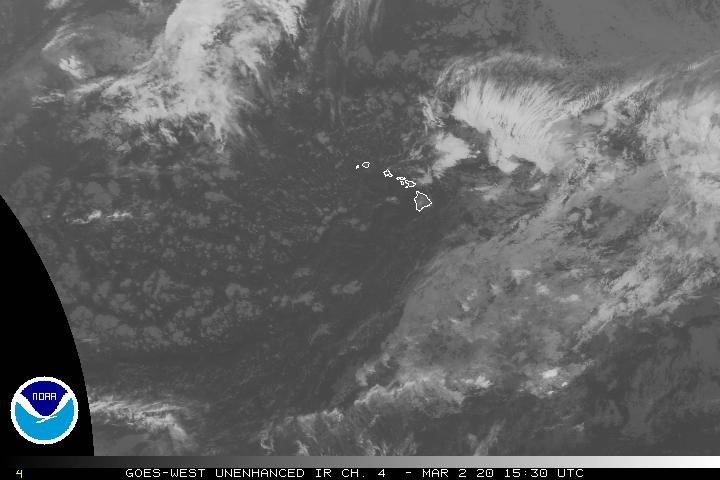
We can use the following links to see what’s going on in our area of the north central Pacific Ocean Wednesday evening. Looking at this NOAA satellite picture we see lots low clouds over the ocean, which are stretching over the islands in many areas at the time of this writing. We can use this looping satellite image to see the lower clouds moving along in the weakening trade wind flow. We can also see the next cold frontal cloud band far to the northwest and north of Hawaii. Checking out this looping radar image we see just a few light showers, generally over the ocean at the time of this writing.
Here are the 24-hour precipitation totals (inches) for each of the islands as of Wednesday evening:
0.08 Lihue, Kauai
0.36 Oahu Forest NWR, Oahu
0.00 Molokai
0.00 Lanai
0.00 Kahoolawe
0.01 Puu Kukui, Maui
0.12 Saddle Quarry, Big Island
Sunset Commentary: A near 1024 millibar high pressure system to the northeast continues to provide a light trade wind flow across our islands Wednesday night. This latest weather map shows a cold front to the north, which as it gets closer, is pushing the high's ridge to the northeast of the islands. At the same time, we find a new high pressure system to the northwest, on the other side of the cold front…which will increase our local trade winds a notch for a day or two. The latest computer models continue to show the cold front getting to within about 100 miles north of Kauai tonight into Thursday…before it stalls. The front's associated showers will likely remain just north of the islands, continuing our dry conditions into Friday. As we get into the upcoming weekend, we'll find generally dry conditions with lighter winds prevailing. The light winds will put us into modified convective pattern, with clear and slightly cooler than normal mornings, giving way to cloudy afternoons, and a few light showers over the leeward slopes in places. As we push into early next week, we may see a new cold front or two approaching, perhaps one of which may move down into the state…bringing possible showery weather.
The rough surf that has been breaking along our north and west shores continued to do so today, although it has dropped quite a bit in size for the moment…enough so that the high surf advisory has been dropped across the state. A second northwest swell will arrive later Thursday into Friday, followed by yet another potential high surf warning level northwest swell late Sunday into early next week. Fortunately, the south shores aren't seeing these large waves breaking, so that these beaches will be much more user friendly to the ordinary citizen wanting gentle beach conditions. The surf community, especially those big wave riders…are rejoicing in these winter high surf conditions!
~~~ Here in Kula, Maui at 630pm HST, it was calm and mostly clear, with an air temperature of 62.2F degrees. As noted above, our weather will remain dry for the most part, although the windward sides will pick up a few showers. The cold front to our north, as shown on this satellite image, will get just a little closer to Kauai, although is expected to stall just short of reaching the Garden Isle. Our weather will remain rather placid through most of the rest of this week, with generally lighter winds as we get into the weekend, which may allow some haze to begin forming. The latest computer forecast models continue to show a cold front or two approaching the state right after the weekend, which may bring a period of unsettled weather at some point between Monday and Wednesday. I just checked both the GFS and Navy's NOGAPS models, to see what they are showing about these cold fronts…and neither one of them make these cold fronts look quite as threatening as they had previously. I say we give the models another day or two to decide what they decide about the weather after the weekend. ~~~ Looking out the windows of my weather tower this evening just after sunset, I see gloriously clear skies, after what was a remarkably cloud free day here in Hawaii! I'll be back early Thursday morning with your next sunrise commentary, I hope you all have a great night wherever you're spending it! Aloha for now…Glenn.
Interesting: New research led by scientists from Oxford University and Exeter University has shown that the invasion of the land by plants in the Ordovician Period (488-443 million years ago) cooled the climate and may have triggered a series of ice ages. During this period sea levels are very high and at the end of the period there was a mass extinction event. At the beginning of the period, around 480 million years ago, the climate was very hot due to high levels of CO2, which gave a strong greenhouse effect.
The marine waters are assumed to have been around 45°C, which restricted the diversification of complex multi-cellular organisms. But over time, the climate become cooler, and around 460 million years ago, the ocean temperatures became comparable to those of present day equatorial waters.
The dramatic cooling of the planet between 300 and 200 million years ago was also the result of the evolution of large plants with large rooting systems that caused huge changes in both of these processes. In the current results it was shown that the appearance of the first land plants had a similar effect and much earlier in time.
Land plants evolved from chlorophyte algae, perhaps as early as 510 million years ago; some molecular estimates place their origin even earlier, as much as 630 million years ago. Land plants may have evolved from a branched, filamentous, alga, dwelling in shallow fresh water, perhaps at the edge of seasonally desiccating pools.
The team set out to identify the effects that the first land plants had on the climate during the Ordovician Period, which ended 444 million years ago. During this period the climate gradually cooled, leading to a series of ice ages. This global cooling was caused by a dramatic reduction in atmospheric carbon, which this research now suggests was triggered by the arrival of plants.
Among the first plants to grow on land were the ancestors of mosses that grow today. This study shows that they extracted minerals such as calcium, magnesium, phosphorus and iron from rocks in order to grow. In so doing, they caused chemical weathering of the Earth’s surface. This had a dramatic impact on the global carbon cycle and subsequently on the climate.
It could also have led to a mass extinction of marine life. The research suggests that the first plants caused the weathering of calcium and magnesium ions from silicate rocks, such as granite, in a process that removed carbon dioxide from the atmosphere and forming new carbonate rocks in the ocean.
This cooled global temperatures by around five degrees Celsius. In addition, by weathering the nutrients phosphorus and iron from rocks, the first plants increased the quantities of both these nutrients going into the oceans, fueling productivity there and causing organic carbon burial. This removed yet more carbon from the atmosphere, further cooling the climate by another two to three degrees Celsius.
It could also have had a devastating impact on marine life, leading to a mass extinction whose cause had puzzled scientists. The team used the modern moss, Physcomitrella patens for their study. They placed a number of rocks, with or without moss growing on them, into incubators.
Over three months they were able to measure the effects the moss had on the chemical weathering of the rocks. They then used an Earth system model to establish what difference plants could have made to climate change during the Ordovician Period. One of the lead researchers, Professor Tim Lenton of Geography at the University of Exeter said: "This study demonstrates the powerful effects that plants have on our climate.
Although plants are still cooling the Earth’s climate by reducing atmospheric carbon levels, they cannot keep up with the speed of today’s human-induced climate change. In fact, it would take millions of years for plants to remove current carbon emissions from the atmosphere."
 Email Glenn James:
Dave Says:
Hello Glenn,
I love the website! Your forecasts are very accurate and I enjoy reading about the interesting articles you post. This one reminded me of an article I read recently, you may have seen it, about moss that colonized the top of Kohala here on the Big Island. Only 1 spore landed and sprouted and it's been reproducing vegetatively without a mate for 50,000 years! It might even be the oldest multicellular organism on the planet!
http://news.nationalgeographic.com/news/2011/12/111230-cloning-sex-moss-hawaii-oldest-science
http://www.sciencedaily.com/releases/2011/12/111222102949.htm
Aloha!
Dave~~~Hi Dave, great to receive your positive feedback on my website! Yes, I love interesting nature articles, and that’s a very good one that you share with us now! I appreciate your checking in, please give an update on that weather down on your island anytime. Aloha, Glenn
Aaron Says:
Hi Glen,
I enjoy your commentary. My family I will be in Kaanapali the 6th-16th. I see the weather seems to be taking a turn for the wetter during this time. Will we still see a majority of great sunshine or should we expect to have quite a few rainy days?
Thanks,
-aaron~~~Hi Aaron, thanks for visiting my website. As you point out, it looks as if we may have some rain, at least locally as we start next week…just when you arrive. I would imagine that you will see some showers, although just down the road in Lahaina, is one of the driest places on the island, so you may want to take that short drive to find more sunshine, if the weather is a problem. Nonetheless, you will still have lots of warm, dry and sunny weather during your vacation, no worries! I hope you have a great time while visiting our wonderful island of Maui! Aloha, Glenn