











Air Temperatures – The following maximum temperatures were recorded across the state of Hawaii Friday:
Lihue, Kauai – 80
Honolulu airport, Oahu – 81
Kaneohe, Oahu – 78
Molokai airport – 82
Kahului airport, Maui – 83 (Highest temperature for this date was 88 – in 1951)
Kona airport – 80
Hilo airport, Hawaii – 79
Air Temperatures ranged between these warmest and coolest spots near sea level – and on the highest mountain tops…as of 5pm Friday evening:
Barking Sands, Kauai – 80
Princeville, Kauai – 73
Haleakala Crater – 45 (near 10,000 feet on Maui)
Mauna Kea – 34 (near 13,800 feet on the Big Island)
Hawaii’s Mountains – Here’s a link to the live web cam on the summit of near 13,800 foot Mauna Kea on the Big Island of Hawaii. This web cam is available during the daylight hours here in the islands…and when there’s a big moon shining down during the night at times. Plus, during the nights you will be able to see stars, and the sunrise and sunset too…depending upon weather conditions. Here's the Haleakala Crater webcam on Maui…which is working only sometimes lately.
Aloha Paragraphs

Trade winds, generally dry weather…
lots of daytime sunshine!
As this weather map shows a near 1033 millibar high pressure system far to the northeast. The location of this high pressure cell, and its associated ridge to our north through west-northwest will keep light to moderately strong trade winds blowing, which will prevail through the next week…some days stronger than others.
The following numbers represent the strongest wind gusts (mph), along with directions Friday evening:
17 Port Allen, Kauai – E
15 Kahuku, Oahu – NE
25 Molokai – NE
00 Kahoolawe
27 Kahului, Maui – NE
00 Lanai
21 South Point, Big Island – NE
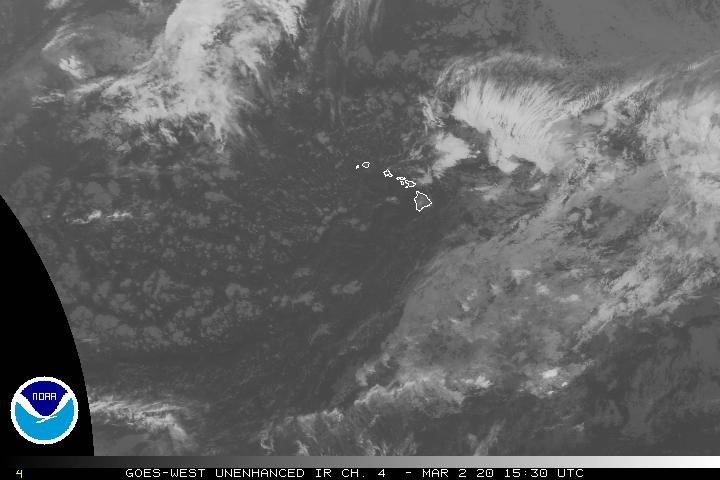
We can use the following links to see what’s going on in our area of the north central Pacific Ocean Friday evening. Looking at this NOAA satellite picture we see low level clouds out over the oceal in all directions of the islands, most of which remain offshore. We can use this looping satellite image to see high clouds well offshore to the northeast of the islands. Checking out this looping radar image we see just a few showers over the ocean, falling over the windward sides of the islands locally.
Here are the 24-hour precipitation totals (inches) for each of the islands as of Friday evening:
0.03 Lihue, Kauai
0.01 Moanalua, Oahu
0.00 Molokai
0.00 Lanai
0.00 Kahoolawe
0.00 Maui
0.01 South Point, Big Island
Sunset Commentary: A near 1033 millibar high pressure system remains parked far to the northeast of the Hawaiian Islands Friday evening. It has a trailing ridge extending southwest and then west, to the north of Hawaii. This ridge runs all the way over across the International Dateline into the western Pacific. The strength of this high pressure cell, and its associated ridge will keep light to moderately strong trade winds blowing. A series of low pressure systems to our northwest, as shown on this weather map, will migrate northeast into the Gulf of Alaska. There will be a cold front draping southward to the north of Hawaii this weekend, which will tamp down our trade wind speeds a little. As this front moves by, our trade winds will bump-up again through the first half of the new week, before easing up again later…as a cold front approaches around next Thursday or so.
Satellite imagery shows quite a few low clouds to the northeast and north of the islands, although hardly any of these are precipitating however. The state is generally dry, with just a few windward biased showers here and there locally at times. The trade winds are blowing now, as mentioned above, although the overlying atmosphere will remain very dry and stable. This in turn will limit showers greatly, and as a matter of fact, will keep us in this very dry period. This is somewhat unusual, as we're definitely in the middle of our wet season. We have a La Nina phase of the ENSO cycle active now too, which I had expected to produce a somewhat wetter than normal winter. The next chance for rainfall will have to wait until later next week, when a frontal cloud band moves into the state around Thursday.
Have you been noticing the nearing full moon the last couple of nights? As it dropped down into the horizon early this morning, I sure did. I thought it might have already been full, although now see that it reaches its fullest extent January 8th at 1030pm here in Hawaii. This first full Moon of 2012 highlights the opposition between the Sun in Capricorn and the Moon in Cancer, and speaks to the nurturing, creating and protecting aspects of life and society. It brings up the archetypal powers of mother and father, the issues of nurturing and protecting, and impacts our emotional body as well as our social body. The energies of family and state begin our new year, the structures that bind us together.
Some things never change, just the way I like it. So, I'll be heading down the mountain to Kahului this evening to see one of the many new films that are showing. The one that I've chosen this time is My Week With Marilyn, starring Michelle Williams, Eddie Redmayne, Emma Watson, Kenneth Branagh, Judi Dench…among many others. The synopsis: Sir Laurence Olivier is making a movie in London. Young Colin Clark, an eager film student, wants to be involved and he navigates himself a job on the set. When film star Marilyn Monroe arrives for the start of shooting, all of London is excited to see the blonde bombshell, while Olivier is struggling to meet her many demands and acting ineptness, and Colin is intrigued by her. Colin's intrigue is met when Marilyn invites him into her inner world where she struggles with her fame, her beauty and her desire to be a great actress. Who doesn't love Marilyn Monroe, although all I know about her for the most part is from looking at the millions of photo's that were taken before her death. The film is getting an A- grade on the Yahoo movies website, while rotten tomatoes is giving it a high 83% rating. This is amply enough praise to draw me into the theater, and I like how the trailer looks too. I'll of course let you know what I think Saturday morning.
Here in Kula, Maui at around 530pm HST, it was mostly clear…with an air temperature of 65.7F degrees. As expected, today turned out to be yet another gorgeous day! Skies were generally clear all day, as as we slide into our sunset hour, the clouds remain few and far between. As I was mentioning this morning, it was our coldest morning this winter up here in Kula. I expect another chilly night ahead, so if you live anywhere with elevation, keep that extra blanket on the bed. As a matter of fact, even down near sea level, it will be quite a nippy night too. As I was writing about above, the very near full moon will be reflecting all kinds of bright light tonight, in preparation for the full moon Sunday night. ~~~ Kden, that's all for now, as I get ready to head downtown, for a light dinner out, and then to bask in the beauty and glory of Marilyn Monroe, in the theater that is. I hope you have a great Friday night, and I'll meet you here in the morning! Aloha for now…Glenn.
Interesting: A rapid rise in air pollution from fossil fuels and biomass burning has worsened winter smog and extended its duration in many parts of South Asia, scientists and officials have said. In Bangladesh, India and Nepal the temperature has plummeted and clouds of fog and smoke hang in the sky blocking sunlight for several days. Normal lives have been affected with many flights diverted and suspended and trains delayed because of low visibility.
Experts say they have noticed that the intensity of smog has grown in the Indo-Gangetic plains in the last few years, leading to increased impacts. "Since 1990 onwards, there has been increase in the number of [smog-affected] days in northern India," says BP Yadav, director of the Indian Meteorological Department. "It is not a linear trend showing an increase every year.
There are, of course, year-to-year fluctuations. "But there are more years that have seen dense fogs." Nepal's Department of Hydrology and Meteorology director-general Keshav Prasad Sharma agrees the issue of smog is becoming increasingly serious in the plains in southern Nepal bordering India.
"Until 10 years ago, we did not have such dense fog for long durations like we have these days," he says. "Although the 10-year period is too short for statistical trends, it is indeed being seen as a major issue now."
Continue reading the main story “Start Quote At times, all means of transport come to a complete halt because of zero visibility ” Iqbal Habib, Bangladesh Environment Movement Some are also investigating whether the conditions can be linked to health problems in parts of the region. Although widely reported as the direct effect of a cold wave, medical professionals say deaths and illnesses are often related to respiratory diseases.
"None of our patients died of hypothermia," says senior consultant physician Gaurang Mishra of a regional referral hospital in south-eastern Nepal where dozens of people have been reported to have died during the last three weeks that saw many smoggy days.
"They mostly suffer from chronic pulmonary obstructive disease that is caused by burning of wood and cow-dung cake and pollution from industries and vehicles, mainly during winter season." The number of such patients, particularly children and elderly people, is also in the rise in Bangladesh.
"But it is not just about people's health in our country," says Iqbal Habib of the Bangladesh Environment Movement (BAPA). "At times, all means of transport come to a complete halt because of zero visibility and all walks of lives are affected. "The working hours come down to as little as four hours a day."
Experts say besides regular sources like vehicles, industrial factories, power plants and dust from gravelled roads, air pollution in some areas in Bangladesh is getting worse because of fast increasing numbers of brick kilns. Some studies have shown that they account for around 40% of air pollution in and around the capital Dhaka.
"Since we have a sustainable economic growth rate, we need more bricks and the number of brick kilns is going up day by day," admits Monowar Islam, director general of Bangladesh's Department of Environment. "We know the situation is becoming serious but it is not alarming.
"We have been demolishing unauthorised brick kilns and have been implementing the World Bank-supported clean air and sustainable environment project through which we patronise new technologies that reduce air pollution." Just like in Bangladesh, India also sees lots of constructions during winter as this is the dry season before the region gets monsoon rainfall preventing such works.
"Construction works too are major contributors for the smog in this season as they lead to more pollution in the air," says the Indian Meteorological Department's BP Yadav. That is in addition to pollutants from energy sources. Energy demand In its World Energy Outlook 2010, the International Energy Agency said: "India is the second-largest contributor to the increase in global energy demand to 2035, accounting for 18% of the rise."
Scientists say pollutants and aerosols in the air enhance condensation of water in the atmosphere causing dense smog. "The more pollutants in the air, the denser the smog," says Keshav Prasad Sharma at Nepal's Department of Hydrology and Meteorology. "In some Nepal-India bordering areas, smog blankets can be seen from early evening."
When such blankets of smog block sunlight, sending temperatures down, people make fire from wood, cow-dung cake and hay to warm themselves and that creates more air pollution which leads to denser smog. Scientists say the real trouble is that smog during winter cannot escape to the upper atmosphere as it can during other seasons, because of meteorological conditions.
"During winter, the cold air that blows towards the southwest from the northeast tends to push the boundary layer (the layer of atmosphere closest to the Earth surface) low," William Lau, deputy director for atmospheres at Nasa's Goddard Space Flight Center told BBC News.
"As a result, all the pollutants get trapped in the boundary layer that is pushed down to as low as one kilometre from the Earth's surface while it is more than five kilometres away during other seasons. "The cold wave becomes severe because of this local trapping of the aerosols and other pollution that block off the solar radiation and create very unhealthy air in this part of the world."
 Email Glenn James:




Gerry Says:
Aloha Glen,
I too have been surprised by our dry winter in leeward areas…so far. On our farm (lower Kula) we really depend on winter rainfall to help with bringing our soil alive. I read on Jeff Masters blog that the unusually warm and dry weather in the Mainland this winter is from a northward departure of the jet stream caused by variations in the Atlantic and North Atlantic oscillation (http://www.wunderground.com/blog/JeffMasters/comment.html?entrynum=2010). Do you think that might be why we have been so dry this winter? Any ideas when/if we will see a change…the dry winter of 2009-2010 was no fun for us. Thanks for your comment! Gerry~~~Hi Gerry, I’m surprised that it has been so dry, with all the storms remaining so far north, and their cold fronts staying up in the mid-latitudes as well. It has been dry, and I honestly don’t see any signs of a big change up ahead. I do trust however that things will change, and that we will end up getting some good rains with time. I’m sure you love this great weather here in Kula too, although I can certainly understand why you need some precipitation down on your farm! Best of luck Gerry, hang in there my friend. Aloha, Glenn