











Air Temperatures – The following maximum temperatures were recorded across the state of Hawaii Thursday:
Lihue, Kauai – 80
Honolulu airport, Oahu – 83 (Highest temperature for this date was 85 – in 1990)
Kaneohe, Oahu – 80
Molokai airport – 81
Kahului airport, Maui – 83 (Highest temperature for this date was 88 – in 1951)
Kona airport – 81
Hilo airport, Hawaii – 79
Air Temperatures ranged between these warmest and coolest spots near sea level – and on the highest mountain tops…as of 5pm Thursday evening:
Port Allen, Kauai – 79
Hilo, Hawaii – 75
Haleakala Crater – 45 (near 10,000 feet on Maui)
Mauna Kea – 30 (near 13,800 feet on the Big Island)
Hawaii’s Mountains – Here’s a link to the live web cam on the summit of near 13,800 foot Mauna Kea on the Big Island of Hawaii. This web cam is available during the daylight hours here in the islands…and when there’s a big moon shining down during the night at times. Plus, during the nights you will be able to see stars, and the sunrise and sunset too…depending upon weather conditions. Here's the Haleakala Crater webcam on Maui…which is working only sometimes lately.
Aloha Paragraphs

Fresh trade winds, generally dry weather…
really nice early winter conditions!
Robbie Naish Kiteboarding
As this weather map shows a near 1037 millibar high pressure system far to the northeast, with a dissipating cold front to the northeast of the central islands. The location of this high pressure cell, and its associated ridge to our north through west-northwest will keep light to moderately strong trade winds blowing, which will prevail through the next week…some days stronger than others.
The following numbers represent the strongest wind gusts (mph), along with directions Thursday evening:
22 Port Allen, Kauai – ENE
23 Bellows, Oahu – NE
25 Molokai – NE
0 Kahoolawe
29 Kahului, Maui – NE
07 Lanai – NW
31 Upolu Point, Big Island – NE
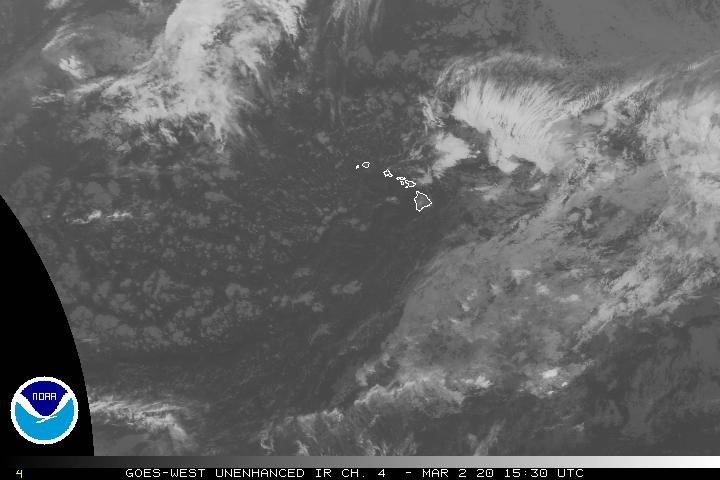
We can use the following links to see what’s going on in our area of the north central Pacific Ocean Thursday evening. Looking at this NOAA satellite picture we see low level clouds around the islands, most of which remain offshore to the northeast and southeast through south. We can use this looping satellite image to see high clouds well offshore to the north of the islands. Checking out this looping radar image we see just a few showers over the ocean, falling in a very limited way over the islands locally.
Here are the 24-hour precipitation totals (inches) for each of the islands as of Thursday evening:
0.18 Mount Waialeale, Kauai
0.07 Maunawili, Oahu
0.00 Molokai
0.00 Lanai
0.00 Kahoolawe
0.01 Puu Kukui, Maui
0.01 Kawainui Stream, Big Island
Sunset Commentary: A strong near 1037 millibar high pressure system is digging in for a long standing relationship with the islands. It has a trailing ridge extending southwest and then west, to the north of Hawaii. This ridge runs across the International Dateline into the western Pacific. The strength of this high pressure cell, and its associated ridge will keep light to moderately strong trade winds blowing through Friday. A series of low pressure systems to our northwest, as shown on this weather map, will migrate northeast into the Gulf of Alaska. There will be cold fronts draping southward to the north of Hawaii this weekend, which may knock our trade wind speeds down somewhat then. As those fronts move by, our trade winds will bump-up again through the first couple of days of next week, before easing up again later next week…as a cold front approaches around next Thursday or so.
Satellite imagery shows nothing but low clouds, and hardly any of those are precipitating. The state is generally dry, with just a few windward biased showers here and there perhaps locally at night. The trade winds are blowing now, as mentioned above, although the overlying atmosphere will remain dry and stable. This in turn will limit showers lots, and as a matter of fact, it appears that we're heading into, or should I say continuing into a very dry period. This is somewhat unusual, as we're smack dab in the middle of our wet season. We have a La Nina phase of the ENSO cycle active now too, which I had expected to produce a somewhat wetter than normal winter. Winter isn't over by any means however, so lets trust that our winter rains are just delayed for the time being.
Here in Kula, Maui at around 5pm HST, it was clear…with an air temperature of 68.5F degrees, with light breezes at best. As I was writing above, our trade winds, which have been unusually persistent this winter, will not be stopping anytime soon. They will continue through the next week at least, and perhaps longer. If you've been waiting for dry weather, for whatever reason, here it is! Need to paint something, or wash your car, or just about anything in this regard…get on it now. We are in a well established dry spell, with nothing to stop it through the next six days. Once we hit next Thursday or Friday, things may change, we'll see. ~~~ Today was one of those very sweet days, with hardly a cloud in the sky, much less any showers. I expect this great winter weather will continue through this weekend, so plan to take full advantage of it. I'm heading out now for my second walk of the day, as I'm very fortunate to be working from home these days, yowza! I'll catch up with you early Friday morning, when I'll have your next new weather narrative ready for you. I hope you have a great Thursday night until then! Aloha for now…Glenn.
Interesting: Scientists have rejected fears that a series of highly destructive large-scale earthquakes in the past few years, in countries bordering the Pacific Ocean, signal an increased global risk of these deadly events. Several vast earthquakes have taken place since 2004 — in Chile, Indonesia and Japan — leading some academics to express concern that they may be linked. But a new study suggests that the pattern of earthquakes, although improbable, is likely to be random and that the risk of large earthquakes is no higher today than it was historically.
The conclusion of the study, published online in Proceedings of the National Academy of Sciences last month (19 December), challenges speculation that the above-average rate of earthquakes of magnitude 8 and above on the Richter scale in recent years reflects a change in the underlying rate of activity. Seismologist Peter Shearer from the Scripps Institution of Oceanography at the University of California, San Diego, United States, and statistician Philip Stark at the university's Berkeley campus, examined records of the timings of quakes of magnitude 7 and above since 1900.
"We found no evidence that the recent global sequence of earthquakes and an earlier one over a 15-year period during the 1950s and 1960s is not simply a random occurrence, but we also cannot say with certainty that it is random,". "The number of large earthquakes since 1900 (five of magnitude 9) is simply too small to reach a firm conclusion.
It's also not surprising that most giant earthquakes occur around the Pacific, because the world's most active subduction zones border that ocean," he added. Because empirical earthquake data do not settle the question conclusively, the researchers looked at the plausibility of a physical mechanism that could link large events that are far away, such as the recent earthquakes in Chile and Japan.
They concluded that the likelihood of the existence of such a mechanism was small for two main reasons. First, no large quake has triggered another one at distances beyond 600 to 1,000 kilometres in the last 30 years, according to an earlier study published in Nature Geoscience.
Second, if changes underneath the Earth's crust had taken place, smaller earthquakes would also have increased during periods when several large ones occur, but this has not happened. "Shearer's and Stark's paper rightly concludes that the grouping of mega-earthquakes can be considered to be random," Sergio Barrientos, director of the Seismological Service at the University of Chile, told SciDev.Net. Mario Pardo, geophysicist and seismologist at the same university, agreed that the risk of large earthquakes has not changed in the last century and that it may simply be a coincidence when several happen in a short space of time.
Interesting2: A vacuum cleaner is a device that uses an air pump to create a partial vacuum to suck up dust and dirt, usually from floors, and optionally from other surfaces as well. Does not sound so bad does it? Some vacuum cleaners — those basic tools for maintaining a clean indoor environment in homes and offices — actually contribute to indoor air pollution by releasing into the air bacteria and dust that can spread infections and trigger allergies, researchers report in a new study.
It appears in the ACS' journal Environmental Science & Technology. Lidia Morawska and colleagues explain that previous studies showed that vacuum cleaners can increase levels of very small dust particles and bacteria in indoor spaces, where people spend about 90 percent of their time.
In an effort to provide more information about emission rates of bacteria and small dust particles, the scientists tested 21 vacuum cleaners sold in Australia. The vacuums came from 11 manufacturers, included those marketed for household and commercial use, ranged in age from six months to 22 years and cost from less than $100 to almost $800.
They looked at the effects that age, brand and other factors had on the amount of small particles and bacteria released into air. All of the studied vacuums released some fine dust and bacteria into the air. Surprisingly, vacuums with so-called High-Efficiency Particulate Air (HEPA) filters in some cases released only slightly lower levels of dust and bacteria.
Newer and more expensive vacuum cleaners were generally less polluting than older or less expensive models. HEPA is a type of air filter. Filters that are awarded the HEPA accolade are used in various locations, whether in medical facilities, automotive vehicles, airplanes, home filters, or wherever very pure air is sought.
To qualify as HEPA by government standards, an air filter must remove 99.97% of all particles greater than 0.3 micrometer from the air that passes through. Vacuuming can be a source of indoor exposure to biological and nonbiological aerosols, although there are few existing data that describe the magnitude of emissions from the vacuum cleaner itself.
The study sought to quantify emission rates of particles and bacteria from a large group of vacuum cleaners and investigate their potential variables, including temperature, dust bags, exhaust filters, price, and age. Vacuum cleaner emissions were determined to contribute to indoor exposure for nonbiological and biological aerosols when vacuuming, and this effect may vary markedly depending on the vacuum used.
 Email Glenn James:
Eliza Says:
Aloha Glenn –
Sharing as an FYI – reviewing posts on Spaceweather.com, it seems that the Atlantic side of the planet had the best Quadrantid displays. They've posted a few great photos of solo streaks against starry skies. One posted there today from the Adirondacks of NY state. Yesterday's was from Norway. Also on yesterday's post was a diagram of the path of the comet fragments and their intersection with earth's orbit.
Nice to see the vog is gone. phew! Happy day ~ Eliza~~~Hi Eliza, thanks for confirming that the Quadrantids did actually doing some shooting around…although as I mentioned the other day, nothing but clouds is what I saw that night from here in Kula. Yes, absolutely, finally the vog is gone, feels much better! Aloha, Glenn