











Air Temperatures – The following maximum temperatures were recorded across the state of Hawaii Tuesday:
Lihue, Kauai – 79
Honolulu airport, Oahu – 81
Kaneohe, Oahu – 80
Molokai airport – 79
Kahului airport, Maui – 85 (Record high temperature on this date – 88F – 1953)
Kona airport – 80
Hilo airport, Hawaii – 80
Air Temperatures ranged between these warmest and coolest spots near sea level – and on the highest mountain tops…as of 6pm Tuesday evening:
Honolulu, Oahu – 77
Hilo, Hawaii – 71
Haleakala Crater – 50 (near 10,000 feet on Maui)
Mauna Kea – 36 (near 13,800 feet on the Big Island)
Hawaii’s Mountains – Here’s a link to the live web cam on the summit of near 13,800 foot Mauna Kea on the Big Island of Hawaii. This web cam is available during the daylight hours here in the islands…and when there’s a big moon shining down during the night at times. Plus, during the nights you will be able to see stars, and the sunrise and sunset too…depending upon weather conditions. Here's the Haleakala Crater webcam on Maui…which is working only sometimes lately.
Aloha Paragraphs
Winds becoming lighter – a few showers –
gradually lowering surf north and west shores –
potential unsettled weather after the weekend
As this weather map shows, we have a 1025 millibar high pressure system to the northeast of the islands…which is slowly moving eastward. At the same time, we have lots of low pressure systems far to the northwest through north, with a very long cold front extending down into the tropics…part of which is northwest of Kauai. Our winds will be trade winds…gradually becoming lighter into Wednesday.
The following numbers represent the strongest wind gusts (mph), along with directions Tuesday evening:
16 Port Allen, Kauai – SE
20 Waianae, Oahu – SSE
07 Molokai
28 Kahoolawe – ESE
21 Kapalua, Maui – ENE
06 Lanai
25 South Point, Big Island – ENE
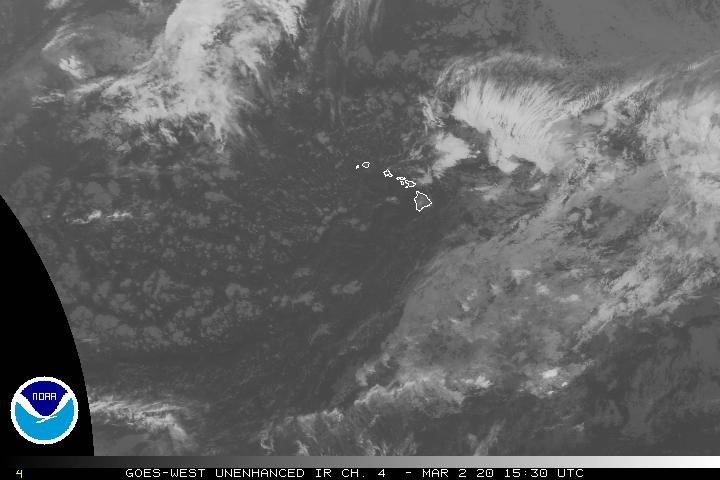
We can use the following links to see what’s going on in our area of the north central Pacific Ocean Tuesday evening. Looking at this NOAA satellite picture we see lots low clouds over the ocean, most notably to the north through southeast, which are stretching over the islands in many areas at the time of this writing. We can use this looping satellite image to see the lower clouds moving along in the weakening trade wind flow, although now veering to the southeast over the islands. We can also see the next cold frontal cloud band far to the northwest of Hawaii. Checking out this looping radar image we see just a few light showers over the ocean at the time of this writing.
Here are the 24-hour precipitation totals (inches) for each of the islands as of Tuesday evening:
0.19 Mount Waialeale, Kauai
0.06 Hawaii Kai Golf Course, Oahu
0.00 Molokai
0.00 Lanai
0.00 Kahoolawe
0.09 Ulupalakua, Maui
0.64 Kawainui Stream, Big Island
Sunset Commentary: A near 1027 millibar high pressure system to the northeast is spinning out our local breezes, although these winds are easing up now…and veering to the southeast. This latest weather map shows our next cold front to the northwest, which as it gets closer, will push the high pressure system eastward…and at the same time nudge this high's ridge down closer to the islands. All of this is beginning to prompt lighter winds across Hawaii now, with this process continuing overnight into mid-week. We may then see a temporary slight increase again Thursday and Friday…before the winds tumble in strength again this weekend. The latest computer models continue to show the cold front, or what's left of it, getting close to Kauai by late Wednesday into Thursday. This may or may not bring an increase in shower activity, although most of it would be focused on Kauai. As we get into the weekend, we'll find generally dry conditions with lighter winds prevailing. As we push into early next week, we may see stronger winds from the south to southwest, as a fairly vigorous new cold front approaches…and then moves down into the state.
The north and west facing shores have been downgraded from a high surf warning, back into a high surf advisory, as large waves have been breaking there today. Please be very careful if you're heading to the beach along these coasts, or better yet…head to the south shores where waves won't be an issue. Small Craft Advisories cover all our marine environment, due to the rough surf. The Kona west facing shores on the Big Island will find larger than normal surf conditions as well, where a high surf advisory is remains active. As we get into the mid-week period, this unusually large surf episode will gradually scale back into a more manageable size. A second northwest swell will arrive Friday into the weekend, followed by yet another potential high surf warning level northwest swell late Sunday into early next week.
~~~ Here in Kula, Maui at 640pm HST, it was calm and cloudy, with an air temperature of 61.9F degrees. At noted above, we're moving into a short period where we'll find lighter south to southeast breezes into mid-week. Our weather will remain dry for the most part, although the windward sides will pick up a few showers temporarily. The cold front to our northwest, as shown on this satellite image, will get closer to Kauai through the next couple of days, although is expected to stall before arriving on Kauai. Our weather will remain rather placid through most of the rest of this week, with generally lighter winds, which may allow some haze to begin forming, especially towards the upcoming weekend. The latest computer forecast models are now showing a robust cold front approaching the state right after the weekend, which may bring unsettled weather to our islands between Monday and Wednesday, perhaps longer…stay tuned for more about this in the coming days. I'll be back early Wednesday morning with your next new weather narrative, I hope you have a great Tuesday night until then! Aloha for now…Glenn.
Interesting: A mysterious, centuries-long cool spell, dubbed the Little Ice Age, appears to have been caused by a series of volcanic eruptions and sustained by sea ice, a new study indicates. The research, which looked at chemical clues preserved in Arctic vegetation as well as other data, also pinpointed the start of the Little Ice Age to the end of the 13th century.
During the cool spell, which lasted into the late 19th century, advancing glaciers destroyed northern European towns and froze the Thames River in London and canals in the Netherlands, places that are now ice-free. There is also evidence it affected other continents.
"This is the first time anyone has clearly identified the specific onset of the cold times marking the start of the Little Ice Age," said Gifford Miller, a geological sciences professor at the University of Colorado, Boulder, and the lead study researcher.
"We also have provided an understandable climate feedback system that explains how this cold period could be sustained for a long period of time." The cause appears to have been massive tropical volcanic eruptions, which spewed tiny particles called aerosols into the atmosphere.
While suspended in the air, the aerosols reflect solar radiation back into space, cooling the planet below. The cooling was sustained after the aerosols had left the atmosphere by a sea-ice feedback in the North Atlantic Ocean, the researchers believe.
Expanding sea ice would have melted into the North Atlantic Ocean, interfering with the normal mixing between surface and deeper waters. This meant the water flowing back to the Arctic was colder, helping to sustain large areas of sea ice, which, in turn, reflect sunlight back into the atmosphere.
The result was a self-sustaining feedback loop. Miller and colleagues came to these conclusions by looking at radiocarbon dates — based on how much of the radioactive form of carbon they contain — from dead plants revealed by melting ice on Baffin Island, in the Canadian Arctic.
Their analysis found that many plants at both high and low altitudes died between A.D. 1275 and A.D. 1300 — evidence that Baffin Island froze over suddenly. Many plants also appeared to have died at around A.D. 1450, an indication of a second major cooling.
These periods coincide with two of the most volcanically active half centuries in the past millennium, according to the researchers. They also found that the annual layers in sediment cores from a glacial lake linked with an ice cap in Iceland suddenly became thicker, indicating increased erosion caused by the expansion of the ice cap in the late 13th century and in the 15th century .
"This gave us a great deal more confidence that there was a major perturbation to the Northern Hemisphere climate near the end of the 13th century," Miller said. Simulations using a climate model showed that several large, closely spaced eruptions could have cooled the Northern Hemisphere enough to spark sea-ice growth and the subsequent feedback loop.
It's unlikely decreased solar radiation, a separate theory to explain the Little Ice Age, played a role, according to the researchers. The research will appear Tuesday (Jan. 31) in the journal Geophysical Research Letters.
 Email Glenn James:
J.J. Iuorno-Paladino Says:
good morning Glenn …
always a pleasure to read your interesting commentaries about the weather, the fauna, the flora and life in general,,,
warm Aloha from Lower Kula by the sea (kihei) …
jj~~~Hi JJ, good to hear from you my friend…lower Kula by the sea – Kihei (nice). Looking forward to listening to your Manao radio show this evening. Aloha, Glenn