Air Temperatures – The following maximum temperatures were recorded across the state of Hawaii Friday:
Lihue, Kauai – 78
Honolulu airport, Oahu – 79
Kaneohe, Oahu – 80
Molokai airport – 82
Kahului airport, Maui – 83 (Record high temperature on this date – 85F – 1959, 1993)
Kona airport – 82
Hilo airport, Hawaii – 80
Air Temperatures ranged between these warmest and coolest spots near sea level – and on the highest mountain tops…as of 6am Saturday morning:
Kahului, Maui – 73
Hilo, Hawaii – 63
Haleakala Crater – 43 (near 10,000 feet on Maui)
Mauna Kea – 32 (near 13,800 feet on the Big Island)
Hawaii’s Mountains – Here’s a link to the live web cam on the summit of near 13,800 foot Mauna Kea on the Big Island of Hawaii. This web cam is available during the daylight hours here in the islands…and when there’s a big moon shining down during the night at times. Plus, during the nights you will be able to see stars, and the sunrise and sunset too…depending upon weather conditions. Here's the Haleakala Crater webcam on Maui…which is working only sometimes lately.
Aloha Paragraphs

Strengthening trades winds – a few windward showers –
active surf north and west shores…then larger Monday
As this weather map shows, we have a storm system located far to the north-northeast, along with its associated retiring cold front draping southwest to the northeast of the state. At the same time, we have a huge storm to the northwest of the state, with a very long, comma shaped cold front. We also have a high pressure system far to the northeast, which is moving closer to the state now. Our winds will become stronger…with trade winds returning this weekend into the first part of the new week ahead.
The following numbers represent the strongest wind gusts (mph), along with directions Saturday morning:
12 Port Allen, Kauai – NE
17 Bellows, Oahu – NE
10 Molokai – NE
32 Kahoolawe – E
22 Lipoa, Maui – ESE
06 Lanai – NE
22 Upolu Point, Big Island – NE
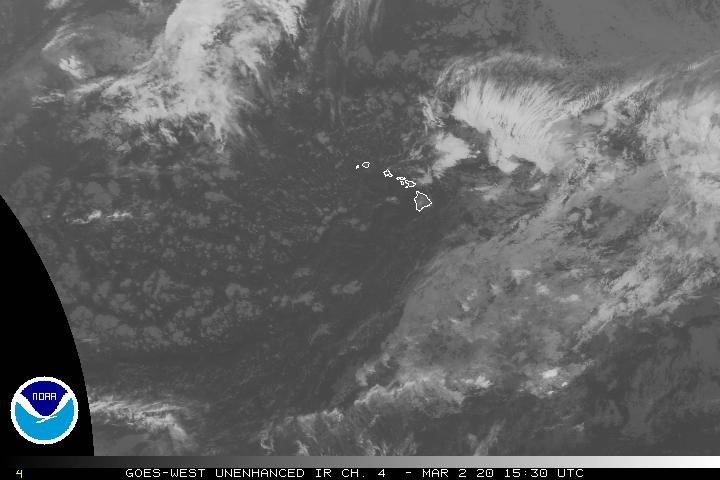
We can use the following links to see what’s going on in our area of the north central Pacific Ocean Saturday morning. Looking at this NOAA satellite picture we see low clouds over the ocean, just a few of which are stretching over the islands locally. At the same time, what's left of the cold front is stretched southwest to northeast offshore from the central islands. We can use this looping satellite image to see the lower clouds, especially over and south of the Big Island, moving along in the returning trade winds. We can also see the next cold frontal cloud band far to the northwest of Hawaii. Checking out this looping radar image we see a few light showers over the ocean, impacting the islands in just a few places at the time of this writing.
Here are the 24-hour precipitation totals (inches) for each of the islands as of Saturday morning:
0.03 N Wailua Ditch, Kauai
1.16 Moanalua Stream, Oahu
0.00 Molokai
0.00 Lanai
0.00 Kahoolawe
0.12 Kepuni, Maui
0.21 Kealakomo, Big Island
Sunrise Commentary: A retiring cold front pushed down to the central islands, bringing a few good showers to Oahu. This quickly dissipating frontal boundary, or what's left of it, it mostly offshore to the northeast today. Here's a satellite image to see where these leftover clouds are located this morning. A strengthening high pressure ridge will move into the area recently occupied by the cold front, and in turn cause a good strengthening of our local trade winds. The prolonged period of volcanic haze will be blown out over the ocean to our southwest and west as a result. This shift back to the trade winds will become more evident as we move through Saturday, returning a few windward showers to our north and east facing coasts and slopes as well. The trade winds will continue into the new work week ahead, although will ease up in strength some around next Wednesday or Thursday…as another weak cold front stalls to our northwest. The overall outlook calls for active trade winds, and less than the usual amount of shower activity going forward.
Here in Kula, Maui at around 715am HST, it was calm and clear, with an air temperature of 52.9F degrees…with still a small amount of vog in our local skies before sunrise. We'll find the trade winds moving back into the state now, becoming stronger Sunday into Monday. The marine environment, along our north and west facing beaches, will warrant the headline weather news this weekend…as a new large northwest swell kicks the surf up. As we push into the new work week ahead, yet another even larger northwest swell train of waves will arrive, perhaps becoming large enough to necessitate a more unusual high surf warning then. The surf along our east, and especially our south shores will be considerably smaller, with your best beaching activities focused along our leeward south facing shores. Sunshine will be abundant, along with nice warm air temperatures as well!
~~~ I went to see a new film last evening in Kahului, this one called The Artist, which stars Jean Dujardin and Berenice Bejo…among many others. The synopsis: Hollywood 1927. George Valentin is a silent movie superstar. The advent of the talkies will sound the death knell for his career and see him fall into oblivion. For young extra Peppy Miller, it seems the sky's the limit – major movie stardom awaits. The ratings are almost off the scale for this film, with the typically hard grading rotten tomatoes website giving it a very impressive 97% out of 100…an almost unheard of rating for that site. I liked this film, although it was very unusual, portraying an old time silent film, which was shot in black and white…and was actually silent 99% of the time. It was just the opposite of your normal action film, which was refreshing for a change. The leading star was very handsome, and the leading lady was very attractive too. They teamed up in a sweet way, and their friendship and caring for each other carried the film in a really nice way. I would give this film a B+ grade, and could recommend it solidly. It was interesting, for being such a talked about film, it was shown in the smallest theater in this megaplex, although all the seats were filled. Here's the trailer for this film.
~~~ Looking over towards the West Maui Mountains early this morning, I can still see evidence of vog, although it is much less dense. As the trade winds blow today, I expect all that leftover vog to be completely gone by the end of the day. It's clear enough that I'll be back taking my usual walks now, after curtailing that activity due to the poor air qualities we've seen the last three or four days. I'll be back with a sunset commentary early this evening, a bit later than usual…as I'm going up hiking around the Haleakala Crater with my neighbors. I hope you have a great Saturday until then! Aloha for now…Glenn.
Interesting: Deloitte Touche Tohmatsu Limited (DTTL) today launched the Water Tight 2012 report, which explores the future of the global water sector in the year ahead. The report examines how major global trends such as population growth, increasing economic development, and urbanization, coupled with the changes in climate patterns, underscore the importance of effective public policy and private sector water stewardship in managing this finite and shared resource.
The growing demand for water is making conservation and efficient use central issues, particularly as governments, utilities, and the private sector come under increasing pressure to be stewards of this precious and shared resource. The report states that a clearer water pricing will play an important role in how customers better manage their water usage.
"There is a compelling case for utilities either to increase water prices or create a better pricing system that addresses scarcity issues, allows them to invest in the replacement of ageing infrastructure, and provides them with a satisfactory financial return," says James Leigh, Global Leader for Water, DTTL.
"Increasing water prices, however, is a difficult political decision, as domestic water usage is considered a basic human right. As such, raising awareness of water related issues and educating the public about the necessity of more effective water pricing is crucial."
According to the report, one potential solution for affordable prices and sufficient financial returns is tiered pricing. As water usage increases so would the price. Tiered pricing has already been successfully implemented in Israel, Australia, Hong Kong, Japan, South Korea, and parts of the United States.
Interesting2: Even after 100 years have passed a restored wetland may not reach the state of its former glory. A new study in the open access journal PLoS Biology finds that restored wetlands may take centuries to recover the biodiversity and carbon sequestration of original wetlands, if they ever do.
The study questions laws, such as in the U.S., which allow the destruction of an original wetland so long as a similar wetland is restored elsewhere. "Once you degrade a wetland, it doesn't recover its normal assemblage of plants or its rich stores of organic soil carbon, which both affect natural cycles of water and nutrients, for many years," said lead author David Moreno-Mateos, with the University of California, Berkeley, in a press release.
"Even after 100 years, the restored wetland is still different from what was there before, and it may never recover." Looking at over 124 studies on wetland restoration covering 621 wetlands around the world (though 80 percent of them were in the U.S.), the study found that 50-100 years after restoration, wetlands still stored 23 percent less carbon and had 26 less plant species than pristine wetlands.
On average restored wetlands were a quarter less productive than original wetlands. The study also found that wetlands in colder regions took longer to restore ecosystem services than those in warmer areas. "Wetlands accumulate a lot of carbon, so when you dry up a wetland for agricultural use or to build houses, you are just pouring this carbon into the atmosphere," says Moreno-Mateos.
"If we keep degrading or destroying wetlands, for example through the use of mitigation banks, it is going to take centuries to recover the carbon we are losing."
 Email Glenn James: