Air Temperatures – The following maximum temperatures were recorded across the state of Hawaii Wednesday:
Lihue, Kauai – 79
Honolulu airport, Oahu – 79
Kaneohe, Oahu – 78
Molokai airport – 80
Kahului airport, Maui – 84 (Record high temperature on this date – 90F 1952, 2006)
Kona airport – 83
Hilo airport, Hawaii – 82
Air Temperatures ranged between these warmest and coolest spots near sea level – and on the highest mountain tops…as of 5pm Wednesday evening:
Kahului, Maui – 79
Molokai airport – 76
Haleakala Crater – 50 (near 10,000 feet on Maui)
Mauna Kea – 39 (near 13,800 feet on the Big Island)
Hawaii’s Mountains – Here’s a link to the live web cam on the summit of near 13,800 foot Mauna Kea on the Big Island of Hawaii. This web cam is available during the daylight hours here in the islands…and when there’s a big moon shining down during the night at times. Plus, during the nights you will be able to see stars, and the sunrise and sunset too…depending upon weather conditions. Here's the Haleakala Crater webcam on Maui…which is working only sometimes lately.
Aloha Paragraphs

Gradually returning trade winds through Saturday –
just a few showers – generally nice weather prevailing
As this weather map shows low pressure systems far to the north-northeast and northwest, along with their associated cold fronts draping southwest from their centers. The location of these low pressure systems, and a weak ridge of high pressure near the Big Island is resulting in localized east to southeast breezes.
The following numbers represent the strongest wind gusts (mph), along with directions Wednesday evening:
21 Barking Sands, Kauai – SE
23 Wheeler AFB, Oahu – SSE
14 Molokai – SSE
13 Kahoolawe – SW
17 Kahului, Maui – SW
07 Lanai – SSE
22 South Point, Big Island – NE
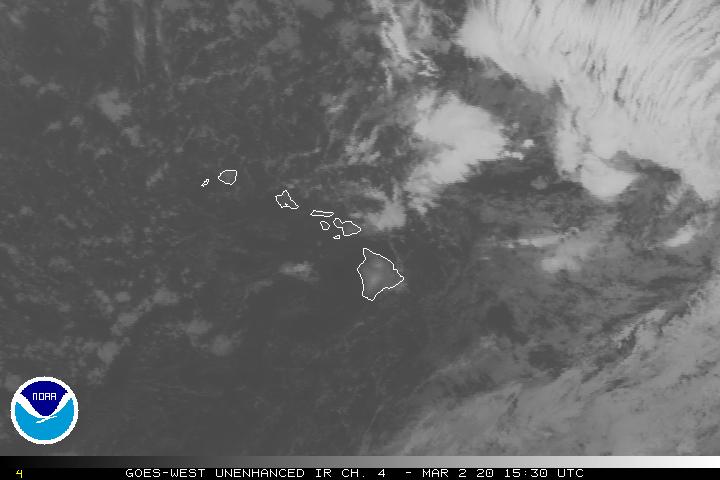
We can use the following links to see what’s going on in our area of the north central Pacific Ocean Wednesday evening. Looking at this NOAA satellite picture we see generally clear skies across all of the Hawaiian Islands at the time of this writing. We can use this looping satellite image to see whats left of some high clouds moving over the Big Island eastward. Checking out this looping radar image we see just a few light to moderately heavy showers over the ocean for the most part at the time of this writing.
Here are the 24-hour precipitation totals (inches) for each of the islands as of Wednesday evening:
1.86 Waialae, Kauai
0.51 Wheeler AFB, Oahu
0.00 Molokai
0.00 Lanai
0.00 Kahoolawe
0.00 Maui
0.06 Ahumoa, Big Island
Sunset Commentary: The dissipating tail-end of our recent cold front is now quite far to the northeast of the state…and moving away. As this front moves away, and the ridge moves back north of the state gradually, we'll transition back into a fairly typical trade wind flow. The trade winds will slowly return Thursday and Friday into the first part of the weekend. The computer forecast models continue to suggest that the trade winds will be short lived however, as southeast to south winds begin on Sunday…as the next cold front approaches early next week.
As the cold front is now out of our local weather picture, the trade winds will return, with just a few showers into the weekend. The computer models are suggesting that we'll have less than the normal amount of windward biased showers into the weekend. The next cold front will push in our direction late this week into early next week, although may stall before reaching Kauai…like this most recent one did. All things considered we're moving into what looks like a very favorably inclined weather pattern through the end of the week, and even into the start of next week too. Thereafter, we'll have to contend with some weather changes, which we'll be discussing over the next several days.
Here in Kula, Maui at around 615pm HST, it was dry and clear, without any volcanic haze, and an air temperature of 66.7F degrees. Wednesday was a really nice day, with still lots of high clouds around from about Maui County down through the Big Island. Those high cirrus have shifted eastward now, leaving Maui with really nice clear skies, and just a few lower level clouds around the edges. Those cirrus clouds are still trying to clear the Big Island, and will during the night…as we can see using this satellite image. You can also see how cloud free the rest of the state is, with just a few clouds over the ocean to the northwest of Kauai. I expect Thursday to be a lovely day, with light winds as the ridge now near the Big Island migrates northward, with light trade winds filling in to its south as it goes. I'll be back early Thursday morning to confirm all those things that I wrote about above, and just to celebrate the beauty of our lovely Hawaiian Islands. I hope you have a great Wednesday night until then! Aloha for now…Glenn.
Interesting: Global warming threatens China's march to prosperity by cutting crops, shrinking rivers and unleashing more droughts and floods, says the government's latest assessment of climate change, projecting big shifts in how the nation feeds itself. The warnings are carried in the government's "Second National Assessment Report on Climate Change," which sums up advancing scientific knowledge about the consequences and costs of global warming for China – the world's second biggest economy and the biggest emitter of greenhouse gas pollution.
Global warming fed by greenhouse gases from industry, transport and shifting land-use poses a long-term threat to China's prosperity, health and food output, says the report. With China's economy likely to rival the United States' in size in coming decades, that will trigger wider consequences.
"China faces extremely grim ecological and environmental conditions under the impact of continued global warming and changes to China's regional environment," says the 710-page report, officially published late last year but released for public sale only recently. Even so, China's rising emissions of carbon dioxide, the main greenhouse gas from burning fossil fuels, will begin to fall off only after about 2030, with big falls only after mid-century, says the report.
Assuming no measures to counter global warming, grain output in the world's most populous nation could fall from 5 to 20 percent by 2050, depending on whether a "fertilization effect" from more carbon dioxide in the air offsets losses, says the report. But that possible fall can be held in check by improved crop choice and farming practices, as well as increased irrigation and fertilizer use.
China is the world's biggest consumer of cereals and has increasingly turned to foreign suppliers of corn and soy beans. The report was written by teams of scientists supervised by government officials, and follows up on a first assessment released in 2007. It does not set policy, but offers a basis of evidence and forecasts that will shape policy. Water, either too much or too little, lies at the heart of how that warming could trip up China's budding prosperity.
Threat to food security "Climate change will lead to severe imbalances in China's water resources within each year and across the years. In most areas, precipitation will be increasingly concentrated in the summer and autumn rainy seasons, and floods and droughts will become increasingly frequent," says the report.
"Without effective measures in response, by the latter part of the 21st century, climate change could still constitute a threat to our country's food security," it says. Under one scenario of how global warming will affect water availability, by 2050 eight of mainland China's 31 provinces and provincial-status cities could face severe water shortages – meaning less than 500 cubic meters per resident – and another 10 could face less dire chronic shortages.
In low-lying coastal regions, rising seas will press up against big cities and export zones that have stood at the forefront of China's industrialization. China's efforts to protect vulnerable coastal areas with embankments are inadequate, says the report, noting their vulnerability to typhoons and flood tides that global warming could intensify. There are sure to be shifts in Chinese crop patterns as well, says the report.
More rice and other crops will probably grow in the northeast, thanks to warmer weather and possibly more rain. In the northwest cotton-growing region of Xinjiang, shrinking water availability could lead to a "marked decline in agricultural crop productivity". China, with 1.34 billion people, already emits a quarter of the world's CO2, with the United States the world's second largest greenhouse gas emitter.
China's emissions, which grew 10 percent in 2010 according to BP, are likely to start falling only after 2030, the report says. It says China's emissions reduction efforts up to 2020 will cost 10 trillion yuan ($1.5 trillion), including 5 trillion yuan for energy-saving technology and new and renewable energy.
 Email Glenn James: