











Air Temperatures – The following maximum temperatures were recorded across the state of Hawaii Friday:
Lihue, Kauai – 78
Honolulu airport, Oahu – 81
Kaneohe, Oahu – 78
Molokai airport – 78
Kahului airport, Maui 80
Kona airport 82
Hilo airport, Hawaii – 78
Air Temperatures ranged between these warmest and coolest spots near sea level – and on the highest mountain tops…as of 5pm Friday evening:
Kailua-kona – 81
Princeville, Kauai – 72
Haleakala Crater – 37 (near 10,000 feet on Maui)
Mauna Kea – M (near 13,800 feet on the Big Island)
Hawaii’s Mountains – Here’s a link to the live web cam on the summit of near 13,500 foot Mauna Kea on the Big Island of Hawaii. This web cam is available during the daylight hours here in the islands…and when there’s a big moon shining down during the night at times. Plus, during the nights you will be able to see stars, and the sunrise and sunset too…depending upon weather conditions. Here's the Haleakala Crater webcam on Maui…which is working only sometimes lately.
Aloha Paragraphs

Trade wind weather pattern, locally strong and gusty…
windward showers increasing later tonight into Saturday
Total Lunar Eclipse early Saturday morning in Hawaii!
As this weather map shows, we find a near 1030 millibar high pressure system located far to the northeast of the Hawaiian Islands Friday evening. This high pressure cell nearly stationary offshore from the Oregon and northern California borders. Meanwhile, we see high pressure cells to the north and east-northeast of the islands. Finally, we have a trough of low pressure located to the east of the state. This pressure configuration keeps moderately strong trade winds blowing across our latitudes of the north central Pacific…strongest over the Maui and Big Island end of the chain as usual.
The following numbers represent the strongest wind gusts (mph), along with directions Friday evening:
17 Port Allen, Kauai – NE
28 Kahuku Training Area, Oahu – E
30 Molokai – NE
36 Kahoolawe – E
35 Kaupo Gap, Maui – NE
40 Lanai – NE
43 Waikoloa, Big Island – NE
We can use the following links to see what’s going on in our area of the north central Pacific Ocean Friday evening. Looking at this NOAA satellite picture we find that high and middle level cloudiness are located over the ocean to the east and south of the state, along with lower level clouds to our east through northeast, taking aim on the windward sides. We can use this looping satellite image to see low clouds being carried over the islands on the trade wind flow here and there…although skies were quite clear in some areas today. We can see a large area of thunderstorms over the ocean to the southeast and east of the Big Island, with high cirrus clouds flying off the tops of those storms…carried by the strong upper level winds in that area. There's an area of high cirrus clouds moving by not too far south of the Big Island as well. Checking out this looping radar image we see showers over the ocean, most of which are in the light to moderately heavy category, the most active areas are coming into the windward sides…with a few sliding over into the leeward sides on the smaller islands.
Here are the 24-hour precipitation totals (inches) for each of the islands as of Friday evening:
0.55 Mount Waialeale, Kauai
0.54 Nuuanu Upper, Oahu
0.26 Molokai
0.00 Lanai
0.00 Kahoolawe
1.10 Puu Kukui, Maui
1.14 Piihonua, Big Island
Sunset Commentary: The trade winds continue to blow steadily, with no definite end in sight through the next week. High pressure systems to our north through northeast and east-northeast will keep these active late autumn winds blowing. This in turn has made our marine coastal and channel waters rough and choppy…necessitating small craft wind advisories in most areas around the state. These gusty winds are expected remain quite breezy through early Sunday, although may ease up a touch later Sunday into later Monday…before picking up again later Tuesday onwards into the week.
Rainfall may become an issue this weekend at times…and in various places. As we have the trade winds blowing briskly, there will be passing windward arriving. The trade winds will be strong enough that a few showers could spill over into the leeward sides on the smaller islands as well. These showers could end up increasing in frequency and intensity Sunday, and as we push into the new work week ahead. We can see on this satellite image, an area of clouds not far to the east of our islands, which will increase those showers later tonight into Saturday. There will be colder air edging in over the state soon too, which will enhance these showers. The NWS office in Honolulu has even gone so far as to mention the chance of thunderstorms over the windward waters tonight into Saturday. Looking even further ahead, these increasing showers may stretch right on into the new week ahead.
Since it's Friday evening, and I have a nice weekend coming up, I'll be driving over to Kahului to see a new film. This one is called Tower Heist, starring Ben Stiller, Eddie Murphy, Alan Alda, Matthew Broderick, Tea Leoni…among many others. The synopsis: when a billionaire steals their retirement money, the workers at a luxury condominium come up with a plan to even the score. The critics are giving this film a B- grade, while the viewers are upping it slightly to a B rating. I must admit that I don't have high hopes for this film, although am willing to give it a chance. I'll let you know what I thought about it when I get back online Saturday morning. Here's a trailer for this film, just in case you have the slightest interest in taking a quick peek.
Here in Kihei, Maui at around 530pm Friday evening, skies were mostly clear, with just a few scattered clouds around the edges. The trades are rather strong and gusty, like they have been all afternoon. I'm sure the ocean is rough and choppy, and likely pretty chilly down near the beach right now. As I was mentioning in the paragraph above, we have some showers heading our way, which is good from a drought perspective, as we need the moisture…although from being able to see the lunar eclipse early Saturday morning, I'm getting a bit worried. I'll be setting my alarm clock for around 345am, and hope to see this very interesting celestial event. I can't ever remember seeing such an occurrence, so am hoping my house in Kula will be clear. ~~~ I'll of course let you know what I found in my morning sunrise commentary. I hope you have good luck in seeing it, that is if you can peel yourself out of bed. Otherwise, here's wishing you a great Friday whatever you have in mind to do! Aloha for now…Glenn.
Extra: December 10 – Total lunar eclipse (visible in Hawai‘i)…the last total lunar eclipse until 2014
There is a total lunar eclipse early in the morning on December 10. This is the first total lunar eclipse visible in Hawai‘i since the one of December 20, 2010. Hawai‘i and Alaska are well-place to view this December 2011 eclipse. Please note that this eclipse happens early in the morning on December 10, 2011 – i.e., either stay up late on the 9th and then look for it starting at 3:00am on the 10th; or set your alarm very early on the 10th.
From the Hawaiian Islands, the partial phase on this lunar eclipse starts at about 2:45am on December 10, as the moon starts to enter the deep inner shadow (umbra) of the earth. By 4:10am HST the eclipse will be total, with the entire moon now in the dark inner shadow of the earth. By this time, the moon should be dramatically darker and redder than usual. This total phase, with the moon completely within the earth’s umbra, will last till 4:55am HST. At that time the moon will start to leave the umbra, and you will see the moon start to lighten. By 6:20am, just as the first glimmer of dawn appears in the east, the partial phase will be over.
Lunar eclipses occur when the earth comes in between the moon and sun. The earth’s atmosphere blocks most of the light coming from the sun and stops that light from hitting the moon. However, the longer wavelengths of red light from the sun do make it through the earth’s atmosphere and continue on to strike to moon. Thus, during lunar eclipses the moon can turn a pale copper color; or a deep shade of red; or can be just plain dark. This is largely a function of the earth’s atmosphere at the time of the eclipse. If there is a lot of material in the air, say from recent volcanic activity, the moon tends to be darker. If the atmosphere is relatively clear, the moon is often more reddish.
All of Alaska will see this eclipse; the total phase there will run from 5:10 to 5:55am Alaska Standard Time. The western half of the continental US will see the moon set while it’s total. Viewers in the middle portion of the US will see the eclipse the partial phase start, but will see the moon set before the total phase begins. Viewers on the eastern quarter of the continental US will not see any visible change. The moon will set from the eastern part of the US while the eclipse is still penumbral (i.e. the moon is only in the earth’s fainter outer shadow, the penumbra) and there is no visible change in the moon’s brightness during the penumbral phrase.
Elsewhere: virtually all of Asia will see this eclipse.
Interesting: Scientists have used satellite data from NASA-built Landsat missions to confirm that more than 20 years of warming temperatures in northern Quebec, Canada, have resulted in an increase in the amount and extent of shrubs and grasses. "For the first time, we've been able to map this change in detail, and it's because of the spatial resolution and length-of-record that you can get with Landsat," says Jeff Masek, the program's project scientist.
He's based at NASA's Goddard Space Flight Center in Greenbelt, Md. Masek and his co-authors will present their study at the American Geophysical Meeting in San Francisco on Dec. 9. The study, focusing on Quebec, is one of the first to present a detailed view of how warmer temperatures are influencing plant distribution and density in northern areas of North America.
"Unlike the decline of sea ice, which is a dramatic effect that we're seeing as a result of global warming, the changes in vegetation have been subtle," Masek says. Computer models predict the northward expansion of vegetation due to warmer temperatures.
"They predict a dramatic change over the next 100 years, and people have been wondering why we weren't seeing these changes already, Masek says. The difference between the computer predictions and real-life vegetation may have to do with all the other factors that come into play with plants, like the availability of water and sunlight; the type of terrain; competition from other plants for soil, resources and space; and plant predators like caribou.
"The warm temperatures are only part of the equation," says Doug Morton, the Principal Investigator of the study and a researcher at NASA Goddard. Scientists track vegetation with satellites by measuring the 'greenness' of a study area.
Morton says previous studies used yearly compilations, making it difficult to determine if the increase in 'greenness' was due to expansion of vegetation cover or if what scientists were seeing was instead just the effect of a longer growing season.
For this study, the scientists focused only on 'greenness' measurements during the peak summer growing seasons from 1986 to 2010. By using Landsat's higher, ~98 foot resolution and viewing the same area at the same time for 23 years, Masek and his colleagues were able to track the areas as they continued to show more 'greenness' over the years.
"It makes sense," Masek says. "This is how shrub encroaching occurs. They increase in size, they increase in density, and then they move northward." In contrast to the expansion of shrubs, the scientists found little evidence for 'greenness' trends in forested areas, suggesting that forest response to recent warming may be occurring more slowly.
Masek adds that it shows how getting the big picture of warming's effect on forests will rely on continued observations from new U.S. missions that extend and enhance these data records.
Interesting2: A second hurricane-strength storm is heading for the UK and this time the entire country looks set to suffer. Forecasters say the next severe storm is now brewing in the North Atlantic and will bring with it cold air, snow and sleet as well as hurricane-strength winds from Monday evening. They say next week's massive storm will affect the whole of the UK and will last through the whole of Tuesday and into Wednesday.
Weather experts say they cannot officially classify the storms as hurricanes because the severe weather systems have a cold core instead of a warm core, but the wind speeds are the same and they still carry the same destructive power. Weather expert Tim Ballisty, a meteorologist at weather.com, said: "There are two main computer models that we use to forecast the weather and both are showing an intense area of low pressure that will swing in across the North Atlantic on Monday, last all day Tuesday and into Wednesday."
Tim described how the huge weather system will "stall out" over the UK and the forecasts show the area of low pressure, that brings severe winds and rain, will deepen and intensify across the whole of the UK and across to the west coast of France. He explained: "What is interesting about this next storm is that the huge weather system that slammed into Scotland on Thursday was very constrained, its damage was limited to Scotland.
"However, next week's storm looks likely to cover the whole of the UK, it is tremendously wide and has a much broader scope to it. "The winds may not be nudging 150mph again but it will certainly produce the same destructive power as Thursday's storm." Tim said the forecasts showed the massive storm will arrive late on Monday with heavy rain across most parts of the country, followed by a very cold air mass, which will trigger sleet and snow.
The hurricane-force winds of at least 74mph will last through the whole of Tuesday and into Wednesday. And Jonathan Powell of Positive Weather Solutions, who accurately warned of the huge scale of Thursday's storm earlier in the week, said they also had picked up the aggressive new storm in the Atlantic.
He told ClickGreen: “This storm will affect the entire nation, Monday will be a complete wash-out and whereas Scotland took the last storm on the chin – this will hit the whole of the country square-on.”
Tim Ballisty explained that while the UK was in the icy grip of the Big Freeze this time last year, this year a change in the upper atmosphere meant the country would be prone to more wild weather and Atlantic storms.
“In 2011, there was what was known as the 'Greenland Block' that virtually created a traffic jam in the atmosphere – the Arctic air that normally progresses from West to East was forced to plunged Southward and created the Big Freeze across much of the northern hemisphere, including the East Coast of the US and much of Europe.
“However this year, there is no 'Greenland Block' so these weather system can freely pass from West to East unobstructed.
“These storms are all part of the seasonal change and look very likely to continue.”
The UK Met Office this afternoon issued a Severe Weather Warning for the South and South West of the UK for Monday and Tuesday, advising of the risk of heavy winds. The yellow alert is in place between 6pm on Monday evening to 6pm on Tuesday evening.
The advisory states the South and West are at the “greatest risk of very windy weather on Monday evening and during Tuesday which could lead to disruption.
“At this stage there is a good deal of uncertainty and the public are advised to monitor forecasts over the weekend to keep up to date with this warning. Hurricane-strength winds of more than 75mph are being forecast by Jonathan Powell at Positive Weather Solutions, who warns overnight Monday will be a critical time.
He predicts the massive incoming storm will not pack the same destructive punch as the weather system that crashed through Scotland on Thursday as some of its power will be lost as it crosses Ireland. However, the huge low area is far wider and is expected to stay across most parts of the UK until Wednesday.
 Email Glenn James: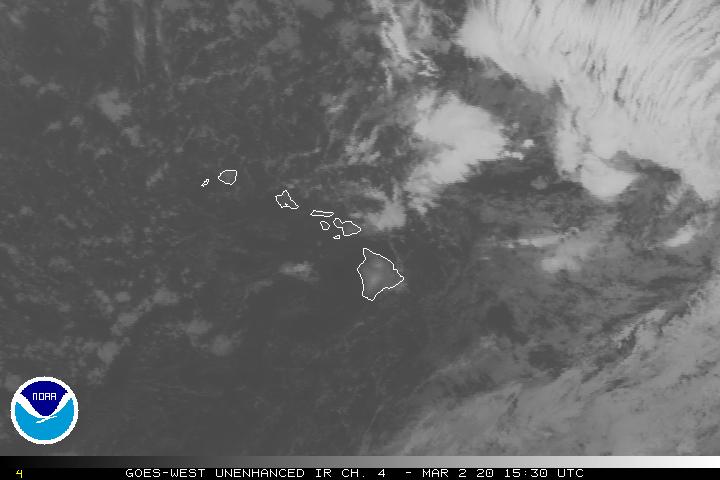


Paul Says:
Aloha Glenn,
Got up at 2:45 to witness the eclipse. It was just starting and I stayed out to view it until it was total. Perfectly clear down here in Ocean View, Big Island. As the moonlight faded, the stars seemed to explode. Great stuff. Question for you: Where can I get an accurate rain gauge? I have a cheap one, but would like to have a better check on precipitation down here. FYI, the last two years, we've been under 17 inches and this year so far we're at 11.4" Mahalo nui for your weather narratives, although we seem to be on a different planet most of the time weather wise. ~~~Hi Paul, good to hear from you down there on the Big Island, I used to live in Honaunau back around 1976. Good to hear that you witnessed the big occasion last night, and with clear skies too. As for the rain gauge, do a search for one of those on the internet, at least that’s what I would do…or go to your local hardware store…they usually have ones that are good enough. Thanks for reporting in, good commentary Pau! Aloha, Glenn
Eliza Says:
Aloha Glenn –
Many are anticipating the eclipse, so the question is, will it be a cloudless night/early morning for great viewing? Mahalo nui ~
Eliza~~~Hi Eliza, that the 64,000 dollar question (I think that was the dollar amount in that old popular TV show). I’m a little nervous about some high clouds to our south, which I’m already seeing in our skies to the south of Kihei. Then there will be those showery clouds along the windward sides to deal with too. I recommend perhaps find someplace on the slopes of the Crater, or down near the beaches on our leeward sides. This will be very fun to watch, lets hope for the best! Aloha, Glenn