Air Temperatures – The following maximum temperatures were recorded across the state of Hawaii Friday:
Lihue, Kauai – 79
Honolulu airport, Oahu – 84 (record high for the date – 87 in 1983)
Kaneohe, Oahu – 80
Molokai airport – 82
Kahului airport, Maui 83
Kona airport 81
Hilo airport, Hawaii – 79
Air Temperatures ranged between these warmest and coolest spots near sea level – and on the highest mountain tops…as of 5pm Friday evening:
Barking Sands, Kauai – 80
Kapalua, Maui – 73
Haleakala Crater – 48 (near 10,000 feet on Maui)
Mauna Kea – 41 (over 13,500 feet on the Big Island)
Here are the 24-hour precipitation totals (inches) for each of the islands as of Friday evening:
0.07 Moloaa Dairy, Kauai
0.40 Oahu Forest NWR, Oahu
0.00 Molokai
0.00 Lanai
0.00 Kahoolawe
0.02 Puu Kukui, Maui
0.39 Piihonua, Big Island
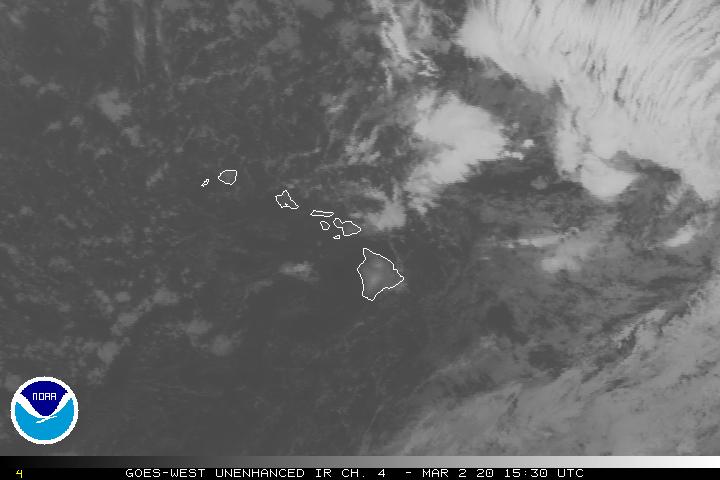
Satellite and Radar Images: To view the cloud conditions we have here in Hawaii, please use the following satellite links, starting off with this Infrared Satellite Image of the islands to see all the clouds around during the day and night. This next image is one that gives close images of the islands during the daytime hours, and is referred to as a Close-up visible image. Finally, here's a Looping IR satellite image, making viewable the clouds around the islands 24 hours a day. To help you keep track of where any showers may be around the islands, here’s the latest animated radar image.
Hawaii’s Mountains – Here’s a link to the live web cam on the summit of near 13,500 foot Mauna Kea on the Big Island of Hawaii. This web cam is available during the daylight hours here in the islands…and when there’s a big moon shining down during the night at times. Plus, during the nights you will be able to see stars, and the sunrise and sunset too…depending upon weather conditions. The Haleakala Crater webcam on Maui just came back online, after being on the blink for several weeks.
Tropical Cyclone activity in the eastern and central Pacific – Here’s the latest weather information coming out of the National Hurricane Center, covering the eastern north Pacific. You can find the latest tropical cyclone information for the central north Pacific (where Hawaii is located) by clicking on this link to the Central Pacific Hurricane Center. A satellite image, which shows the entire ocean area between Hawaii and the Mexican coast…can be found here. Here's a tropical cyclone tracking map for the eastern and central Pacific.
Aloha Paragraphs

Windy weekend…rough and choppy ocean
As this weather map shows, we find a strengthening 1033 millibar high pressure system located to the northwest of the Hawaiian Islands…which will provide strong and gusty trade winds through the weekend. At the same time, there’s an area of low pressure to the north-northeast of Hawaii…with a weak cold front to the northwest through north of our islands. The forecast continues to call for our local trades to surge this weekend, with strong and gusty trade winds riding in behind a cold front…into early in the new work week ahead.
The following numbers represent the strongest wind gusts (mph), along with directions Friday evening:
27 Mana, Kauai – NW
22 Makua Ridge, Oahu – NE
17 Molokai – NE
27 Kahoolawe – NE
15 Lipoa, Maui – NE
25 Lanai – NE
21 Upolu Point, Big Island – NE
We can use the following links to see what’s going on in our area of the north central Pacific Ocean early Friday evening. Looking at this NOAA satellite picture we find that high and middle level cloudiness is located to the north, northeast, east, and southeast of the state…over the state too. We can use this looping satellite image to see low cloud bands being carried over the islands on the trade wind flow. At the same time, we find a considerable amount of thunderstorm activity far to our southwest over the ocean, with high cirrus clouds flying off the tops of those clouds. We can see a very thin cold front being pushed in our direction by the soon to be much stronger trade wind flow. Checking out this looping radar image we see few light showers falling locally over the ocean, a few of which are reaching the islands in places.
Sunset Commentary: The main thing that we’ll need to look out for this weekend will be the gusty northeast winds, which will feel a bit cool too. These have triggered small craft wind advisories over all of our local coasts and channels…along with possible gale warnings in at least some of the major channels around the state with time. The islands themselves won’t be immune from these blustery and chilly winds, with wind advisories possible over at least some parts of the state, and even up high over the mountains on both Maui and the Big Island. This isn’t your ordinary strong and gusty wind event, which happens so often here in the Aloha state. This looks like it could be one of the stronger blows we've seen in a while. It’s not often that the NWS talks about gale warnings and wind advisories in the same breath.
As this weather map shows, we have a big near 1033 millibar high pressure system up to the northwest, which will quickly blast eastward. This moderately strong high pressure cell will be in the area north of Hawaii by Saturday. The clockwise rotation of this high will bring air down from the area near Alaska, thus cooler weather this weekend too. At the same time we need to bring the words wind chill into play as well, and the very dry character of the winds too. These will team up to drop our air temperatures both Saturday and Sunday several degrees below what would be considered normal for this time of year. It won’t be shocking by any means, although most folks might notice that its a little on the cool side soon. This tropical cool snap will begin to fade by early in the new work week ahead, as the winds calm down and turn more to our more customary easterly direction.
Meanwhile, we have that high pressure shown above getting ready to push a weak cold front down through the islands too. This is being noted all the way down here on the page, after the windy news above…as it will be rather insignificant as far as cold fronts go. Here’s a big satellite image showing this rather thin and diffuse frontal cloud band to our north and northwest. If after scrolling around and finding the islands outlined in blue, you may be wondering where is the cold front? There are quite a few bands of clouds up to our north, and that’s why this particular cold front is being called diffuse. It’s not easy to pick out from the various bands up that way. As this front gets in closer to the state on Saturday, we can more effectively use this satellite picture. At any rate, it will arrive on Kauai first, early Saturday morning, and not too long after that on Oahu. It will take a while for this front to push down through the islands of Maui County, and then across the Big Island. It will bring some showers, but nothing all that impressive. It should fizzle out rather quickly, although drizzle or mist could stick on the north and northeast facing slopes for a while, hung up there by the gusty winds blowing through.
Since it's Friday evening, I'm going into Kahului for a quick dinner, before walking over to the theater and seeing a new film. This one is called Twilight Saga, The Breaking Dawn, starring Kristen Stewart, Robert Pattinson and Taylor Lautner…among many others. The synopsis: Bella and Edward, plus those they love, must deal with the chain of consequences brought on by a marriage, honeymoon, and the tumultuous birth of a child… which brings an unforeseen and shocking development for Jacob Black. I can't find what the critics are giving this film, although the viewers are giving it a pretty high B+ grade. I've seen the other films in this series, and have enjoyed these vampire flicks. I'll be sure and let you know what I think Saturday morning. Until then, here's a trailer just in case you have any interest in seeing what I'm sitting through this evening.
Here in Kihei, Maui at around 545pm Friday evening, its partly to mostly cloudy, much of which are composed of the middle level altocumulus variety. It will be quite interesting to see just how strong these winds will become this weekend, they should reach their peak at some point Saturday afternoon through Sunday evening. I'll be back in the morning to write more about this windy episode, I hope you have a great Friday night until then! Aloha for now…Glenn.
Interesting: Australia moved to set up the world's biggest marine park on Friday to protect vast areas of the Coral Sea off the country's northeast coast and the site of fierce naval battles during World War II. Environment Minister Tony Burke said the park would cover almost 1 million square km — an area the size of France and Germany combined — and would help protect fish, pristine coral reefs and nesting sites for sea birds and the green turtle.
"The environmental significance of the Coral Sea lies in its diverse array of coral reefs, sandy cays, deep sea plains and canyons," Burke said. "It contains more than 20 outstanding examples of isolated tropical reefs, sandy cays and islands."
The new park would also cover ships sunk in the Battle of the Coral Sea, a series of naval engagements between Japanese, American and Australian forces in 1942, considered the world's first aircraft carrier battle. Three U.S. ships were known to have sunk in the northeastern area of the Coral Sea, the USS Lexington, the USS Sims and the USS Neosho, Burke said.
The government will finalize what limits will be imposed on the Coral Sea marine park, which will be within Australia's economic zone, in 90 days.
Interesting2: Air pollution caused more than 100 billion euros ($134.95 billion) in health and environmental damage, highlighting the need for more renewables sources of energy, a report published on Thursday by the European Environment Agency found. Europe's 10,000 largest factories and energy facilities resulted in 102-169 billion euros in health issues, such as respiratory and cardiovascular problems, and environmental costs because of air pollution in 2009, the most recent available data.
Per citizen, the cost was between 200-300 euros. "This analysis shows the significant impact of fossil-fueled power stations and the very high costs they impose on people's health and the environment, making the case for introducing cleaner types of energy even more urgent," European Environment Agency Executive Director Jacqueline McGlade said in a statement.
The power generation sector was the biggest contributor of damage costs, with 66-112 billion euros, the study showed. It covered the EU 27 member states as well as Norway and Switzerland. A small number of facilities, 622 or 6 percent of the total number, represented 75 percent of the total damage costs resulting from air pollutants, such as heavy metals, sulphur dioxide, nitrogen oxides and carbon dioxide greenhouse gases.
To tackle this problem, the EU plans to review EU air quality legislation in 2013, but resistance from the bloc's member states is expected. Germany, France, Italy, Poland, and the United Kingdom, which have the largest number of facilities, were identified as contributing the most in terms of total damage costs. Bulgaria, the Czech Republic, Estonia, Poland and Romania were also responsible for a significant level of damage relative to their overall emissions levels.
Two British power stations, Drax and Longannet, were ranked five and 19 respectively out of the top 20 in terms of generating the highest pollution damage costs.
 Email Glenn James: