Air Temperatures – The following maximum temperatures were recorded across the state of Hawaii Wednesday:
Lihue, Kauai – 86
Honolulu airport, Oahu – 89 (record high for the date – 91 in 1973)
Kaneohe, Oahu – 84
Molokai airport – 84
Kahului airport, Maui – 87
Kona airport 85
Hilo airport, Hawaii – 86
Air Temperatures ranged between these warmest and coolest spots near sea level – and on the highest mountain tops…as of 5pm Wednesday evening:
Port Allen, Kauai – 86
Kaneohe, Oahu – 76
Haleakala Crater – 48 (near 10,000 feet on Maui)
Mauna Kea Summit – 39 (over 13,500 feet on the Big Island)
Here are the 24-hour precipitation totals (inches) for each of the islands as of Wednesday evening:
0.13 Mount Waialeale, Kauai
0.23 Manoa Lyons Arboretum, Oahu
0.00 Molokai
0.00 Lanai
0.00 Kahoolawe
0.02 Oheo Gulch, Maui
0.02 Hilo airport, Big Island
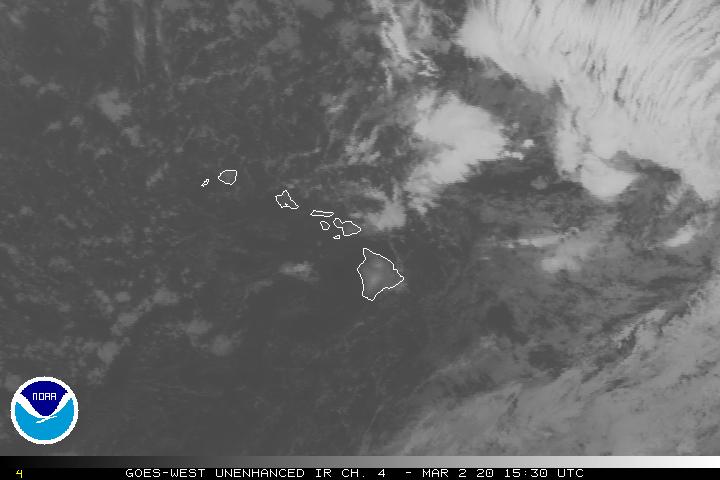
Satellite and Radar Images: To view the cloud conditions we have here in Hawaii, please use the following satellite links, starting off with this Infrared Satellite Image of the islands to see all the clouds around during the day and night. This next image is one that gives close images of the islands only during the daytime hours, and is referred to as a Close-up visible image. Finally, here's a Looping IR satellite image, making viewable the clouds around the islands 24 hours a day. To help you keep track of where any showers may be around the islands, here’s the latest animated radar image.
Hawaii’s Mountains – Here’s a link to the live web cam on the summit of near 13,500 foot Mauna Kea on the Big Island of Hawaii. This web cam is available during the daylight hours here in the islands…and when there’s a big moon shining down during the night at times. Plus, during the nights you will be able to see stars, and the sunrise and sunset too…depending upon weather conditions. The Haleakala Crater webcam on Maui just came back online, after being on the blink for several weeks.
Tropical Cyclone activity in the eastern and central Pacific – Here’s the latest weather information coming out of the National Hurricane Center, covering the eastern north Pacific. You can find the latest tropical cyclone information for the central north Pacific (where Hawaii is located) by clicking on this link to the Central Pacific Hurricane Center. A satellite image, which shows the entire ocean area between Hawaii and the Mexican coast…can be found here. Here's a tropical cyclone tracking map for the eastern and central Pacific.
Aloha Paragraphs

Locally gusty trade winds, high
clouds…some windward showers
Our trade winds will be locally quite strong and gusty, then mellow out a little Thursday into the weekend. Glancing at this weather map, it shows a near 1027 millibar high pressure system to our north. East and west running ridges extend from the center of this high pressure cell, into the western and eastern Pacific. Small craft wind advisories are active over those windiest coasts and channels in Maui County and the Big Island. These strong trade winds will last into Thursday, with a slight weakening into the weekend.
Trade winds continue…the following numbers represent the strongest gusts (mph), along with directions Wednesday evening:
24 Port Allen, Kauai – NE
23 Waianae, Oahu – ESE
24 Molokai – NE
24 Kahoolawe – ESE
29 Kahului, Maui – NE
05 Lanai – WSW
23 Upolu Point, Big Island – NE
We can use the following links to see what’s going on in our area of the north central Pacific Ocean Wednesday evening. Looking at this NOAA satellite picture we find low clouds generally offshore of the islands…although they are being carried over the islands at times. At the same time we see high cirrus clouds to our west and north, which continue to move eastward over the islands on the upper winds. We can use this looping satellite image to see those low clouds moving along in the trade wind flow. There are those high level clouds coming our way from the west. Checking out this looping radar image we see some showers over the ocean, moving along in the trade wind flow, impacting the windward sides at times.
Sunset Commentary: The trade winds will be on the stronger and gusty side of the wind spectrum today. As we push into Thursday, we’ll begin to see a slightly lighter wind flow arriving over the islands…which will continue through the rest of this week. The winds aren’t going to be stopping completely by any means, although will mellow out a touch. We’ll likely find light to moderately strong trade winds continuing into the first day or two of next week.
The latest computer models are showing a cold front digging southward towards the tropics around the middle of next week. This in turn would turn our long lasting trade winds off, or slow them way down for several days. Some of the models are now showing a low pressure system forming to the northwest of the state. If, and this is still quite a large if, this were to happen, we could see southwest kona winds kick in, which could carry showers our way for several days…stay tuned for more about these two possibilities.
Meanwhile, the surf’s up along our south and west facing beaches. The NWS high surf advisory remains active on the southern leeward beaches, although will likely be dropped by Thursday. The north shores have some surf, as do the east facing beaches…although they’re quite a bit smaller. The south shore surf will be diminishing through the rest of the week, as usually happens this time of year. The north and west shores will become more and more active as we head deeper into our autumn season.
Here in Kihei, Maui at around 530pm HST Wednesday evening, skies were rather muted looking, with the high cirrus clouds up above. Glancing at this satellite image, we can see more of those icy cirrus clouds coming our way from the west. Upper level low pressure systems to our west will keep these high clouds flowing along in the subtropical jet stream at times through the the next couple of days. They will thin out, and then become thicker at times, which will provide nice sunrise and sunset colors when they're around! ~~~ Meanwhile, the high surf along our leeward sides continued to break today, and then will slowly diminish in size Thursday onwards. The high surf advisory along our south facing beaches is still in effect. The stronger trade winds now have kicked up wind swell along our east facing beaches. The north shores are getting into this action as well, as north and northwest swells are forecast to keep waves breaking along these beaches. The next major change could arrive around the middle of next week, when a low pressure system forms to our northwest. If this happens, we would find a wind shift somewhere between the southeast to southwest…with periods of increased rainfall through the last couple of days of the work week. ~~~ I'm just about ready to head back upcountry to Kula. I hope you have a great Wednesday night, until I have your next new weather narrative ready for you early Thursday morning! Aloha for now…Glenn.
Interesting: Great Lakes shorelines are becoming clogged by algae blooms fed by agricultural run-off, while invasive mussels decimate the food chain in deeper waters, an environmental group said on Tuesday. The five lakes, which contain one-fifth of the world's fresh water and supply tens of millions of people, may be "veering close to ecosystem collapse," the report by the National Wildlife Federation said.
"Too much food is causing massive algal blooms in Lake Erie and other coastal systems, while too little food is making fish starve in Lake Huron's offshore waters," said the group's Great Lakes director, Andy Buchsbaum. There are many problems afflicting the Great Lakes, which in other ways have grown healthier after years of pollution.
This past summer, Lake Erie was choked by toxic algae blooms up to 2 feet thick and 10 miles wide, and algae coated some Lake Michigan coastlines. Water treatment removes the toxin, at a cost, but often creates an unpleasant odor, one of the report's authors, Julie Mida Hinderer, said in an interview.
In deeper water, prolific quagga mussels have beaten out zebra mussels and colonized vast stretches of the lake bottoms, filtering out vital plankton that is the base of the lakes' food web. This has starved small fish such as alewives, bloater fish, and rainbow smelt that in turn has hurt populations of top lake predators such as whitefish and salmon.
Both mussel species are not native and arrived in the ballast water of ocean-going ships, but quagga mussels are more of a hazard because they colonize more of the lake bottom than zebra mussels. There has been a 95 percent decline in fish biomass in Lake Huron, one of three larger lakes, in the past 15 years, according to the report.
Freshwater shrimp that are key to Lake Michigan's fishery have declined by 94 percent in 10 years. Scientists blame too much phosphorous from farm fertilizer runoff for the algae blooms, which decompose and create an oxygen-depleted "dead zone" in the Lake Erie.
Interesting2: New evidence supports the theory that comets delivered a significant portion of Earth's oceans, which scientists believe formed about 8 million years after the planet itself. The findings, which involve a University of Michigan astronomer, are published Oct. 5 online in Nature.
"Life would not exist on Earth without liquid water, and so the questions of how and when the oceans got here is a fundamental one," said U-M astronomy professor Ted Bergin, "It's a big puzzle and these new findings are an important piece."
Bergin is a co-investigator on HiFi, the Heterodyne Instrument for the Infrared on the Hershel Space Observatory. With measurements from HiFi, the researchers found that the ice on a comet called Hartley 2 has the same chemical composition as our oceans.
Both have similar D/H ratios. The D/H ratio is the proportion of deuterium, or heavy hydrogen, in the water. A deuterium atom is a hydrogen with an extra neutron in its nucleus. This was the first time ocean-like water was detected in a comet. "We were all surprised," Bergin said.
Six other comets HiFi measured in recent years had a much different D/H ratio than our oceans, meaning similar comets could not have been responsible for more than 10 percent of Earth's water. The astronomers hypothesize that Hartley 2 was born in a different part of the solar system than the other six.
Hartley most likely formed in the Kuiper belt, which starts near Pluto at about 30 times farther from the sun than Earth is. The other six hail from the Oort Cloud more than 5,000 times farther out. The source of earth's oceans has been a subject for debate among astronomers for decades. Until now, asteroids were thought to have provided most of the water.
Now, however, Herschel has shown that at least one comet does have ocean-like water. "The results show that the amount of material out there that could have contributed to Earth's oceans is perhaps larger than we thought," Bergin said.
 Email Glenn James: