











Air Temperatures – The following maximum temperatures were recorded across the state of Hawaii Thursday:
Lihue, Kauai – 84
Honolulu airport, Oahu – 88 (record high for the date – 94 in 1984)
Kaneohe, Oahu – 82
Molokai airport – 83
Kahului airport, Maui – 85
Kona airport 84
Hilo airport, Hawaii – 84
Air Temperatures ranged between these warmest and coolest spots near sea level – and on the highest mountain tops…as of 5pm Thursday evening:
Honolulu, Oahu – 83
Hilo, Hawaii – 76
Haleakala Crater – 48 (near 10,000 feet on Maui)
Mauna Kea Summit – 39 (over 13,500 feet on the Big Island)
Here are the 24-hour precipitation totals (inches) for each of the islands as of Thursday evening:
0.90 Mount Waialeale, Kauai
0.39 Oahu Forest NWR, Oahu
0.02 Molokai
0.00 Lanai
0.02 Kahoolawe
0.55 Oheo Gulch, Maui
0.83 Puu Waawaa, Big Island
Satellite and Radar Images: To view the cloud conditions we have here in Hawaii, please use the following satellite links, starting off with this Infrared Satellite Image of the islands to see all the clouds around during the day and night. This next image is one that gives close images of the islands during the daytime hours, and is referred to as a Close-up visible image. Finally, here's a Looping IR satellite image, making viewable the clouds around the islands 24 hours a day. To help you keep track of where any showers may be around the islands, here’s the latest animated radar image.
Hawaii’s Mountains – Here’s a link to the live web cam on the summit of near 13,500 foot Mauna Kea on the Big Island of Hawaii. This web cam is available during the daylight hours here in the islands…and when there’s a big moon shining down during the night at times. Plus, during the nights you will be able to see stars, and the sunrise and sunset too…depending upon weather conditions. The Haleakala Crater webcam on Maui just came back online, after being on the blink for several weeks.
Tropical Cyclone activity in the eastern and central Pacific – Here’s the latest weather information coming out of the National Hurricane Center, covering the eastern north Pacific. You can find the latest tropical cyclone information for the central north Pacific (where Hawaii is located) by clicking on this link to the Central Pacific Hurricane Center. A satellite image, which shows the entire ocean area between Hawaii and the Mexican coast…can be found here. Here's a tropical cyclone tracking map for the eastern and central Pacific.
Aloha Paragraphs
Locally breezy trade winds, high
clouds, windward showers…gradually
lowering surf along our leeward beaches
Our trade winds will be locally quite breezy, then mellow out a little into the weekend. Glancing at this weather map, it shows a near 1026 millibar high pressure system to our north-northeast. East and west running ridges extend from the center of this high pressure cell, into the western and eastern Pacific. Our locally gusty trade winds will continue…with a slight weakening into the weekend and next week.
Trade winds continue…the following numbers represent the strongest gusts (mph), along with directions Thursday evening:
12 Princeville, Kauai – E
21 Honolulu, Oahu – NE
23 Molokai – NE
25 Kahoolawe – SE
23 Lipoa, Maui – E
06 Lanai – SE
22 Upolu Point, Big Island – NE
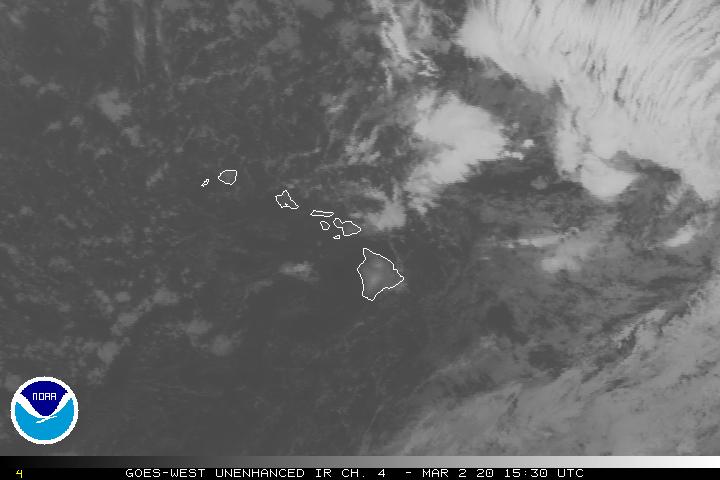
We can use the following links to see what’s going on in our area of the north central Pacific Ocean Thursday evening. Looking at this NOAA satellite picture we find low clouds generally offshore of the islands…although they are being carried over the islands too. At the same time we see considerable high cirrus clouds to our west and north, which continue to move eastward over the islands on the upper winds. We can use this looping satellite image to see those low clouds moving along in the trade wind flow. There are those high level clouds coming our way from the west, which will mute our daytime sunshine, and mask our moonlight at night too. Checking out this looping radar image we see some showers over the ocean, moving along in the trade wind flow, impacting the windward sides at times.
Sunset Commentary: The trade winds remain our major weather element, although the high surf along our leeward beaches have been giving our locally gusty winds a run for their money in this regard. A full bodied 1027 millibar high pressure system remains more or less parked to our north-northeast. This trade wind producing high pressure center will gradually be shifting eastward, and as it does…our local winds will slack-off slightly through the next 4-5 days. The small craft wind advisories, which we’ve in place around Maui County and the Big Island most of this week, have been dropped now…in anticipation of these slightly lighter trades.
In the rain department, there will continue to be those occasional showers. This will as usual, focus their efforts most effectively along our north and east facing windward coasts and slopes. Local radar shows that there have been a few showers sporting medium intensities, although these have remained offshore to the south of the islands. The rather extensive high cirrus clouds of late, continue to spread over the islands. These icy clouds don’t drop rain over our islands, or over the surrounding ocean either, although they certainly dim our sunshine during the days. The up side of this however is the possible colorful sunrise and sunset colors.
Looking into next week, after finishing off this week in a rather pleasant way, we find some possible changes around next Thursday. The GFS forecast model shows a cold front extending down into the subtropics to our northwest. Then, around the middle of next week a low pressure system forms along the tail-end of this frontal boundary. It’s still too early to know exactly what changes may result in our local weather then, although perhaps a week from today…we could see the possibility of some showers arriving around Friday into the weekend.
Here in Kihei, Maui at around 530pm HST Thursday evening skies continue to be mostly cloudy. Glancing at this satellite image, we can certainly see evidence of these long lasting icy cirrus clouds coming our way from the west. These high clouds provided muted sunshine today, as they filtered and dimmed those sun rays coming down through them. They can provide nice sunrise and sunset colors of course, so keep your eye out for those. There's no reason to think that these cirrus will be going away anytime soon…perhaps staying around into the weekend. ~~~ I'm just about to hop in my car for the 40 minute drive home to Kula. This is not a bumper to bumper run on the freeway by any means, and I actually enjoy the drive, glancing left and right at the West Maui Mountains, and the Haleakala Crater. I can see the ocean near Kihei, and over towards the north shore too, so its pleasant. I usually listen to National Public Radio during this drive, and I find that stimulating. As usual, as soon as I get home, I change clothes, and get right back on the road, only for a brisk walk rather than a drive. Then its dinner, talking on the phone a bit, and to bed for reading. I can usually only last 3-4 pages, before I'm nodding off. ~~~ I'll be back early in the morning with your next new weather narrative, I hope you have a great Thursday night until then! Aloha for now…Glenn.
Interesting: Unlikely looking aerobatics performed by fish have given researchers an insight into how aquatic animals evolved to live on land. Researchers discovered that at least six different types of fish are able to launch themselves into the air from a solid surface.
The team said this was an evolutionary snapshot of the transition from living in water to inhabiting land. They published their findings in the Journal of Experimental Zoology A.
Lead scientist Alice Gibb from Northern Arizona University was surprised to find that every species she tested was able to jump.
It suggests that, rather than a rare adaptation that evolved in a select few species, the ability to leap on land is common among bony fishes.
So many more of their ancient aquatic relatives might have invaded the land than had previously been thought. "In my mind, that opens up the fossil record to re-interpretation," Dr Gibb told BBC Nature.
The ancestors we share with fish The scientist and her team are interested the behaviour of living fish, because they are trying to build up a picture of how modern species evolved and how they are related.
An amphibious fish called the mangrove rivulus, which spends some of its time on land, inspired this study. "When we tried to move these fish in the lab [using nets], they would jump out of a net and back into the tank," she recalled.
This made Dr Gibb curious to see if the ability to take off was unique to species that had evolved to spend some of their time on land. She and her team studied six unrelated species of fish, placing them on a flat surface and filming them with a high-speed camera.
"Every one that we studied was able to jump," said Dr Gibb. One particularly intriguing discovery when they examined the footage was that mosquitofish (Gambusia affinis) and zebrafish (Danio rerio) used the same "tail flip" technique to perform their impressive leaps.
"The last common ancestor of the two species examined in this study lived about 150 million years ago," said Dr Gibb, "which implies that the behaviour is at least that old."
 Email Glenn James:

joe blow Says:
Glen just another morning with choking cane smoke here in Kihei~~~Hi Joe, I drove through that stuff coming to work this morning…yuck! Aloha, Glenn