











Air Temperatures – The following maximum temperatures were recorded across the state of Hawaii Tuesday:
Lihue, Kauai – 84
Honolulu airport, Oahu – 86 (record high for the date – 92 in 1995)
Kaneohe, Oahu – 82
Molokai airport – 83
Kahului airport, Maui – 86 (record high for the date – 95 in 1951)
Kona airport 85
Hilo airport, Hawaii – 83
Air Temperatures ranged between these warmest and coolest spots near sea level – and on the highest mountain tops…as of 5pm Tuesday evening:
Barking Sands, Kauai – 83
Princeville, Kauai – 77
Haleakala Crater – 48 (near 10,000 feet on Maui)
Mauna Kea Summit – 41 (over 13,500 feet on the Big Island)
Here are the 24-hour precipitation totals (inches) for each of the islands as of Tuesday evening:
0.52 Kilohana, Kauai
1.34 South Fork Kaukonahua, Oahu
0.15 Molokai
0.00 Lanai
0.07 Kahoolawe
0.75 Puu Kukui, Maui
0.49 Kamuela Upper, Big Island
Satellite and Radar Images: To view the cloud conditions we have here in Hawaii, please use the following satellite links, starting off with this Infrared Satellite Image of the islands to see all the clouds around during the day and night. This next image is one that gives close images of the islands only during the daytime hours, and is referred to as a Close-up visible image. Finally, here's a Looping IR satellite image, making viewable the clouds around the islands 24 hours a day. To help you keep track of where any showers may be around the islands, here’s the latest animated radar image.
Hawaii’s Mountains – Here’s a link to the live web cam on the summit of near 13,500 foot Mauna Kea on the Big Island of Hawaii. This web cam is available during the daylight hours here in the islands…and when there’s a big moon shining down during the night at times. Plus, during the nights you will be able to see stars, and the sunrise and sunset too…depending upon weather conditions. The Haleakala Crater webcam on Maui just came back online, after being on the blink for several weeks.
Tropical Cyclone activity in the eastern and central Pacific – Here’s the latest weather information coming out of the National Hurricane Center, covering the eastern north Pacific. You can find the latest tropical cyclone information for the central north Pacific (where Hawaii is located) by clicking on this link to the Central Pacific Hurricane Center. A satellite image, which shows the entire ocean area between Hawaii and the Mexican coast…can be found here. Here's a tropical cyclone tracking map for the eastern and central Pacific.
Aloha Paragraphs

Locally strong trade winds, high cirrus
clouds…large surf on our leeward
beaches…locally hazy
Our trade winds will be locally strong through Thursday, then mellow out a little Friday into the weekend. Glancing at this weather map, it shows a near 1027 millibar high pressure system to our north. Small craft wind advisories are active over those windiest coasts and channels in Maui County and the Big Island. These strong trade winds will last into Thursday, with a slight weakening Friday into the weekend.
Trade winds continue…the following numbers represent the strongest gusts (mph), along with directions Tuesday evening:
27 Port Allen, Kauai – NE
29 Honolulu, Oahu – NE
31 Molokai – NE
32 Kahoolawe – ESE
35 Kahului, Maui – NE
21 Lanai – NE
35 Upolu Point, Big Island – NE
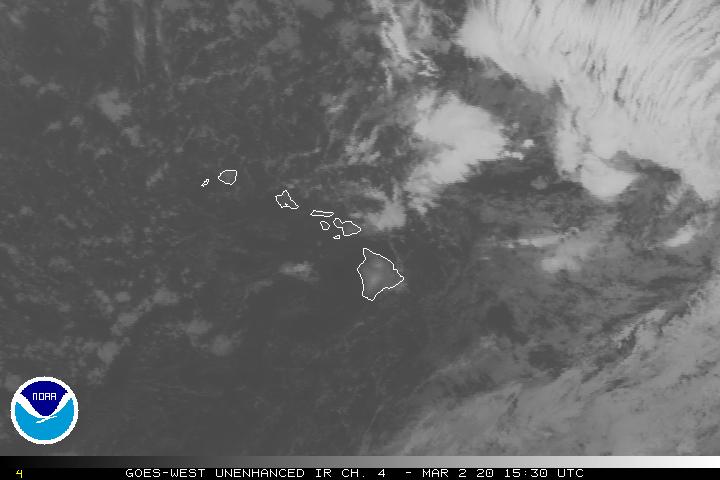
We can use the following links to see what’s going on in our area of the north central Pacific Ocean Tuesday evening. Looking at this NOAA satellite picture we find low clouds generally offshore of the islands…although they are being carried over the islands at times. At the same time we see lots of high cirrus clouds to our west and southwest, continuing to spread over the islands. We can use this looping satellite image to see those low clouds moving along in the trade wind flow. There are those thick high level clouds coming our way from the west and southwest too. Checking out this looping radar image we see some showers over the ocean, moving along in the trade wind flow, impacting the windward sides at times.
Sunset Commentary: The trade winds will hold steady in the rather strong and gusty realms through mid-week or Thursday. This is keeping our small craft wind advisory active over those windiest coastal and channel waters in Maui County and the Big Island. As the high pressure area now to our north, moves eastward through the week…our local trade winds will taper off gradually into the weekend.
Meanwhile, our island skies will remain cloudier than usual, with a combination of high cirrus clouds above, and lower level clouds being carried our way on the breezy trades. As the trade winds peak in strength over the next few days, they will continue to carry somewhat more showery clouds our way, generally arriving along the windward coasts and slopes. The leeward sides may eventually see a few showers being carried over that way on the locally strong and gusty trade winds too.
The weather related feature during this first half of the week, which will have the greatest impact…will be the larger than normal south swell along our leeward beaches. We have an active high surf advisory along those beaches…likely lasting through Wednesday. Large surf in respect to these south and west facing beaches, will necessitate caution for our local visitors and others too. At the same time, we’ll find wind swell waves kicked up by the trade winds on our east shores, and some waves from the north through northwest breaking along our north shores as well.
~~~ Here in Kihei, Maui at around 530pm HST Tuesday evening, skies were mostly cloudy, as they have been most of the day. Glancing at this satellite image, I can see lots of icy cirrus clouds are still being carried our way from the deeper tropics to our southwest. We should continue to have good sunrise and sunset colors for the next day or two, or as long as these high clouds remain over us. Looking out the window here in Kihei before I take the drive back upcountry to Kula, I see lots of haze out there! While I was out for lunch today as well, it was very hazy. Someone asked me where all this haze was coming from, and the only thing that I could think of was the salt spray from the large surf that is breaking along our leeward sides. In other words, I wasn't sure the source, although it sure looked like volcanic haze, or perhaps smoke from a fire someplace. ~~~ I'll be back very early Wednesday morning with your next new weather narrative, I hope you have a great Tuesday night until then! Aloha for now…Glenn.
Interesting: From deforestation to fertilizer; our taste for coffee has left some of the world’s most precious eco-systems in a precarious state. George Blacksell looks at how the coffee industry is cleaning up its act. The world’s second most tradable commodity after oil; coffee growing and processing has proven itself to be a lucrative industry.
The burgeoning coffee culture that sprang up over the last few decades has led to overwhelming success for handful of coffee franchises and a massive spike in supermarket sales. Of the high street coffee chains, Costa, Starbucks, Cafe Nero and Pret A Manger have cornered the lion’s share of the profits.
While no one is denying their right to make a buck, the big question is whether the profits these franchises are making are trickling down to the people actually growing the beans? And how green are they really? Is the high street coffee industry one we should buy into or should we be avoiding it altogether?
Traditionally, complexities within the supply chain have meant that the 100 million people growing coffee around the world have been excluded from the huge profit making potential of coffee. On average, third world coffee farmers receive a paltry 10 per cent of the eventual retail price.
As competition among growers – 70 per cent of whom are smallholders – has stiffened; a combination of price reductions and undercutting has left them exposed to the fluctuations of the volatile coffee market. Along with the negative effect this has had on living conditions, the drive for increased output has had a knock-on effect on the environment as well, with monocropping and sun grown coffee now the norm.
And given that most coffee growing regions are also home to some of the most delicate eco-systems on earth; the potential for serious damage is high.
 Email Glenn James:

Peter Says:
I live on 4th floor of multistory building overlooking Kam 1, Kihei- you continously talk of N or NE trades – however most of our winds over the ocan during daylight hours come from the South, today bringing an unusual thick vog to Lanai this evening – you could trace the line back Southward along the horizon. This Southern wind is with us most days but nothing on your weather maps indicate it – even the sailboat anchored off shore has it's bow pointed South – can you help me with an explanation, as the clouds on West Maui Mountains are always headed West. In pm most times there is a clear split on ocean surface of two wind/wave directions opposing each other- one from South and the other from the East along W.M.Mtns shoreline graduallly shifting to southerly. Am an 8 year follower – mahalo and aloa, Peter.~~~Hi Peter, the trade winds come around the back side of Maui, and then come in from the south…or they circle around after shooting through the Maalaea Bay. The big picture has the trade winds blowing from the east through northeast, although due to the topography of the islands, especially the Big Island and Maui, there are interruptions to the big picture trade wind flow. Aloha, Glenn
Tim Says:
A fire is more plausible, but I haven't heard of anything major yet. I can't help but to consider the geoengineering or chemtrails on days like today. I'm wondering if you have any insight or thoughts on that subject. Once again, thank you for your time! ~~~Hi Tim, thanks for your thoughts. As it turns out there was a big fire on the Big Island yesterday, which the trade winds may have carried over Maui County. As for chemtrails, I honestly don’t know, although when I look up and see cirrus, I don’t think to myself “look at those chemtrails”. Aloha, Glenn
Tim Says:
Aloha Glen,
First off, I'd like to say that I always appreciate and enjoy your diligent, informative daily weather reports!! Secondly, I'm curious as to your thoughts on the unexpected and unexplainable haze. I'd love to hear any deeper, further thoughts regarding this peculiar event!! No offense, but the sea spray theory is hard to accept:) Thanks Glen!~~~Hi Tim, I agree, the sea spray theory is pretty far fetched. As I was driving home I thought perhaps there’s a wild fire somewhere that I’m not aware of, as my eyes were burning slightly as I got up into Kula. Perhaps it is volcanic hazy, although with the trade winds blowing out of the northeast and ENE, that seems pretty unlikely too. Perhaps I’ll hear or think of something else, and will let you know if I do. Aloha, Glenn
Amanda Says:
Glen, when she would start expecting things to start feeling like Autumn? I know there's not a true Autumnal experience here, but there's always a cool period before the even cooler period. When should that kick in? It's October, and I'm just not feeling the fall weather yet. Do you think we'll have any cool weather for Thanksgiving? ~~~Hi Amanda, good question. I typically start seeing the light changing as the first sign of autumn here in the islands, which has been happening. The sunset and sunrise are earlier and later. The suns angle too is different now, which gives a slightly different feel to our days, at least for me. The next thing I’ll look for are more cold fronts trying to dig further into the tropics. This has already begun to happen a little, but granted not much yet. As far as cooler temperatures, that will happen more noticeably in November, with somewhat cooler days, and nights too. Hang in there, as without the yellow leaves falling, its much more subtle here in the tropics…although it will happen. Aloha, Glenn