Air Temperatures – The following maximum temperatures were recorded across the state of Hawaii Wednesday:
Lihue, Kauai – 86
Honolulu airport, Oahu – 89 (record for Wednesday – 91 in 1987)
Kaneohe, Oahu – 84
Molokai airport – 84
Kahului airport, Maui – 86
Kona airport 86
Hilo airport, Hawaii – 80
Air Temperatures ranged between these warmest and coolest spots near sea level – and on the highest mountain tops…as of 5pm Wednesday evening:
Honolulu, Oahu – 86
Hilo, Hawaii – 79
Haleakala Crater – 52 (near 10,000 feet on Maui)
Mauna Kea Summit – 41 (over 13,500 feet on the Big Island)
Here are the 24-hour precipitation totals (inches) for each of the islands as of Wednesday evening:
0.12 Mount Waialeale, Kauai
0.26 Waihee Pump, Oahu
0.14 Molokai
0.00 Lanai
0.00 Kahoolawe
0.56 Oheo Gulch, Maui
1.50 Piihonua, Big Island
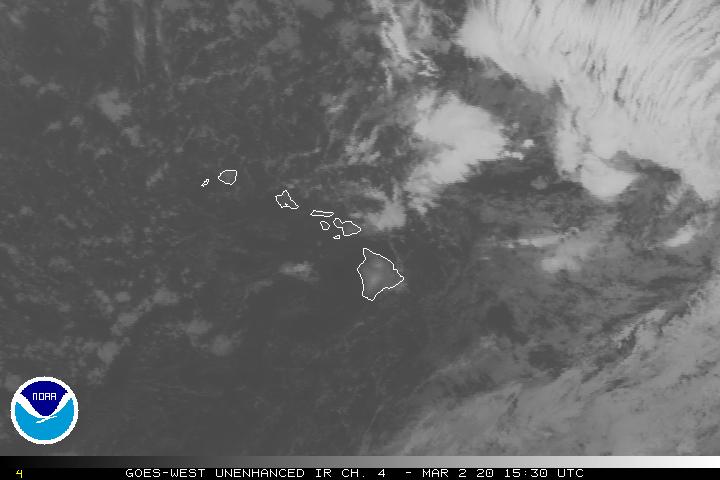
Satellite and Radar Images: To view the cloud conditions we have here in Hawaii, please use the following satellite links, starting off with this Infrared Satellite Image of the islands to see all the clouds around during the day and night. This next image is one that gives close images of the islands only during the daytime hours, and is referred to as a Close-up visible image. Finally, here's a Looping IR satellite image, making viewable the clouds around the islands 24 hours a day. To help you keep track of where any showers may be around the islands, here’s the latest animated radar image.
Hawaii’s Mountains – Here’s a link to the live web cam on the summit of near 13,500 foot Mauna Kea on the Big Island of Hawaii. This web cam is available during the daylight hours here in the islands…and when there’s a big moon shining down during the night at times. Plus, during the nights you will be able to see stars, and the sunrise and sunset too…depending upon weather conditions. The Haleakala Crater webcam on Maui just came back online, after being on the blink for several weeks.
Tropical Cyclone activity in the eastern and central Pacific – Here’s the latest weather information coming out of the National Hurricane Center, covering the eastern north Pacific. You can find the latest tropical cyclone information for the central north Pacific (where Hawaii is located) by clicking on this link to the Central Pacific Hurricane Center. A satellite image, which shows the entire ocean area between Hawaii and the Mexican coast…can be found here. Here's a tropical cyclone tracking map for the eastern and central Pacific.
Aloha Paragraphs

Light to moderate trade winds, strongest
near Maui County and the Big Island…high
cirrus clouds still spreading over the state,
showers…mostly along windward sides
Our trade winds will be light to locally moderate…then increasing a little later Thursday into the weekend. Glancing at this weather map, it shows a weak high pressure system to the east-northeast of the islands…with a ridge west to the north of Hawaii. At the same time, we have a weak cold front approaching Kauai from the north. Our local winds will remain light to moderately strong into the weekend, locally a bit stronger over Maui County and the Big Island.
Trade winds continue…the following numbers represent the strongest gusts (mph), along with directions Wednesday evening:
21 Port Allen, Kauai – ENE
23 Makua Range, Oahu – NE
15 Molokai – ENE
23 Kahoolawe – ESE
15 Lipoa, Maui – NE
24 Lanai – ENE
19 Kealakomo, Big Island – NE
We can use the following links to see what’s going on in our area of the north central Pacific Ocean Wednesday evening. Looking at this NOAA satellite picture we find scattered low clouds generally offshore of the islands, with a large area of high and middle level clouds around the state. We can use this looping satellite image to see the low clouds moving along in the low level trade wind flow. There's also this area of high and middle level clouds to the south and southeast, moving over the entire state now…although it will be locally patchy tonight. Checking out this looping radar image we see showers over the ocean, which are mostly falling over the ocean to the southwest.
Sunset Commentary: A fairly well established early fall trade wind weather pattern remains in place over the islands Wednesday night. High pressure to our northeast and northwest are keeping the light to moderately strong trade wind flow going. There are cold fronts and frontal remnants between these high pressure cells and ridges, and our islands…as shown on this latest weather map. These breezes will continue through the rest of this week, into early next week.
There's expected to be at least some shower activity along our windward sides, although nothing significant in the near term. We had some showers associated with a cold front on Kauai Monday into early Tuesday. Then overnight into this morning there’s been some showers coming up from the southeast, to the Big Island and on Maui some too. There’s a chance for more showers to arrive Friday evening into the weekend, when another remnant cold front gets carried our way on the trade winds.
Looking at the latest weather models, they don’t show anything of particular note. They show hurricane Hilary over in the eastern Pacific, diminishing in strength well away from our shores. At least some models show another tropical cyclone (which would be called Irwin if it was generated) forming offshore from Mexico at the beginning of October or so, and sticking pretty closely to the same track that Hilary took. As for weather (cold fronts and such) influencing us from the northwest through northeast, there doesn’t appear to be anything significant on tap for the time being either.
Here in Kihei, Maui at around 545pm HST Wednesday evening, skies were partly to mostly cloudy, much of which still consists of the high ice crystals, called cirrus clouds. Here's a satellite picture showing these clouds coming up from the deeper tropics to our south and southwest. These can produce nice colorful sunsets, and sunrises too, so you may want to keep an eye out. I'm ready to head back up to Kula now, and will catch up with you again early Thursday morning. I hope you have a great Wednesday night until then! Aloha for now…Glenn.
Interesting: The potato is a starchy, tuberous crop. The word potato may refer to the plant itself as well as the edible tuber. In the region of the Andes, there are some other closely related cultivated potato species. Potatoes were first introduced outside the Andes region four centuries ago, and have become an integral part of much of the world's cuisine.
It is the world's fourth-largest food crop, following rice, wheat, and maize. Long-term storage of potatoes requires specialized care in cold warehouses. The potato contains vitamins and minerals, as well as an assortment of phytochemicals, such as carotenoids and natural phenols.
A medium-size 5.3 oz potato with the skin provides 27 mg of vitamin C (45% of the Daily Value (DV)), 620 mg of potassium (18% of DV), 0.2 mg vitamin B6 (10% of DV) and trace amounts of thiamin, riboflavin, folate, niacin, magnesium, phosphorus, iron, and zinc. The fiber content of a potato with skin (2 g) is equivalent to that of many whole grain breads, pastas, and cereals.
In terms of nutrition, the potato is best known for its carbohydrate content (approximately 26 grams in a medium potato). The predominant form of this carbohydrate is starch. A small but significant portion of this starch is resistant to digestion by enzymes in the stomach and small intestine, and so reaches the large intestine essentially intact.
This resistant starch is considered to have similar physiological effects and health benefits as fiber: It provides bulk, offers protection against colon cancer, improves glucose tolerance and insulin sensitivity, lowers plasma cholesterol and triglyceride concentrations, increases satiety, and possibly even reduces fat storage.
"Potatoes deserve credit for contributing to higher diet quality and increasing vegetable consumption," said lead researcher Adam Drewnowski, PhD. "Potatoes also play an important role in providing affordable nutrition to Americans. You CAN afford to meet key dietary guidelines IF you include potatoes in your diet."
Further analyses of dietary intake showed that putting potatoes on the plate did improve overall diet quality. Individuals who consumed potatoes (baked, boiled and roasted) had higher intakes of potassium and vitamin C and consumed more total vegetables in a day compared to those who did not consume potatoes.
 Email Glenn James: