











Air Temperatures – The following maximum temperatures were recorded across the state of Hawaii Friday:
Lihue, Kauai – 85
Honolulu airport, Oahu – 89 (record for Friday – 93 in 1985)
Kaneohe, Oahu – 82
Molokai airport – 84
Kahului airport, Maui – 87
Kona airport 89
Hilo airport, Hawaii – 84
Air Temperatures ranged between these warmest and coolest spots near sea level – and on the highest mountain tops…as of 5pm Friday evening:
Barking Sands, Kauai – 84
Princeville, Kauai – 77
Haleakala Crater – 50 (near 10,000 feet on Maui)
Mauna Kea Summit – 43 (over 13,500 feet on the Big Island)
Here are the 24-hour precipitation totals (inches) for each of the islands as of Friday evening:
4.66 Mount Waialeale, Kauai
1.54 Honouliuli, Oahu
0.01 Molokai
0.00 Lanai
0.12 Kahoolawe
2.63 Oheo Gulch, Maui
2.44 Mountain View, Big Island
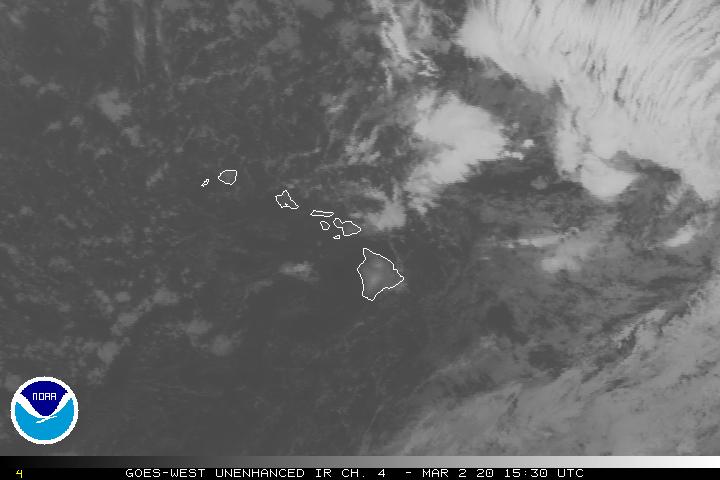
Satellite and Radar Images: To view the cloud conditions we have here in Hawaii, please use the following satellite links, starting off with this Infrared Satellite Image of the islands to see all the clouds around during the day and night. This next image is one that gives close images of the islands only during the daytime hours, and is referred to as a Close-up visible image. Finally, here's a Looping IR satellite image, making viewable the clouds around the islands 24 hours a day. To help you keep track of where any showers may be around the islands, here’s the latest animated radar image.
Hawaii’s Mountains – Here’s a link to the live web cam on the summit of near 13,500 foot Mauna Kea on the Big Island of Hawaii. This web cam is available during the daylight hours here in the islands…and when there’s a big moon shining down during the night at times. Plus, during the nights you will be able to see stars, and the sunrise and sunset too…depending upon weather conditions.
Tropical Cyclone activity in the eastern and central Pacific – Here’s the latest weather information coming out of the National Hurricane Center, covering the eastern north Pacific. You can find the latest tropical cyclone information for the central north Pacific (where Hawaii is located) by clicking on this link to the Central Pacific Hurricane Center. A satellite image, which shows the entire ocean area between Hawaii and the Mexican coast…can be found here. Here's a tropical cyclone tracking map for the eastern and central Pacific.
Aloha Paragraphs

Trade winds…passing windward showers
The trade winds will remain active this weekend…into the new week ahead. Glancing at this weather map, it shows two moderately strong 1028 millibar high pressure systems to the north of our islands. Our local trade winds will remain light to moderately strong during the weekend…locally somewhat more gusty.
Our trade winds will remain active…the following numbers represent the strongest gusts (mph), along with directions Friday evening:
31 Port Allen, Kauai – NE
24 Honolulu, Oahu – NE
24 Molokai – NE
29 Kahoolawe – ESE
29 Kahului, Maui – NE
20 Lanai – NE
27 Upolu Point, Big Island – NE
We can use the following links to see what’s going on in our area of the north central Pacific Ocean Friday evening. Looking at this NOAA satellite picture we find low clouds offshore to the east of the state as we push into the night…most notably to the east of Maui and the Big Island. We can use this looping satellite image to see the low clouds moving along in the trade wind flow, impacting our islands locally. At the same time we see an area of active thunderstorms far to our southeast…and far to our west. Additionally, there is an upper level low pressure system northwest of Kauai. Checking out this looping radar image we see showers around, most of which are falling over the ocean to our west through southwest…some of which are moderately heavy. There will be an increase in showers coming in from our east tonight into Saturday…especially on the Big Island and Maui.
Sunset Commentary: We find ourselves between two low pressure troughs, one to the west and the other to the east. The trough that came through the islands yesterday and last night, brought generous rainfall…at least locally. There were 2.00” to 4.50” + rainfall amounts in those wettest spots around the state…although with many areas having considering less than those high numbers. We're in the drier area between these low pressure areas now, thus the general lack of clouds and showers at the moment.
As we move into the night, and then through Saturday, the next trough to our east will move over and through the island chain. It appears that the associated clouds and showers with this trough will be less of an abundant rainfall producer. Nonetheless, it will bring more showers, generally over the windward and mountain areas. This area of clouds and showers look like they will have the most influence over the Big Island and Maui…at least initially. These two late summer showery periods were/will be beneficial moisture bearers to our relatively dry islands.
Meanwhile, the trade winds have remained rather subdued the last week or even two. This has been due to big early season storms in the Gulf of Alaska, and low pressure troughs in our own area. They finally picked up some today, now that the trough is moving out of our area to the west, and before the next trough moves in to take its place. Friday afternoon there were several gusts topping 30 mph, at least in those windiest areas around the state. As this weather map shows, we have two moderately strong high pressure systems generally to the north of the islands.
Glancing a bit further ahead, we should finally move back into a more normal trade wind weather pattern, Monday through at least the first half of the new work week. The winds may take a down turn later in the new week, as both the NOGAPS and GFS models show a cold front trying to dig southward, pushing our trade wind producing ridge of high pressure down closer to our islands. The fronts aren't expected to arrive, as its still a bit too early in the season for such an occurrence.
This evening I'm driving over to Kahului after work, to see a new film, this one called Contagion, starring Matt Damon and Marion Cotillard, Gwyneth Paltrow, Kate Winslet, Jude Law, Laurence Fishburne…among others. I was going to skip this film, due to the subject matter, which is a bit intimidating in my estimation. I talked with another film fan here at work today, and he convinced me that it was actually quite a good film. So, I decided to see it anyway, although reluctantly I must admit. The film that I'm really looking forward to seeing is called Driver, although I'm hesitant to go to a films opening night, due to the crowds. At any rate, back to Contagion, its about the worldwide medical community, which races to find a cure and to control the panic, when a lethal airborne virus becomes a global epidemic. The critics are giving this film a B grade, while the viewers have dropped it to a C+. This is a bit discouraging, although I'll take my chance. I'll be back Saturday morning with my assessment of this film as usual. Here's the trailer just in case you are curious, which is pretty intense, thus my hesitancy. On the other hand, I just checked the rotten tomatoes film review website, and they are giving it an 83% rating, which is high for them.
Here in Kihei, Maui at 615pm HST Friday evening, skies were clear to partly cloudy, with the trade winds still blowing. I'm heading out now, going to have some sort of dinner at Whole Foods, and then walk over to the theater. I'll catch up with you in the morning, with my next new narrative, and before I head out for my brisk early walk down in Keokea. I hope you have a great Friday night, from wherever you're reading. Aloha for now…Glenn.
Interesting: In the next 20 years, more than 590,000 square miles of land globally — more than twice the size of Texas — will be gobbled up by cities, a trend that shows no signs of stopping and one that could pose threats on several levels, says a Texas A&M University geographer who is part of a national team studying the problem. Burak Güneralp, a research assistant professor in the Department of Geography at Texas A&M, says urban areas are growing faster than urban populations and by 2030, urbanized land worldwide will grow by 590,000 square miles — more than twice the size of Texas, or about the size of Mongolia.
He is part of a team that includes three other researchers from Yale, Stanford and Arizona State and their work is published in the journal PLoS ONE. "This massive urbanization of land is happening worldwide, but India, China and Africa have experienced the highest rates of urban land expansion," Güneralp explains.
"Our study covered the 30 years from 1970 to 2000, and we found that urban growth is occurring at the highest rates in developing countries. However, it is the North America that experienced the largest increase in total urban land."
The United Nations predicts that by 2030 there will be an additional 1.47 billion people living in urban areas. Güneralp says, urban population growth is a significant driver of urban land change, especially in developing regions such in India and Africa.
However, economic growth is also important, particularly in China. He notes that coastal areas are especially vulnerable to urban expansion. "Where cities grow the most seem to be near coastal areas, and this is a very noticeable trend," Güneralp says.
"This makes coastal areas a special area of concern because people and infrastructures are at risk to rising sea levels, flooding, hurricanes, tsunamis and other disasters. All over the world, people like to live by the water, so it's a trend that will likely not change."
Güneralp adds that often urbanization occurs near lands that are environmentally sensitive and in some cases, protected by law. "This will challenge conservation strategies because future urban expansion is expected to be significant in total area extent and also as likely to occur near protected areas as in other regions," he says.
There is a flip side to the urbanization trend, Güneralp points out. "People who live in cities tend to have better access to health care, water and sanitation facilities, and cities are shown to be more efficient with regards to such things as energy consumption compared to rural areas," he notes.
"In cities, people exchange. They exchange ideas, experiences as well as materials. All these spur innovation and create business opportunities. Because of all these interactions, cities are the most likely places to come up with the solutions to the emerging environmental and economic challenges that we face."
 Email Glenn James:





Linda Fong Says:
Hi Glenn, I love your weather site. I have tried clicking on the Haleakala Crater link several times in the past (year +) and have always seen only a black window. Is it inoperative? Thanks, Linda Fong~~~ Hi Linda, very nice to hear that you enjoy my weather site so much, thanks for letting me know! As for the Haleakala Crater webcam, I keep hoping that it will come back online, although until then, I have disabled that link. I’ll keep checking to see when, and if it eventually comes back, and put the link back on my site then. Aloha, Glenn