Air Temperatures – The following maximum temperatures were recorded across the state of Hawaii Thursday:
Lihue, Kauai – 87 (record for Thursday – 89 in 1959)
Honolulu airport, Oahu – 86
Kaneohe, Oahu – 82
Molokai airport – 86
Kahului airport, Maui – 86
Kona airport 85
Hilo airport, Hawaii – 81
Air Temperatures ranged between these warmest and coolest spots near sea level – and on the highest mountain tops…as of 5pm Thursday evening:
Honolulu, Oahu – 84
Hilo, Hawaii – 73
Haleakala Crater – 48 (near 10,000 feet on Maui)
Mauna Kea Summit – 34 (over 13,500 feet on the Big Island)
Here are the 24-hour precipitation totals (inches) for each of the islands as of Thursday evening:
0.60 Kilohana, Kauai
1.92 Oahu Forest NWR, Oahu
0.01 Molokai
0.00 Lanai
0.00 Kahoolawe
0.24 West Wailuaiki, Maui
0.22 Waiakea Uka, Big Island
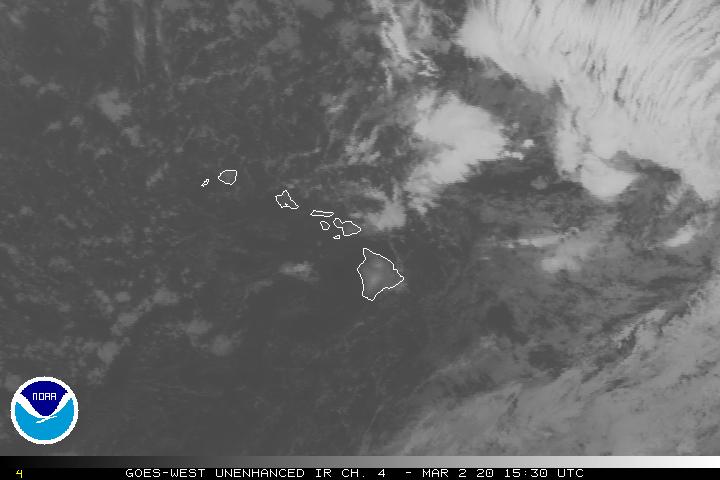
Satellite and Radar Images: To view the cloud conditions we have here in Hawaii, please use the following satellite links, starting off with this Infrared Satellite Image of the islands to see all the clouds around during the day and night. This next image is one that gives close images of the islands only during the daytime hours, and is referred to as a Close-up visible image. Finally, here's a Looping IR satellite image, making viewable the clouds around the islands 24 hours a day. To help you keep track of where any showers may be around the islands, here’s the latest animated radar image.
Hawaii’s Mountains – Here’s a link to the live web cam on the summit of near 13,500 foot Mauna Kea on the Big Island of Hawaii. The tallest peak on the island of Maui is the Haleakala Crater, which is near 10,000 feet in elevation. These two web cams are available during the daylight hours here in the islands…and when there’s a big moon shining down during the night at times. Plus, during the nights you will be able to see stars, and the sunrise and sunset too…depending upon weather conditions.
Tropical Cyclone activity in the eastern and central Pacific – Here’s the latest weather information coming out of the National Hurricane Center, covering the eastern north Pacific. You can find the latest tropical cyclone information for the central north Pacific (where Hawaii is located) by clicking on this link to the Central Pacific Hurricane Center. A satellite image, which shows the entire ocean area between Hawaii and the Mexican coast…can be found here. Here's a tropical cyclone tracking map for the eastern and central Pacific.
Aloha Paragraphs

Trade winds strengthening Friday –
Showers…some locally heavy tonight
The trade winds will increase some Friday into the weekend. Glancing at this weather map, it shows a near 1028 millibar high pressure system to the north of our islands. Our local trade winds will gradually increase Friday into the weekend.
Our trade winds will remain active…the following numbers represent the strongest gusts (mph), along with directions Thursday evening:
13 Barking Sands, Kauai – W
14 Kahuku, Oahu – NE
21 Molokai – NE
18 Kahoolawe – ESE
16 Kahului, Maui – NE
04 Lanai – NW
24 Upolu Point, Big Island – NE
We can use the following links to see what’s going on in our area of the north central Pacific Ocean Thursday evening. Looking at this NOAA satellite picture we find an increased amount of low clouds…mostly over the ocean not far offshore to the east and north of islands at the time of this writing. There are some high and middle level clouds to the south of the Big Island this too. We can use this looping satellite image to see the low clouds moving along in the trade wind flow, impacting our islands. Meanwhile, there are impressive thunderstorms well offshore to our west-southwest and southeast. Checking out this looping radar image we see showers around, most of which are falling over the ocean to our northeast…some of which are moderately heavy and bringing rain to the islands.
Sunset Commentary: A reflection of our shower prone atmosphere showed up over the island of Oahu this morning…where heavy rainfall fell locally. In response, the NWS forecast office in Honolulu issued a flood advisory, which lasted for several hours, into early afternoon. An area of low pressure has been moving by to the north and northwest of the state recently, part of which is responsible for supporting these localized downpours. The other islands have had a few showers, although nothing to compare with Oahu’s precipitation…at least thus far. There is a continued chance for locally heavy showers along our windward sides, and over other parts of the state locally tonight as well.
As we look at this looping radar image, we see more showers, some of which are moderately heavy at the time of this writing, located not too far to the northeast of the islands…and coming ashore now too. The bulk of these offshore showers are to the northeast of Oahu and Maui County…with a few moving by to the south of the Big Island as well. As this IR satellite image shows, those appear destined to impact our windward sides at times through the night.
It appears that just in the wake of this cloud band, there are clearer skies. This suggests that by later Friday our weather will return to a late summer norm. This of course consists of moderately strong trade winds, with off and on passing showers for the windward coasts and slopes. If there are no high level cirrus clouds around, the leeward beach areas will likely bask in sunshine during the days. The computer models still keep cold fronts and tropical cyclones out of our area of the central Pacific…through the rest of our late summer season.
Here in Kihei, Maui at 530pm HST Thursday evening, skies were partly cloudy, although with rainy looking clouds off in the distance, in most directions. The trade winds remain rather light, although should finally begin to accelerate later in the day Friday. I expect, as noted above, that showers will be present during the night…with some being rather generous in places. There's the chance that there could be some localized flooding, as there was earlier in the day on Oahu. The satellite above shows at least one towering cumulus cloud embedded in this cloud band, which often drop heavy rains. Looking out the window here in Kihei, before I head back upcountry to Kula, I can see some towering cumulus clouds in several directions on Maui. As I drove upcountry on the way home, I ran into some very heavy rain once I got near Kula. When I got home, I had to sit in my car for 10 minutes before a heavy shower finally let up enough for me to get into my house without getting soaked. Now some two plus hours later, it's still raining! ~~~ I'll be back early Friday morning with your next new weather narrative, I hope you have a great Thursday night until then! Aloha for now…Glenn.
Interesting: Humanity's relationship to fire — including wildfires, burning of fossil fuels, controlled burns, and human-caused fire — is the focus of a report by an international team of scientists. The team was organized by UC Santa Barbara's National Center for Ecological Analysis and Synthesis (NCEAS).
Fire, both friend and foe, is a controversial force in the world. The team of 18 researchers analyzed the history and possible future of our ever-changing relationship with fire in an article published in the Journal of Biogeography. The article is titled, "The Human Dimension of Fire Regimes on Earth."
"The value of this study is that it presents a critical assessment of the diversity of human uses of fire, from tamed landscape fire, to agricultural fire, to industrial fire," said Jennifer K. Balch, postdoctoral associate at NCEAS and second author on the paper. "Human use and misuse of fire has been so prevalent in our evolutionary history, and the evolution of cultures, that we've forgotten how dominant a force fire really is."
The research team noted that wildfires are often viewed as major disasters, and there is concern that climate change will increase their incidence. However, it is difficult to consider the true impact of past or future wildfires without understanding their place in natural and human history, about which much is unknown.
The researchers offer a historical framework to help other researchers, as well as managers, to develop a context for considering the relationships humans have with fire. This framework is key to planning for future fire risk and understanding the role of fire in natural ecosystems, according to David M. J. S. Bowman, lead author and professor at the School of Plant Science, University of Tasmania.
"There are often needless debates about whether or not fire has any place in flammable landscapes," Bowman said. "These debates are not helpful because of the intertwined relationships among humans, landscapes, and fire throughout human history, which blur any distinction between natural and human-set fires."
The researchers' analysis recognizes four fire phases:
* Natural fires that occur without human influence.
* Tame fire used by hunter-gatherers to manage landscapes for game and wild food production.
* Agricultural fire used to clear land, grow food, and burn fallow.
* Industrial fire to power modern societies that have switched from using living to fossilized plants as the primary fuel.
All these phases still occur today. The researchers explain that this remarkable diversity of human uses of fire, albeit imperfectly controlled, has powered all cultures. However, the problem is that the excessive combustion of fossil fuels is driving climate change. "Our fossil-fuel-dependent economy is yet another extension of our dependence on combustion," Balch said. "We have effectively put fire in a box." The result of massive dependence on this one use of fire may ultimately overwhelm human capacities to control landscape fire, given more extreme fire weather and more production of fuels, according to the researchers.
Considering Earth's fire history before human influence also offers great insights into the flammable planet we have inherited, according to the team. "Unraveling the nature of fire before any human influence is an important element of the current debate," said co-author Andrew C. Scott, professor in the Department of Earth Sciences, Royal Holloway, University of London. "Some only see fires in terms of human causation and impact. Understanding the ways that humans have and are altering natural wildfire systems has profound political and economic significance."
The research highlights the fact that understanding the relative influences of climate, human ignition sources, and cultural practices in particular environments is critical to the development of sustainable fire management to protect human health, property, ecosystems, and diminish greenhouse gas pollution. "Fire is such a defining feature of humans, and we are the only animals that use fire," Bowman said.
"We could have been called Homo igniteus as much as Homo sapiens." With future climate change all of us may have to confront wildfire — even if we do not do so now — so understanding human's relationship with fire will be important for all of us, according to Balch. "Companion with changing climate, human ignitions are also changing; therefore, it is imperative that we better understand the human relationship to fire," she said.
 Email Glenn James: