Air Temperatures – The following maximum temperatures were recorded across the state of Hawaii Thursday:
Lihue, Kauai – 85
Honolulu airport, Oahu – 88 (record for Thursday – 93 in 1995)
Kaneohe, Oahu – 82
Molokai airport – 85
Kahului airport, Maui – 87
Kona airport 85
Hilo airport, Hawaii – 80
Air Temperatures ranged between these warmest and coolest spots near sea level – and on the highest mountain tops…as of 5pm Thursday evening:
Honolulu, Oahu – 85
Hilo, Hawaii – 79
Haleakala Crater – 54 (near 10,000 feet on Maui)
Mauna Kea Summit – 43 (over 13,500 feet on the Big Island)
Here are the 24-hour precipitation totals (inches) for each of the islands as of Thursday evening:
0.62 Mount Waialeale, Kauai
0.26 Oahu Forest NWR, Oahu
0.09 Molokai
0.00 Lanai
0.01 Kahoolawe
0.27 Puu Kukui, Maui
0.53 Hilo airport, Big Island
Marine Winds – Here’s the latest (automatically updated) weather map showing a 1029 millibar high pressure system to the north of our islands. Our local trade winds will remain active through Saturday…strong and gusty.
Satellite and Radar Images: To view the cloud conditions we have here in Hawaii, please use the following satellite links, starting off with this Infrared Satellite Image of the islands to see all the clouds around during the day and night. This next image is one that gives close images of the islands only during the daytime hours, and is referred to as a Close-up visible image. Finally, here's a Looping IR satellite image, making viewable the clouds around the islands 24 hours a day. To help you keep track of where any showers may be around the islands, here’s the latest animated radar image.
Hawaii’s Mountains – Here’s a link to the live web cam on the summit of near 13,500 foot Mauna Kea on the Big Island of Hawaii. The tallest peak on the island of Maui is the Haleakala Crater, which is near 10,000 feet in elevation. These two web cams are available during the daylight hours here in the islands…and when there’s a big moon shining down during the night at times. Plus, during the nights you will be able to see stars, and the sunrise and sunset too…depending upon weather conditions.
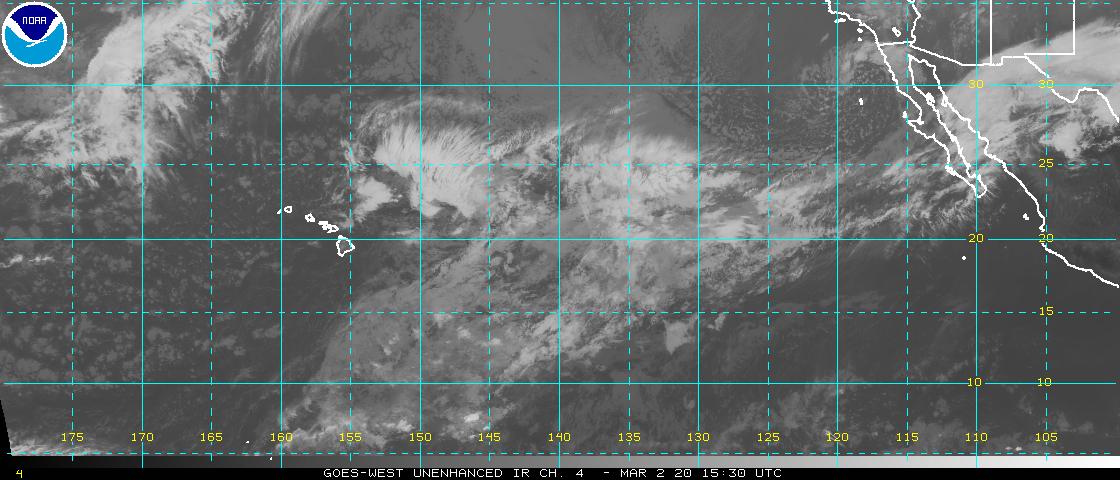
Tropical Cyclone activity in the eastern and central Pacific – Here’s the latest weather information coming out of the National Hurricane Center, covering the eastern north Pacific. You can find the latest tropical cyclone information for the central north Pacific (where Hawaii is located) by clicking on this link to the Central Pacific Hurricane Center. A satellite image, which shows the entire ocean area between Hawaii and the Mexican coast…can be found here. Here's a tropical cyclone tracking map for the eastern and central Pacific.
Aloha Paragraphs

Strong trades through the next couple of days
Kiteboarding
The trade winds will continue to blow through this weekend..gradually easing up some Sunday into next week. Glancing at this weather map, we find a 1029 millibar high pressure cell to the north of the islands Thursday night. This high pressure cell and its associated ridges will provide our trade winds over the islands well into the future. The computer models continue to suggest that our local winds will accelerate into Friday, and remain quite strong and gusty into the weekend. The current small craft wind advisories have been expanded to include all marine zones across the state.
Our trade winds will remain active…the following numbers represent the strongest gusts (mph), along with directions Thursday evening:
28 Port Allen, Kauai – ENE
28 Honolulu, Oahu – NE
31 Molokai – NE
39 Kahoolawe – ESE
35 Kahului, Maui – ENE
22 Lanai – NE
36 Kawaihae, Big Island – NE
We can use the following links to see what’s going on in our area of the north central Pacific Ocean Thursday night. Looking at this NOAA satellite picture we find lots of low level cumulus and stratocumulus clouds evident in all directions. We can use this looping satellite image to see lower level clouds being carried along in the low level wind flow. There are considerable high clouds coming up towards us from the south of the islands too. Checking out this looping radar image we see some showers being carried along in the wind flow…impacting the islands locally.
Sunset Commentary: The trade winds continue to blow across our tropical latitudes here in the north central Pacific. The responsible high pressure system to our north, will continue to spin-out these freshening breezes. Breezes may be the wrong word here, sounding too light…as they will become stronger over the next couple of days.
Small craft wind advisories cover all of our marine zones, both coastal and channel waters. This afternoon we found winds gusting up over 40 mph at Kawaihae on the Big Island…and almost that strong around the small island of Kahoolawe. The computer models are suggesting that our winds could strengthen enough, that the summit on Maui could find a wind advisory going into effect on Friday. There was even some talk from the NWS forecast office recently, that wind advisories could go up in a few of our windier coastal areas as well.
This windy episode will be our main focus in terms of weather through the rest of the week. Meanwhile, we have active tropical cyclones far to our west and east, although none of this wild action will influence our blustery islands. We could end up seeing a bit of surf arriving from far away typhoon Muifa in the western Pacific, which wouldn’t arrive along our western shores until this weekend. Otherwise, steady as we go, with gusty trade winds and those common showers along our windward coasts and slopes.
One note on the tropical cyclone to our east, called hurricane Eugene, it’s not expected to come anywhere near our fragile islands. The National Hurricane Center (NHC) is predicting it dissipating well over 1000 miles and more to our east…in the eastern Pacific. Here’s a satellite image of category 1 [coming down from a category 4 rating Wednesday]…put into motion here. Here’s a satellite picture showing the location of Eugene in relation to our Hawaiian Islands. Again, there’s nothing to concern ourselves with in terms of this gradually weakening hurricane. This tropical cyclone may generate a bit of easterly surf for our windward sides early next week.
Here in Kihei, Maui at around 530pm, skies are clear to partly cloudy, with not very much wind in the uplands of Kihei. I'm sure its windier right down on the coast, as it was earlier in the day. We may begin to see some of those high cirrus clouds coming up from the south soon, which will provide colorful sunset and sunrise colors. Otherwise, it was a good day, albeit it on the windy side, with some gusts topping 40 mph in those windiest locations. I expect even a bit more wind on Friday, so hold on to your hats. My internet connectivity was available at home in Kula this morning, and it may not be again on Friday. If that is the case, my next narrative will be a little later than usual, as it was this morning…as I had to drive down here to Kihei to prepare it. At any rate, life goes on, and so, I'll catch up with you in the morning one way or the other. I hope you have a great Thursday night until then! Aloha for now…Glenn.
Interesting: The mountainous region on the far side of the moon, known as the lunar farside highlands, may be the solid remains of a collision with a smaller companion moon, according to a new study by planetary scientists at the University of California, Santa Cruz. The striking differences between the near and far sides of the moon have been a longstanding puzzle. The near side is relatively low and flat, while the topography of the far side is high and mountainous, with a much thicker crust.
The new study, published in the August 4 issue of Nature, builds on the "giant impact" model for the origin of the moon, in which a Mars-sized object collided with Earth early in the history of the solar system and ejected debris that coalesced to form the moon.
The study suggests that this giant impact also created another, smaller body, initially sharing an orbit with the moon…that eventually fell back onto the moon and coated one side with an extra layer of solid crust tens of kilometers thick.
Interesting2: If this summer's record-breaking heat has you gulping iced tea while bemoaning the evils of climate change, you're probably not alone. But climate communications experts suggest that any extra interest in global warming triggered by the heat wave will be gone by the first winter snow.
July brought oppressive heat to much of the country, with all 50 states setting high temperature records. Climate scientists say that such heat waves will be the norm in the future if climate change continues unabated, but experts say it will take more summers as hot as this one to shift the climate change policy debate.
"It's record-setting temperatures, and people are thinking, 'This is global warming, maybe we should think about this,'" said Ye Li, a postdoctoral researcher at the Center for Decision Sciences at Columbia Business School, who has studied the influence of temperature on climate-change beliefs. "But will it have a long-term impact? Part of that depends on whether people remember these temperatures. I know every winter I'm not remembering what the hottest days of summer were like."
Weather versus climate
No one weather event, including this heat wave, can be attributed directly to climate change, since climate is the sum of weather over time. Rather, climate change loads the dice, making it more likely that with any roll, you'll come up with extreme weather, including heat waves and heavy precipitation.
This tendency toward weather extremes is why a warming planet can expect more heat waves in summer, and at the same time, heavy snowfalls in winter.
Heating up: public opinion
The inability to directly pin a single weather event on climate change makes it tough for scientists to communicate the realities of climate change. Public opinion is split on global warming, a split that tends to fall along party lines.
The Democrat-Republican divide has been growing in recent years. A 2008 Gallup analysis found that in 1998, just under half of both Democrats and Republicans said the effects of global warming had already begun. In 2008, 76 percent of Democrats agreed with that statement, while only 41 percent of Republicans did.
Media and social networks also influence people's opinions, said Anthony Leiserowitz, the director of the Yale Project on Climate Change Communication. News coverage is how most people learn about climate, so quantity and quality of coverage matters. Similarly, people's friends, family and colleagues may influence their beliefs.
But perhaps one of the most unexpected factors that influences people's opinions on climate change is what the weather looks like outside. Columbia's Li surveyed Americans and Australians and found that when it's hotter outside, people are more likely to be worried about global warming. When it's cooler, that worry dissipates.
"This temperature effect is actually quite large," Li said. "It's possible that if you give people enough hot days, it might even overcome a staunch Republican's belief against climate change."
Cherry-picked data
On the other hand, people tend to cherry-pick information based on their pre-existing beliefs about climate, Leiserowitz said. In May 2011, he and his colleagues released a report on people's assessments of global warming. They included questions about whether the winter's snowstorms and the previous summer's record-heat influenced people's beliefs about warming.
People who don't hold strong opinions about global warming tended to be swayed by the weather, Leiserowitz said. Snow made them doubt warming, while heat prompted them to accept it.
But the people at the extremes — the ones whose minds were made up either way — only gave credence to the weather event that fit their preferred narrative. About 77 percent of people who were dismissive of climate change said heat waves did not make them consider the idea that global warming might be real. Likewise, 53 percent of people who are highly alarmed about global warming said snowstorms did not soothe their minds.
Bigger snowstorms are an effect of global warming, and some of the alarmed group may have known this, Leiserowitz said. However, he said, other studies show that a significant portion of this group do not understand that climate change can result in more snow, so an informed population cannot explain the entire effect.
Getting the word out
Misinformation about climate change is rampant, said Edward Maibach, the director of the Center for Climate Change Communication at George Mason University in Virginia. Almost 6 out of 10 Americans don't know that the percent of climate scientists who are convinced that the climate is changing is in the high 90s. The myth that there is scientific disagreement on the topic "turns out to be a very important determinative factor in undermining people's belief that the climate is changing," Maibach said.
Exacerbating the issue is the fact that besides environmental groups, there is little public education on climate change, Maibach said. Unfortunately, he said, environmental groups are viewed with skepticism and not trusted.
This summer's temperatures are unlikely to change the equation, Maibach said.
"I don't think it's going to shift public opinion dramatically," he said.
Interesting3: Construction will soon go forward of Kingdom Tower, a giant skyscraper planned for the Saudi Arabian city of Jeddah. When complete, the sleek, kilometer-tall building will be the world's tallest.
An investment firm headed by Saudi Prince Alwaleed bin Talal will pay the Binladen Group, a construction firm, 4.6 billion riyals ($1.2 billion) to erect the tower over the next five years. Housing offices, a hotel, luxury condos and the world's highest observation tower, it will stand as the centerpiece of a 100-billion-riyal development planned for the area called "Kingdom City."
If it adheres to its construction timeline and does indeed reach unprecedented heights in 2016, the Kingdom Tower will continue a modern trend: Recently, the height record has changed hands every six years.
At 3,280 feet, Kingdom will dwarf the current tallest building in the world, Burj Khalifa in Dubai, United Arab Emirates, which stands at 2,717 ft. Burj Khalifa swiped the record in 2010 from Taipei 101 in Taipei, Taiwan. That 101-story skyscraper became the tallest in 2004, surpassing the Petronas Towers, dual skyscrapers in Kuala Lumpur, Malaysia, that overtook Chicago's Willis Tower in 1998.
The Willis Tower (formerly the Sears Tower) was the last building to hold the world record long enough to settle in and get comfortable — it was tallest for 25 years. It was also the last member of an American dynasty of reigning buildings, having overtaken the World Trade Center towers in New York City in 1973, which themselves overtook the Empire State Building in 1971. That structure held the record for 40 years, topping the Chrysler Building a few blocks away in 1931.
 Email Glenn James: