Air Temperatures – The following maximum temperatures were recorded across the state of Hawaii Tuesday:
Lihue, Kauai – 86
Honolulu airport, Oahu – 89 (record for Tuesday – 93 in 1984)
Kaneohe, Oahu – 82
Molokai airport – 86
Kahului airport, Maui – 88
Kona airport 85
Hilo airport, Hawaii – 84
Air Temperatures ranged between these warmest and coolest spots near sea level – and on the highest mountain tops…as of 5pm Tuesday evening:
Barking Sands, Kauai – 86
Kaneohe, Oahu – 80
Haleakala Crater – 48 (near 10,000 feet on Maui)
Mauna Kea Summit – 45 (over 13,500 feet on the Big Island)
Here are the 24-hour precipitation totals (inches) for each of the islands as of Tuesday afternoon:
0.95 Kilohana, Kauai
0.79 South Fork Kaukonahua, Oahu
0.01 Molokai
0.00 Lanai
0.05 Kahoolawe
0.85 West Wailuaiki, Maui
0.17 Waiakea Uka, Big Island
Marine Winds – Here’s the latest (automatically updated) weather map showing a near 1034 millibar high pressure system far to the north-northeast of our islands. Our local trade winds will remain moderately strong through Thursday…strongest around Maui and the Big Island.
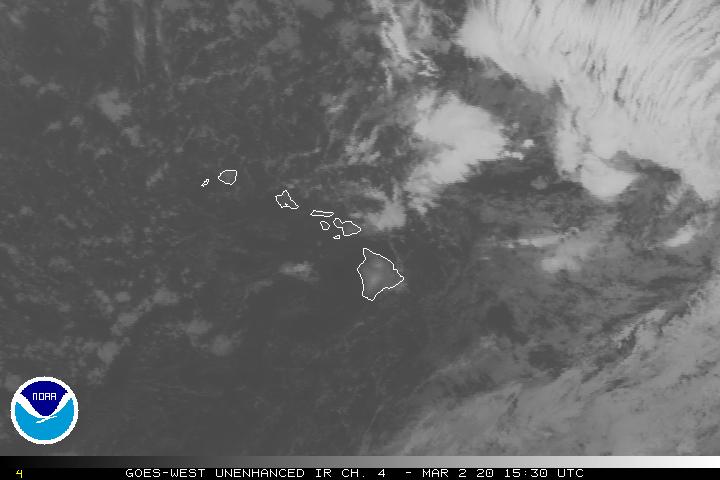
Satellite and Radar Images: To view the cloud conditions we have here in Hawaii, please use the following satellite links, starting off with this Infrared Satellite Image of the islands to see all the clouds around during the day and night. This next image is one that gives close images of the islands only during the daytime hours, and is referred to as a Close-up visible image. Finally, here's a Looping IR satellite image, making viewable the clouds around the islands 24 hours a day. To help you keep track of where any showers may be around the islands, here’s the latest animated radar image.
Hawaii’s Mountains – Here’s a link to the live web cam on the summit of near 13,500 foot Mauna Kea on the Big Island of Hawaii. The tallest peak on the island of Maui is the Haleakala Crater, which is near 10,000 feet in elevation. These two web cams are available during the daylight hours here in the islands…and when there’s a big moon shining down during the night at times. Plus, during the nights you will be able to see stars, and the sunrise and sunset too…depending upon weather conditions.
Tropical Cyclone activity in the eastern and central Pacific – Here’s the latest weather information coming out of the National Hurricane Center, covering the eastern north Pacific. You can find the latest tropical cyclone information for the central north Pacific (where Hawaii is located) by clicking on this link to the Central Pacific Hurricane Center. A satellite image, which shows the entire ocean area between Hawaii and the Mexican coast…can be found here. Here's a tropical cyclone tracking map for the eastern and central Pacific.
Aloha Paragraphs

Trade wind weather pattern continues
Large surf south and west shores…be very careful!
The trade winds will continue, moderately strong…locally stronger around Maui County and the Big Island. Glancing at this weather map, we find a near 1034 millibar high pressure system far to the north-northeast of our islands. Our local trade winds will remain moderately strong…strongest around Maui County and the Big Island. The latest computer forecast models suggest that our trade winds may falter to some extent later this weekend into early next week.
Our trade winds will remain active…the following numbers represent the strongest gusts (mph), along with directions Tuesday evening:
13 Lihue, Kauai – NE
25 Honolulu, Oahu – NE
21 Molokai – NE
28 Kahoolawe – ESE
31 Kahului, Maui – NE
09 Lanai
25 Upolu Point, Big Island – NE
We can use the following links to see what’s going on in our area of the north central Pacific Ocean Tuesday night. Looking at this NOAA satellite picture we find just a few low level clouds in some directions, mostly over the ocean to our southwest and east. There are a few small towering cumulus clouds well offshore to the north of Kauai and Oahu. We can use this looping satellite image to see lower level clouds moving into the state from the east. There are areas of thunderstorms over the ocean, far to the southeast and southwest…and high cirrus to the west and northwest of the islands. Checking out this looping radar image we see that there are a few showers around, some of which are moderately heavy over the ocean to the west of Kauai and Niihau.
Sunset Commentary: The primary focus today has been the hazardous high surf conditions, which have triggered an unusual high surf warning along our south shores. This much larger than normal south swell will keep our leeward beaches deep in surf into Thursday, gradually lowering in size thereafter. The timing of this late summer swell coincides with some of the highest tides of the month here in the islands. This in turn poses some concern about coastal flooding on some of the islands. Waves have been hitting 20 feet (wave faces) along few best aligned local beaches, which will cause beach erosion, and be dangerous to our local visitors…who are not used to this kind of thing. Actually, our local residents aren’t used to this either…although some folks in the local surfing community are likely thrilled!
Other than that big stuff in our marine environment, nothing else is of comparable concern. There is an upper level low pressure system moving by to our north, although it seems to be having a minimum amount of influence, at least as of early this evening. The associated cold air aloft could enhance whatever showers that are around through tonight however. This threat of locally generous showers is fairly minor. This IR satellite image does show somewhat taller clouds over the ocean, to the west of Kauai and Niihau. Local radar images do show a few light to moderately heavy showers falling out that way at the time of this writing.
The trade winds are minding their manners, although still a little gusty over Maui County and the Big Island…as usual. These more or less moderately strong trade winds will keep up their work, of offering relief from the summer heat during our days. The computer models suggest however that they could falter to some extent later this weekend, into early next week. It’s interesting to see the season’s first cold front being pushed down relatively close to the north of our islands early next week as well. It would be extremely unusual to see a cold front bringing any kind of moisture our way during the summer, even the late summer. If it were October, I might be more excited about such a frontal approach.
Here in Kihei, Maui at 530pm HST Tuesday evening, skies were partly cloudy in general. As noted above, our trade winds will continue through Friday, before slipping a notch or two this weekend, into early next week. The upper level low pressure system moving by to our north, hasn't sparked all that many extra showers. We may still find a few showers around that will be heavier than usual tonight, although not as many as I had previously thought might occur. Finally, the waves will be dangerously high along our leeward beaches into Thursday. This includes both the south and west facing beaches. Please be extra careful when going to our local leeward beaches Wednesday, or stay out of the water completely, that is if the waves look too large to you! I'll be back early Wednesday morning with your next new weather narrative, at around 530pm HST. I hope you have a great Tuesday night until then! Aloha for now…Glenn.
Interesting: Preserving just 4 percent of the ocean could protect crucial habitat for the vast majority of marine mammal species, from sea otters to blue whales, according to researchers at Stanford University and the National Autonomous University of Mexico. Their findings were published in the Aug. 16 edition of the Proceedings of the National Academy of Sciences.
Of the 129 species of marine mammals on Earth, including seals, dolphins and polar bears, approximately one-quarter are facing extinction, the study said.
"It's important to protect marine mammals if you want to keep the ocean's ecosystems functional," said study co-author Paul Ehrlich, professor of biology and senior fellow at the Woods Institute for the Environment at Stanford. "Many of them are top predators and have impacts all the way through the ecosystem. And they're also beautiful and interesting."
Mapping marine mammals
To pinpoint areas of the ocean where conservation could protect the maximum number of species and the ones most vulnerable to extinction, the researchers overlaid maps of where each marine mammal species is found. Their composite map revealed locations with the highest "species richness" — the highest number of different species.
"This is the first time that the global distribution of marine mammal richness has been compiled and presented as a map," said co-authors Sandra Pompa and Gerardo Ceballos of the National Autonomous University of Mexico. "The most surprising and interesting result was that all of the species can be represented in only 20 critical conservation locations that cover at least 10 percent of the species' geographic range."
The researchers identified the 20 conservation sites based on three main criteria: how many species were present, how severe the risk of extinction was for each species and whether any of the species were unique to the area. The scientists also considered habitats of special importance to marine mammals, such as breeding grounds and migration routes.
 Email Glenn James: