Air Temperatures – The following maximum temperatures were recorded across the state of Hawaii Wednesday:
Lihue, Kauai – 86
Honolulu airport, Oahu – 87 (record for Wednesday – 91 in 1987, 1994, 1996)
Kaneohe, Oahu – 83
Molokai airport – 84
Kahului airport, Maui – 87 (record for Wednesday – 93 in 1953, 1976, 2004)
Kona airport 87
Hilo airport, Hawaii – 84
Air Temperatures ranged between these warmest and coolest spots near sea level – and on the highest mountain tops…as of 5pm Wednesday evening:
Barking Sands, Kauai – 85
Hilo, Hawaii – 79
Haleakala Crater – 55 (near 10,000 feet on Maui)
Mauna Kea Summit – 46 (over 13,500 feet on the Big Island)
Here are the 24-hour precipitation totals (inches) for each of the islands as of Wednesday evening:
0.15 Mount Waialeale, Kauai
0.57 Manoa Valley, Oahu
0.04 Molokai
0.00 Lanai
0.00 Kahoolawe
0.88 West Wailuaiki, Maui
1.03 Pahoa, Big Island
Marine Winds – Here’s the latest (automatically updated) weather map showing a 1025 millibar high pressure system to the north of our islands. Our local trade winds will remain active through Friday.
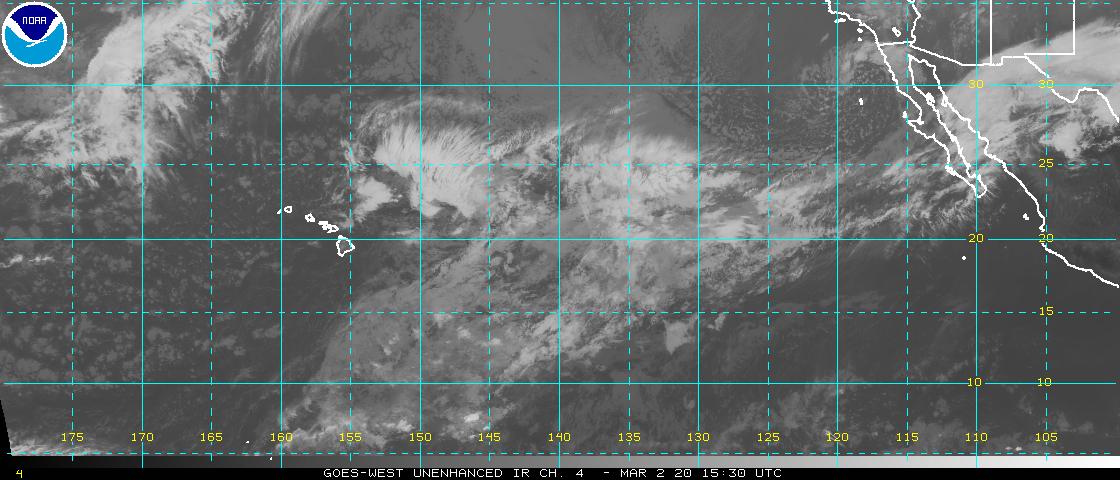
Satellite and Radar Images: To view the cloud conditions we have here in Hawaii, please use the following satellite links, starting off with this Infrared Satellite Image of the islands to see all the clouds around during the day and night. This next image is one that gives close images of the islands only during the daytime hours, and is referred to as a Close-up visible image. Finally, here's a Looping IR satellite image, making viewable the clouds around the islands 24 hours a day. To help you keep track of where any showers may be around the islands, here’s the latest animated radar image.
Hawaii’s Mountains – Here’s a link to the live web cam on the summit of near 13,500 foot Mauna Kea on the Big Island of Hawaii. The tallest peak on the island of Maui is the Haleakala Crater, which is near 10,000 feet in elevation. These two web cams are available during the daylight hours here in the islands…and when there’s a big moon shining down during the night at times. Plus, during the nights you will be able to see stars, and the sunrise and sunset too…depending upon weather conditions.
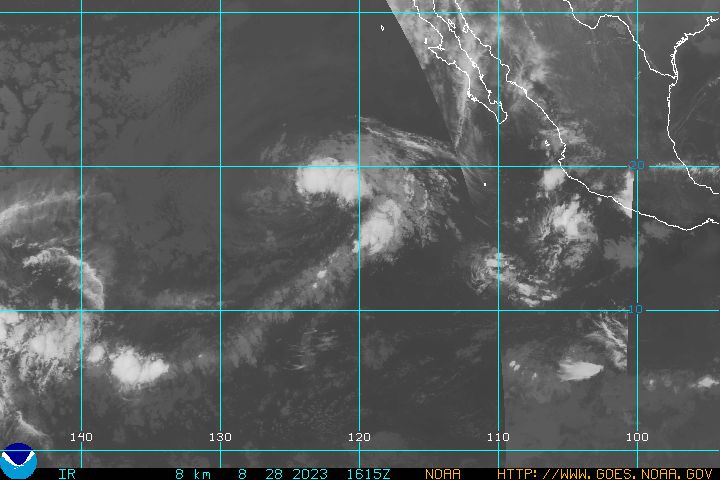
Tropical Cyclone activity in the eastern and central Pacific – Here’s the latest weather information coming out of the National Hurricane Center, covering the eastern north Pacific. You can find the latest tropical cyclone information for the central north Pacific (where Hawaii is located) by clicking on this link to the Central Pacific Hurricane Center. A satellite image, which shows the entire ocean area between Hawaii and the Mexican coast…can be found here. Here's a tropical cyclone tracking map for the eastern and central Pacific.
Aloha Paragraphs

The wonderful beauty of Kauai
Artist Credit: Pierre Bouret
The trade winds will continue, moderate to locally strong and gusty…somewhat lighter starting Friday. Glancing at this weather map, we find a moderately strong 1025 millibar high pressure system to the north of the islands. This high pressure area and its associated ridge will provide steady trade winds…locally stronger and gusty. The small craft wind advisory continues in those windiest coasts and channels around Maui County and the Big Island.
Our trade winds will remain active…the following numbers represent the strongest gusts (mph), along with directions Wednesday evening:
37 Port Allen, Kauai – NE
27 Honolulu, Oahu – NE
27 Molokai – NE
31 Kahoolawe – NE
30 Kahului – NE
22 Lanai – NE
30 South Point, Big Island – NE
We can use the following links to see what’s going on in our area of the north central Pacific Ocean Wednesday night. Looking at this NOAA satellite picture we find only scattered low level clouds being carried through the islands…along with a small area of high clouds just to the southwest of the leeward sides, moving northeast. We can use this looping satellite image to see more lower level clouds approaching from the east. We can also find tropical storm Fernanda spinning westward far to the east-southeast of Hawaii. Checking out this looping radar image we see just a few showers falling locally, some of which are being carried over the windward sides in places…on the trade wind flow
Sunset Commentary: The Hawaiian Islands continues in a well-established summer trade wind weather pattern. High pressure to the north, with low pressure to our south, is the driving force for our moderately strong trades. These will continue through Friday in this more or less same wind speed category. As we move into the weekend, the computer models suggest they may lose their edge a little, coming down a notch into next week. The small craft wind advisories remain in force across those windiest coasts and channels around Maui County and the Big Island.
As is very common while the trade wind flow is present, the most notable showers are brought our way during the night and early morning hours. The atmosphere over and around the islands remains quite dry and stable, which in turn will limit our showers somewhat. They will still be around, although will fall generally in the light category…with just a few exceptions here and there. We might see a modest increase in showers right after the weekend, as the northern fringe of what will be dissipated tropical cyclone Fernanda, moves by to the south of the state…perhaps clipping the Big Island and Maui.
Speaking of Fernanda, she is active in the far western side of the eastern Pacific. This track map from the NHC shows the location. This tropical system will cross over into our area of the Pacific tonight. Here’s a satellite image showing Fernanda in relation to the Hawaiian Islands. Here’s the same picture only with the looping feature on. By the way, despite its current appearance, Fernanda will run its course before posing a threat to our islands. The best results would be for this then retired system to bring the southern part of the island chain some moisture…time will tell.
Then, well to the east-northeast of Fernanda, we have tropical storm Greg, which will become an even stronger storm, a hurricane in fact. It will remain far away from our islands…staying safely in the eastern Pacific, like we like them to do! Here’s the latest NHC graphical track map for Greg. Here’s the latest NOAA satellite picture of Greg, up close to the Mexican coast. Here’s the computer forecast models for Greg, showing it comfortably far east of our area.
Here in Kihei, Maui at near 530pm HST Wednesday evening, skies were mostly clear, with a few clouds here and there. As was the case the trade winds are blowing quite a bit, and especially down near the coast as usual. The strongest gust that I saw today was just under 40 mph on the small island of Kahoolawe. Right now though, I'm going to jump in my car for the drive back upcountry to Kula. Then, as soon as I can change clothes, and put my walking shoes on, you know what I'll be doing shortly thereafter. I'll meet you back here early Thursday morning, at which point I'll have all sorts of new weather stuff ready for your reading pleasure, at least I hope it will be pleasurable! Aloha for now…Glenn.
Interesting:The distribution of Atlantic mackerel is shifting north, east and into shallower waters in response to warming ocean temperatures and changing oceanographic and other environmental changes, a finding that may have significant implications for U.S. commercial and recreational mackerel fisheries, according to research from NOAA marine scientists. Sensitive to changes in water temperature, Atlantic mackerel migrate long distances to feed and breed. Found in Atlantic waters from Cape Hatteras in the south to Newfoundland in the north, they play a central role in the marine food web, feeding primarily on small crustaceans and plankton while being preyed upon by a wide variety of species.
The overwintering population of the species' Northwest Atlantic stock has shifted from deeper waters off the continental shelf to shallower waters on the shelf where there is now a greater area in their preferred temperature range. In all, this population has shifted some 155 miles north and about 30 miles east between 1968-2008, according to researchers from NOAA's Northeast Fisheries Science Center (NEFSC).
"Our findings suggest that both the commercial and recreational Atlantic mackerel fisheries in the United States will probably be faced with more variable resource conditions in the future in terms of the winter distribution of the stock," study co-author Jon Hare said. "The continental shelf is warming, increasing the area over which the stock can be distributed, while at the same time the distribution of the stock is shifting northward."
There's plenty of Atlantic mackerel about at present to satisfy commercial and recreational fisheries, but the shift in population distribution is likely to make it more difficult to find and catch Atlantic mackerel during the traditional late winter-early spring season, according to the researchers, whose study is published online in the American Fisheries Society journal, "Marine and Coastal Fisheries: Dynamics, Management and Ecosystem Science."
 Email Glenn James: