Air Temperatures – The following maximum temperatures were recorded across the state of Hawaii Monday:
Lihue, Kauai – 82
Honolulu airport, Oahu – 86
Kaneohe, Oahu – 80
Molokai airport – 83
Kahului airport, Maui – 87 (record for Monday – 93 in 1981)
Kona airport 83
Hilo airport, Hawaii – 78
Air Temperatures ranged between these warmest and coolest spots near sea level – and on the highest mountain tops…as of 5pm Monday evening:
Barking Sands, Kauai – 84
Hilo, Hawaii – 73
Haleakala Crater – 46 (near 10,000 feet on Maui)
Mauna Kea Summit – 45 (over 13,500 feet on the Big Island)
Here are the 24-hour precipitation totals (inches) for each of the islands as of Monday evening:
0.48 Mount Waialeale, Kauai
0.65 Oahu Forest NWR, Oahu
0.03 Molokai
0.00 Lanai
0.00 Kahoolawe
0.36 Puu Kukui, Maui
2.65 Waiakea Uka, Big Island
Marine Winds – Here’s the latest (automatically updated) weather map showing a 1030 millibar high pressure system to the north-northwest of our islands. Our local trade winds will remain active Tuesday and Wednesday…although becoming slightly lighter.
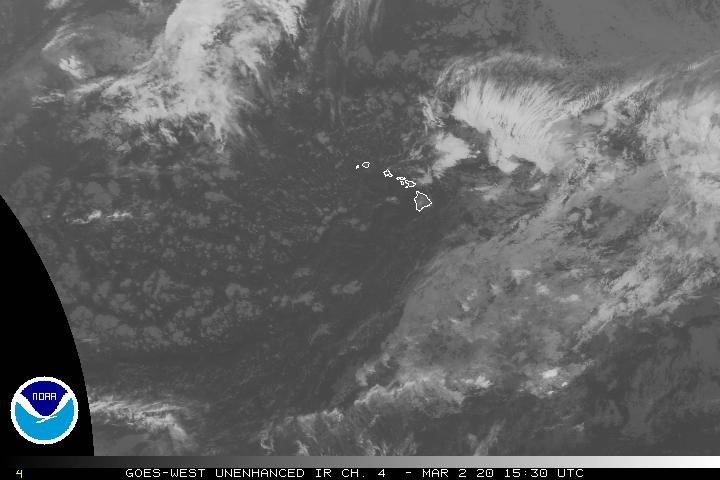
Satellite and Radar Images: To view the cloud conditions we have here in Hawaii, please use the following satellite links, starting off with this Infrared Satellite Image of the islands to see all the clouds around during the day and night. This next image is one that gives close images of the islands only during the daytime hours, and is referred to as a Close-up visible image. Finally, here's a Looping IR satellite image, making viewable the clouds around the islands 24 hours a day. To help you keep track of where any showers may be around the islands, here’s the latest animated radar image.
Hawaii’s Mountains – Here’s a link to the live web cam on the summit of near 13,500 foot Mauna Kea on the Big Island of Hawaii. The tallest peak on the island of Maui is the Haleakala Crater, which is near 10,000 feet in elevation. These two web cams are available during the daylight hours here in the islands…and when there’s a big moon shining down during the night at times. Plus, during the nights you will be able to see stars, and the sunrise and sunset too…depending upon weather conditions.
Tropical Cyclone activity in the eastern and central Pacific – Here’s the latest weather information coming out of the National Hurricane Center, covering the eastern north Pacific. You can find the latest tropical cyclone information for the central north Pacific (where Hawaii is located) by clicking on this link to the Central Pacific Hurricane Center. A satellite image, which shows the entire ocean area between Hawaii and the Mexican coast…can be found here. Here's a tropical cyclone tracking map for the eastern and central Pacific.
Aloha Paragraphs

Trade winds…windward showers
The trade winds will remain active Monday, then easing up some later Tuesday into Wednesday…through the remainder of the week. Glancing at this weather map, we find our primary high pressure system weighing-in at 1030 millibars…located to our north-northwest. The placement of this area of high pressure, and its associated ridges, will keep our trade winds blowing. We have small craft wind advisories pared back to just those windiest areas around Maui County and the Big Island. We should see this advisory being dropping by mid-week…and remain inactive through the rest of the week.
Our trade winds will remain active…the following numbers represent the strongest gusts, along with directions Monday evening:
30 Port Allen, Kauai – NE
29 Honolulu, Oahu – NE
31 Molokai – NE
31 Kahoolawe – NE
36 Kahului, Maui – ENE
20 Lanai – NE
32 South Point, Big Island – NE
We can use the following links to see what’s going on in our area of the north central Pacific Ocean Monday night. Looking at this NOAA satellite picture we find lower level clouds to the east and northeast of the Hawaiian Islands. At the same time we find high cirrus clouds moving through the island chain….just over the Big Island at the time of this writing. We can use this looping satellite image to see low clouds being carried towards our windward sides by the trade winds. The upper level low pressure system, continues to be present to our northwest. We find an area of high cirrus clouds stretching into the state from the west…coming and going. Checking out this looping radar image we see a few showers being carried along in the trade wind flow, especially across the windward sides.
Sunset Commentary: Despite the arrival, or expected arrival of colder air aloft, associated with an area of low pressure aloft over the state, we haven’t seen too much direct influence on our localized rainfall pattern…at least not yet. The forecast calls for this low to enhance showers through Tuesday. Looking at this latest satellite image, we don’t even see all that many lower level clouds in our area. The Big Island perhaps has the best chance of seeing somewhat more than normal amounts of precipitation falling. There are some high level cirrus that continues to stream overhead periodically…most of which is over the Big Island at the time of this writing. Putting this satellite picture into motion however, shows that the other islands may eventually see some more of these icy clouds streaking overhead with time. It’s been quite interesting, that this streak of rather narrow cirrus has been sticking close to the islands for the last 2-3 days.
Otherwise, weather conditions look pretty normal for this time of year. The models continue to suggest that whatever extra moisture we might get through Tuesday…will fade away Wednesday through the rest of the week. What few showers that are able to fall, will occur along our windward coasts and slopes. The fact that the trade winds will be lighter during the second half of the week suggests that we’ll see a few of those windward biased showers…along with a few light afternoon upcountry showers along the leeward sides of Maui and the Big Island too. In sum: summer is here, without even the most remote sign of a tropical cyclone anywhere here in the Pacific Ocean…at the moment that is.
At around 530pm Monday evening here in Kihei, Maui, the weather looks exceptionally nice! Skies are clear to partly cloudy, with lots of warm sunshine still streaming down from above. The high clouds are now down near the Big Island, although folks here on Maui may be able to see it light up nicely around sunset…if its not too far south. It still looks like this week will be very nice, leading right on into a three day holiday weekend, yes! I'll be back early Tuesday morning with your next new weather narrative from paradise, I hope you have a great Monday night until then! Aloha for now…Glenn.
Interesting: After being hunted to local extinction more than a century ago and unable to remember their ancestral calving grounds, the southern right whales of mainland New Zealand are coming home. A new study published today has shown for the first time that whales from a small surviving population around remote, sub-Antarctic islands have found their way back to the New Zealand mainland.
Before the onslaught of 19th century whaling, historical records suggest that up to 30,000 of these impressive whales once migrated each winter to New Zealand's many sandy, well-protected bays to give birth and raise their calves. As a particularly social and acrobatic species, they could be seen from shore as they frolicked, slapped their tails and breached almost entirely out of the water.
And now they're coming back, according to researchers from Oregon State University, the University of Auckland and other institutions. The findings were just published in Marine Ecology Progress Series. "We used DNA profiling to confirm that seven whales are now migrating between the sub-Antarctic islands and mainland New Zealand," said Scott Baker, associate director of the Marine Mammal Institute at OSU who initiated a study of these whales in 1995.
"These are probably just the first pioneers," Baker said. "The protected bays of New Zealand are excellent breeding grounds, and I suspect that we may soon see a pulse of new whales following the pioneers, to colonize their former habitat." Because of their playful behavior and inclination to swim close to shore, Baker said, southern right whales have become a major tourist attraction in Argentina and South Africa, where their population has increased more rapidly.
The right whales — three species are now recognized— earned their names from the dubious distinction of being the "right" species to kill. They could be hunted from small boats launched from shore, they couldn't flee rapidly from approaching boats, and they floated when killed because of their large stores of blubber. The same characteristics that made them an ecological marvel also caused them to be sought by hunters.
A large baleen whale, adult right whales can reach up to 60 feet in length and weigh up to 100 tons. Even calves weigh a ton, and right whales are thought to live for 70 years or more. Hunting of right whales peaked in New Zealand and Australia in the 1830s and 1840s, the researchers noted in their report, and small remaining populations were further depleted by illegal harvest by the Soviet Union in the early 1960s.
None were seen around mainland New Zealand for decades of the 20th century. A small population of this species survived, however, near the Auckland and Campbell Islands south of New Zealand in sub-Antarctic waters. But right whales have a strong "maternal fidelity" in which migration and calving grounds are passed along from mother to calf. Mainland New Zealand had once been a favored breeding ground, but once the last individuals there were killed, they didn't come back.
"This maternal fidelity contributed to the vulnerability of these local populations, which were quickly hunted to extinction using only open boats and hand-held harpoons," said Emma Carroll, lead author on the study and a doctoral student working with Baker, who has an adjunct appointment at the University of Auckland.
Interesting2: Pine Island Glacier is a large ice stream flowing west-northwest along the south side of the Hudson Mountains into Pine Island Bay, Amundsen Sea, Antarctica. It was mapped by the United States Geological Survey (USGS) from surveys and United States Navy air photos, 1960—66, and named in association with Pine Island Bay. The area drained by Pine Island Glacier comprises about 10% of the West Antarctic Ice Sheet.
Satellite measurements have shown that the Pine Island Glacier Basin has a greater net contribution of ice to the sea than any other ice drainage basin in the world and this has increased due to recent acceleration of the ice stream. An international team of scientists from Lamont-Doherty Earth Observatory and British Antarctic Survey has discovered that due to an increased volume of warm water reaching the cavity beneath Pine Island Glacier in West Antarctica, it’s melting 50 percent faster than it was 15 years earlier.
The glacier is currently sliding into the sea at a rate of 2.5 miles a year, while its ice shelf (the part that floats on the ocean) is melting at about 80 cubic kilometers a year. “More warm water from the deep ocean is entering the cavity beneath the ice shelf, and it is warmest where the ice is thickest,” said lead author, Stan Jacobs, an oceanographer at Columbia University’s Lamont-Doherty Earth Observatory.
In 2009, Jacobs and colleagues sailed to the Amundsen Sea aboard the icebreaking ship Nathaniel B. Palmer to study the region’s thinning ice shelves — floating tongues of ice where land bound glaciers meet the sea. One goal was to study oceanic changes near Pine Island Glacier, which they had visited in an earlier trip in 1994. The researchers discovered that melting beneath the ice shelf had risen by about 50 percent.
Although regional ocean temperatures had also warmed slightly, by around 0.2 degrees C, that was not enough to account for the jump. The local geology offered one explanation. On the same cruise, a group led by Adrian Jenkins, a glaciologist at British Antarctic Survey (BAS) and study co-author, sent an automated submarine called Autosub3 under the ice shelf, which revealed an underwater ridge (mountain) on the sea floor.
The team concluded that the ridge had once slowed the glacier like a giant retaining wall. When the receding glacier detached from the ridge, sometime before the 1970s, the warm deep water gained access to deeper parts of the glacier. Over time, the inner cavity grew, more warm deep water flowed in, more melt water flowed out, and the ice thinned. With less friction between the ice shelf and seafloor, the land bound glacier behind it accelerated into the sea.
Other glaciers in the Amundsen region have also thinned or widened, including Thwaites Glacier and the much larger Getz Ice Shelf. Dr Adrian Jenkins from British Antarctic Survey said, “Our research shows that the glacier melt rate has increased significantly because more warm water is circulating beneath it. It appears that the thinning of the ice shelf that has resulted from the higher melt rates is what has allowed the circulation to strengthen.
It’s evidence of a complex feedback between glacier dynamics, seabed topography and ocean circulation that we need to understand if we are to say how Pine Island Glacier will evolve in the future. The Pine Island and Thwaites Glaciers are two of Antarctica's five largest ice streams. Scientists have found that the flow of these ice streams has accelerated in recent years, and suggested that if they were to melt, global sea levels would rise by 1—2 yards, destabilizing the entire West Antarctic Ice Sheet and perhaps sections of the East Antarctic Ice Sheet.
In 1981 Terry Hughes proposed that the region around Pine Island Bay may be a "weak underbelly" of the West Antarctic Ice Sheet. This is based on the fact that, unlike the majority of the large West Antarctic ice streams, those flowing into the Amundsen Sea are not protected from the ocean by large floating ice shelves. Also, although the surface of the glacier is above sea level, the base lies below sea level and slopes downward inland, this suggests that there is no geological barrier to stop a retreat of the ice once it has started.
Interesting3: The adage "Eat less, exercise more" generally works, but new research suggests that half the fight to stay slim lies in long-term lifestyle changes and eating the right foods. One study in The New England Journal of Medicine reports that avoiding fattening foods and sugar-heavy beverages reduces weight gain, yet some foods are far better at keeping the pounds off. To better understand the relationships among lifestyles, food and weight, the team approached the problem in reverse.
Rather than studying weight loss in overweight or obese individuals, scientists looked at how certain activities and diet affected weight gain over several years. Using data tracking 120,877 healthy U.S. men and women for 12 and 20 years, researchers surveyed lifestyle variables such as exercise, TV time, sleep and alcohol use.
Because smoking affects weight loss and gain, scientists considered it a variable likely to skew results. They also surveyed the types of foods consumed, but could not always know portion sizes. The obvious: Those gaining the least amount of weight also received six to eight hours of sleep, exercised, consumed less alcohol, watched less TV and ate healthier foods.
On the other hand, weight gain was most strongly associated with the intake of potato chips, potato products, sweetened beverages, sweets, and processed and unprocessed red meats.
 Email Glenn James: