Air Temperatures – The following maximum temperatures were recorded across the state of Hawaii Wednesday:
Lihue, Kauai – 82
Honolulu airport, Oahu – 82
Kaneohe, Oahu – 80
Molokai airport – 84
Kahului airport, Maui – 87 (record high temperature Wednesday – 91F…1950)
Kona airport – 84
Hilo airport, Hawaii – 79
Air Temperatures ranged between these warmest and coolest spots near sea level – and on the highest mountain tops…as of 5pm Wednesday evening:
Kahului, Maui – 83
Hilo, Hawaii – 76
Haleakala Crater – 50 (near 10,000 feet on Maui)
Mauna Kea summit – 30 (over 13,500 feet on the Big Island)
Here are the 24-hour precipitation totals (inches) for each of the islands as of Wednesday evening:
0.27 Waialae, Kauai
1.71 Oahu Forest NWR, Oahu
0.00 Molokai
0.00 Lanai
0.00 Kahoolawe
0.14 Oheo Gulch, Maui
0.12 Kohala Ranch, Big Island
Marine Winds – Here’s the latest (automatically updated) weather map showing a surface trough of low pressure located west of the state, with a weak low pressure system to our northwest. Our local winds will continue to come up from the east to southeast to even south Thursday and Friday.
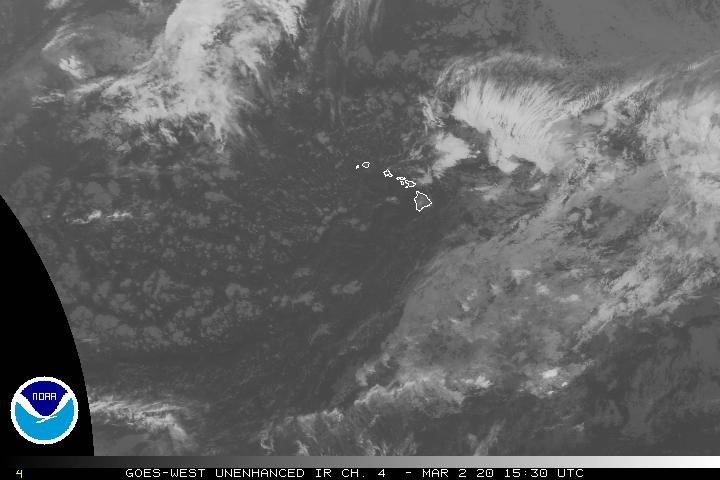
Satellite and Radar Images: To view the cloud conditions we have here in Hawaii, please use the following satellite links, starting off with this Infrared Satellite Image of the islands to see all the clouds around during the day and night. This next image is one that gives close images of the islands only during the daytime hours, and is referred to as a Close-up visible image. This next image shows a larger view of the Pacific…giving perspective to the wider ranging cloud patterns in the Pacific Ocean. Finally, here's a Looping IR satellite image, making viewable the clouds around the islands 24 hours a day. To help you keep track of where any showers may be around the islands, here’s the latest animated radar image.
Hawaii’s Mountains – Here’s a link to the live web cam on the summit of near 13,500 foot Mauna Kea on the Big Island of Hawaii. The tallest peak on the island of Maui is the Haleakala Crater, which is near 10,000 feet in elevation. These two web cams are available during the daylight hours here in the islands…and when there’s a big moon shining down during the night at times. Plus, during the nights you will be able to see stars, and the sunrise and sunset too…depending upon weather conditions.
Tropical Cyclone activity in the eastern and central Pacific – Here’s the latest weather information coming out of the National Hurricane Center, covering the eastern north Pacific. You can find the latest tropical cyclone information for the central north Pacific (where Hawaii is located) by clicking on this link to the Central Pacific Hurricane Center. Here’s a tracking map covering both the eastern and central Pacific Ocean. A satellite image, which shows the entire ocean area between Hawaii and the Mexican coast…can be found here. Of course, as we know, our hurricane season ended November 30th here in the central Pacific…and begins again June 1st.
Aloha Paragraphs

Gradually improving weather, although still
showers locally, some quite generous…with a
random possible thunderstorm
The classic east to east-northeast trade winds are slow in returning…and may hold off through the weekend. Glancing at this weather map, we find a trough of low pressure to our west, with its parent 1010 millibar low pressure system to the northwest of the state, which are responsible for keeping our wind directions from the south to east. The eastern side of the island chain should feel some easterly breezes, while the Kauai side continues to see more southeasterly or even southerly breezes. It will take until the weekend, or even early next week before our trade winds finally rebound fully across the entire state.
Our local winds will be quite light although locally stronger…the following numbers represent the strongest gusts, along with directions early Wednesday evening:
08 Port Allen, Kauai – SE
18 Kahuku, Oahu – ENE
10 Molokai – SE
29 Kahoolawe – ESE
21 Lipoa, Maui – ESE
07 Lanai – NW
23 South Point, Hawaii – NE
We can use the following links to see what’s going on in our area of the north central Pacific Ocean Wednesday night. Looking at this NOAA satellite picture we variable amount of clouds across all of the islands, with a major new thrust of high cirrus clouds streaming overhead from the west and southwest. We can use this looping satellite image to see these high clouds moving over the entire state once again. Checking out this looping radar image shows that despite all the cloudiness stretching over us now, rainfall remains light, with most of it falling over the ocean offshore from the islands.
Sunset Commentary: The area of low pressure to our west and northwest remains there Wednesday evening, which is helping to drag lots of high and middle level clouds over the Aloha state now. These high clouds don't provide precipitation, although certainly limit the amount of sunshine trying to get through it during the days. It looks like it will become thicker before it moves out of our area at some point in the future…probably after Thursday at the earliest. We just can't seem to break back into our normal spring time weather it seems.
Part of what's missing these days is our classic trade wind flow, which has been missing in action so far this week, and before that even. The area of low pressure mentioned above is messing with our trade winds too, curving them up from the southeast and even south at times near Kauai. As this weather map shows, the isobars are being forced up from the southeast and south, into the low pressure system to our northwest. Winds from these directions can bring volcanic haze to the smaller islands, along with providing rather muggy conditions during the days too. We're still in somewhat of an unsettled weather pattern, so showers, even a few heavy ones…aren't out of the question for the time being.
Here in Kihei, Maui before I take the drive back upcountry to Kula, its cloudy. The bulk of these sunset clouds will be of the high variety, which will dim and filter our sunshine Thursday as I noted above. They are the kind that can at times light up colorfully at sunset and sunrise too, keep an eye out. I'll be back early Thursday morning with your next new weather narrative, I hope you have a great night until then! Aloha for now…Glenn.
Extra: There's still some snow atop the summit of Mauna Kea…on the Big Island
Extra2: Interesting sky alignment this month
Interesting: Airports can pose a far bigger threat to local air than previously recognized, thanks to the transformative power of sunlight. In the first on-tarmac measurements of their kind, researchers have shown that oil droplets spewed by idling jet engines can turn into particles tiny enough to readily penetrate the lungs and brain.
Allen Robinson of Carnegie Mellon University in Pittsburgh and his team collected the pollution spewed from a plane powered by one of the most common types of commercial jet engines as it operated at different loads.
Though jet engines operating at full power produce mostly solid particles, at low engine loads — such as when a plane idles at the gate or on the runway — emissions are predominantly in the form of microscopic droplets. The researchers piped the engine's exhaust into a 7-cubic-meter covered Teflon bag.
When the bag was full the researchers uncovered it, allowing sunlight to fire up chemical reactions that would normally occur in the open air. Within minutes solid particles were generated by interactions between the oily micro-droplets and gases.
"Driving this chemistry," Robinson notes, "was hydroxyl radical," or OH — the oxidant that's most effective at catalyzing the breakdown of oily hydrocarbons. "To create this hydroxyl radical, you need sunlight," he explains.
Sunlight's oxidation of the exhaust emitted at idling can generate 35 times more particles than the engine originally emitted and 10 times what computer models have typically predicted, the researchers report online May 5 in Atmospheric Chemistry and Physics. Robinson says he found these new data "unbelievable. It sort of blew our minds."
Interesting2: The Neanderthal is an extinct member of the Homo genus known from Pleistocene specimens found in Europe and parts of western and central Asia. The first proto-Neanderthal traits appeared in Europe as early as 350,000—600,000 years ago. These characteristics are generally thought of as disappeared in Asia by 50,000 years ago and in Europe by about 30,000 years ago.
Researchers have dated a Neanderthal fossil discovered in a significant cave site in Russia in the northern Caucasus, and found it to be 10,000 years older than previous research had suggested. This new evidence throws into doubt the theory that Neanderthals and modern humans interacted for thousands of years.
Instead, the researchers believe any co-existence between Neanderthals and modern humans is likely to have been much more restricted, perhaps a few hundred years. It could even mean that in some areas Neanderthals had become extinct before anatomically modern humans moved out of Africa.
Genetic evidence suggests interbreeding took place with Homo sapiens (anatomically modern humans) between roughly 80,000 and 50,000 years ago in the Middle East, resulting in 1—4% of the genome of people from Eurasia having been contributed by Neanderthals.
The youngest previously reported Neanderthal finds include Hyaena Den (UK), considered older than 30,000 years ago, while the Vindija (Croatia) Neanderthals have been re-dated to between 32,000 and 33,000 years ago.
No definite specimens younger than 30,000 years ago have been found; however, evidence of fire by Neanderthals at Gibraltar indicate they may have survived there until 24,000 years ago. Cro-Magnon or early modern human skeletal remains with Neanderthal traits were found in Lagar Velho (Portugal), dated to 24,500 years ago and controversially interpreted as indications of extensively admixed populations.
Neanderthal stone tools provide further evidence for their presence where skeletal remains have not been found. The last traces of Mousterian culture, a type of stone tools associated with Neanderthals, were found in Gorham's Cave on the remote south-facing coast of Gibraltar.
Other tool cultures sometimes associated with Neanderthal include Châtelperronian, Aurignacian, and Gravettian, with the latter extending to 22,000 years ago, the last potential indication of Neanderthal presence. The new research, directed by the University of Oxford and University College Cork in collaboration with the Laboratory of Prehistory at St Petersburg, Russia, and funded by Science Foundation Ireland is published today in PNAS Online Early Edition.
The research centers on Mezmaiskaya Cave, a key site in the northern Caucasus within European Russia, where the team directly dated the fossil of a late Neanderthal infant from the Late Middle Paleolithic layer and a series of associated animal bones.
They found that the fossil was 39,700 years old, which implies that Neanderthals did not survive at the cave site beyond this time. This finding challenges previous claims that late Neanderthals survived until 30,000 years ago in the northern Caucasus, meaning that late Neanderthals and modern humans were not likely to experience any significant period of co-existence.
The new dating evidence throws new light on when the Neanderthals became extinct and why. The research team believes that Neanderthals died out when the modern humans arrived or that they had already become extinct before then, possibly because of climate change, dwindling resources, or other scenarios.
The research suggests that if we are to have accurate chronologies the data needs to be revised, improved and corrected so possible associations between Neanderthal extinctions, dispersals of early modern humans and climatic events can be properly assessed.
Interesting3: The Mongol invasion of Asia in the 1200s took enough carbon dioxide out of the atmosphere to offset a year's worth of the world's gasoline demand today, according to a new study. But even Genghis Khan couldn't create more than a blip in atmospheric carbon compared to the overwhelming effect of agriculture.
The study, published online Jan. 20 in the journal The Holocene, looked at land use and carbon dioxide in the atmosphere between the years 800 and 1850. Globally at the time, humans were cutting down forests for agriculture, driving carbon into the atmosphere (vegetation stores carbon, so trees and shrubs are what scientists call "carbon sinks").
But in some regions during certain times, wars and plagues culled the population, disrupting agriculture and allowing forests to regrow. The question, said Julia Pongratz, a postdoctoral researcher at the Carnegie Institution's Department for Global Ecology at Stanford University, was whether this regrowth could have locked up enough carbon to make a difference in global atmospheric carbon dioxide.
"We wanted to check if humans had an impact on carbon dioxide by increasing it by deforestation, but also by decreasing it," Pongratz said. Pongratz and her colleagues used a detailed reconstruction of historical agriculture to model the effect of four major wars and plagues in the 800 to 1850 time period: the Mongol takeover of Asia (from about 1200 to 1380), the Black Death in Europe (1347 to 1400), the conquest of the Americas (1519 to 1700) and the fall of the Ming Dynasty in China (1600 to 1650). All of these events led to death on a massive scale (the Black Death alone is thought to have killed 25 million people in Europe).
But Mother Nature barely noticed, the researchers found. Only the Mongol invasion had a noticeable impact, decreasing global carbon dioxide by less than 0.1 part per million. This small amount required that the forests absorb about 700 million tons of carbon dioxide, which is the amount emitted annually by worldwide gasoline demand today. But it was still a very minor effect, Pongratz said.
Interesting4: A new study reported by Fair Trade USA and conducted by researchers from MIT, Harvard and LSE shows that the prominent appearance of the "Fair Trade Certified" label on coffee packaging can potentially increase sales by up to 13%. The researchers conducted a 6 month study in partnership with a large national retailer to examine the purchasing behavior of U.S. consumers in 26 different stores.
A few key findings show that:
•The Fair Trade Certified label alone has a large positive impact on sales.
•Sales of the two most popular bulk coffees sold in each of the 26 test stores increased by up to 13 percent when labeled as Fair Trade Certified.
•The study also revealed that a substantial segment of consumers are willing to pay up to eight percent more for a product bearing the Fair Trade Certified label.
"Overall the findings suggest that there is substantial consumer support for Fair Trade," said Michael J. Hiscox of Harvard University. "The Fair Trade label by itself had a large positive effect on sales, indicating that a substantial number of coffee buyers place a positive value on Fair Trade certification…"
Interesting5: Around a third of the food produced in the world every year – about 1.18 billion tonnes – gets lost or wasted, the UN's Food and Agriculture Organisation (FAO) says. "Given the limited availability of natural resources it is more effective to reduce food losses than increase food production in order to feed a growing world population," the FAO said in a report released today.
The FAO said the amount of food lost or wasted every year is equivalent to more than half of the world's annual cereals crop. Some 925 million people around the world suffer from hunger. The report said that the problem in the developing world was mainly food losses – through, for example, crop failures and poor infrastructure.
In industrialised countries, the issue is more about "retailers and consumers throwing perfectly edible foodstuffs into the trash". The report found that in Europe and North America consumers wasted between 95 and 115 kilograms of food every year. The report found that in the retail industry there was an "over-emphasis on appearance".
"Surveys show that consumers are willing to buy produce not meeting appearance standards as long as it is safe and tastes good," it said. "Consumers in rich countries are generally encouraged to buy more food than they need," the FAO said, giving as an example oversized ready-to-eat meals produced by the food industry and fixed-price buffets in restaurants.
The data was contained in a report commissioned by the FAO from the Swedish Institute for Food and Biotechnology for "Save Food!" – a conference being held in Germany later this month.
 Email Glenn James: