











Air Temperatures – The following maximum temperatures were recorded across the state of Hawaii Tuesday:
Lihue, Kauai – 80
Honolulu airport, Oahu – 83
Kaneohe, Oahu – 79
Molokai airport – 82
Kahului airport, Maui – 85
Kona airport – 83
Hilo airport, Hawaii – 80
Air Temperatures ranged between these warmest and coolest spots near sea level – and on the highest mountain tops…as of 5pm Tuesday evening:
Kahului, Maui – 83F
Poipu, Kauai – 77
Haleakala Crater – 51 (near 10,000 feet on Maui)
Mauna Kea summit – 30 (over 13,500 feet on the Big Island)
Precipitation Totals – The following numbers represent the largest precipitation totals Tuesday evening:
1.34 Waiakoali, Kauai
0.59 Poamoho, Oahu
0.00 Molokai
0.14 Lanai
0.03 Kahoolawe
0.15 West Wailuaiki, Maui
0.87 Ahumoa, Big Island
Marine Winds – Here’s the latest (automatically updated) weather map showing a large 1042 millibar high pressure system to the north of Hawaii. Our winds will become gradually lighter, trending towards the southeast over the open ocean…with daytime onshore sea breezes in closer to the islands through Thursday.
Satellite and Radar Images: To view the cloud conditions we have here in Hawaii, please use the following satellite links, starting off with this Infrared Satellite Image of the islands to see all the clouds around during the day and night. This next image is one that gives close images of the islands only during the daytime hours, and is referred to as a Close-up visible image. This next image shows a larger view of the Pacific…giving perspective to the wider ranging cloud patterns in the Pacific Ocean. Finally, here's a Looping IR satellite image, making viewable the clouds around the islands 24 hours a day. To help you keep track of where any showers may be around the islands, here’s the latest animated radar image.
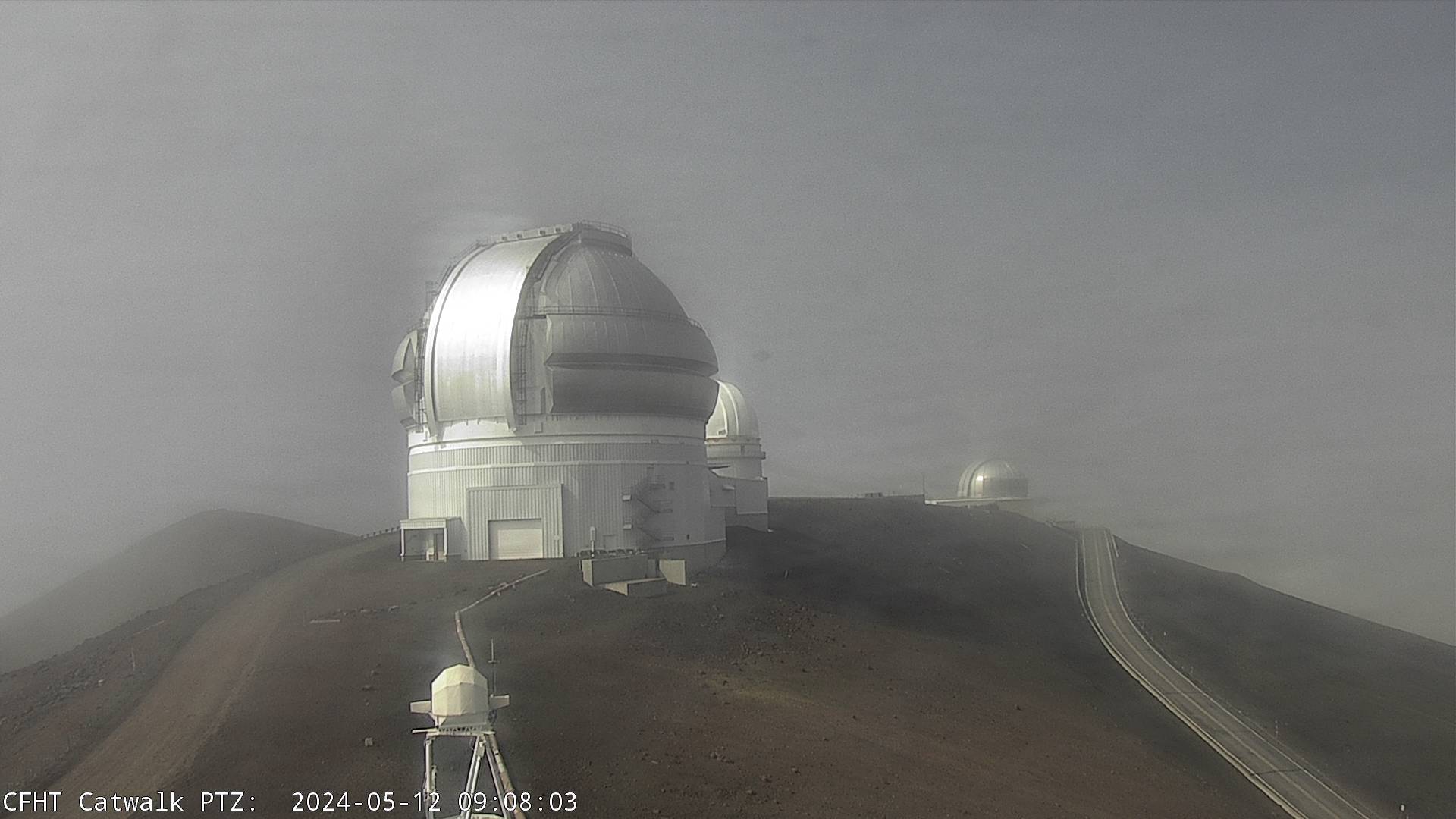
Hawaii’s Mountains – Here’s a link to the live web cam on the summit of near 13,500 foot Mauna Kea on the Big Island of Hawaii. The tallest peak on the island of Maui is the Haleakala Crater, which is near 10,000 feet in elevation. These two web cams are available during the daylight hours here in the islands…and when there’s a big moon rising just after sunset for an hour or two! Plus, during the nights and early mornings you will be able to see stars, and the sunrise too…depending upon weather conditions.
Tropical Cyclone activity in the eastern and central Pacific – Here’s the latest weather information coming out of the National Hurricane Center, covering the eastern north Pacific. You can find the latest tropical cyclone information for the central north Pacific (where Hawaii is located) by clicking on this link to the Central Pacific Hurricane Center. Here’s a tracking map covering both the eastern and central Pacific Ocean. A satellite image, which shows the entire ocean area between Hawaii and the Mexican coast…can be found here. Of course, as we know, our hurricane season ended November 30th here in the central Pacific…and begins again June 1st.
Aloha Paragraphs

Increasing clouds leading to showers,
some of which will become locally heavy,
with isolated thunderstorms here and there.
Flash flood watch starting late tonight, lasting
into later Thursday night…on all islands.
The trade winds have ended, with lighter southeast breezes in place now through Friday…before the trade winds return later this weekend into next week. According to this weather map, we find a robust 1042 millibar high pressure system positioned to the north of the islands Tuesday night. Meanwhile, we have a 1017 millibar low pressure system just to our north, which has an associated trough of low pressure near Kauai. Our winds will remain quite light through much of the rest of this work week…trending southeast. There may be some strong and gusty winds associated with thunderstorms over the next day or two. At the same time we have a small craft wind advisory around Kauai and Oahu, due to the incoming swells in Hawaiian waters.
Gradually lighter breezes will prevail through much of this week…the following numbers represent the strongest gusts, along with directions Tuesday evening:
20 mph Port Allen, Kauai – SE
16 Wheeler AFB, Oahu – SE
10 Molokai – S
23 Kahoolawe – SE
18 Lipoa, Maui – E
08 Lanai Airport – WNW
22 South Point, Big Island – NE
We can use the following links to see what’s going on in our area of the north central Pacific Ocean Tuesday night. This large University of Washington satellite image shows an extensive amount of clouds surrounding the Hawaiian Islands…with a few thunderstorms starting to pop up to the north of Kauai at the time of this writing. Looking at this NOAA satellite picture we see lots of high clouds, while at the same time…there are various patches of low clouds out over the ocean and over the islands in places too. We can use this looping satellite image to see the counterclockwise circulation of an upper low pressure system to our north…with its surface reflection below it. At the same time, there are lots of high cirrus clouds streaming through over our island chain from the northwest. Checking out this looping radar image shows moderately heavy showers falling over the ocean offshore from the islands, even grading towards a bit heavy at the time of this writing…generally closest to the islands of Kauai and Oahu at the moment.
In summary: Our local winds have taken on a more southeasterly orientation later in the day Tuesday. As a trough of low pressure aloft moves southward, and a trough of low pressure at the surface shifts further southeast as well…our winds have finally started easing up. The general wind flow is expected to be southeast through the next couple of days at least. This in turn may lead to an increase in volcanic haze, at least locally. We'll see lots of high clouds associated with this approaching area of low pressure to our north…which may provide some nice looking sunset and sunrise colors at times.
As we move into the night and during the day Wednesday, things will become more interesting. An area of unusually cold air aloft is in the process of moving overhead now…making our overlying atmosphere unstable. This unstable atmosphere is expected to spark thunderstorms at some point through Thursday. If this situation manifests as the computer models are suggesting, we could see locally heavy rainfall, along with snow falling over our highest summits on the Big Island…which already began to happen Tuesday afternoon! This unsettled weather pattern will exist through Thursday, with a continued chance of flash flooding. The models then show the dynamics for heavy rain moving away as we get into Friday, although we could continue to see light to moderate showers into the weekend. During the weekend time frame, the trade winds will return, keeping the bulk of those showers falling along our windward sides…with drier and sunnier weather possible along our leeward beaches.
Here in Kihei, Maui, at around 535pm, skies were partly cloudy with high cirrus, although there were dark clouds brewing over the Haleakala Crater. The inclement weather circumstances described above will be hit and miss for the most part. Thus, there will be places that get more rainfall than others, with the mountains probably seeing the most. The daytime heating of the islands should trigger perhaps the heaviest showers and even thunderstorms, especially during the afternoon and evening hours. Don't rule out the chance that there could be showers, even some heavy ones just about anywhere through Thursday however. Friday will likely be a transition day, with some improvement expected then. ~~~ I'll be back early Wednesday morning with your next new weather narrative, with the latest updates and news about this unfolding wet weather situation. I hope you have a great Tuesday night until then! Aloha for now…Glenn.
Interesting: Coastal mangrove forests store more carbon than almost any other forest on Earth, according to a study conducted by a team of U.S. Forest Service and university scientists. Their findings are published online in the journal Nature Geoscience.
A research team from the U.S. Forest Service's Pacific Southwest and Northern research stations, University of Helsinki and the Center for International Forestry Research examined the carbon content of 25 mangrove forests across the Indo-Pacific region and found that per hectare mangrove forests store up to four times more carbon than most other tropical forests around the world.
"Mangroves have long been known as extremely productive ecosystems that cycle carbon quickly, but until now there had been no estimate of how much carbon resides in these systems. That's essential information because when land-use change occurs, much of that standing carbon stock can be released to the atmosphere," says Daniel Donato, a postdoctoral research ecologist at the Pacific Southwest Research Station in Hilo, Hawaii.
The mangrove forest's ability to store such large amounts of carbon can be attributed, in part, to the deep organic-rich soils in which it thrives. Mangrove-sediment carbon stores were on average five times larger than those typically observed in temperate, boreal and tropical terrestrial forests, on a per-unit-area basis.
The mangrove forest's complex root systems, which anchor the plants into underwater sediment, slow down incoming tidal waters allowing organic and inorganic material to settle into the sediment surface.
Low oxygen conditions slow decay rates, resulting in much of the carbon accumulating in the soil. In fact, mangroves have more carbon in their soil alone than most tropical forests have in all their biomass and soil combined.
Interesting2: The long-standing conflicts over nuclear power and the risks of radiation exposure are nothing new — in fact, the debate over the damaged Fukushima Dai-Ichi plant in Japan are similar to arguments happening between scientists, governmental agencies and the public since 1945, according to an Oregon State University expert on the history of science. Historian Jacob Hamblin is the author of the 2008 book, "Poison in the Well: Radioactive Waste in the Oceans at the Dawn of the Nuclear Age."
He specializes in the history of the Cold War era, with a particular focus on environmental sciences and the history of nuclear issues. "Science without history is just ignorance," Hamblin said. "Much of the current media debate about the safety of nuclear power and radiation exposure is an echo of conflicts going on since the dawn of the nuclear era."
Hamblin said nuclear scientists have long decried public concerns over radiation exposure and the safety of nuclear power plants. Yet he says these same issues continue to cause conflict between anti-nuclear activists, scientists and pro-nuclear advocates.
"In the 1950s, the response to the public was that it was irrational and that its fears about nuclear energy were based on emotion," Hamblin said. "I don't believe the public is irrational, but I do believe that the nuclear industry has failed to address some key issues, namely the issue of nuclear waste disposal and the risk of radiation exposure and contamination when something like Fukushima occurs."
Hamblin's book tells the history of how policy decisions, scientific conflicts and public relations strategies were employed from the end of World War II through the blossoming environmental movement of the 1970s. By avoiding simplistic pro-or-con arguments, Hamblin said his goal was to research how and why decisions are made.
"You can talk to scientists from a variety of backgrounds and hear five different true statements about nuclear power, and each of them will lead you to different conclusions," Hamblin said. "My point is not that nuclear power is bad, because I don't necessarily believe that, but that the public is torn on these issues because there are a variety of ways to interpret the science."
In his book, Hamblin gives the example of tests being done by the U.S. military in the 1950s. Nuclear bombs were detonated over the Pacific Ocean, and oceanographers then studied how radioactivity circulated in the ocean and how much it was diluted. "Some oceanographers and radiation physicists tested the water and found that indeed, the ocean seemed to have diluted the radiation and there was little to no risk," Hamblin said.
"Then another batch of scientists came out and they started testing the plants and fish and other sea life and they found higher levels of radiation absorption in those things that we eat." Hamblin's cautionary tale is that unanswered questions regarding nuclear energy need to be addressed with the public, and not in a dismissive way. In addition, he believes that there are lessons that can be learned from history.
"Just over 40 years ago, people thought storing nuclear waste in ocean trenches was a good idea, until the discovery of plate tectonics," he said. "In the 1950s, safety levels of radiation exposure to reproductive organs were based on the assumption that most people were done having children by the age of 30."
"My point is that the science is often informed by the culture and the politics and the technology of the time — and those things are always shifting. We need to consider what we want our energy legacy to be, and how we as a society plan to deal with the aftermath of whatever we choose."
Interesting3: Bats mean big money for American farmers. Their nightly bug-munching saves U.S. agriculture between $3.7 to $53 billion a year on pesticides and crop losses. A U.S. Geological Survey study, published in Science, put a dollar sign on the services bats offer free of charge. The study found that bats are high rollers in the game of insect control. But the researchers are worried.
Bats are dying off in unprecedented numbers. A bat-plague, called the white nose syndrome, has wiped out over 70 percent of the bat populations in some of the 16 states and 3 Canadian provinces where it has been found. And the fungal disease is spreading west from New York, where it was discovered, into areas with higher agricultural outputs like the Midwest.
Bats in the Midwest are already getting clobbered by wind turbines. The energy producing turbines cause air pressure changes that damage bat lungs. They also smack the flying mammals out of the sky with their rapidly spinning blades.
"Additionally, because the agricultural value of bats in the Northeast is small compared with other parts of the country, such losses could be even more substantial in the extensive agricultural regions in the Midwest and the Great Plains where wind-energy development is booming and the fungus responsible for white-nose syndrome was recently detected," said Tom Kunz, a professor of ecology at Boston University and co-author of the study in a USGS press release.
Interesting4: "Coral reefs provide a range of critical goods and services to humanity — everything from nutrient cycling to food production to coast protection to economic revenues through tourism," says Camilo Mora at Dalhousie University and lead researcher of the study. "Yet the complex nature and large-scale distribution of coral reefs is challenging scientists to understand if this natural ecosystem will continue working to deliver goods and services given the ongoing loss of biodiversity in coral reefs."
"Numerous experiments have showed that biodiversity has positive effects on several ecosystem processes, although the number of species required to ensure the functionality of a given process is fairly low, as many species often have similar ecological roles," says Michel Loreau from McGill University, a co-author of the study.
"What remains largely unknown, however, is whether the results of experimental studies reflect what happens in real ecosystems." To fill this unknown, 55 researchers, in a two-year study, collected the necessary data to determine whether biodiversity influences the efficiency of reef fish systems to produce biomass, and if so, elucidate the role of humans in such a linkage.
The team collected demographic data on human populations as well as environmental and biological data on the identity of species, their abundances and body sizes in almost two thousand coral reef locations worldwide. The data on abundance and body size were used to calculate the cumulative weight of all fishes on each reef (also called standing biomass), which is one of the main services reef fishes provide to humanity through food supply but also a very close proxy for how effectively ecosystems produce biomass.
"The results of the study were stunning," says co-author Kevin Gaston at Sheffield University. "While experimental studies have elucidated that the biomass production of ecosystems stabilizes after a certain number of species is reached, this field study demonstrated that the production of biomass in reef fish systems did not saturate with the addition of new species."
"This study shows, quite simply, that the more biodiversity, the better," says co-author Marah Hardt with OceanInk. "The benefits appear limitless, if we allow ecosystems to operate at their full potential." "The reasons leading to a non-saturating relationship between diversity and biomass production are intriguing," says coauthor Michel Kulbicki at the French Institute for Research and Development.
"Nevertheless, this strong relationship clearly indicates that species interact in such a way that their combined effect is larger than the addition of their individual parts and that the loss of species can have far-reaching consequences in the functioning of coral reefs."
The study also demonstrated that standing biomass reduced with increasing human density, although for the same number of people the reduction of biomass was significantly larger in more diverse ecosystems. The authors presume that the stronger deleterious effect of humanity on more diverse reefs is due to the selective extirpation of large fishes, which are often more efficient at turning food into biomass and lack competitors precluding their ecological replacement by other species.
"It's been usual to expect that diverse ecosystems could lose a few species without it mattering very much because the high redundancy of species should allow to replace any species that is lost," said Peter F. Sale, assistant director of the Institute for Water, Environment and Health of the United Nations University, who was not involved in the study.
"The results of this study now suggest that we do not have such insurance and that reef ecosystems are at greater risk from human pressures than we previously thought." The study documented that the deleterious effect of humanity on reef fish systems can be widespread, as some 75% of the world's coral reefs are near human settlements and could worsen, as 82% of countries with coral reefs are expected to double their human populations within the next 50 to 100 years.
"Human overpopulation is a very sensitive topic across endeavors from science to religion and politics," Mora says. "Unfortunately, we find again and again that our global population cannot be sustainably supported without the deterioration of the world's natural resources and the resulting backlash on human welfare.
Thus, identifying socially and politically acceptable solutions to curb human population growth is at the core of finding ultimate solutions for the protection of biodiversity and the prevention of unnecessary hardship." "We found that dense human populations were associated with heavy overfishing, land use, and coastal development," says coauthor David Booth at the University of Technology, Sydney.
"This highlights the challenge behind the management required to adequately protect coral reefs and the need to focus on alternative economic and policy tools that address the root drivers of reef degradation." "This is a critical situation," says coauthor Sebastian Ferse from the Leibniz Center of Tropical Marine Ecology.
"It underlines once again that current management approaches are insufficient to protect marine biodiversity on a large scale, and that holistic approaches combining natural and social systems are needed." "Not everything was doom and gloom," says coauthor Maria Beger at the University of Queensland.
The study reported that at least 25% of the world's reefs remain distant from direct human effects. Those reefs are located on small and isolated areas where human habitation is harsh. "These few reefs are in stark contrast with degraded sites, and may still be able to act as sources to replenish others.
This is a fortunate situation that can buy us some time while we figure out effective solutions to this coral reef crisis," she adds. "Coral reefs are the most diverse ecosystem on the planet, hosting thousands of species and generating numerous goods and services to millions of people worldwide," says Enric Sala, a National Geographic fellow and co-author of the study.
"The future of coral reefs and the services they provide to a growing human population depend on how soon countries become seriously committed to regulating human threats."
Interesting5: College students around the world report that they are 'addicted' to media, describing in vivid terms their cravings, their anxieties and their depression when they have to abstain from using media. The findings are all part of a new global study released April 5 by the International Center for Media & the Public Agenda (ICMPA) at the University of Maryland. As an American student noted: "I was itching, like a crackhead, because I could not use my phone."
"Media is my drug; without it I was lost. I am an addict," said a student from the UK. A student from China said: "I can say without exaggeration, I was almost freaking out." A student from Argentina observed: "Sometimes I felt 'dead.'" And a student from Slovakia simply noted: "I felt sad, lonely and depressed."
"The world Unplugged" study, concludes that most college students, whether in developed or developing countries, are strikingly similar in how they use media — and how 'addicted' they are to it. Student after student spoke about their generation's utter dependency on media — especially the mobile phone.
"My dependence on media is absolutely sickening," said a student from Lebanon. "I felt like there was a problem with me," wrote a student from Uganda. "Because I became so addicted," observed a student from Hong Kong, "I have less time for my studies and face-to-face meetings with my friends."
The ICMPA study, conducted with the assistance of the university partners of the Salzburg Academy on Media & Global Change, asked around 1000 students in 10 countries on five continents to give up all media for 24 hours. After their daylong abstinence, the students recorded their experiences.
In total, students wrote almost half a million words: in aggregate, about the same number of words as Leo Tolstoy's War and Peace. Students also completed a demographic survey. The study shows: If you are under 25, it doesn't matter if you live in the U.S. or Chile or China, Slovakia, Mexico or Lebanon: you not only can't imagine life without your cell phone, laptop and mp3 player, you can't function without them.
"Five hours in and my typically relaxed Sunday has had the adverse effect. Raised heart rate, increased anxiety. I'm panicking not knowing what is going on in not just the outside world but also my world. My friends, my family, my life."
— UK Digital Natives Have No Passports "Perhaps naively, we assumed that we would find substantial differences among the students who took part in this study," noted project director Susan D. Moeller, a journalism and public policy professor at the University of Maryland's Philip Merrill College of Journalism and the director of ICMPA.
"After all, our partner universities come from very different regions — Chile, Slovakia and Hong Kong, for example — and from countries with great disparities in economic development, culture and political governance — for instance, Uganda, Lebanon and mainland China."
"But it quickly became apparent from looking at the student demographics and the students' narrative comments," said Moeller, "that all the student-responders in this study are digital natives. It was then that we realized that digital natives have no passports: if we had covered up the place name of a student's comment we would have had no idea of the student's nationality."
The ICMPA study documented that taken as country-based groups, the students reacted almost identically to going without media for 24 hours. Most students from all countries failed to go the full 24 hours without media, and they all used virtually the same words to describe their reactions, including: Fretful, Confused, Anxious, Irritable, Insecure, Nervous, Restless, Crazy, Addicted, Panicked, Jealous, Angry, Lonely, Dependent, Depressed, Jittery and Paranoid.
The study shows: Students were blind-sided by how much media have come to dominate their lives. They had thought of media as just a convenience; a way to communicate with friends and get news. After going without media, they came to recognize that they literally construct their identities through media.
Going unplugged, therefore, was like losing part of themselves. "I felt like a helpless man on a lonely deserted island in the big ocean." — China It was striking to us," said PhD student Sergei Golitsinski, a former reporter in St. Petersburg, Russia and a member of ICMPA's research team, "how many students around the world wrote that going without media not only severed their connections to their friends, but challenged their sense of self.
Who were they, if they weren't plugged in? Media are not just tools for students to communicate — students reported that how they use media shapes the way others think of them and the way they think about themselves." "We were surprised, too," noted Golitsinski, "that again and again students around the world said that media — and their phones, especially — were both emotionally and even physically comforting. In effect, cell phones have become this generation's security blanket."
"After a while I missed holding my cell phone so much that I actually left my battery in my bag and held my phone in my hand. It is almost like a comfort to hold and just know it was there." — USA The study shows: No matter where they live, students no longer search for news; the news finds them.
They inhale, almost unconsciously, the news that is served up on the sidebar of their email account, that is on friends' Facebook walls, that comes through on Twitter and via chat. "We are used to having information about everything on the planet and this information we have to have in an unbelievable time.
Our generation doesn't need certified and acknowledged information. More important is quantity, not quality of news." — Slovakia News to Students Means "Anything That Just Happened" "Students now get their news in chunks of 140 characters or from Facebook posts.
Students want and get their news as it is breaking, with few filters," observed PhD student Jessica Roberts, a former reporter at the Cape Times in South Africa, and a member of ICMPA's research team. In their reporting of their media habits, most students in the "Unplugged" study didn't discriminate between news that The New York Times, the BBC or Al Jazeera might cover, and news that might only appear in a friend's Facebook status update.
Indeed, very few students mentioned any legacy or online news outlets by name. "Students are interested in news," said Roberts, "it's just that students today are more inclusive about what they consider news than older adults are. 'News' to students means 'anything that just happened' — and students want to know it all immediately, whether it is a globally momentous story or only one of personal interest."
 Email Glenn James:
david northup Says:
Thanks for your daily word. It keeps me in touch with Hawaii. I like your narrative on the coral reef's. Having lived on Maui and witnessed reef damage and decay "due to our not think before we do things policy "shows it's effects. One of the main reefs that is no longer around is right next to the Maalaea harbor. When they built the break wall they cut off the natural sweeping current flow that removed silt and provided nutrients to the reef.
Not far from this same area is the man made wall consisting of the old outflow pipes that are halfway between the park and the breakwall and at the parks entry to the water "Rusty Pipes" . This was as I heard long ago a gift from our military folks that was never removed. If these two man made blockage's were removed the reef and beachs would have a smoother flow in which to clear the silt and debri off of them and hopefully bring back Life. I hope to someday get my act together and push for the removal of these man made flow stoppers.
Mahalo for your Kokua on all of the issues that that you report on.
Aloha .
Donut Dave~~~Thanks for your long and thoughtful comment Dave, appreciate your thoughts on the Maalaea Bay situation here on Maui. Aloha, Glenn
petermac Says:
Aloha Glenn – There's new snow on Mauna Kea!~~~I see that, I put a link in my narrative up above. Thanks for sending this note! Aloha, Glenn
Denise Says:
Glenn, I am an anthropologist and as per Interesting #2, I could not agree more with this statement: "My point is that the science is often informed by the culture and the politics and the technology of the time — and those things are always shifting."~~~Glad to hear of your agreement, thanks for giving your perspective, always welcome by you, or anyone else reading these news stories. Aloha, Glenn