











January 6-7, 2011
Air Temperatures – The following maximum temperatures were recorded across the state of Hawaii Thursday afternoon:
Lihue airport, Kauai – 77
Honolulu airport, Oahu – 78
Kaneohe, Oahu – 76
Molokai airport – 75
Kahului airport, Maui – 73
Kona airport – 82
Hilo airport, Hawaii – 79
Air Temperatures ranged between these warmest and coolest spots near sea level – and on the highest mountain tops…as of 5pm Thursday evening:
Port Allen, Kauai – 79F
Kapalua, Maui – 70
Haleakala Crater – 46 (near 10,000 feet on Maui)
Mauna Kea summit – 36 (near 14,000 feet on the Big Island)
Precipitation Totals – The following numbers represent the largest precipitation totals (inches) during the last 24 hours on each of the major islands, as of Thursday afternoon:
2.01 Kokee, Kauai
0.72 Maunawili, Oahu
0.52 Molokai
0.10 Lanai
0.10 Kahoolawe
1.18 West Wailuaiki, Maui
0.19 Waikii, Big Island
Marine Winds – Here’s the latest (automatically updated) weather map sshowing a gale low pressure system to the northeast, moving away to the north…with its associated cold front stalled near Maui and the Big Island. Our winds will be from the north Friday, turning more west or northwest Saturday….locally breezy.
Satellite and Radar Images: To view the cloud conditions we have here in Hawaii, please use the following satellite links, starting off with this Infrared Satellite Image of the islands to see all the clouds around during the day and night. This next image is one that gives close images of the islands only during the daytime hours, and is referred to as a Close-up visible image. This next image shows a larger view of the Pacific…giving perspective to the wider ranging cloud patterns in the Pacific Ocean. Finally, here's a Looping IR satellite image, making viewable the clouds around the islands 24 hours a day. To help you keep track of where any showers may be around the islands, here’s the latest animated radar image.
Hawaii’s Mountains – Here’s a link to the live web cam on the summit of near 14,000 foot Mauna Kea on the Big Island of Hawaii. The tallest peak on the island of Maui is the Haleakala Crater, which is near 10,000 feet in elevation. These two web cams are available during the daylight hours here in the islands…and when there’s a big moon rising just after sunset for an hour or two! Plus, during the nights and early mornings you will be able to see stars, and the sunrise too…depending upon weather conditions.
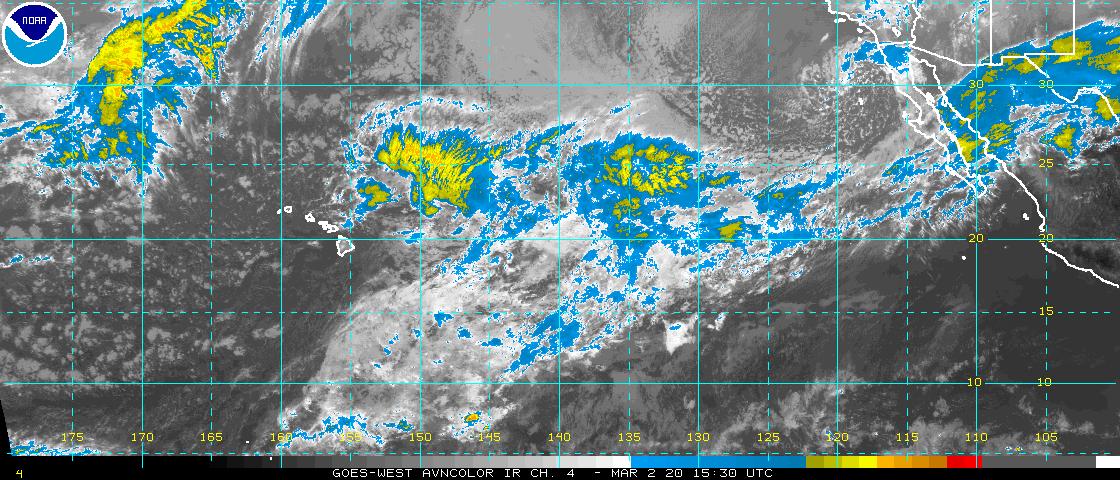
Tropical Cyclone activity in the eastern and central Pacific – Here’s the latest weather information coming out of the National Hurricane Center, covering the eastern north Pacific. You can find the latest tropical cyclone information for the central north Pacific (where Hawaii is located) by clicking on this link to the Central Pacific Hurricane Center. Here’s a tracking map covering both the eastern and central Pacific Ocean. A satellite image, which shows the entire ocean area between Hawaii and the Mexican coast…can be found here. Of course, as we know, our hurricane season won't end until November 31st here in the central Pacific.
Aloha Paragraphs

Cool breezes…chance of isolated showers Friday
Haleakala Crater, Maui
As expected, chilly north winds are blowing across in the islands now. This weather map shows a gale low pressure system to the north-northeast of our islands. This low pressure system is the parent of this dissipating cold front. The entry of this cold front into our area has set up a tropical cool spell…ushered in on the north winds. The air will be drier, despite the stable low clouds that get carried our way, with only limited showers at best. The north facing slopes, where the moisture would be forced up the sides, might be the most likely place for a few light drizzles or mist. As we grade into Friday however, we may see a different story setting up. This could be prompted by exceptionally cold air moving over the islands, aloft, destabilizing our overlying air mass…with the added chance of showers.
Cool, generally north winds are blowing Thursday evening…the following numbers represent the strongest breezes, along with directions:
15 mph Barking Sands, Kauai – NNE
20 Waianae, Oahu – NW
10 Molokai – NNE
24 Kahoolawe – NNE
25 Maalaea Bay, Maui – ENE
14 Lanai Airport – NE
15 Kona airport, Big Island – N
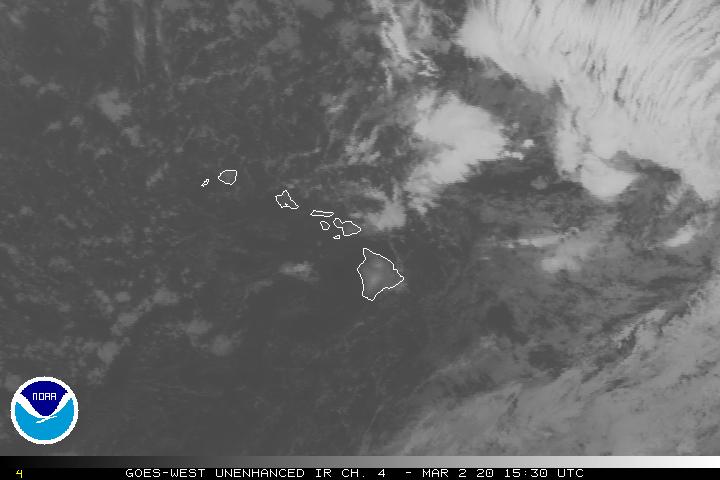
The well publicized winter cold front brought showers to all the islands Thursday, and is now stalled near Maui and the Big Island Thursday night. This large University of Washington satellite image shows the cold front losing its integrity over the state. Looking at this NOAA satellite picture, we can take a closer look at this frontal cloud band generally falling apart. We see an area of stable low clouds just to the north of Kauai, which is indicative of drier air…and since it is coming down out of the north, more or less, it will have a cool edge to it. There are also some brighter white high cirrus clouds in the picture. This is associated with an area of exceptionally cold air (at higher levels of our atmosphere) moving by to the north of the state. We can loop this satellite image, to see the high cirrus clouds to our east moving away. This animation also shows that the frontal boundary is stretching apart. Checking out this looping radar image we see very few showers anywhere in the islands…although a few light showers are noted around Maui and the Big Island.
Things will calm down now, as drier air floods into the state, that is until Friday…when the arrival of very cold air aloft brings the slight threat of thunderstorms to the state. The main thing now will be a relatively short period of cool north breezes that will blow through our islands, bringing cooler weather to the Aloha state into Friday. The low pressure area (aloft) that carries this cold air (near 0 degrees Fahrenheit) into the state, will make our overlying air mass unstable. The big question continues to be whether this will spark a few thunderstorms Friday into the night…or not? As we move into the upcoming weekend, a stronger cold front will begin making its way in our direction from the northwest. Winds will gradually shift to the west and then southwest ahead of this next front. This winter cold front will likely bring a day or so of rainfall as it passes down through the island chain, first on Kauai perhaps as early as Sunday night…into Monday. The computer models continue to show yet another cold front arriving towards mid-week next week.
~~~ Here in Kihei, Maui, it's totally clear on this leeward side of the island, as it is pretty much state-wide in the south and west facing areas. Looking over towards the north sides, it looks cloudy, although with hardly any showers falling…or a few very light misty areas here and there. High temperatures got stuck in the 70F's today at sea level, with only the Kona airport, protected from the north winds, reaching a still warm 82 degrees. Interestingly enough, the lowest high temperature was at the Kahului airport here on Maui…reaching only 73 degrees. Air temperatures will drop down into the 60F's tonight at sea level, at least in most areas. This may depend upon where there are clouds, which will help to hold in the heat a bit more, than where we find clear skies. By the way, the Molokai airport dipped down to a cool 57F degrees Thursday morning, with Kahului falling to 59 degrees. ~~~ Friday will be an interesting day, with all that unusually cold air up high in the atmosphere, in regards to whether it will be able to destabilize our air mass enough to trigger a few thunderstorms? ~~~ I'll be back early Friday morning with your next new weather narrative, I trust that you will have a pleasant night, and if you live here, again you may want to keep that extra blanket nearby. It's around 9pm in my weather tower, before crawling under my down comforter. Looking at my outside thermometer, it was reading a chilly 53F degrees. I'm 99% sure that I'll be looking at 40 something degrees, by the time I get back to my desk early in the morning! Aloha for now…Glenn.
Interesting: Britain has just gone through its coldest December since nationwide records began 100 years ago, the Met Office said on Wednesday. The country shivered as temperatures averaged minus 1 degree Celsius, well below the long-term average of 4.2 degrees, and colder than the previous record for the month of 0.1 degrees hit in 1981.
Provisional figures released by the forecaster showed that December saw exceptionally cold and snowy weather across the country, with temperatures regularly falling to between minus 10 and minus 20 overnight.
The Arctic blast caused havoc with the country's transport sector, closing roads, airports and railways and hitting retail sales during the traditionally busy Christmas period as shoppers struggled to get to stores.
The Met Office said that over the last 50 winters, there have been eight similar spells of severe weather. It also said December 2010 was the coldest month in England and Wales since February 1986, the coldest in Scotland since February 1947 and that in Northern Ireland it was the coldest on record.
Despite the freeze, the forecaster said precipitation including snow and rain was less than half of that expected for the month, making it sunny and dry, and the third driest since records began in 1910.
The Met Office told the government in October to prepare for an exceptionally cold winter, but decided against informing the wider public after opting last year to drop seasonal forecasts in favor of monthly ones.
Interesting2: Scientists have used satellites to track the world's largest nesting population of leatherback turtles across the South Atlantic for the first time. Their results reveal the routes the critically endangered creatures take make them more vulnerable to commercial fishing in the South Atlantic than previously thought.
The turtles leave their hatching grounds in Gabon in western Africa and return to the open ocean to feed, following one of three routes. Some go straight to the equatorial region of the mid-Atlantic, while others journey across the Atlantic to the coast of South America, or to the South African coast. Some of these trips are up to 4,700 miles long.
They stay in these areas for two to five years to build up enough fat reserves to reproduce, before returning to Gabon to lay eggs once again. The problem is their routes coincide with large coastal fisheries off South America and South Africa, and long-line fisheries in the mid-Atlantic.
While leatherback turtle populations in the North Atlantic appear stable, scientists are concerned that this could soon change. The pace of industrialization of fisheries and the increasing numbers of turtles that have fallen victim to fisheries as bycatch are two reasons for this.
Interesting3: The government of Italy has become the first in the European Union to outlaw the use of plastic bags by all retailers, signaling a large shift in a country which uses over 20 billion bags per year (400 per person) — an amount equal to 25% of the total produced and used in the entire EU. The Italian environmental organization Legambiente estimates that the ban will save 180,000 metric tons of CO2 emissions per year and help save many of the 100,000 marine mammals that the UN Environmental Program estimates are killed every year by improper disposal of the bags.
In a recent poll conducted by Legambiente which surveyed 20,000 consumers in 80 locations, more than 73% of respondents said they would prefer reusable bags if they could not use plastic. Only 16% said they would prefer bio-plastic, and 10% said they would prefer paper.
While there are only a few cities (and few, if any, countries) with plastic bag bans in place, many businesses have reduced bag use significantly in the past year. IKEA has reduced plastic bag use by 90%by replacing free, plastic bags with low-cost reusable bags and the UK’s Marks & Spencer has reduced bag usage by 80% in less than one year.
Interesting4: A team of U.S. Geological Survey (USGS) and academic scientists are analyzing samples of coral and surrounding sediments from an area damaged near the Deepwater Horizon site in the Gulf of Mexico. These samples, collected in December, are being used to investigate how and why the corals on these reefs died. There are many potential causes of coral death.
This particular case may be related to the oil release from Deepwater. Coral colonies may live for decades or centuries. Some causes are predation by other sea creatures such as Sea Stars. Global warming is a potential cause as well as other human related activities. The USGS revisited MC 338, the site where dead and dying coral were found covered by an unknown brown substance in November 2010.
USGS ecologist Amanda Demopoulos, Ph.D., collected samples of animals living on the seafloor as part of an expedition led by Penn State University professor Charles Fisher, Ph.D., to study how deep-sea reefs in the Gulf of Mexico have been affected by the Deepwater Horizon oil spill Using push cores, scientists collected sediments at the damage site. They also suctioned the unknown brown material off of the corals.
These materials are being sent for hydrocarbon analysis and used to study the sediment-dwelling animals using traditional taxonomy and new DNA-based techniques. In a series of dives in the manned submersible Alvin, USGS ecologists collected tissue samples from corals known as Madrepora and gorgonians at the damaged reefs found during the November expedition.
The samples are being used to examine the health of coral tissues including damage at the genetic level. Cell structure in corals can change in response to stress, such as by increasing the number of mucous-producing cells. Corals may also up-regulate certain genes in response to stressors, so researchers are comparing the proteins expressed in certain genes of the corals found at the MC 338 site with coral from control areas.
Samples are being analyzed to test for the chemical signature of oil from the Deepwater Horizon spill, known as MC 252 oil. The full array of samples — including corals, the unknown substance coating them, surrounding sediments, and associated animals — make it possible for scientists to examine whether exposure to oil or dispersants was related to the damage observed on the site.
Ocean pollution can poison coral polyps. Pollution takes on many forms including oil slicks, pesticides and other chemicals, heavy metals, and garbage. In some cases, this may be simple poisoning and in other cases the pollutant may smother the coral. Fertilizer runoff and untreated sewage introduce added nutrients to coastal ecosystems.
These elevated nutrient levels promote algae growth. Unfortunately, high concentrations of algae or solid sewage can overwhelm and smother coral polyps. Under normal conditions, herbivorous fish and some invertebrates keep the algae population balanced.
As ocean temperatures warm due to climate change, incidences of coral bleaching may increase. Increased ocean acidification may also kill coral. Time and careful scientific study will determine the cause of the recent Gulf of Mexico coral death.
Interesting5: In a finding that gives new meaning to the adage, "waste not, want not," scientists are reporting that household sewage has far more potential as an alternative energy source than previously thought. They say the discovery, which increases the estimated potential energy in wastewater by almost 20 percent, could spur efforts to extract methane, hydrogen and other fuels from this vast and, as yet, untapped resource.
Their report appears in ACS' journal Environmental Science & Technology. Elizabeth S. Heidrich and colleagues note that sewage treatment plants in the United States use about 1.5 percent of the nation's electrical energy to treat 12.5 trillion gallons of wastewater a year.
Instead of just processing and dumping this water, they suggest that in the future treatment facilities could convert its organic molecules into fuels, transforming their work from an energy drain to an energy source.
Based on their research, they estimate that one gallon of wastewater contains enough energy to power a 100-watt light bulb for five minutes. Only one other study had been done on wastewater's energy potential, and Heidrich thought that the results were too low because some energy-rich compounds were lost to evaporation.
In the new study, the scientists freeze-dried wastewater to conserve more of its energy-rich compounds. Using a standard device to measure energy content, they found that the wastewater they collected from a water treatment plant in Northeast England contained nearly 20 per cent more than reported previously.
 Email Glenn James: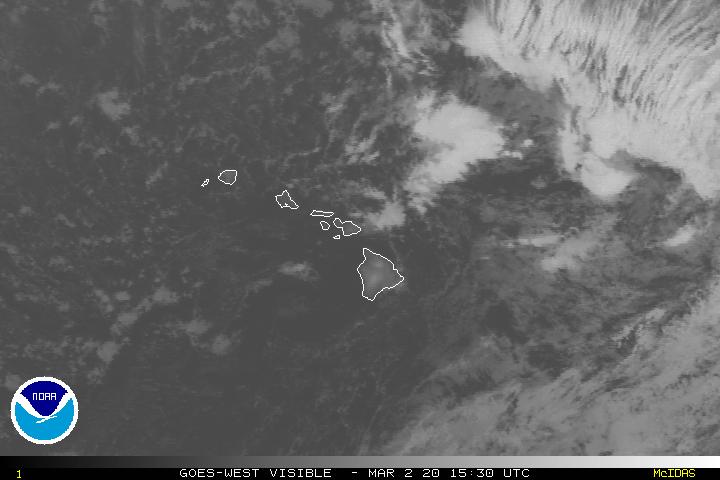


Amanda Says:
@Glenn Unfortunately this fireplace isn't made for generating much heat. It was designed for decoration when the house was built in the 70s. Not usually much need for the heat at 1800ft. Though, now I'm wishing it was designed for heat generation. Oh, and we may just have to light it for a few days. Good thing we've got plenty kiawe. ~~~Amanda, its nice to have the heat when you need it, although many folks here in Hawaii simply put on some socks and close the windows for heat! Kiawe wood, makes for a nice flame, and a good hot fire…stay warm. Have fun, Aloha, Glenn
Amanda Says:
Eliza and I must live near each other. It is so cold this morning. I have my rain coat on inside the house because I'm so chilled! At least it made for a great cup of coffee, and may make a reason to have a fire in the fireplace tonight! ~~~Hi Amanda, “a fire in the fireplace”, now that sounds like fun. That’s the one thing that I wish I had so much, well…that and an outdoor hot tub, so I could watch the weather on a chilly morning! Wait until Friday and Saturday mornings…they could be even a degree or two cooler. Thanks for staying in touch! Aloha, Glenn
Eliza Says:
Aloha Glenn –
Nice solid rain here in upper Pukalani this morning. Started with light mists before 8am and now (8:40) it is coming down with a nice flow. Nothing like our thunderstorm on Christmas night, so hopefully, there will be no flooding in Kihei from this moisture. Kinda thought we were in for some wet weather when I saw both mountains yesterday morning completely clear of any clouds. Have a great Thursday.
A hui hou ~ Eliza~~~Hi Eliza, thanks for your on the spot report from upcountry! Yeah, it’s even lightly raining over here in Kihei this morning, coming down on a nice slant…due to the north winds carrying it here. Aloha, Glenn