January 5-6, 2011
Air Temperatures – The following maximum temperatures were recorded across the state of Hawaii Wednesday afternoon:
Lihue airport, Kauai – 79
Honolulu airport, Oahu – 79
Kaneohe, Oahu – 78
Molokai airport – 80
Kahului airport, Maui – 81
Kona airport – 82
Hilo airport, Hawaii – 80
Air Temperatures ranged between these warmest and coolest spots near sea level – and on the highest mountain tops…as of 5pm Wednesday evening:
Kailua-kona – 79F
Hilo, Hawaii – 73
Haleakala Crater – 46 (near 10,000 feet on Maui)
Mauna Kea summit – 39 (near 14,000 feet on the Big Island)
Precipitation Totals – The following numbers represent the largest precipitation totals (inches) during the last 24 hours on each of the major islands, as of Wednesday afternoon:
0.55 Lihue, Kauai
0.12 Punaluu Stream, Oahu
0.00 Molokai
0.00 Lanai
0.00 Kahoolawe
0.17 West Wailuaiki, Maui
0.58 Kawainui Stream, Big Island
Marine Winds – Here’s the latest (automatically updated) weather map showing a moderately strong high pressure systems to the northeast of our islands. Our winds will become cooler from the northerly direction Thursday and Friday…locally breezy.
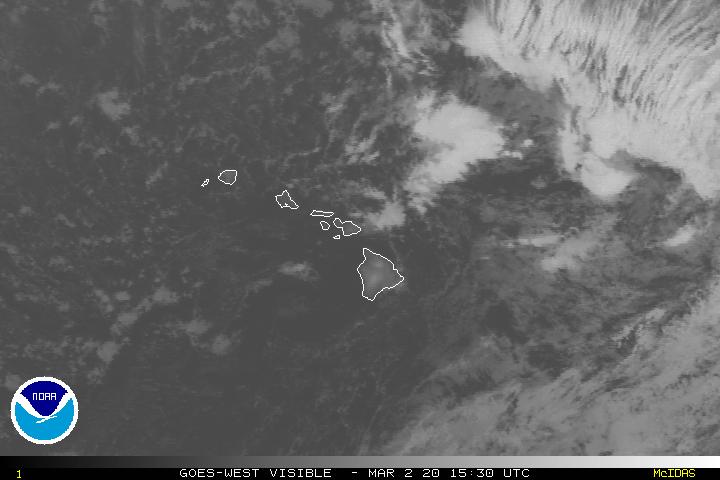
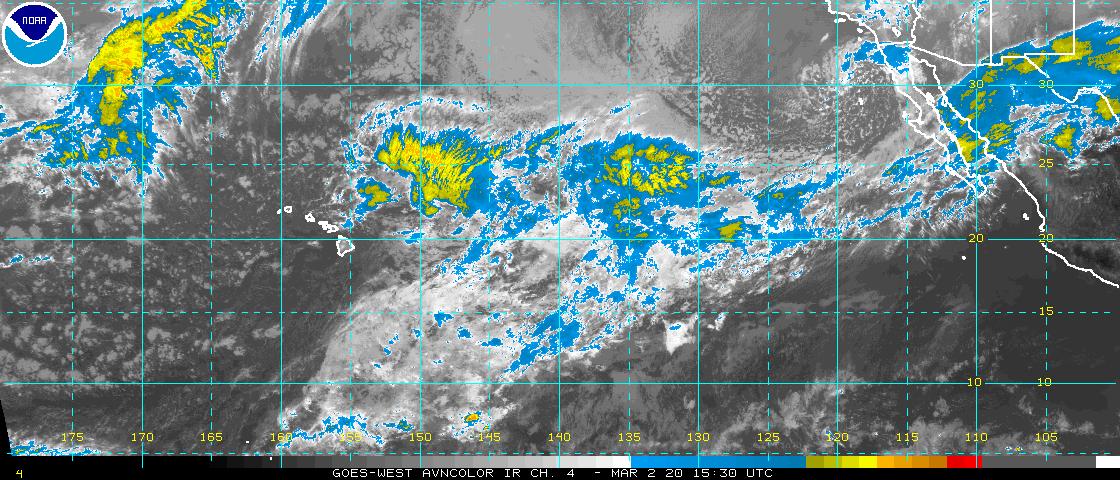
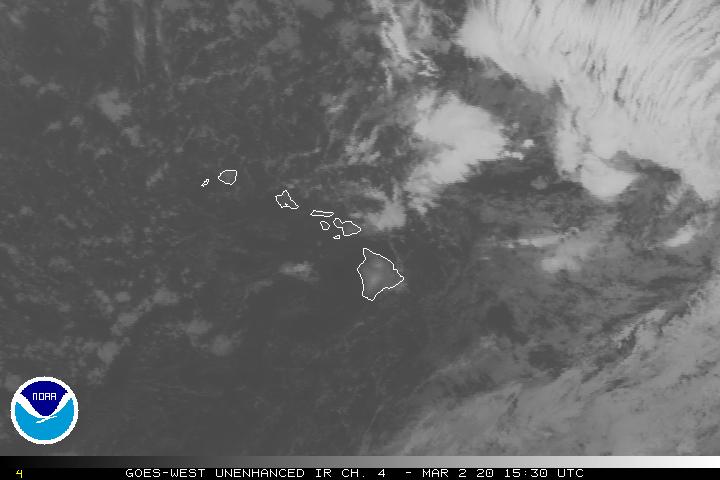
Satellite and Radar Images: To view the cloud conditions we have here in Hawaii, please use the following satellite links, starting off with this Infrared Satellite Image of the islands to see all the clouds around during the day and night. This next image is one that gives close images of the islands only during the daytime hours, and is referred to as a Close-up visible image. This next image shows a larger view of the Pacific…giving perspective to the wider ranging cloud patterns in the Pacific Ocean. Finally, here's a Looping IR satellite image, making viewable the clouds around the islands 24 hours a day. To help you keep track of where any showers may be around the islands, here’s the latest animated radar image.
Hawaii’s Mountains – Here’s a link to the live web cam on the summit of near 14,000 foot Mauna Kea on the Big Island of Hawaii. The tallest peak on the island of Maui is the Haleakala Crater, which is near 10,000 feet in elevation. These two web cams are available during the daylight hours here in the islands…and when there’s a big moon rising just after sunset for an hour or two! Plus, during the nights and early mornings you will be able to see stars, and the sunrise too…depending upon weather conditions.
Tropical Cyclone activity in the eastern and central Pacific – Here’s the latest weather information coming out of the National Hurricane Center, covering the eastern north Pacific. You can find the latest tropical cyclone information for the central north Pacific (where Hawaii is located) by clicking on this link to the Central Pacific Hurricane Center. Here’s a tracking map covering both the eastern and central Pacific Ocean. A satellite image, which shows the entire ocean area between Hawaii and the Mexican coast…can be found here. Of course, as we know, our hurricane season won't end until November 31st here in the central Pacific.
Aloha Paragraphs

Cool northerly breezes Thursday and Friday
Winds have become much lighter today, compared to the last several days…as expected. This weather map shows a moderately strong high pressure system far to the northeast of the islands, with an associated ridge to our northeast at mid-week. Our winds have gone through the expected transition today. This means that our gusty trade winds, which we saw both Monday and Tuesday, are rapidly slacking off. The next change in our wind department will occur Thursday, and remain in place Friday…perhaps into Saturday morning. This will happen as a weak cold front to our north drops down over Kauai and Oahu tonight into Thursday, and then dissipates over Maui Thursday evening. This intrusion by the front will prompt a tropical cool spell…ushered in by the chilly north winds already blowing through frontal cloud band. As we move into the later part of the weekend ahead, our local breezes will swing around to the southwest direction, ahead of a more vigorous cold front. Looking at climatology as a guide, winds can come in from the northwest through north to northeast behind the frontal passage, again on the cool side, gradually becoming trade winds around the middle of next week, or just as likely…the next cold front approaches about this time next week.
Winds will gradually come around to the north Wednesday night…which will soon become cooler and breezy…the following numbers represent the strongest breezes late-afternoon today, along with the directions:
16 mph Barking Sands, Kauai – NNW
16 Waianae, Oahu – SW
09 Molokai – SW
07 Kahoolawe – SE
20 Maalaea Bay, Maui – SW
06 Lanai Airport – SW
15 South Point, Big Island – NE
We’re just on the south side of an approaching weak cold front Wednesday evening, with generally fine weather…although looking northward we can see the front’s associated high cirrus clouds coming our way. This large University of Washington satellite image shows the cold front closing in on our islands, not far to our north and northwest at the time of this writing. Looking at this NOAA satellite picture, we see areas of low clouds coming into the state around the Big Island, and then that beautiful display of cirrus out ahead of the cold front too. Checking out this looping radar image we see very few showers falling, mostly over the ocean near the Big Island at the moment. As we move into the night, radar will begin to show showers arriving with the cold front by early Thursday morning on Kauai.
Wednesday remained very nice, just like Monday and Tuesday did…with more clouds, and cooler air arriving Thursday into Friday. This approaching weak cold front has sent our trade winds packing, and will likely bring some showers to Kauai and Oahu by Thursday morning. This cloud band won't be a strong one, so that it will likely stall before pushing very far into the state, coming to a stop somewhere near Maui County Thursday evening. A period of cool north breezes will start to blow through this dissipating frontal boundary, bringing cooler weather to the Aloha state Thursday and Friday. This won’t be like a cold snap on the mainland by any means, although most folks will notice the difference. As we move into the upcoming weekend, a stronger cold front will begin making its way in our direction from the northwest. Winds will gradually shift to the southwest ahead of this front. The cold front will likely bring a day or two of rainfall as it passes down through the island chain early next week.
~~~ Here in kihei, Maui it was a mostly clear day in all directions. The air mass is rather dry and stable now, and will remain that way, except for whatever showers that the cold front brings to Kauai and Oahu, with perhaps a few light showers making their way towards Maui County later Thursday. The north winds are blowing through the cold front now, so its just a matter of time before this new cool and dry air flow arrives. It will be fun to experience a little chill to the air, even for those folks right down at sea level. What we'll be looking at, will be high temperatures not getting out of the 70F's likely through the next several days. The overnight air temperatures won't get out of the 60F's, with some of those cooler locations, yes even at the beaches, bottoming out in the 50F's here and there by Friday and Saturday. Thursday will be the transition day for this cool spell, so best grab that extra blanket for the bed, and remember where you put that sweater too. ~~~ I'll be back early Thursday morning with your next new weather narrative, I hope you have a great Wednesday night until then! Aloha for now…Glenn.
Interesting: The Australian Bureau of Meteorology (B.O.M.) has reported that the year 2010 was the third wettest year on record for the nation as a whole since records began in 1900. Average rainfall for the nation as a whole was pegged at 690 mm, or 27.2 inches. In the northeastern state of Queensland, which even now is struggling with catastrophic flooding, the B.O.M. said that 2010 was the wettest year on record.
Rainfall averaged across the state's 715,000 square miles was 1,110 mm, or 43.7 inches. The Murray-Darling Basin, a vast swath taking in parts of four of the nation's seven states, also had its wettest year on record. This was a major development for this river basin, which holds the lion's share of nation's most productive growing areas.
This is because it implied a marked reversal following as many as 14 unusually dry years. The report stated that water storage in the Murray-Darling Basin rose to 80 percent of capacity from 27 percent the year before. One outstanding contrast reported was that of southwestern Australia, which had its driest year on record.
Other highlights of the bureau's report showed that it was the wettest spring on record in the states of New South Wales, Queensland and Northern Territory. Sea-surface temperatures rose to a record-high 0.97 degree F above normal, and, although last year was the coolest since 2001, the decade ended in 2010 was shown to be the warmest decade on record for Australia as a whole.
Underpinnings of the year's abnormal rainfall likely included sea surface temperature patterns of the tropical Pacific Ocean, where a marked flip in the Southern Oscillation from El Nino to La Nina took place during the first half of 2010. Odds are that this contribution to wetness got a boost from the unusual warmth of the tropical seas off northern Australia.
Along with massive disruption in the lives of hundreds of thousands of people, the year-end floods of 2010 have taken a costly toll on valuable agricultural and mineral commodities. Unharvested crops have been degraded or destroyed. Output of mines, especially that of the vital Queensland coalfields, has been cut. Estimates of economic lost stemming from the Queensland flooding, alone, have run well beyond $1 billion.
Interesting2: The first in-depth national study of wild bees in the U.S. has uncovered major losses in the relative abundance of several bumble bee species and declines in their geographic range since record-keeping began in the late 1800s. The researchers report that declining bumble bee populations have lower genetic diversity than bumble bee species with healthy populations and are more likely to be infected with Nosema bombi, an intracellular parasite known to afflict some species of bumble bees in Europe.
The new study appears this week in the Proceedings of the National Academy of Sciences. "We have 50 species of bumble bees in North America. We've studied eight of them and four of these are significantly in trouble," said University of Illinois entomology professor Sydney Cameron, who led the study. "They could potentially recover; some of them might. But we only studied eight.
This could be the tip of the iceberg," she said. The three-year study analyzed the geographic distribution and genetic diversity of eight species of bumble bees in the U.S., relying on historical records and repeated surveys of about 400 sites. The researchers compiled a database of more than 73,000 museum records and compared them with current sampling based on intensive national surveys of more than 16,000 specimens.
The national analysis found that the relative abundances of four of the eight species analyzed have declined by as much as 96 percent and that their surveyed geographic ranges have shrunk by 23 to 87 percent. Some of these contractions have occurred in the last two decades.
Researchers have many hypotheses about what is causing the declines, but none have been proven, Cameron said. Climate change appears to play a role in the declines in some bumble bee species in Europe, she said. Habitat loss may also contribute to the loss of some specialist species, she said. Low genetic diversity and high infection rates with the parasite pathogen are also prime suspects.
"Whether it's one of these or all of the above, we need to be aware of these declines," Cameron said. "It may be that the role that these four species play in pollinating plants could be taken up by other species of bumble bees. But if additional species begin to fall out due to things we're not aware of, we could be in trouble."
Interesting3: First, it was the blackbirds. On New Year's Eve, thousands fell from the central Arkansan sky, leading to speculation that booming fireworks disoriented them and caused them to collide with buildings. Then on Tuesday, about 500 birds were found dead in Louisiana. Then more dead birds were reported in Sweden, and masses of dead fish have washed ashore in several countries.
A Washington Post blog has a name for this rash of mysterious, foreboding animal deaths: Aflockalypse. Although the coincidences invite conspiracy theories, the cause is most likely human, according to the Post.
"Rather than a divine sign, the cause is likely human: fireworks scaring the birds, toxic chemical killing the fish or power lines tangling up the birds," writes Melissa Bell of the Post.
John Fitzpatrick, director of Cornell University’s Laboratory of Ornithology in Ithaca, N.Y., said that while loud fireworks may have disoriented the Arkansan birds, the explanation isn't completely satisfying.
Rather, he tells the Wall Street Journal, that someone may have intentionally tried to harm the birds. As the New Year began in Arkansas, residents described a scene akin to horror movie, complete with responders in Hazmat suits.
Interesting4: About 375 million years ago, the diversity of species in the Earth's oceans plummeted — not because more species were going extinct, but because fewer new groups of organisms were forming. A new study identifies a culprit: invasive species. The crisis of the Late Devonian Period is typically considered to be one of the "Big Five" mass extinctions; however, this terminology is inaccurate, according to Alycia Stigall, the study researcher and an associate professor of geology at Ohio University.
During a given point of time, some species are going extinct, while others are being created, a process called speciation, according to Stigall. "During normal intervals, those numbers offset one another," she said. During a mass extinction, like the one at the end of the Cretaceous Period when the dinosaurs disappeared, the rate of extinction exceeds the rate at which new species are created.
Scientists have known for some time that the Late Devonian was different, according to Stigall. During the Devonian Period, which began about 416 million years ago, most life still lived in the seas, where armored fish, such as the 4-ton Dunkleosteus terrelli (thought to be able to tear a shark in two) dominated. Life on land was limited, but by the time the Devonian Period had ended, the first seed plants, forests, insects and amphibians had emerged.
The crisis, however, primarily affected marine life. Continents were also moving together, colliding and forming mountain ranges, and behind them, depressions. Sea levels were rising, and many inland oceans appeared. This geographic change allowed some species to spread and establish themselves in new environments, but their presence prevented native species from diversifying.
To better understand what had happened with speciation rates, Stigall created detailed evolutionary trees for four groups of organisms: clams, a type of predatory armored shrimp and two types of brachiopods, which are shelled, filter-feeding organisms. (Unlike a clam, the two shells of a brachiopod are different in size, and brachiopods use a specialized structure called a lophophore instead of gills to feed and breathe.)
These family trees, which incorporated about 130 species, allowed her to tell when and where new species emerged, as well as when they went extinct. For example, one species of deep-water brachiopod, called Schizophoria impressa, evolved in what is now the New York state area, then with the next major rise in sea level, the same species appeared in the Iowa basin, and with the subsequent rise, it invaded the New Mexico basin.
Most new species arise because of a process called vicariance. This occurs when a geographic barrier such as a mountain range or river divides a population, and the subpopulations evolve into new species. However, during the Late Devonian many invader species gained access to new habitats, and their presence prevented new species from forming, regardless of the barriers present.
This process is likely happening now, to Stigall. "We have both a potential problem with speciation and a clearly documented problem with extinction," Stigall said. In fact, the Earth is believed to be in the midst of a sixth major extinction event, thanks to human activities that have fragmented natural habitat and caused many species to disappear.
Humans have also transported invasive species around the world and created environments where invasive species that can handle a variety of settings – think pigeons, raccoons and rats – thrive. Modern speciation rates are difficult to calculate because the process takes 10,000 to 50,000 years, she said.
Interesting5: The new year has a new name among environmentalists. The U.N. General Assembly declared 2011 to be the International Year of Forests. The moniker will be used to raise awareness about how to improve the health of all types of forests, which cover 31 percent of the Earth's land surface, according to an environmental group that's behind the initiative.
The International Year of Forests will officially begin Jan. 24 with the U.N. forum on the topic in New York. The world's forests support the planet's diverse creatures, and keeping forests robust also could help humanity achieve some of its biggest goals: reducing poverty, curbing climate change and achieving sustainable development, according to a statement from the International Union for Conservation of Nature.
The IUCN is a global environmental network of governmental and private groups. "'Forests 2011' will be an international celebration of the central role of people in the management, conservation and sustainable development of our world's forests," said Julia Marton-Lefèvre, the IUCN director-general.
"The air we breathe, the food, water and medicines we need to survive, the variety of life on Earth, the climate that shapes our present and future — they all depend on forests. 2011 must be the year when the world recognizes the vital importance of healthy forests to life on earth — for all people and biodiversity."
Throughout 2011, the IUCN will highlight new research findings, promote restoration work and build upon recent successes of the international 2010 REDD-plus (Reducing Emissions from Deforestation and forest Degradation) agenda. Home to 80 percent of the world’s biodiversity and 300 million people, forests provide livelihoods for 1.6 billion people, almost a quarter of humanity, according to the IUCN.
Forests store more carbon than the amount currently in the atmosphere. Saving them is the quickest and most cost-effective means of curbing global emissions, some scientists say. Halving these emissions between 2010 and 2200 would save an estimated $3.7 trillion, according to the IUCN.
"Forests 2011" is the latest branding campaign from the United Nations. 2010 was the International Year of Biodiversity, and the decade of 2011 to 2020 has been named the Decade of Biodiversity.
Interesting6: Riding the rails with Amtrack in the U.S. may feel even slower after a Chinese train's latest record-breaking run. The unmodified passenger train reached a blistering 302 mph during a test run between Beijing and Shanghai — supposedly the fastest speed ever recorded for a regular commercial train.
Specially modified trains in France and Japan have run faster, but this represents just the latest step in China's grand rail-building plans. The new passenger train is slated to cut travel time in half between Beijing and Shanghai to just five hours, according to the AP. Operations are scheduled to begin in 2012.
China can also boast of having the world's longest high-speed rail network, as well as a Maglev bullet train that is the fastest in operation. This railway boom certainly looks impressive, but it's not a luxury for China — the country needs the added infrastructure to cope with its massive and increasingly mobile population.
Memories of chaotic crowds packing into train stations during the great migration around Chinese New Year's — as seen in the 2010 documentary "Last Train Home" — are also sure to spur on such rail-building efforts.
 Email Glenn James: