January 4-5, 2011
Air Temperatures – The following maximum temperatures were recorded across the state of Hawaii Tuesday afternoon:
Lihue airport, Kauai – 79
Honolulu airport, Oahu – 82
Kaneohe, Oahu – 78
Molokai airport – 79
Kahului airport, Maui – 81
Kona airport – 82
Hilo airport, Hawaii – 79
Air Temperatures ranged between these warmest and coolest spots near sea level – and on the highest mountain tops…as of 4pm Tuesday afternoon:
Port Allen, Kauai – 81F
Hilo, Hawaii – 76
Haleakala Crater – 46 (near 10,000 feet on Maui)
Mauna Kea summit – 34 (near 14,000 feet on the Big Island)
Precipitation Totals – The following numbers represent the largest precipitation totals (inches) during the last 24 hours on each of the major islands, as of Tuesday afternoon:
0.25 Mount Waialeale, Kauai
0.06 Punaluu Stream, Oahu
0.03 Molokai
0.00 Lanai
0.00 Kahoolawe
0.28 West Wailuaiki, Maui
0.43 Waiakea Uka, Big Island
Marine Winds – Here’s the latest (automatically updated) weather map showing two moderately strong high pressure systems to the northeast of our islands. Our winds will be active from the trade wind direction Tuesday…then calming down Wednesday.
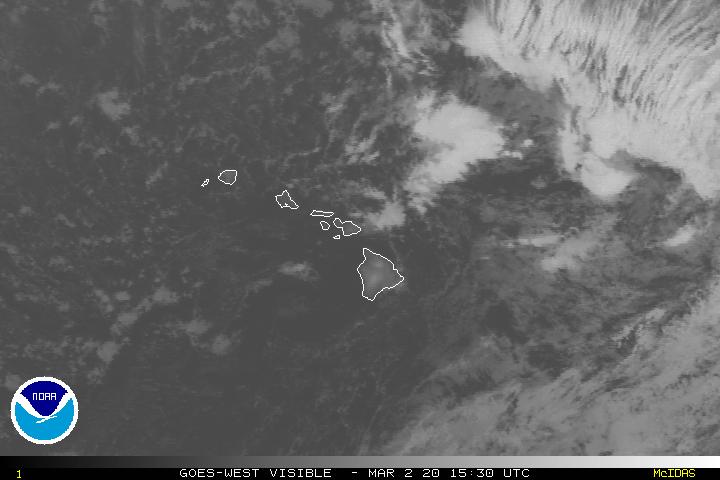
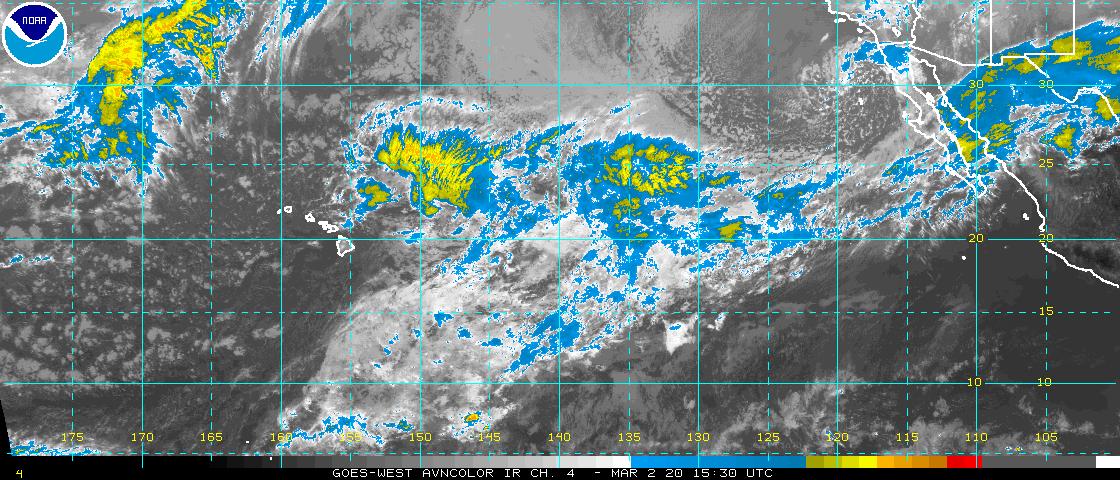
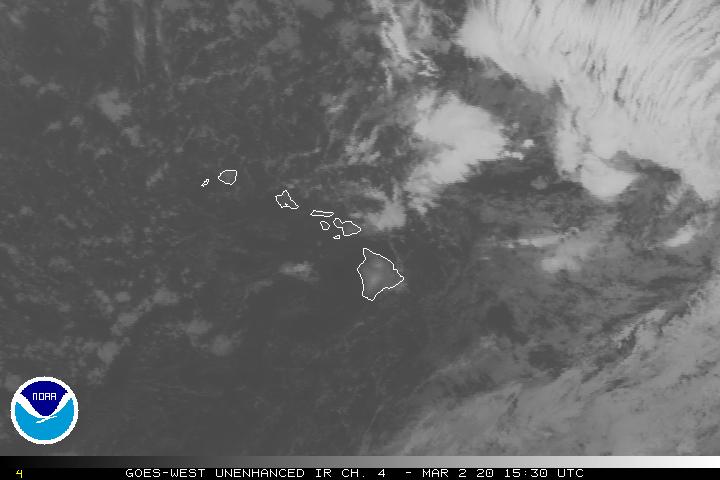
Satellite and Radar Images: To view the cloud conditions we have here in Hawaii, please use the following satellite links, starting off with this Infrared Satellite Image of the islands to see all the clouds around during the day and night. This next image is one that gives close images of the islands only during the daytime hours, and is referred to as a Close-up visible image. This next image shows a larger view of the Pacific…giving perspective to the wider ranging cloud patterns in the Pacific Ocean. Finally, here's a Looping IR satellite image, making viewable the clouds around the islands 24 hours a day. To help you keep track of where any showers may be around the islands, here’s the latest animated radar image.
Hawaii’s Mountains – Here’s a link to the live web cam on the summit of near 14,000 foot Mauna Kea on the Big Island of Hawaii. The tallest peak on the island of Maui is the Haleakala Crater, which is near 10,000 feet in elevation. These two web cams are available during the daylight hours here in the islands…and when there’s a big moon rising just after sunset for an hour or two! Plus, during the nights and early mornings you will be able to see stars, and the sunrise too…depending upon weather conditions.
Tropical Cyclone activity in the eastern and central Pacific – Here’s the latest weather information coming out of the National Hurricane Center, covering the eastern north Pacific. You can find the latest tropical cyclone information for the central north Pacific (where Hawaii is located) by clicking on this link to the Central Pacific Hurricane Center. Here’s a tracking map covering both the eastern and central Pacific Ocean. A satellite image, which shows the entire ocean area between Hawaii and the Mexican coast…can be found here. Of course, as we know, our hurricane season won't end until November 31st here in the central Pacific.
Aloha Paragraphs

Large surf on the north and west shores
Our winds will continue from the trade wind direction today, easing up Wednesday…before cooler air from the north to northeast arrives Thursday and Friday. This weather map shows two moderately strong high pressure systems to the northeast of the islands, with an associated ridge to our north and northwest. Our winds will be active from the trade wind direction, locally gusty today. The forecast continues showing that our winds will become noticeably lighter Wednesday, and then become cooler from the north and northeast Thursday and Friday. As we move into the later part of the weekend ahead, our local breezes will swing around through the southeast to southwest directions…ahead of a vigorous cold front.
Trade winds will give way to lighter winds Wednesday…the following numbers represent the strongest breezes early Tuesday evening, along with the directions:
22 mph Port Allen, Kauai – NE
24 Honolulu, Oahu – NE
23 Molokai – NNE
27 Kahoolawe – ESE
31 Maalaea Bay, Maui – NW
10 Lanai Airport – NE
24 South Point, Big Island – NE
We'll be moving into a generally dry convective weather pattern Wednesday. This large University of Washington satellite image shows a cold front far to our north and northwest…which has been hanging up there for the last several days. Looking at this next NOAA satellite picture, we see areas of low clouds coming into the state, with these rather minor patches being carried along in the trade wind flow. These showers will fall generally along the windward sides…although a few sprinkles may be carried over into the leeward sides on the smaller islands. Checking out this looping radar image we see that area of showers falling over the ocean near the Big Island, and a few more around Maui County… up through Oahu.
As noted in the paragraphs above, trade wind weather conditions are just about over…with their return not in sight. Tuesday continued the streak of pleasant weather that we saw Monday, with lots of sunshine, although with a few passing showers along the windward sides. An approaching weak cold front will help to knock our trade winds down Wednesday, and likely bring some showers to Kauai and Oahu by Thursday morning. This cloud band won't be a strong one, so that it will likely stall before pushing very far into the state. A period of cool north to northeast breezes will start to blow through this dissipating frontal boundary, bringing slightly cooler weather to the Aloha state. As we move into the upcoming weekend, a stronger cold front will begin making its way in our direction from the northwest. Winds will gradually shift to the east, southeast, and finally to the south and southwest ahead of this front. The cold front will likely bring a day or two of rainfall as it passes down through the island chain early next week.
~~~ Here in Kihei, Maui it was clear to partly cloudy early this evening. The trade winds are still blowing, although they will be less strong by Wednesday. A friend brought me a roll jammed with cooked fresh lobster meat for lunch. I haven't had any of that for a long time. This friends sister had eight lobsters air flown here from the east coast. I got invited for a full-on lobster dinner the other night, but couldn't make it, so it was fun to taste this luxury food again for lunch. The truth is that I felt sorry for the lobsters, and couldn't fathom being around them when they were stuck in the boiling water…or whatever. ~~~ I just got a call from a couple of friends who live in Wailea, asking if I wanted to come over for a drink and to watch the sunset. I had said no, but then had a second thought that I should start doing more socializing. I can get into a rut and just do the same things day after day, I find it so comfortable that way. At any rate, I'd better get a move on here, so I can go meet those ladies, and then get home fairly early, back up to Kula. I'll be back early Wednesday morning with your next new weather narrative, I hope you have a great Tuesday night until then! Aloha for now…Glenn.
Extra: Babies having a laugh
Interesting: A senior Chinese official has said it will take 300 years to turn back China's advancing deserts at the current rate of progress. Liu Tuo, who leads China's efforts to tackle the problem, said investment was "seriously insufficient."
More than one quarter of China is either covered by desert or is land that is suffering desertification. The process is often caused by overgrazing and other unsuitable farming techniques.
Authorities worry that expanding deserts could put crops and water supplies in the world's second largest economy at risk. But the official leading China's efforts against the problem said not enough was being done.
Liu Tuo said there was a "huge gap" in the country's efforts, adding that at current rates it would take 300 years to reclaim land which has recently become desert.
"There is about 0.67m sq miles of desertified land in China, and about 530,000 sq km of that can be treated," he said. "At our present rate of treating 1,717 sq km a year, I've just calculated we'll need 300 years."
He also warned that global warming could exacerbate the problem by causing drought. Most of the desertification in China happens on the fringes of the Gobi Desert which lies in the west of the country.
Interesting2: In order to maximize gold extraction, mercury is often used to amalgamate with the metal. The gold is then produced by boiling away the mercury from the amalgam, a process which is hazardous owing to the toxicity of mercury vapor. Mercury is effective in extracting very small gold particles, but should be reclaimed in an effective and safe process.
With the price of gold at record levels. the small-scale mining sector, much of it illegal and unregulated, is expanding worldwide faster than at anytime in history and, with it, the health threats posed by mercury. This global gold rush began in Brazil in the late 1970s, before sweeping South America, Asia, and Africa, with an estimated 15 to 20 million prospectors now active in more than 60 countries.
Poverty driven miners rely on inexpensive, outdated, polluting technologies and chemicals because it is what they can afford. Mercury can vaporize and exposure to concentrations above o.1 mg/m3 can be harmful. At this level, humans cannot detect the Mercury and can be exposed until harmed.
While most gold is produced by major corporations, tens of thousands of people work independently in smaller, artisan operations, in some cases illegal. In Ghana, for instance, the galamseys, independent mine workers, are estimated to number 20,000 to 50,000. In neighboring countries, such workers are called orpailleurs.
In Brazil, such workers are called garimpeiros. A total of about 165,000 tons of gold have been mined in human history, as of 2009. The world consumption of new gold produced is about 50% in jewelry, 40% in investments, and 10% in industry.
Gold mining is Colombia’s fastest growing industry, with 200,000 small-scale miners producing more than 50 percent of the country’s gold. This growth has turned Colombia into the world’s leading per-capita emitter of mercury, especially in states such as Antioquia.
Ground-level concentrations of mercury gas in gold-processing hamlets like Segovia are so high, experts fear the outbreak of an environmental health crisis worse than any caused by mercury since Minamata, Japan, where releases of mercury from a factory in the mid-20th century killed more than 1,700 people.
Mercury exposure has shown effects such as tremors, impaired cognitive skills, and sleep disturbance in workers with chronic exposure to mercury vapor even at low concentrations Slightly higher exposure have resulted in chest pain, dyspnea, cough, hemoptysis, impairment of pulmonary function, and evidence of interstitial pneumonitis.
Acute exposure to mercury vapor has been shown to result in profound central nervous system effects, including psychotic reactions characterized by delirium, hallucinations, and suicidal tendency.
After the birth of industrial-scale mining in the late 19th century, small-scale mining receded to the corners of crumbling, impoverished Columbian states, offering a refuge for the poor. Unlike larger scale industrial mining operations, small scale mines never abandoned mercury.
Cheap, abundant, and easy to use, mercury used in gold mining causes significant mercury pollution. But because of a widespread perception that small-scale mining was no longer a global force, serious efforts to document these toxic emissions only began recently.
In Colombia, two modest technical adjustments (adding mercury after, rather than during, the grinding of ores, and capturing its vapor in ovens) could eliminate nearly all mercury emissions. However, most miners and processors lack the resources to change.
Interesting3: The first Chevrolet Volts, Nissan Leafs, and Smart EDs were delivered in December, but in the annals of history 2011 will be remembered as the year that electric vehicles (EVs) arrived. EVs for sale to consumers will dominate the headlines throughout the year as average Americans begin to recognize EVs as they roll down the road.
Because of the stalled start in the 1990s, when consumers were tempted by and then denied access to GM's EV1 and other EVs, every milestone during the year will be magnified in the media. By year's end nearly 50,000 EVs will be plugging in at garages and lots across America.
The arrival of new models from automakers Think, Coda, Mitsubishi, Mini, Toyota and Chevrolet (a few of which were delayed from 2010) will give consumers more options and be closely tracked. Any missteps — and there will be some — will be cause celebre for the EV doubters who don't believe in or desire a move away fossil fuels.
Humans have always been fallible in designing and operating vehicles, and replacing liquid fuel with electrons won't change that. While considerable safeguards have been put in place to prevent accidents when charging a vehicle, somewhere someone will find a creative way for failure, and we can expect considerable fanfare by the naysayers when this inevitably occurs.
Any of the important trends we've identified at Pike Research for 2011 will be the slow subsiding of the catch phrase "range anxiety." Range anxiety is the supposed fear that both prevents consumers from wanting to buy an EV with a 80-100 mile range or from driving said car very far for fear that the batteries will run out, leaving the driver stranded. Range anxiety has been overblown, underestimating drivers' ability to monitor their battery charge level through the various dashboard displays and auditory prompts.
Interesting4: There is a lot of plastic trash floating in the Pacific Ocean, but claims that the "Great Garbage Patch" between California and Japan is twice the size of Texas are grossly exaggerated, according to an analysis by an Oregon State University scientist. Further claims that the oceans are filled with more plastic than plankton, and that the patch has been growing tenfold each decade since the 1950s are equally misleading, pointed out Angelicque "Angel" White, an assistant professor of oceanography at Oregon State.
"There is no doubt that the amount of plastic in the world's oceans is troubling, but this kind of exaggeration undermines the credibility of scientists," White said. "We have data that allow us to make reasonable estimates; we don't need the hyperbole. Given the observed concentration of plastic in the North Pacific, it is simply inaccurate to state that plastic outweighs plankton, or that we have observed an exponential increase in plastic."
White has pored over published literature and participated in one of the few expeditions solely aimed at understanding the abundance of plastic debris and the associated impact of plastic on microbial communities. That expedition was part of research funded by the National Science Foundation through C-MORE, the Center for Microbial Oceanography: Research and Education.
The studies have shown is that if you look at the actual area of the plastic itself, rather than the entire North Pacific subtropical gyre, the hypothetically "cohesive" plastic patch is actually less than 1 percent of the geographic size of Texas.
"The amount of plastic out there isn't trivial," White said. "But using the highest concentrations ever reported by scientists produces a patch that is a small fraction of the state of Texas, not twice the size."
Another way to look at it, White said, is to compare the amount of plastic found to the amount of water in which it was found. "If we were to filter the surface area of the ocean equivalent to a football field in waters having the highest concentration (of plastic) ever recorded," she said, "the amount of plastic recovered would not even extend to the 1-inch line."
Recent research by scientists at the Woods Hole Oceanographic Institution found that the amount of plastic, at least in the Atlantic Ocean, hasn't increased since the mid-1980s — despite greater production and consumption of materials made from plastic, she pointed out.
"Are we doing a better job of preventing plastics from getting into the ocean?" White said. "Is more plastic sinking out of the surface waters? Or is it being more efficiently broken down? We just don't know. But the data on hand simply do not suggest that 'plastic patches' have increased in size. This is certainly an unexpected conclusion, but it may in part reflect the high spatial and temporal variability of plastic concentrations in the ocean and the limited number of samples that have been collected."
The hyperbole about plastic patches saturating the media rankles White, who says such exaggeration can drive a wedge between the public and the scientific community. One recent claim that the garbage patch is as deep as the Golden Gate Bridge is tall is completely unfounded, she said. "Most plastics either sink or float," White pointed out. "Plastic isn't likely to be evenly distributed through the top 100 feet of the water column."
White says there is growing interest in removing plastic from the ocean, but such efforts will be costly, inefficient, and may have unforeseen consequences. It would be difficult, for example, to "corral" and remove plastic particles from ocean waters without inadvertently removing phytoplankton, zooplankton, and small surface-dwelling aquatic creatures.
"These small organisms are the heartbeat of the ocean," she said. "They are the foundation of healthy ocean food chains and immensely more abundant than plastic debris." The relationship between microbes and plastic is what drew White and her C-MORE colleagues to their analysis in the first place. During a recent expedition, they discovered that photosynthetic microbes were thriving on many plastic particles, in essence confirming that plastic is prime real estate for certain microbes.
White also noted that while plastic may be beneficial to some organisms, it can also be toxic. Specifically, it is well-known that plastic debris adsorbs toxins such as PCB. "On one hand, these plastics may help remove toxins from the water," she said. "On the other hand, these same toxin-laden particles may be ingested by fish and seabirds. Plastic clearly does not belong in the ocean."
Among other findings, which White believes should be part of the public dialogue on ocean trash:
• Calculations show that the amount of energy it would take to remove plastics from the ocean is roughly 250 times the mass of the plastic itself;
• Plastic also covers the ocean floor, particularly offshore of large population centers. A recent survey from the state of California found that 3 percent of the southern California Bight's ocean floor was covered with plastic — roughly half the amount of ocean floor covered by lost fishing gear in the same location. But little, overall, is known about how much plastic has accumulated at the bottom of the ocean, and how far offshore this debris field extends;
• It is a common misperception that you can see or quantify plastic from space. There are no tropical plastic islands out there and, in fact, most of the plastic isn't even visible from the deck of a boat;
• There are areas of the ocean largely unpolluted by plastic. A recent trawl White conducted in a remote section of water between Easter Island and Chile pulled in no plastic at all.
There are other issues with plastic, White said, including the possibility that floating debris may act as a vector for introducing invasive species into sensitive habitats. "If there is a takeaway message, it's that we should consider it good news that the 'garbage patch' doesn't seem to be as bad as advertised," White said, "but since it would be prohibitively costly to remove the plastic, we need to focus our efforts on preventing more trash from fouling our oceans in the first place."
Interesting5: Visitors to the Big Island of Hawaii eager to see lava from Kilauea volcano as it approaches the Puna coastline will soon get a better, closer look at the flow. The current Kalapana coastline viewing area, maintained by Hawaii County Civil Defense, will be extended over freshly hardened lava flows, according to the Associated Press. What this means for visitors making the long drive to the site from Hilo or Kona is the best view of the lava flow in recent months.
According to Hawaiian Volcano Observatory geologists, one of two current breakout Kilauea lava flows in the Kalapana area had advanced within 100 feet of the end of Highway 130 as of 1 p.m., Sunday. The trail to the viewing area typically begins near the end of the highway, depending on the position, speed and direction of the lava flow on any given day.
Big Island Civil Defense officials did not immediately announce when the lava viewing area would be extended. Currently, no lava flows from Kilauea volcano are entering the ocean. News of the improved vantage point for visitors arrives at an ideal time for Kilauea watchers.
The Big Island’s second annual Volcano Awareness Month runs through the entirety of January, organized by Hawaiian Volcano Observatory with Hawaii Volcanoes National Park, Hawaii County Civil Defense and the University of Hawaii at Hilo.
The park will host evening talks, guided hikes and other opportunities to learn more about volcanoes, especially the Big Island’s active volcanoes, Kilauea and Mauna Loa. January 3 marked the 28th anniversary of the start of the current Kilauea eruption, on the volcano’s east rift zone.
The eruption remains as active as ever in two locations—on the east rift zone, and at Kilauea summit’s Halemaumau crater. In the last year, lava flows from the eruption destroyed two homes in Kalapana Gardens — the same area where lava destroyed 104 structures in 1990.
 Email Glenn James: