January 21-22, 2011
Air Temperatures – The following maximum temperatures were recorded across the state of Hawaii Friday afternoon:
Lihue airport, Kauai – 79
Honolulu airport, Oahu – 83
Kaneohe, Oahu – 82
Molokai airport – 81
Kahului airport, Maui – 83
Kona airport – 81
Hilo airport, Hawaii – 80
Air Temperatures ranged between these warmest and coolest spots near sea level – and on the highest mountain tops…as of 5pm Friday evening:
Honolulu, Oahu – 80F
Molokai airport – 73
Haleakala Crater – missing (near 10,000 feet on Maui)
Mauna Kea summit – 36 (near 14,000 feet on the Big Island)
Precipitation Totals – The following numbers represent the largest precipitation totals (inches) during the last 24 hours on each of the major islands, as of Friday evening:
1.47 Mount Waialeale, Kauai
0.46 Nuuanu Upper, Oahu
0.00 Molokai
0.00 Lanai
0.00 Kahoolawe
0.18 West Wailuaiki, Maui
0.22 Glenwood, Big Island
Marine Winds – Here’s the latest (automatically updated) weather map showing a 1030 millibar high pressure system to our northeast…with a high pressure ridge to the north and northwest of Kauai. Our winds will be blow in the light to locally moderate range, although locally stronger…from the trade wind direction Saturday and Sunday.
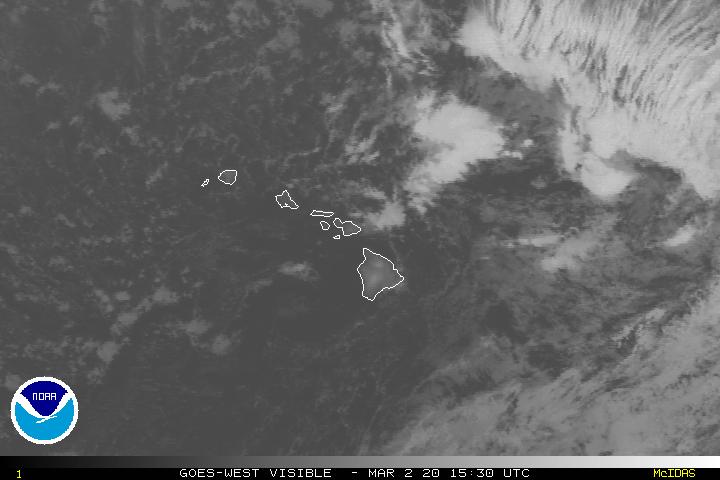
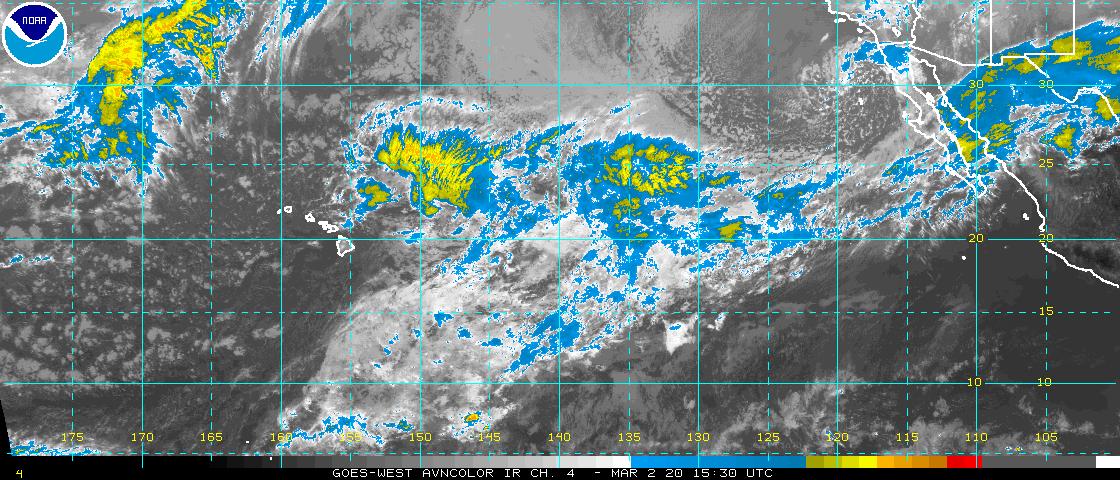
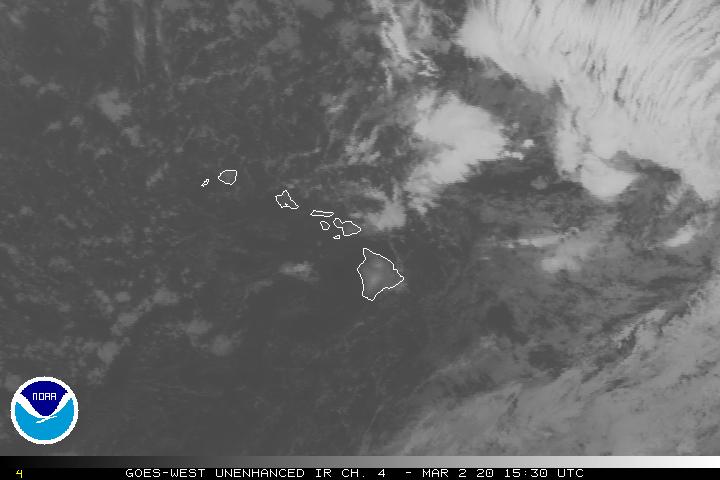
Satellite and Radar Images: To view the cloud conditions we have here in Hawaii, please use the following satellite links, starting off with this Infrared Satellite Image of the islands to see all the clouds around during the day and night. This next image is one that gives close images of the islands only during the daytime hours, and is referred to as a Close-up visible image. This next image shows a larger view of the Pacific…giving perspective to the wider ranging cloud patterns in the Pacific Ocean. Finally, here's a Looping IR satellite image, making viewable the clouds around the islands 24 hours a day. To help you keep track of where any showers may be around the islands, here’s the latest animated radar image.
Hawaii’s Mountains – Here’s a link to the live web cam on the summit of near 14,000 foot Mauna Kea on the Big Island of Hawaii. The tallest peak on the island of Maui is the Haleakala Crater, which is near 10,000 feet in elevation. These two web cams are available during the daylight hours here in the islands…and when there’s a big moon rising just after sunset for an hour or two! Plus, during the nights and early mornings you will be able to see stars, and the sunrise too…depending upon weather conditions.
Tropical Cyclone activity in the eastern and central Pacific – Here’s the latest weather information coming out of the National Hurricane Center, covering the eastern north Pacific. You can find the latest tropical cyclone information for the central north Pacific (where Hawaii is located) by clicking on this link to the Central Pacific Hurricane Center. Here’s a tracking map covering both the eastern and central Pacific Ocean. A satellite image, which shows the entire ocean area between Hawaii and the Mexican coast…can be found here. Of course, as we know, our hurricane season won't end until November 31st here in the central Pacific.
Aloha Paragraphs

Trade winds through the weekend…nice weather
Trade winds, light to moderately strong, although locally stronger through the next several days…then becoming lighter by the middle of the new week. This weather map shows a moderately strong 1030 millibar high pressure system far to our northeast, with its associated ridge of high pressure (orange zigzag line) extending southwest, to the north and northwest of the islands. Our local winds will remain active, with little change expected through the first part of the upcoming work week.
Trade winds will continue to blow, strongest around Maui County and the Big Island…the following numbers represent the strongest gusts, along with directions early Friday evening:
23 mph Port Allen, Kauai – ESE
21 Kahuku, Oahu – ENE
09 Molokai – NE
37 Kahoolawe – ESE
25 Kahului, Maui – E
08 Lanai Airport – NE
30 South Point, Big Island – NE
The trade winds will carry cloud patches towards our windward coasts and slopes…with generally clear to partly cloudy skies prevailing over the leeward coasts. This large University of Washington satellite image shows an area of high level clouds to our north, associated with a cold front that won't make it south to our islands. At the same time, there are low clouds traveling along in the trade wind flow from the east. Looking at this NOAA satellite picture, it shows fairly minor bands of cumulus clouds to our east, which will keep the north and east facing windward sides partly cloudy…with cloudy periods at times.
Showers will fall at times on our windward sides, with generally nice weather prevailing on our south and west facing leeward beaches. We can use this looping satellite image to see a common trade wind cloud pattern in our latitudes of the north central Pacific. There are frontal clouds to our north, and a few very minor thunderstorms well to our south. Checking out this looping radar image it shows a few light showers embedded in the trade wind flow, approaching the windward sides of the islands, although there shouldn't be any heavy showers.
The bottom line here is that generally fair weather will prevail, with the trade winds blowing, and the large waves gradually coming down along our north and west shores. The trade winds will be strongest near Maui County and the Big Island, where we'll see gusts hovering around the 40 mph mark in those windiest locations. The surf will gradually come down over the next few days, then come back up on Monday! Otherwise, our weather through this weekend will be fine, with just those off and on showers falling at times along our windward sides. The leeward areas will be the best place for beaching, as the waves will be smallest there, with the best chances for warm sunshine.. ~~~ I'm running late, as I want to catch a new film this evening, and will be staying here in Kihei to do that, rather than going to Kahului. I'm going to see an action film called The Green Hornet, and will be sure to let you know what I think in the morning, together with your next new weather narrative. Don't forget, I'm leaving Sunday for Seatlle, and will be gone a week and two days later. I hope you have a great Friday night! Aloha for now. Aloha for now…Glenn.
Interesting: A survey of a remote forest area in Madagascar turned up seven new groups of silky sifaka, a critically endangered lemur threatened by habitat destruction. The finding raises hope that the species—which is listed as one of the world's 25 most endangered primates—is surviving in Marojejy National Park despite an outbreak of illegal rosewood logging in 2009 and 2010.
The seven week expedition was led by Cornell University's Erik Patel, who heads SIMPONA, a non-profit organization that aims to protect the silky sifaka and its habitat. Patel's team has found 31 silky sifaka groups consisting of 131 total individuals in Marojejy National Park in the past few years. SIMPONA was joined in the most recent survey by Madagascar National Parks, Madagascar's protected areas authority.
"I am encouraged by our latest survey results," Patel told mongabay.com. "Our latest survey region had been heavily impacted by illegal rosewood extraction in 2004/5 and 2009/2010. It was a relief that we did not find any active rosewood logging…We are all just grateful that Marojejy National Park remains so much calmer than Masoala National Park, for example, where illegal rosewood logging continues at a high level."
The survey, which assessed 24 square kilometers of rugged terrain, counted 23 individuals among the seven groups. Patel said the number is relatively low given the area assessed, but noted that the silky sifaka has "patchy" population distribution, making it difficult to extrapolate the total population for the species.
Interesting2: College is a time of learning, expanding the mind and gaining new skills, right? Not so much, according to a new study. By the end of sophomore year, 45 percent of students show no significant improvement in critical thinking, writing and complex reasoning, the Associated Press reports.
The findings come from a study of more than 2,300 undergraduates published in a new book, "Academically Adrift: Limited Learning on College Campuses" (University of Chicago Press, 2011) by New York University sociologist Richard Arum and University of Virginia sociologist Jospia Roksa.
Students didn't get a brain boost in their last two years of college either, the study found. After four years, 36 percent of students failed to demonstrate significant academic improvement. The findings are the latest in a series of bad news about today's college students.
Recent research has found that mental health problems are on the rise among university students. Another study found that college students are "addicted" to social media, which can affect their grades.
The authors of the new report blame students who seek easy courses and fail to study, as well as colleges that value research over teaching, for the lack of learning. Students who studied harder, read and wrote more and majored in traditional art and science fields were most likely to learn in college, the study found.
Interesting3: Single, holding a leadership position at work, and living in a large city: This is the profile of the average "green" citizen of China, according to a new study. Of these traits, it's the last one that took researchers by surprise. "One of the things we did not anticipate is the major difference between big cities and small cities," Jianguo Liu, a co-author of the study appearing online Jan. 18 in the journal Environmental Conservation, told LiveScience.
Residents of larger cities like Beijing, Shanghai and Tianjin reported engaging significantly more in environmentally friendly behavior, such as recycling plastic bags, than residents of smaller cities, Liu and colleagues found. The study analyzed data collected in 2003 from 5,073 Chinese respondents as part of the China's General Social Survey.
That survey, which is ongoing and being conducted by Hong Kong University of Science and Technology and by Renmin University of China, did not have complete data on all rural regions. Liu, who is the Rachel Carson Sustainability Chair at Michigan State University, speculated there are two reasons for the difference: Big cities experience the environmental problems first, and big-city residents have more opportunity for environmental education.
The survey asked participants whether they had engaged in one or more of six "green" behaviors in the previous year: recycling plastic bags, sorting garbage to separate recyclables, talking about environmental issues, volunteering for an environmental organization, participating in environmental education, or participating in litigation. The survey also collected a variety of demographic data.
Work also appeared to be an important factor. The analysis indicated that employed people and those in leadership positions at work reported more "green" actions than their counterparts did. This indicates that people may be exposed to the diffusion of environmental values through the workplace, the researchers write. Income, however, appeared to have only a weak effect.
The study has implications for an economy that has grown the fastest of any major nation over the past three decades, and its environment has suffered, the study's authors write. China is the world's largest contributor of carbon dioxide, atmospheric sulphur oxides and chlorofluorocarbons, the researchers write, and acid rain fell on more than a quarter of Chinese cities during the 1990s.
China has a top-down culture with respect to government and policy, and past research found a lack of sense of personal responsibility, as people tended to think protecting the environment was the government's job. This is consistent with the fact that people in leadership positions, those perceived to have more ability to effect change, were more likely to take action, the authors write.
Ultimately, the answer is a combination, Liu said. For example, in addressing climate change, "the government is crucial to initiate a lot of policies or incentives or disincentives to steer people's actions to help the environment in the long run, and also help people and the economy," he said.
Individuals, too, need to take responsibility, he said. "In the past we tend to blame industry for environmental problems, but actually everyone has responsibility for environmental problems, because we all consume resources and generate demand for products."
 Email Glenn James: