











January 15-16, 2011
Air Temperatures – The following maximum temperatures were recorded across the state of Hawaii Saturday afternoon:
Lihue airport, Kauai – 79
Honolulu airport, Oahu – 81
Kaneohe, Oahu – 78
Molokai airport – 79
Kahului airport, Maui – 82
Kona airport – 79
Hilo airport, Hawaii – 80
Air Temperatures ranged between these warmest and coolest spots near sea level – and on the highest mountain tops…as of 9pm Saturday evening:
Barking Sands, Kauai – 78F
Hilo, Hawaii – 68
Haleakala Crater – missing (near 10,000 feet on Maui)
Mauna Kea summit – missing (near 14,000 feet on the Big Island)
Precipitation Totals – The following numbers represent the largest precipitation totals (inches) during the last 24 hours on each of the major islands, as of Saturday afternoon:
0.40 Puu Lua, Kauai
0.02 Palehua, Oahu
0.00 Molokai
0.00 Lanai
0.00 Kahoolawe
0.00 Maui
0.12 Kealakekua, Big Island
Marine Winds – Here’s the latest (automatically updated) weather map showing a moderately strong high pressure to our northeast, with an associated high pressure ridge extending from its center to over the islands. Our winds will be light from the southeast…then strengthening Sunday from the south to southwest. Monday will have blustery northwest winds.
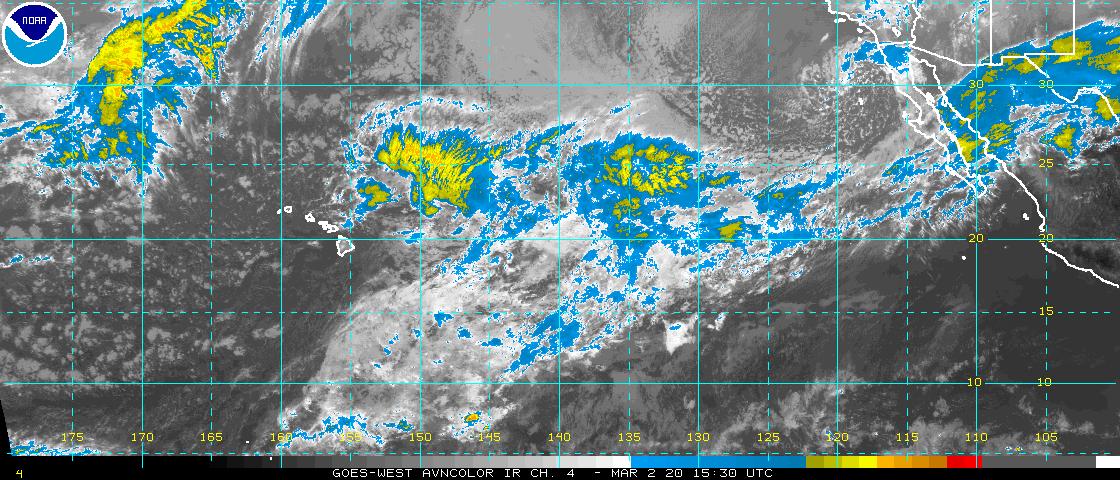
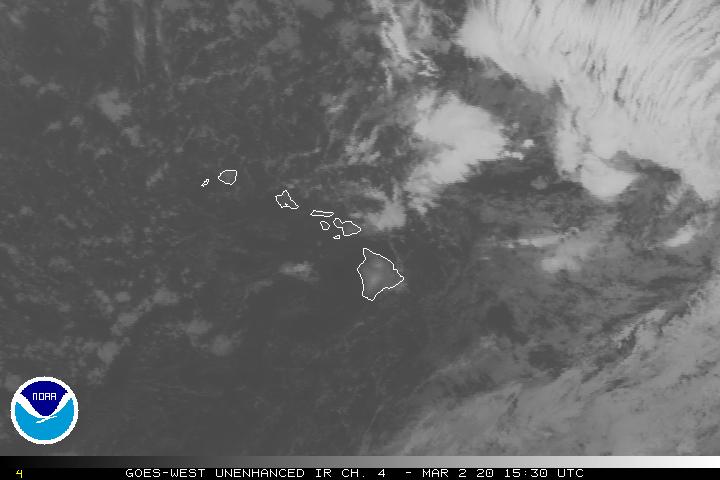
Satellite and Radar Images: To view the cloud conditions we have here in Hawaii, please use the following satellite links, starting off with this Infrared Satellite Image of the islands to see all the clouds around during the day and night. This next image is one that gives close images of the islands only during the daytime hours, and is referred to as a Close-up visible image. This next image shows a larger view of the Pacific…giving perspective to the wider ranging cloud patterns in the Pacific Ocean. Finally, here's a Looping IR satellite image, making viewable the clouds around the islands 24 hours a day. To help you keep track of where any showers may be around the islands, here’s the latest animated radar image.
Hawaii’s Mountains – Here’s a link to the live web cam on the summit of near 14,000 foot Mauna Kea on the Big Island of Hawaii. The tallest peak on the island of Maui is the Haleakala Crater, which is near 10,000 feet in elevation. These two web cams are available during the daylight hours here in the islands…and when there’s a big moon rising just after sunset for an hour or two! Plus, during the nights and early mornings you will be able to see stars, and the sunrise too…depending upon weather conditions.
Tropical Cyclone activity in the eastern and central Pacific – Here’s the latest weather information coming out of the National Hurricane Center, covering the eastern north Pacific. You can find the latest tropical cyclone information for the central north Pacific (where Hawaii is located) by clicking on this link to the Central Pacific Hurricane Center. Here’s a tracking map covering both the eastern and central Pacific Ocean. A satellite image, which shows the entire ocean area between Hawaii and the Mexican coast…can be found here. Of course, as we know, our hurricane season won't end until November 31st here in the central Pacific.
Aloha Paragraphs

Locally very high surf Sunday…cold front arriving too
Winds will be generally light, although locally stronger…then increase from the south to southwest Kona directions Sunday. These breezes will increase ahead of our next cold front Sunday into Monday. This weather map shows a high pressure system to our northeast, with an associated ridge of high pressure extending southwest, to a position over the islands Saturday night. These breezes have carried a bit of volcanic haze (vog) over some of the smaller islands. As noted above, winds will pick up ahead of our next cold front. A following high pressure system will veer the winds around to the northwest in the wake of the cold front briefly. Then, as we move through the upcoming new work week, we'll likely see easterly trade winds returning to the Aloha state.
Winds are generally quite light at the moment, although locally stronger…the following numbers represent the strongest gusts, along with directions Saturday night:
06 mph Port Allen, Kauai – NE
10 Kahuku, Oahu – NE
07 Molokai – NNE
27 Kahoolawe – E
21 Lipoa, Maui – SE
06 Lanai Airport – NE
27 South Point, Big Island – NE
Saturday was generally a pretty nice day, although there were clouds around…and some volcanic haze too. This large University of Washington satellite image shows areas of low clouds around Saturday night, although generally clear skies prevailed. At the same time we can see the rather dynamic looking cold front approaching from the northwest. Looking at this NOAA satellite picture, shows clear to partly cloudy skies. We can see the ragged leading edge of the cold front to our northwest, coming almost within striking distance of Kauai. The Garden Isle of Kauai is expected to see the front's clouds and showers arriving Sunday morning.
At noted above, we had decent weather around during this first part of the weekend. This next cold front will bring more rain however, with a chance of a few more thunderstorms popping-up Sunday into the night. We can use this looping satellite image to keep track of this cold front as it heads our way. Checking out this looping radar image confirms that there aren't very many showers around, which should continue to be the case into early Sunday. Rainfall will increase as we move through Sunday, some of which may become locally heavy. The Big Island will be last to see this precipitation, as it arrives there Sunday night or early Monday morning.
Several days ago we found a deep storm low pressure system to our northwest…which has generated an unusually large swell train of waves in our direction. This surf will arrive Saturday night, and bring dangerously large surf to some of our local beaches Sunday into Monday. The storm occurred in more southern latitudes of the Pacific Ocean than normal. This in turn will make for a west-northwest swell, rather than the usual northwest swell. There will be some island blocking of this swell, so that it won't get into all areas. Everyone should be careful when they go to many of our local beaches Sunday, where they'll find very large waves breaking. A high surf warning and high surf advisories have been issued by the NWS forecast office in Honolulu in response.
Friday evening when I got off work I went to see a new film called King's Speech. I had several friends recommend this film to me, and I ended up liking it very much! The critics are giving this film an A grade, while viewers gave it an A- rating. Personally, I have no reason to add a minus to the A grade I see fit to give. It was outstanding, really one of the best films that I've seen in quite awhile. The stars were Colin Firth, Geoffrey Rush, and Helena Bonham Carter…among many others. The synopsis: George VI, also known as Bertie, reluctantly takes the throne of England when his brother, Edward, abdicates in 1936. The unprepared king turns to a radical speech therapist, Lionel Logue, to help overcome his nervous stutter and the two forge a friendship. Here's a trailer for this great film.
It's Saturday night here in Kula, Maui. The air temperature was 56.1F degrees at around 930pm. Clouds collected around the mountains, at least here on Maui today, with even fog for a short period. The beaches remained quite sunny in contrast to around the mountains…although those clouds have cleared out after dark. Saturday night looks like it will be fine, with the well advertised cold front's clouds reaching Kauai Sunday morning. Many areas of the state will remain just fine Sunday, until the frontal cloud band arrives. Again, I want to say that the surf will be very large in some areas Sunday into Monday, be very careful if you go near the ocean at these beaches! I'll be back Sunday morning with your next new weather narrative, with more current information about the cold front. You can use the satellite images above to track the approach of these soon to be increasing clouds. I hope you have a great Saturday night until then! Aloha for now…Glenn.
Interesting: Forecasting the weather can be a tricky business, especially in winter. When a winter storm approaches, forecasts can range widely across the board from light flurries to a blizzard. As many know, the jet stream over the North American continent moves west to east. That is why the National Oceanic and Atmospheric Administration (NOAA) is dispatching its state of the art aircraft to gather atmospheric data over the North Pacific Ocean, the region where North America's weather originates.
NOAA's new aircraft is highly specialized to collect data which can be analyzed for predicting weather intensities and storm tracks. It is a high-altitude twin-engine Gulfstream IV-SP jet that will be stationed at Yokota Air Force Base in Japan, but will be later moved to Honolulu, Hawaii. Data that will be collected include wind speed & direction, air pressure, temperature, humidity, and more. This data will then be transmitted to forecasting centers where they will be plugged into sophisticated computer models.
"Data collected from these flights will help provide a more refined snapshot of the atmosphere, which in turn improves forecasts," said Louis Uccellini, Ph.D., director of the National Centers for Environmental Prediction, in Camp Springs, Md. From the western side of the Pacific, they can see storms advancing towards North America well in advance. Although the west coast does not experience hurricane-like storms, winter storms can be particularly brutal.
"By expanding our reach to Japan, we are able to gather data upstream of winter storms, thereby gaining more lead time for emergency managers and responders to prepare for the impacts of severe winter weather on lives and property," said meteorologist and flight director Jack Parrish with the NOAA Office of Marine and Aviation Operations. The NOAA aircraft are being deployed by the National Centers for Environmental Prediction, a division of NOAA’s National Weather Service.
Interesting2: Think small variations in temperature and precipitation levels don't have much of an impact? Guess again. A prolonged period of wet weather spurred the spread of the Bubonic plague in medieval times, according to a new study. And a 300-year spell of unpredictable weather coincided with the decline of the Roman Empire.
Climate change wasn't necessarily the cause of these and other major historical events, researchers say. But the study, which pieced together a year-by-year history of temperature and precipitation in Western Europe, dating back 2,500 years, offers the most detailed picture yet of how climate and society have been intertwined for millennia.
"We need to have a better understanding about the ancient climate system and its variability to understand the modern situation," said Ulf Büntgen, a paleoclimatologist at the Swiss Federal Research Institute in Zurich. "It does not provide any predictions. But it helps us take it as something to be considered."
Büntgen and colleagues collaborated with archaeologists to amass a database of more than 9,000 pieces of wood dating back 2,500 years. Samples came from both live trees and remains of buildings and other wooden artifacts, all from France and Germany. By measuring the width of annual growth rings in the wood, the researchers were able to determine temperature and precipitation levels on a year-by-year basis.
Interesting3: Last year tied with 2005 as the warmest on record, according to U.S. agencies, but is likely to be overtaken soon by the next year with a strong El Nino weather event, experts say. A gradual build-up of greenhouse gases from human activities is heating the planet but natural events such as El Nino, which every few years warms the surface of the eastern and central Pacific Ocean, can have a far bigger immediate impact.
"It will take an El Nino year to break the record, so possibly the next one," said professor Phil Jones of the Climatic Research Unit at the University of East Anglia in Britain. On Wednesday, the U.S. National Climatic Data Center (NCDC) and NASA's Goddard Institute for Space Studies said 2010 tied with 2005 as the warmest year since reliable data started in 1880, capping a decade of record temperatures.
Last year started with an El Nino, as did 2005 and 1998 which is rated the warmest year by the U.N.'s World Meteorological Organization (WMO). The WMO is likely to give a view of 2010's ranking in late January, after compiling temperature data that is also due from Jones' unit alongside NCDC and NASA. El Nino can disrupt world weather, with effects on everything from food to energy prices.
Knut Alfsen, research director at the Center for International Climate and Environmental Research in Oslo, said greenhouse gases from human activities caused the Earth to absorb more energy than it radiated into space. "Most of that energy goes into the oceans — so a record depends on the behavior of the oceans, typically an El Nino or La Nina event," he said.
Interesting4: The magnitude of climate change during Earth's deep past suggests that future temperatures may eventually rise far more than projected if society continues its pace of emitting greenhouse gases, a new analysis concludes. The study, by National Center for Atmospheric Research (NCAR) scientist Jeffrey Kiehl, will appear as a "Perspectives" piece in this week's issue of the journal Science.
Building on recent research, the study examines the relationship between global temperatures and high levels of carbon dioxide in the atmosphere tens of millions of years ago. It warns that, if carbon dioxide emissions continue at their current rate through the end of this century, atmospheric concentrations of the greenhouse gas will reach levels that existed about 30 million to 100 million years ago, when global temperatures averaged about 29 degrees Fahrenheit above pre-industrial levels.
Kiehl said that global temperatures may gradually rise over centuries or millennia in response to the carbon dioxide. The elevated levels of carbon dioxide may remain in the atmosphere for tens of thousands of years, according to recent computer model studies of geochemical processes that the study cites.
The study also indicates that the planet's climate system, over long periods of times, may be at least twice as sensitive to carbon dioxide than currently projected by computer models, which have generally focused on shorter-term warming trends. This is largely because even sophisticated computer models have not yet been able to incorporate critical processes, such as the loss of ice sheets, that take place over centuries or millennia and amplify the initial warming effects of carbon dioxide.
"If we don't start seriously working toward a reduction of carbon emissions, we are putting our planet on a trajectory that the human species has never experienced," says Kiehl, a climate scientist who specializes in studying global climate in Earth's geologic past. "We will have committed human civilization to living in a different world for multiple generations."
The Perspectives article pulls together several recent studies that look at various aspects of the climate system, while adding a mathematical approach by Kiehl to estimate average global temperatures in the distant past. Its analysis of the climate system's response to elevated levels of carbon dioxide is supported by previous studies that Kiehl cites. The work was funded by the National Science Foundation, NCAR's sponsor.
Learning from Earth's past
Kiehl focused on a fundamental question: when was the last time Earth's atmosphere contained as much carbon dioxide as it may by the end of this century? If society continues on its current pace of increasing the burning of fossil fuels, atmospheric levels of carbon dioxide are expected to reach about 900 to 1,000 parts per million by the end of this century. That compares with current levels of about 390 parts per million, and pre-industrial levels of about 280 parts per million.
Since carbon dioxide is a greenhouse gas that traps heat in Earth's atmosphere, it is critical for regulating Earth's climate. Without carbon dioxide, the planet would freeze over. But as atmospheric levels of the gas rise, which has happened at times in the geologic past, global temperatures increase dramatically and additional greenhouse gases, such as water vapor and methane, enter the atmosphere through processes related to evaporation and thawing. This leads to further heating.
Kiehl drew on recently published research that, by analyzing molecular structures in fossilized organic materials, showed that carbon dioxide levels likely reached 900 to 1,000 parts per million about 35 million years ago.
At that time, temperatures worldwide were substantially warmer than at present, especially in polar regions — even though the Sun's energy output was slightly weaker. The high levels of carbon dioxide in the ancient atmosphere kept the tropics at about 9-18 degrees F above present-day temperatures. The polar regions were some 27-36 degrees F above present-day temperatures.
Kiehl applied mathematical formulas to calculate that Earth's average annual temperature 30 to 40 million years ago was about 88 degrees F — substantially higher than the pre-industrial average temperature of about 59 degrees F.
Twice the heat?
The study also found that carbon dioxide may have at least twice the effect on global temperatures than currently projected by computer models of global climate. The world's leading computer models generally project that a doubling of carbon dioxide in the atmosphere would have a heating impact in the range of 0.5 to 1.0 degree C watts per square meter.(The unit is a measure of the sensitivity of Earth's climate to changes in greenhouse gases.) However, the published data show that the comparable impact of carbon dioxide 35 million years ago amounted to about 2 degrees C watts per square meter.
Computer models successfully capture the short-term effects of increasing carbon dioxide in the atmosphere. But the record from Earth's geologic past also encompasses longer-term effects, which accounts for the discrepency in findings. The eventual melting of ice sheets, for example, leads to additional heating because exposed dark surfaces of land or water absorb more heat than ice sheets.
"This analysis shows that on longer time scales our planet may be much more sensitive to greenhouse gases than we thought," Kiehl says. Climate scientists are currently adding more sophisticated depictions of ice sheets and other factors to computer models. As these improvements come on line, Kiehl believes that the computer models and the paleoclimate record will be in closer agreement, showing that the impacts of carbon dioxide on climate over time will likely be far more substantial than recent research has indicated.
Because carbon dioxide is being pumped into the atmosphere at a rate that has never been experienced, Kiehl could not estimate how long it would take for the planet to fully heat up. However, a rapid warm-up would make it especially difficult for societies and ecosystems to adapt, he says. If emissions continue on their current trajectory, "the human species and global ecosystems will be placed in a climate state never before experienced in human history," the paper states.
Interesting5: High speed rail is considered the holy grail of mass transit planning, and touted as a necessity for advanced economies. America is often derided for not having any high speed rail networks, while other advanced nations in Europe and Asia have them well established. A new report from the group America 2050 outlines the areas of the United States which have the greatest potential to support a high speed rail network.
America 2050 is a national organization whose mission is to help solve the nation's economic, environmental, and infrastructure challenges as America's population increases by 130 million by the year 2050. One step to further that goal is the identification of megaregions which are large networks of metropolitan areas. These megaregions will be the location of most population growth and therefore deserve the most attention.
Examples of megaregions include the Northeast Megalopolis, which spans the I-95 corridor from Washington D.C. to Boston. They include Southern California from Los Angeles down to Tijuana, Mexico. They also include Florida, the Great Lakes region, the Gulf Coast, Texas Triangle, and more.
The study judges which rail corridors have the greatest potential by evaluating 12 critical factors. These include population, employment concentrations, air travel markets, and rail transit accessibility. In order to be able to compete with car and air travel, each rail corridor identified is between 100 and 600 miles, such as Dallas to Houston, Milwaukee to Chicago, or Portland to Seattle.
The report calls on the federal government to become actively involved in promoting and developing high speed rail networks. "America 2050 strongly believes that investments in HSR will be essential to the long-term economic success and mobility of the nation and its megaregions, and supports the Obama Administration's efforts to lay the foundation for a national HSR network serving these places," said Robert Yaro, president of Regional Plan Association and co-chair of America 2050.
"The report recommends, however, that the federal government adopt a data-driven, ridership-based approach to choosing rail corridors for federal investment in the future in order to direct funding toward projects with the greatest market demand."
The development of these networks will face significant economic challenges as we stumble out of a recession and attempt to cut the deficit. But it will be a matter of time before they become a reality. High speed rail would most likely start in the Northeast where the greatest population density exists. If this proves successful, other mega-regions will follow suit. One day, we will all be riding bullet trains across the country.
 Email Glenn James: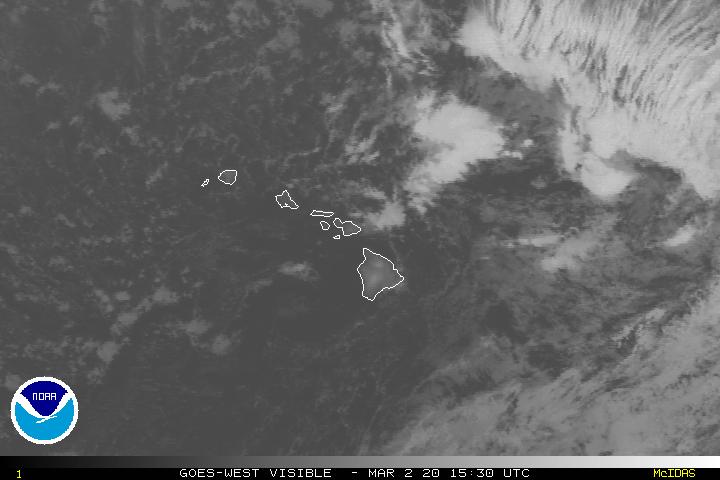





Vicky Says:
Hi Glenn, love reading the weather on Maui every day thanks to you. My husband and I are hoping to move to Kula one day. I have heard there are no centipedes or scorpions at that elevation and that the climate is just about perfect….is that true? Hope to be in your neck of the woods one day soon 🙂 ~~~ Hi Vicky, you’re welcome, I like being in Kula, it works well for me, as there are only very small centipedes, and have never been bitten up here, as I was down in Haiku many years ago. I’ve never seen a scorpion up here either. Yes, Kula is near perfect for me, at least now in my life. I can see why you are attracted to this part of Maui. Aloha, Glenn
Evelyn Says:
Wow, it looks like this will be our first time, (out of 7) that we will experience Hawaiian rain. I love the rain or I wouldn't live here in Vancouver, Wa. How long is your long walk that you take every week end? thanks for all your info~~~Hi Evelyn, it won’t rain the entire time you are here, by any means. You will be able to warm up and dry out from Vancouver…that’s for sure. My long weekend walk is in contrast to my shorter, but more strenuous walk that I take during my week days. It’s 2-3 miles, where I walk quickly, and there are some rises and dips in the terrain too. I hope you have a wonderful vacation here in paradise! Aloha, Glenn
tom atkins Says:
I am planning on moving to Maui in the next few months, and am having trouble finding accurate weather information for Makawao and Punalaki. The published weather station monthly tempertature high/low data appears to come from either the Kahului or Kula stations. If you have that information, could you email it to me or let me know where to look for it. If there is no record for this 1700 ft level, is it accurate to just subtract 3 degrees F for each 1000 ft increase in elevation?
Thanks for maintaining a GREAT weather information site. I have gone there every day for the past year, and have learned a lot, and enjoyed your personal narrative on many subjects.~~~Hi Tom, you are correct, Kahului and Kula are reporting places for temperature and rainfall…and then just rainfall for Kula. Pukalani is more or less in the middle. I think you could use the 3 degree rule as a general estimate. Makawao is wetter than Pukalani usually, and slightly cooler. Thanks for your positive feedback, I appreciate that very much! Come ahead, you will love living here in upcountry east Maui. Aloha, Glenn