











January 12-13, 2011
Air Temperatures – The following maximum temperatures were recorded across the state of Hawaii Wednesday afternoon:
Lihue airport, Kauai – 80
Honolulu airport, Oahu – 80
Kaneohe, Oahu – 79
Molokai airport – 75
Kahului airport, Maui – 77
Kona airport – 81
Hilo airport, Hawaii – 79
Air Temperatures ranged between these warmest and coolest spots near sea level – and on the highest mountain tops…as of 5pm Wednesday evening:
Kailua-kona – 79F
Kapalua, Maui – 73
Haleakala Crater – 41 (near 10,000 feet on Maui)
Mauna Kea summit – 27 (near 14,000 feet on the Big Island)
Precipitation Totals – The following numbers represent the largest precipitation totals (inches) during the last 24 hours on each of the major islands, as of Wednesday evening:
3.34 Mount Waialeale, Kauai
2.84 Maunawili, Oahu
1.20 Molokai
1.12 Lanai
0.80 Kahoolawe
2.83 Puu Kukui, Maui
1.13 Pali 2, Big Island
Marine Winds – Here’s the latest (automatically updated) weather map showing a cold front approaching from the west and northwest, which will stall over Kauai or Oahu. Our winds will be locally strong and gusty Thursday, from the south and southwest. Winds will gradually become lighter from the south Friday.
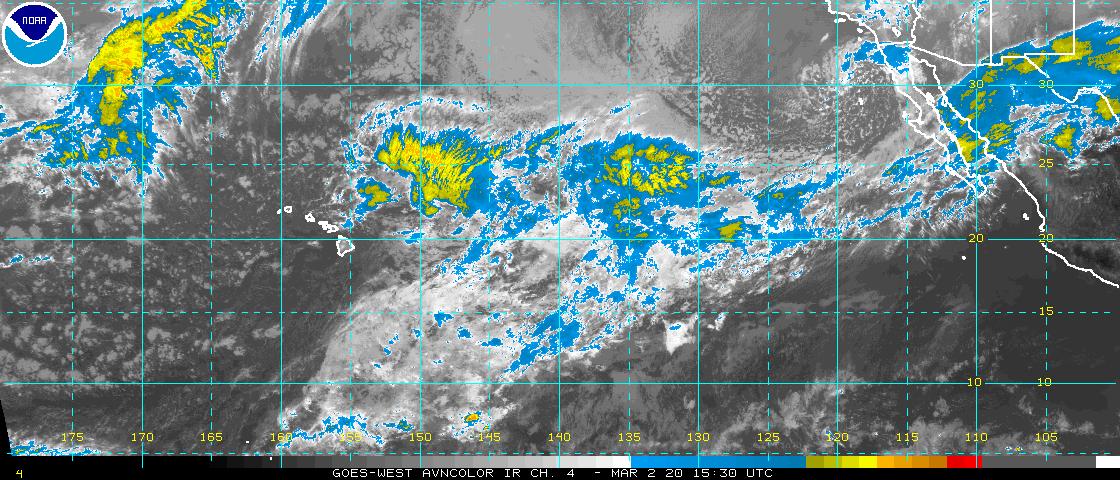
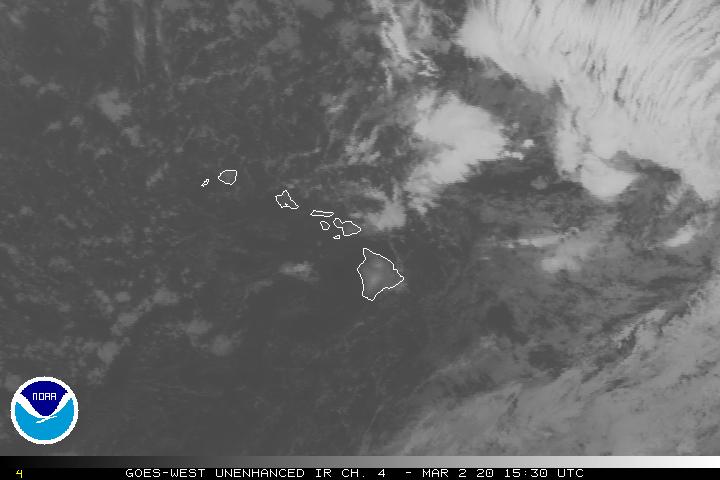
Satellite and Radar Images: To view the cloud conditions we have here in Hawaii, please use the following satellite links, starting off with this Infrared Satellite Image of the islands to see all the clouds around during the day and night. This next image is one that gives close images of the islands only during the daytime hours, and is referred to as a Close-up visible image. This next image shows a larger view of the Pacific…giving perspective to the wider ranging cloud patterns in the Pacific Ocean. Finally, here's a Looping IR satellite image, making viewable the clouds around the islands 24 hours a day. To help you keep track of where any showers may be around the islands, here’s the latest animated radar image.
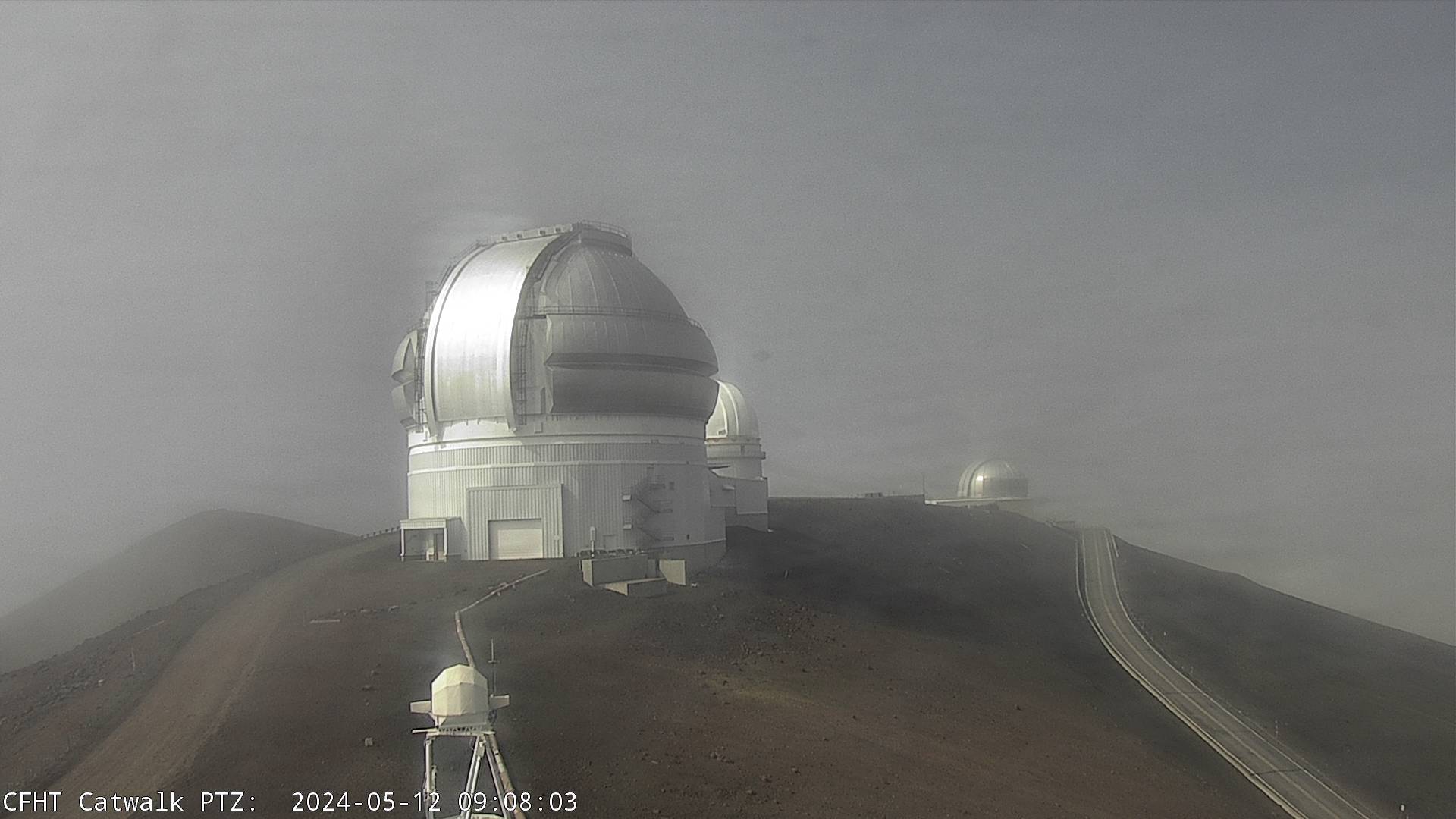
Hawaii’s Mountains – Here’s a link to the live web cam on the summit of near 14,000 foot Mauna Kea on the Big Island of Hawaii. The tallest peak on the island of Maui is the Haleakala Crater, which is near 10,000 feet in elevation. These two web cams are available during the daylight hours here in the islands…and when there’s a big moon rising just after sunset for an hour or two! Plus, during the nights and early mornings you will be able to see stars, and the sunrise too…depending upon weather conditions.
Tropical Cyclone activity in the eastern and central Pacific – Here’s the latest weather information coming out of the National Hurricane Center, covering the eastern north Pacific. You can find the latest tropical cyclone information for the central north Pacific (where Hawaii is located) by clicking on this link to the Central Pacific Hurricane Center. Here’s a tracking map covering both the eastern and central Pacific Ocean. A satellite image, which shows the entire ocean area between Hawaii and the Mexican coast…can be found here. Of course, as we know, our hurricane season won't end until November 31st here in the central Pacific.
Aloha Paragraphs

Locally flooding rains overnight, with unsettled conditions Thursday, better weather Friday and Saturday…before another cold front arrives by the early part of next week
>>Looping Radar Image of the Hawaiian Islands<<
Winds were strong gusty today…remaining on the blustery side into Thursday. This weather map shows the new cold front approaching from the west and northwest. The air flow ahead of this front has become windy, depending upon the location here in the islands. Winds will be stronger than usual everywhere, although there will be those places that gusts are reaching up between 40-50 mph. Our winds will back down Friday into Saturday, remaining from a southerly direction. Breezes are likely to pick up again later Sunday, ahead of the next cold front…arriving Monday morning. The top wind gust so far during this event, as shown below, was an impressive 49 mph on the north shore of Oahu. It wouldn’t be surprising to see a gust or two topping 50 mph before every
Winds remain unusually gusty…the following numbers represent the strongest gusts, along with directions early Wednesday evening:
43 mph Lihue, Kauai – SSW
49 Kahuku, Oahu – SSW
46 Molokai – SE
35 Kahoolawe – S
39 Kahului, Maui – SW
37 Lanai Airport – NW
37 Keahole airport, Big Island – SSW
Rounds of locally heavy rainfall, with flooding, and thunderstorms passed over the Hawaiian Islands Wednesday, and remain active into the night. This precipitation enveloped the entire state at times, from sea level…all the way up to the highest summits. This large University of Washington satellite image shows that the Hawaiian Islands are there are some breaks in the earlier overcast, and that the cold front is just reaching Kauai. Looking at this NOAA satellite picture, shows that there are towering cumulus clouds and random thunderstorms clouds are still around the Hawaiian Islands. There continues to be locally heavy rains coming up towards the Big Island and Maui County…at least at the time of this writing. Meanwhile, Oahu and Kauai are still seeing clouds loaded with precipitation too…lots of it locally!
Clouds will continue to come into the state as we move into Thursday…bringing their heavy showers and rain at times. We can loop this satellite image, which shows this large area of clouds, at least on the eastern side of the state, gradually moving away to the northeast. Although at the same time, the cold front is bringing in its own area of heavy showers, focusing most intently on Kauai and Oahu, although Maui and the Big Island are not out of the woods yet either. Checking out this looping radar image shows that the islands of Oahu and Kauai are most threatened by the copious amount of tropical showers and rain coming up from the southwest. This rainfall will make flooding, which has already been happening, a continued reality.
Here in Kihei, Maui, early Wednesday evening, skies are cloudy, with off and on showers…most of which have been light to moderately heavy during the day. This rainfall has been heavier at times here on Maui, and throughout the rest of the island chain. The prefrontal precipitation which has kept us busy today, is starting to fade now. This will be replaced however as the cold front slowing moves into the state, generally over Kauai and Oahu…where it may stall. There's always that chance that it could find just enough energy, to stretch its way down to Maui County. Where this cold front is, and where it decides to stall, will greatly determine where the heaviest rains fall, and the resultant flooding occurs. ~~~ I'll be back early Thursday morning with your next new weather narrative. I would strongly suggest that if you are out and about, especially in your car, drive very carefully, and even slow down to the speed limit for a change, I say that to myself as well – smiling! Aloha for now…Glenn
~~~Flash flood watch entire state through Thursday afternoon…among many other warnings, watches and advisories
~~~Webcam view of the Mauna Kea summit on the Big Island (snow covered lens)
Interesting: Floods caused by heavy rainfall in Sri Lanka have affected nearly a million people, including more than 127,000 displaced from their homes, the United Nations humanitarian office reported today, quoting figures provided by the Government. Torrential rainfall has lashed the island nation since 26 December, triggering floods and mudslides, mainly in the eastern and central parts of the country, with Batticaloa district in the east reported to have received the largest amount of precipitation in a century.
The inclement weather conditions prevailing in the Eastern region today forced the Sri Lankan President Mahinda Rajapaksa to curtail his visit to the flood affected coastal city of Batticaloa and Ampara. According to Disaster Management Center, over 937,000 people have been affected by the recent torrential rain that affected the entire Eastern Province, North Central, Central and Northern Provinces.
Around 48,000 displaced people have been moved to 453 centers set up in all affected districts. Sri Lanka’s health ministry has sent five medical teams to the eastern and Polonnaruwa areas ready to control possible outbreaks of diseases, and to set up mobile medical clinics to assist internally displaced persons.
The UN World Health Organization (WHO) will bear the cost of the mobile clinics. The floods have destroyed acres of paddy fields. Officials in Ampara say the rainfall there since Saturday has been the highest ever recorded in such a short time. The Sri Lankan Army, Navy and the Air Force have been pressed into relief operation in the affected areas.
Interesting2: Brisbane residents this morning awoke to the good news that the river has peaked at 4.46 meters, more than a meter below the predicted peak of 5.5m. The 1974 flood, the worst of last century, was 5.45 meters. But while the news was better than expected, scores of homes have still been inundated, and thousands of Brisbane residents remain evacuated from their homes.
More than 120,000 southeast Queensland residents were without power at 5.30am today. Three times overnight, the Bureau of Meteorology revised down its flood forecast for how high the Brisbane River would rise. At 4.01am today, a level of 4.46 meters was recorded, after several hours of fluctuating readings.
Between 3.30pm yesterday and 1am today, the river level fluctuated in the range of 4.2 to 4.3 meters. Overnight, there was high drama as a 300-metre section of the battered Riverwalk structure broke free and was carried away by rapidly moving river waters, forcing the closure of the Gateway bridges further downstream.
However, the bridges were reopened after the structure floated past the bridges and out to Moreton Bay, police said. Authorities were also concerned the Island Party Boat, a barge that held parties along the Brisbane River, was in danger of coming off its mooring and said it may be scuttled.
Three men, meanwhile, were charged with looting after allegedly trying to steal boats from the swollen river. Police today warned people to avoid travelling to the central business district today unless absolutely necessary, and urged sightseers to stay away from the river because they could hamper emergency service workers.
The police statement said evacuations in a number of Brisbane suburbs occurred overnight and there would be an increased police presence in these areas. At Ipswich, flood levels are falling strongly, to below 18 meters around 3am today, following a peak of 20.5m yesterday. River levels will continue falling during Thursday, to below the major flood level.
Queensland Premier Anna Bligh last night described the first downgraded river forecast as a "slight reprieve" but said the city would still be devastated by the flood peak. She said anywhere between 20,000 and 30,000 people would be affected by flooding.
‘‘Brisbane will go to sleep tonight and wake up to scenes that they have, many of them, never seen anything like in their lives,’’ Ms Bligh said. Hundreds of people were being housed in five flood evacuation centers across the city. And Lord Mayor Campbell Newman said many more would have self-evacuated to stay with friends and family.
‘‘I do recommend people do [that] because they will be more comfortable,’’ he told Sky News. Cr Newman said raw sewage was seeping into Brisbane waterways, however the city's drinking water supply remained unaffected.
‘‘There is no problem whatsoever with the water in our area and supplies in the main should be maintained,’’ he said. There was worse news for the CityCat network, with Cr Newman confirming services would likely be out of action for some time after the floods receded.
‘‘The pontoons and the ferry terminals have been smashed to pieces in the main and it’s going to be very expensive just to fix that,’’ he said. Residents in Brisbane's low-lying suburbs were yesterday told to get out of their houses during the day, rather than waiting until the situation became too dire.
People living in the CBD were advised to seek alternative accommodation with family and friends with power cut to parts of the city and flood waters predicted to inundate city streets.
"We don't need people struggling at midnight; we need them to start now, the latest by this afternoon, to be either out of their homes or close to it," Emergency Services Minister Neil Roberts said. The Riverside Expressway had been closed in the CBD, with police advising motorists to avoid driving through the city.
Interesting3: Canada had its warmest year on record in 2010, according to the country's environmental agency, with the biggest impact seen in the Arctic region. The national average temperature for the year was 3 degrees Celsius above normal, based on preliminary data, according to a report put on Environment Canada's website on Monday.
That made it the warmest year since nationwide records began in 1948. Most areas of the northern territory of Nunavut and of northern Quebec were at least 4 degrees above normal, while the Arctic tundra region was 4.3 degrees above normal.
Along with the Arctic tundra, the Arctic mountains and fiords, the northeastern forest and Atlantic regions also had the warmest year on record. Scientists link the higher temperatures in the Arctic to the greenhouse gas emissions blamed for global warming.
Global warming is gradually melting the Arctic ice cap, raising the possibility of increased shipping and mining in the environmentally sensitive region. "What we're seeing is clearly a trend and the changes in the north seem to be becoming permanent," said John Bennett, executive director of the Sierra Club Canada.
"We're looking at a month or so less winter in the north." The previous warmest year was 1998, which was 2.5 degrees above normal, according to the data. Annual temperatures have been above normal since 1997.
Interesting4: A total of 333 rhinos were illegally killed in South Africa in 2010, including ten critically endangered black rhinos, according to national park officials. The yearly total is the highest ever experienced in South Africa and nearly triple 2009 when 122 rhinos were killed in the country. An additional five rhinos have been lost to poaching since the new year.
Kruger National Park, the world famous safari destination, was hardest hit losing 146 rhinos to poaching in 2010, authorities said. The park is home to the largest populations of both white and black rhinos in the country. Rhinos constitute one of the much-revered "Big 5" of African wildlife tourism, including elephants, lions, leopards and Cape buffalo.
Rhino poaching across Africa has risen sharply in the past few years, threatening to reverse hard-won population increases achieved by conservation authorities during the 20th century. The first alarming yearly spike occurred in 2008 when 83 rhinos were lost. South Africa has responded by intensifying its law enforcement efforts, and made approximately 162 poaching arrests last year.
"Many more successful convictions, backed up by appropriately daunting penalties will significantly demonstrate the South African government's commitment to preventing the clouding of the country's excellent rhino conservation track record that it has built up over the past several decades," said Dr. Morné du Plessis, CEO of WWF South Africa.
 Email Glenn James: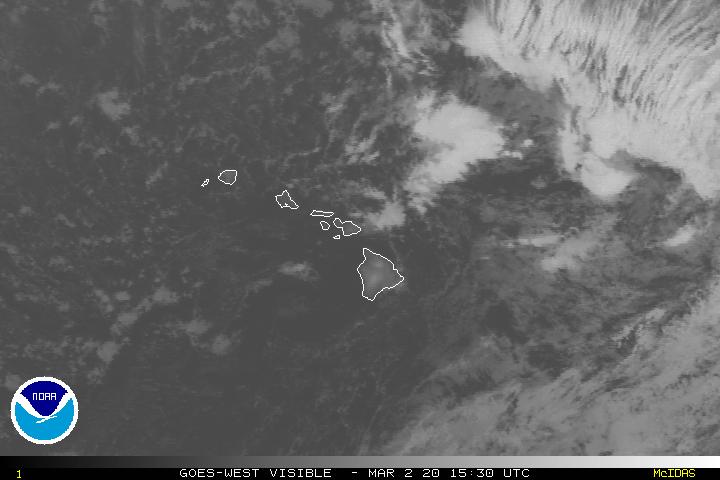


Bob Says:
I live just a little mauka of Makawao at about 2300 feet el. I am gratelful for your very comprehensive site and check-in daily. During storms I check for updates many times during my day. Your "Aloha Paragraphs" are well written and informative. While I enjoy your movie reviews and personal commentary I'd prefer to see an ongoing column on meteorolory for the layman. Perhaps you might include a little of both. Keep up your terrific work. ~~~Hi Bob, meteorology for layman and women is what this website is all about. I’m glad you enjoy it Bob, and thanks for your general praise. Aloha, Glenn
kim Says:
Hi Glenn,
thanks for all the great updates!! How does tomorrow look? Luckily it seems Maui is missing the major part of the storm? Or is there more to come.
P.S. you should have a donations link on your website! I know it takes a lot of time to update your website, I've been checking your site about 10 times per day over the past few days! Thanks again for all the great info….~~~Hi Kim, thanks for your positive feedback, I appreciate it! Thursday looks to be an unsettled day with more rain, gusty winds, and thunderstorms…Friday should be better. Aloha, Glenn
Matt Says:
Glenn,
Why does the looping radar image not seem to show rain on Kauai, even when it is clearly raining heavily there (as noted in your rainfall accumulation totals)? Perhaps Kauai is in a 'shadow' of the radar?
Matt~~~The rainfall totals I show are 24 hour accumulations. Kauai will be getting more rainfall, that’s for sure, as will the rest of the state, especially Oahu at the time of this writing. Good question Matt, Aloha, Glenn
Jack weber Says:
"This precipitation enveloped the entire state at times, from sea level…all the way up to the highest summits."
None here but a few droplets. Nice to have a break this time around!~~~Hi Jack, glad to see you are getting what you want. Aloha, Glenn
chad Says:
Aloha Glen!
My family and I are coming to maui Jan. 17th thru the 26th. We are all very excited! We love your daily reports. It is very interesting to view the different graphs and maps of the islands and the greater pacific. Hopefully come Monday things will settle down a little. We are coming from Minnesota (right now -9 below zero with snow on the way) so rain or no rain has no bearing on our attitudes! Although a little sunshine would be nice.
Thanks Again!~~~Hi Chad, nice to hear from you there in MN, cold as it is! I like your positive attitude, it works for me. I’m positive that you will have get some nice warm sunny weather here in paradise. I know you and your family will have a great time. Thanks for enjoying my website, I like that! Aloha, Glenn