January 11-12, 2011
Air Temperatures – The following maximum temperatures were recorded across the state of Hawaii Tuesday afternoon:
Lihue airport, Kauai – 75
Honolulu airport, Oahu – 78
Kaneohe, Oahu – 76
Molokai airport – 75
Kahului airport, Maui – 78
Kona airport – 81
Hilo airport, Hawaii – 81
Air Temperatures ranged between these warmest and coolest spots near sea level – and on the highest mountain tops…as of 5pm Tuesday evening:
Kailua-kona – 79F
Hilo, Hawaii – 71
Haleakala Crater – 46 (near 10,000 feet on Maui)
Mauna Kea summit – 28 (near 14,000 feet on the Big Island)
Precipitation Totals – The following numbers represent the largest precipitation totals (inches) during the last 24 hours on each of the major islands, as of Tuesday afternoon:
0.09 Kokee, Kauai
1.05 Schofield Barracks , Oahu
1.40 Molokai
1.04 Lanai
0.37 Kahoolawe
1.82 Mahinahina, Maui
1.01 Kahua Ranch, Big Island
Marine Winds – Here’s the latest (automatically updated) weather map showing a cold front stalled to the southeast of the Big Island, with a very weak high pressure system just to the west of the islands. A new cold front is approaching from the northwest. Our winds will become stronger and gusty Wednesday into Thursday, from the south and southwest…ahead of the next cold front.
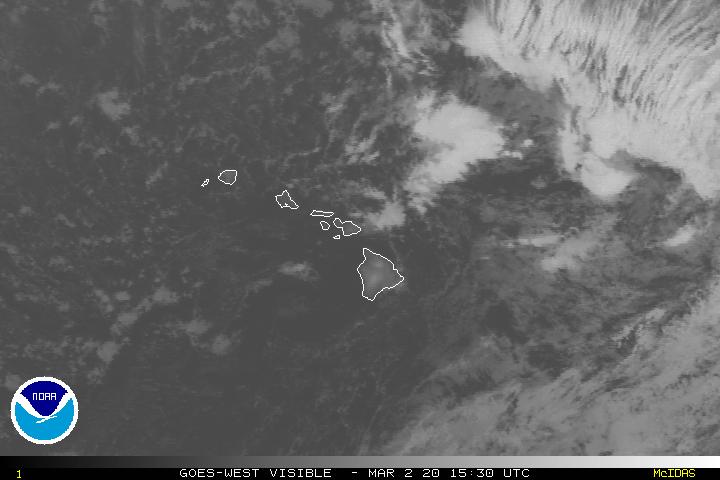
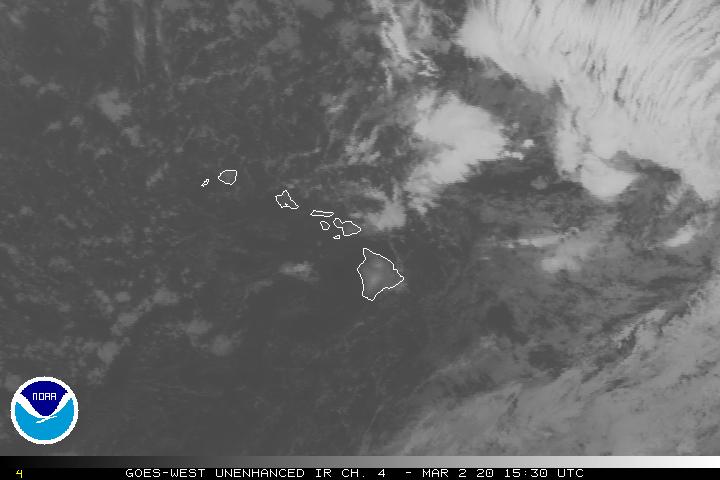
Satellite and Radar Images: To view the cloud conditions we have here in Hawaii, please use the following satellite links, starting off with this Infrared Satellite Image of the islands to see all the clouds around during the day and night. This next image is one that gives close images of the islands only during the daytime hours, and is referred to as a Close-up visible image. This next image shows a larger view of the Pacific…giving perspective to the wider ranging cloud patterns in the Pacific Ocean. Finally, here's a Looping IR satellite image, making viewable the clouds around the islands 24 hours a day. To help you keep track of where any showers may be around the islands, here’s the latest animated radar image.
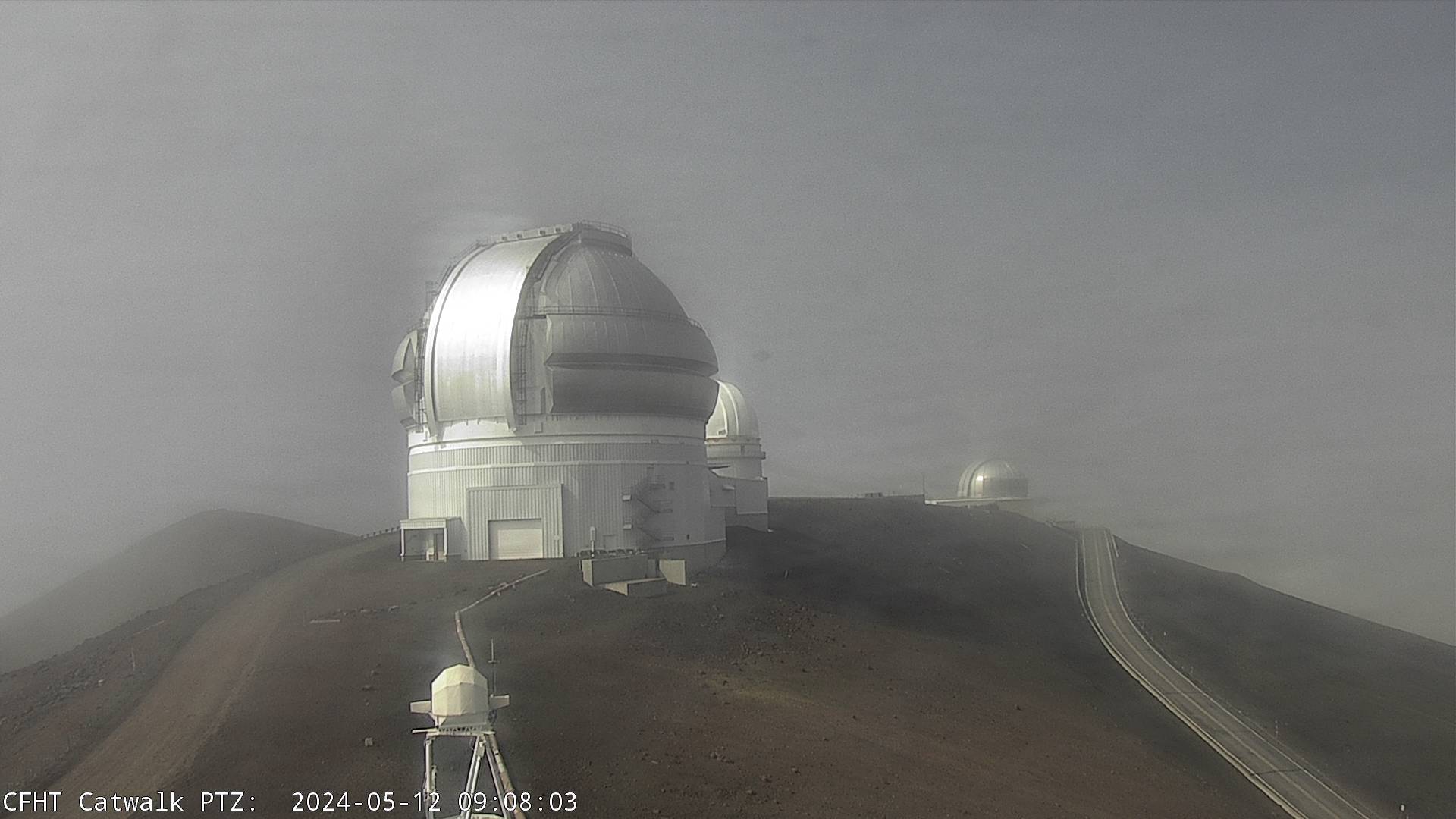
Hawaii’s Mountains – Here’s a link to the live web cam on the summit of near 14,000 foot Mauna Kea on the Big Island of Hawaii. The tallest peak on the island of Maui is the Haleakala Crater, which is near 10,000 feet in elevation. These two web cams are available during the daylight hours here in the islands…and when there’s a big moon rising just after sunset for an hour or two! Plus, during the nights and early mornings you will be able to see stars, and the sunrise too…depending upon weather conditions.
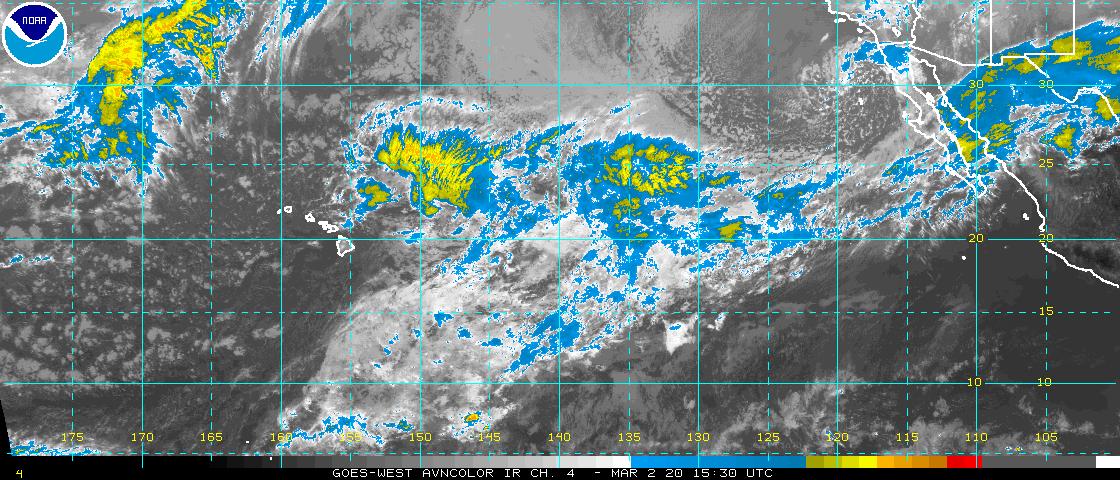
Tropical Cyclone activity in the eastern and central Pacific – Here’s the latest weather information coming out of the National Hurricane Center, covering the eastern north Pacific. You can find the latest tropical cyclone information for the central north Pacific (where Hawaii is located) by clicking on this link to the Central Pacific Hurricane Center. Here’s a tracking map covering both the eastern and central Pacific Ocean. A satellite image, which shows the entire ocean area between Hawaii and the Mexican coast…can be found here. Of course, as we know, our hurricane season won't end until November 31st here in the central Pacific.
Aloha Paragraphs

Wet and blustery conditions returning later Wednesday into Thursday, better weather again Friday and Saturday…before another cold front arrives later Sunday into the early part of next week
Winds were light to very light Tuesday, after the blustery conditions yesterday…and the expected blustery Kona winds move in Wednesday. This weather map shows a very weak high pressure system just to the west-northwest of Kauai. This high, if we can barely call it that, considering its 1010 millibar weight…has a ridge extending into the state today. This overlying ridge is why our winds were so light. At the same time, we see the “old” cold front, from Monday, now just to the southeast of the Big Island. The “new cold front” is to the west and northwest of Hawaii, moving steadily in our direction Tuesday night.
As this frontal boundary pushes towards our islands, we’ll see the weak high moving away, or just disappear. This will open the flood gates for what will be a transition from the current light and variable breezes…back into stronger south and southwest Kona winds Wednesday into Thursday. These winds will strengthen as this next cold front gets closer, likely by Wednesday morning we’ll see the airplanes taking off into those south and southwest breezes. It won’t take very long for them to crank-up, becoming strong enough to trigger wind advisories in those windiest places around the Aloha state…which are now already in effect starting Wednesday. The latest models are showing the winds becoming lighter again by Friday, although remaining from the Kona direction into the weekend.
Light and variable breezes are blowing early Tuesday evening…the following numbers represent the strongest breezes, along with directions:
06 mph Barking Sands, Kauai – SSE
14 Wheeler, Oahu – S
08 Molokai – NNE
09 Kahoolawe – SE
09 Lipoa, Maui – NE
00 Lanai Airport
18 South Point, Big Island – SW
As the wind flow was so light, and there was so much leftover moisture in our atmosphere, and on the ground too…we saw clouds forming over and around the mountains Tuesday afternoon locally. Showers were limited however, although the Big Island did have some locally heavy showers falling, with even a few thunderstorms. This large University of Washington satellite image shows that the Hawaiian Islands are in-between the cold front to our east, and the quickly approaching cold front to our west and northwest. Looking at this NOAA satellite picture, shows what’s left of the clouds from the old front, mostly near the Big Island and Maui…those lower level clouds. We can also see the leading edge of the high clouds coming towards the state to our northwest as well.
Clouds will be on the increase tonight, and do nothing but more of that during the day Wednesday. We can loop this satellite image, to see the old clouds to our east shifting further away, and the high cirrus rocketing in our direction…riding in on the northwesterly jet stream winds. All of this high stuff may bring a nice sunset this evening, with colorful skies quite likely. Checking out this looping radar image we see practically no showers falling anywhere in the state. There was an area of moderately heavy showers near the Big Island, coming down off the mountains towards Hilo Bay Tuesday afternoon into the evening.
All evidence still points to a windier and wetter cold front steadily moving in our direction. As we move into Wednesday, conditions will break down…at least compared to the relatively nice weather we saw Tuesday. This next strong cold front will help to draw up lots of tropical moisture from the deeper tropics, and deposit it over our islands. This next front too…looks destined to produce flooding rainfall for a couple of days. There’s always that good chance that the current flash flood watch could become a flash flood warning with time. The current small craft wind advisory has already transitioned into a wind advisory on all the smaller islands starting Wednesday. All of this will be happening down near sea level, with the highest mountain tops getting into snowy weather, like they had Monday into the night…on the Big Island. Here’s the latest webcam view of Mauna Kea…with ice on the camera lens at the time of this writing, viewable during the daylight hours.
At this point it seems prudent to write: batten down the hatches…in terms of wind and rain. The prospect still calls for the best chance for excessive rainfall to occur on the Kauai side of the island chain. This certainly doesn’t mean that Maui County and the Big Island won’t find hazardous conditions as well. The good thing here is that Friday and Saturday look like better days, giving us time to catch our breath, and scrap the mud off our boots…before the next cold front makes its way in our direction later this weekend. I’ve lived in Hawaii for over 35 years, and this winter is bringing back memories of what past winters have been like, previous to the dry and mild mannered ones of late. I think we can safely say that our long lasting drought is gone, at least in most areas of the state!
~~~ Here in Kihei, Maui, early Tuesday evening, its partly cloudy, with those high cirrus clouds quickly moving overhead from the northwest. Today was quite a nice day, at least compared to what we expect to arrive during the next couple of days. I'll be back early Wednesday morning with all the latest information that I can gather, put together in your next weather narrative from paradise. I hope you have a great Tuesday night until then! Aloha for now…Glenn.
~~~Flash flood watch entire state starting Wednesday morning through Thursday afternoon
~~~Small Craft Wind Advisory now through 6pm Wednesday (rough seas)
~~~High Surf Advisory through 6 pm Wednesday…north and west facing shores
~~~Wind Advisory for higher summits on Maui and Big Island…starting Wednesday noon
~~~Wind Advisory for Kauai, Oahu, and Maui County…starting Wednesday pm
~~~Webcam view of the Mauna Kea summit on the Big Island (snow covered lens)
Interesting: About 2 decades ago, scientists coined the term "snowball Earth" to describe a period about 700 million years ago when glaciers apparently smothered the planet even at latitudes near the equator. However, new evidence from ancient rocks bolsters the notion that some of the world's seas remained unfrozen during this global deep freeze, striking a blow against the controversial idea that the planet was completely swaddled in ice at the time.
In some versions of the snowball Earth scenario, even the surface of the oceans was completely frozen, blocking the release of oxygen into the atmosphere by ocean-dwelling phytoplankton, thereby potentially affecting the timing and pace of evolution .Yet some climate models have hinted that even in this death grip of global cold, substantial parts of the ocean remained open water.
And the geological record contains scattered inklings of glacial flow during this era, a sign that the ice wasn't so cold that it was locked in place. Now Daniel Le Heron, a sedimentary geologist at Royal Holloway, University of London, and his colleagues report rock-solid evidence of open water during this global cold spell.
They examined rocks gathered in southern Australia that were deposited as marine sediments about 700 million years ago during the heart of the 220-million-year-long Cryogenian period, as the snowball Earth era is also known. And some layers contain dome-shaped structures that once were heaps of sea-floor material similar to miniature sand dunes.
The shape of these tiny hummocks, as well as the layering of material within them, indicates that the structures were formed by currents that repeatedly alternated direction.
Le Heron says that such oscillating flows are produced only by storm-generated waves in ocean depths of less than 200 meters or so—a sure sign that the seas in this region at this time were open and, therefore, unfrozen, he and his colleagues reported online 3 December in Geology.
These wave-generated structures are the first recognized in rocks of the Cryogenian period and suggest that geologists should look for similar features in rock formations of that age in other regions, says Le Heron. The presence of wave-sculpted sediments in other locations would help scientists determine the extent of ice-free regions during the Cryogenian, he adds.
Interesting2: The rearing of cattle and pigs for meat production results in an estimated 18 percent of global greenhouse gas emissions. With worldwide consumption of beef and pork expected to double by 2020, alternatives are being investigated.
Of these, perhaps the most notable has been the development of "in-vitro meat" which is lab-grown tissue not requiring the production of a whole organism. Initiated by NASA as a form of astronaut food, in-vitro meat production took its first steps in 2000 when scientists used goldfish cells to grow edible protein resembling fish fillets.
Since then, turkey and pig cells have been used to create spam-like substances, and Time Magazine has included in-vitro meat in its list of the top 50 breakthrough ideas of 2009.
In addition to the environmental impact of current meat production techniques, scientists believe that the inevitable increase in price as population-driven demand grows will ultimately result in traditional meat products becoming unavailable to many people around the world.
However, if the idea of eating meat grown in a lab doesn't appeal to you, there is another option. Researchers at Wageningen University in the Netherlands looked at mealworms, house crickets, migratory locusts, sun beetles, and Dubia cockroaches, and for the first time quantified the amounts of methane (CH4) and nitrous oxide (N2O) released per kilogram of insect meat.
They found that the amounts of gases released by insects to be much smaller than those released by cattle and pigs. For instance, mealworms produce between ten and a hundred times less greenhouse gas emissions per kilogram than do pigs. Ammonia levels also declined significantly.
Interesting3: The worst flooding in the Australian state of Queensland in 50 years could push up the nation's fruit and vegetable prices by as much as 20 to 30 percent, lifting inflation and potentially dampening retail spending. Economists and the country's top supermarket chains said new, torrential flooding and rains across farmlands in southeastern Queensland in the past day had damaged crops and cut roads, preventing moving goods to market.
Unlike some previous natural disasters, which affected a smaller geographic area and a narrow range of foods, many vegetables are likely to be affected. In 2006, Cyclone Larry caused a spike in banana prices and this alone helped to lift the overall inflation rate.
"I think this will actually dampen discretionary spending during this period," said ANZ Bank head of Australian economics Katie Dean, referring to spending across the entire economy. "In the case of the bananas (in 2006), we just stopped buying bananas.
But this is a very broad range of fruit and veggies that will be affected, the grocery bill will inevitably rise as the substitution ability is less," Dean said. Australian retailers have already endured a tough few months as cautious consumers spend less and save more.
Retail sales in November rose a moderate 0.3 percent and were up just 1.3 percent from a year earlier, compared with historic growth of about 6 percent per year, while the national savings rate has topped 10 percent.
Interesting4: Researchers at the University of Tennessee, Knoxville, continue to chip away at the mysterious existence of water on the moon — this time by discovering the origin of lunar water. Larry Taylor, a distinguished professor in the Department of Earth and Planetary Sciences, was the one last year to discover trace amounts of water on the moon.
This discovery debunked beliefs held since the return of the first Apollo rocks that the moon was bone-dry. Then, he discovered water was actually pretty abundant and ubiquitous — enough so a human settlement on the moon is not unquestionable.
Now, Taylor and a team of researchers have determined the lunar water may have originated from comets smashing into the moon soon after it formed. His findings will be posted online, in the article "Extraterrestrial Hydrogen Isotope Composition of Water in Lunar Rocks" on the website of the scientific journal, Nature Geoscience.
Taylor and his fellow researchers conducted their study by analyzing rocks brought back from the Apollo mission. Using secondary ion mass spectrometry, they measured the samples' "water signatures," which tell the possible origin of the water — and made the surprising discovery that the water on the Earth and moon are different.
"This discovery forces us to go back to square one on the whole formation of the Earth and moon," said Taylor. "Before our research, we thought the Earth and moon had the same volatiles after the Giant Impact, just at greatly different quantities.
Our work brings to light another component in the formation that we had not anticipated — comets." Scientists believe the moon formed by a giant impact of the nascent Earth with a Mars-sized object called Theia, which caused a great explosion throwing materials outward to aggregate and create the moon.
Taylor's article theorizes that at this time, there was a great flux of comets, or "dirty icebergs," hitting both the Earth and moon systems. The Earth already having lots of water and other volatiles did not change much. However, the moon, being bone-dry, acquired much of its water supply from these comets.
Taylor's research shows that water has been present throughout all of the moon's history — some water being supplied externally by solar winds and post-formation comets and the other internally during the moon's original formation. "The water we are looking at is internal," said Taylor.
"It was put into the moon during its initial formation, where it existed like a melting pot in space, where cometary materials were added in at small yet significant amounts." To be precise, the lunar water he has found does not consist of "water" — the molecule H2O — as we know it on Earth.
Rather, it contains the ingredients for water — hydrogen and oxygen — that when the rocks are heated up, will be liberated to create water. The existence of hydrogen and oxygen — water — on the moon can literally serve as a launch pad for further space exploration. "This water could allow the moon to be a gas station in the sky," said Taylor.
"Spaceships use up to 85 percent of their fuel getting away from Earth's gravity. This means the moon can act as a stepping stone to other planets. Missions can fuel up at the moon, with liquid hydrogen and liquid oxygen from the water, as they head into deeper space, to other places such as Mars."
 Email Glenn James: