December 30-31, 2010
Air Temperatures – The following maximum temperatures were recorded across the state of Hawaii Thursday afternoon:
Lihue airport, Kauai – 78
Honolulu airport, Oahu – 81
Kaneohe, Oahu – 79
Molokai airport – 80
Kahului airport, Maui – 82
Kona airport – 82
Hilo airport, Hawaii – 80
Air Temperatures ranged between these warmest and coolest spots near sea level – and on the highest mountain tops…as of 5pm Thursday evening:
Kailua-kona – 81F
Kapalua, Maui – 75
Haleakala Crater – 52 (near 10,000 feet on Maui)
Mauna Kea summit – 34 (near 14,000 feet on the Big Island)
Precipitation Totals – The following numbers represent the largest precipitation totals (inches) during the last 24 hours on each of the major islands, as of Thursday afternoon:
0.76 Mount Waialeale, Kauai
0.54 Oahu Forest NWR, Oahu
0.02 Molokai
0.00 Lanai
0.00 Kahoolawe
0.04 Puu Kukui, Maui
0.62 Glenwood, Big Island
Marine Winds – Here’s the latest (automatically updated) weather map showing a high pressure system to our northeast, with a high pressure ridge to the northeast of our islands. Our winds will remain trades during the day Friday…gradually becoming light and variable into Saturday.
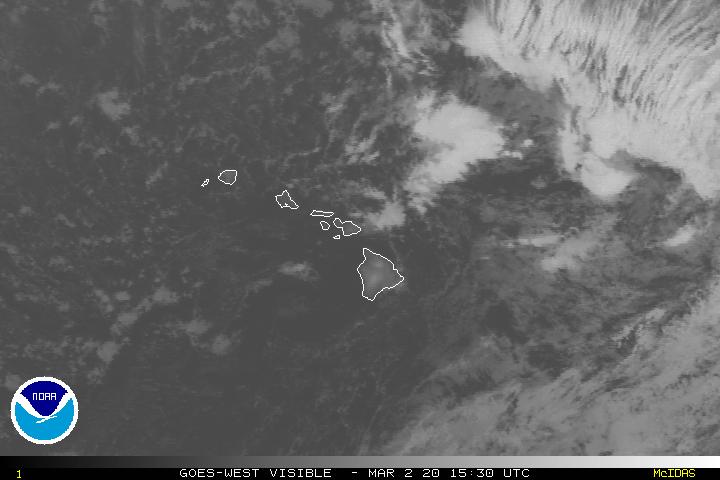
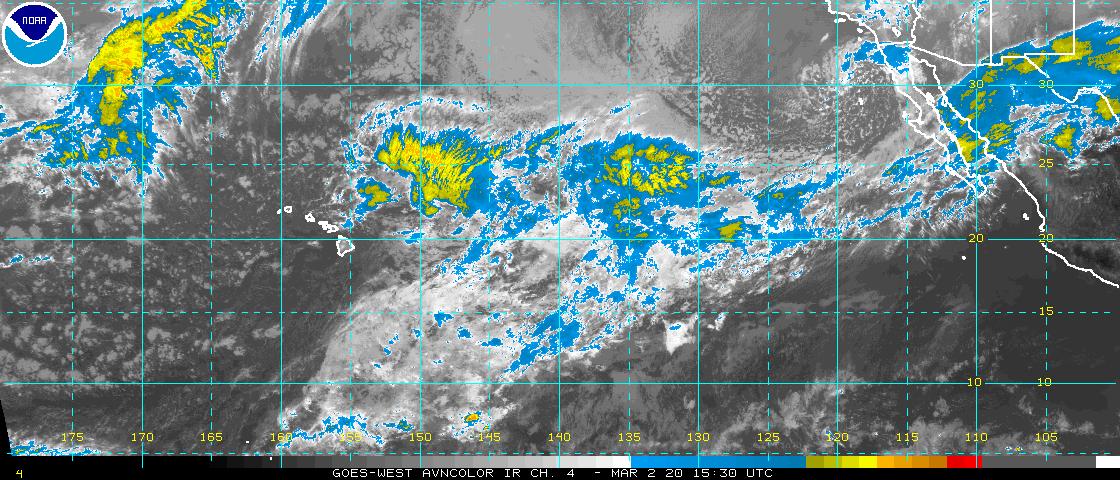
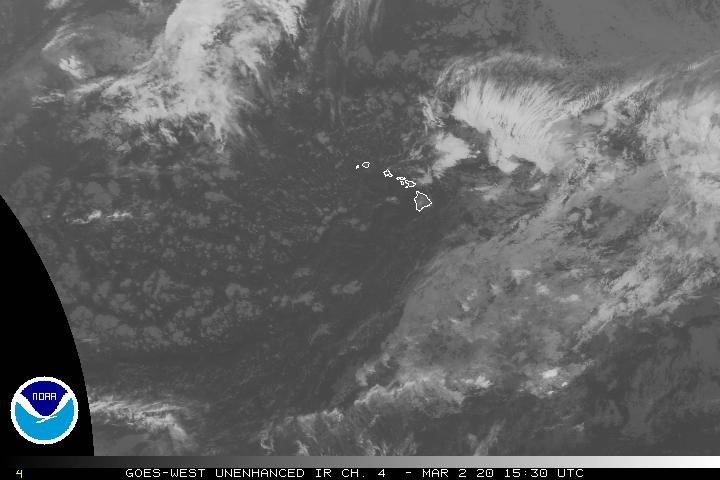
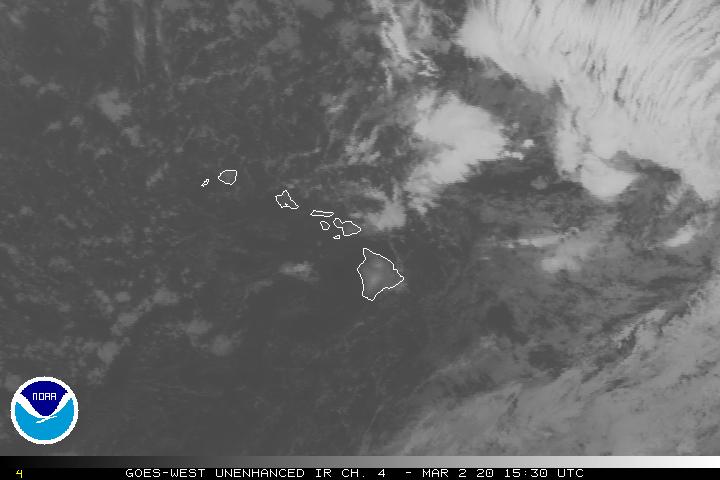
Satellite and Radar Images: To view the cloud conditions we have here in Hawaii, please use the following satellite links, starting off with this Infrared Satellite Image of the islands to see all the clouds around during the day and night. This next image is one that gives close images of the islands only during the daytime hours, and is referred to as a Close-up visible image. This next image shows a larger view of the Pacific…giving perspective to the wider ranging cloud patterns in the Pacific Ocean. Finally, here's a Looping IR satellite image, making viewable the clouds around the islands 24 hours a day. To help you keep track of where any showers may be around the islands, here’s the latest animated radar image.
Hawaii’s Mountains – Here’s a link to the live web cam on the summit of near 14,000 foot Mauna Kea on the Big Island of Hawaii. The tallest peak on the island of Maui is the Haleakala Crater, which is near 10,000 feet in elevation. These two web cams are available during the daylight hours here in the islands…and when there’s a big moon rising just after sunset for an hour or two! Plus, during the nights and early mornings you will be able to see stars, and the sunrise too…depending upon weather conditions.
Tropical Cyclone activity in the eastern and central Pacific – Here’s the latest weather information coming out of the National Hurricane Center, covering the eastern north Pacific. You can find the latest tropical cyclone information for the central north Pacific (where Hawaii is located) by clicking on this link to the Central Pacific Hurricane Center. Here’s a tracking map covering both the eastern and central Pacific Ocean. A satellite image, which shows the entire ocean area between Hawaii and the Mexican coast…can be found here. Of course, as we know, our hurricane season won't end until November 31st here in the central Pacific.
Aloha Paragraphs

Trade winds Friday…generally nice
Artist Credit: Pierre Bouret
Locally gusty trade winds into Friday, then lighter breezes this weekend…before stronger trade winds return during the new work week ahead. This weather map shows a high pressure system to our northeast, with its associated ridge located to the northeast of Kauai. This high and ridge will keep the trade winds blowing into Friday…gusting locally up over 30 mph. We'll see these trade winds faltering later Friday into Saturday, becoming light and variable in places, as a low pressure system digs in our direction from the northwest. This easing of our wind speeds will be temporary however, as the computer models show the trade winds returning later Sunday…becoming quite strong and gusty into next week. This reduction in trade wind speeds during the New Year’s Eve celebrations Friday night, if they get softer that soon, could allow fireworks smoke to collect in urban areas…at least to some degree.
Winds are generally moderate, although locally stronger in gusts…the following numbers represent the strongest breezes early Thursday evening, along with the directions:
25 mph Port Allen, Kauai – ESE
29 Oahu Forest NWR, Oahu – NNE
24 Molokai – ENE
35 Kahoolawe – E
30 Kahului, Maui – NE
28 Lanai Airport – NE
29 South Point, Big Island – NE
Most of the recent clouds are gone now, so that we'll find generally sunny to partly cloudy skies continuing as we move through the last day of 2010 Friday. This large satellite image shows an area of active thunderstorms to the south of the islands…with the clouds just to the north of Kauai. Looking at this next satellite picture, we see an area of low clouds to our east, being carried towards the windward sides on the trade winds. Checking out this looping radar image we see a few areas of showers moving towards the Big Island Thursday evening, elsewhere is generally dry. As the trade winds continue to blow we'll likely see a few passing showers along our windward sides.
Despite the clearing skies, and improvement in our local weather conditions, which will continue Friday, we need to keep an eye on the chance of showers moving back over us…during the second half of this upcoming holiday weekend. It appears that we could see local showers, or even a few thunderstorms returning at some point Saturday night into Sunday. An upper level low pressure system edging towards the islands then, would help to destabilize our overlying atmosphere, prompting the increased chance of showers. This situation will depend upon how much moisture is over and around the islands then. These showers may end up being hit and miss, falling most anywhere. As we push into early next week, and the trade winds return, whatever leftover showers that are carried our way…will generally end up along the windward sides. The trade winds are apt to become strong enough however, that a few of those showers may be carried over into the leeward sides on the smaller islands.
Here in Kihei, Maui, at around 545pm, skies look mostly clear, although with a few clouds around the edges. The trade winds returned today, gusting up into the middle to almost upper 30 mph range locally, which did a good job of ventilating most of the volcanic haze away. Friday looks like another good day, and likely right on into Saturday as well. We might see a few afternoon upcountry showers developing during the afternoon, with an even better chance during the night into Sunday…we'll see. ~~~ Since this is the last work day of the year here in Kihei, and I have Friday off from work…I'll go see a new film this evening in Kahului. This one is called True Grit, starring Jeff Bridges and Matt Damon, among many others. The synopsis: an aging, drunken, one-eyed marshal is enlisted by a 14 year old girl to hunt down her father's murderer. This should be a good film, with the critics giving it a B+ grade, while the viewers are giving it this same rating. I've been looking forward to seeing this film ever since I saw the trailer way back when. I'll let you know what I thought Friday morning, when I come back online with your next new weather narrative. Here's the trailer for this film. I hope you have a great Thursday night until then! Aloha for now…Glenn.
Interesting: They say that fossil fuel riches become a curse to any country that possess them. Where fossil fuels flow — corruption, reduced democracy and increased inequality follow. It is such a recognized pattern that it has become a cliche: the resource curse.
No nation is immune. Even one-time staid and fair-minded Canada has now succumbed to this corruption of democracy, under the pressure from its oil sands provinces. So when Houston-based Noble Energy today confirmed that its Leviathan gas find under the water off the shore of Israel is easily the largest exploration discovery in its history, with an estimated 16 trillion cubic feet of natural gas — it is not a moment of rejoicing — but one of trepidation.
Not only is the resource curse the kiss of death for one little democracy in the Middle East, but the huge find straddles the borders of neighbors that have never had neighborly relations. There is an estimated 122 trillion cubic feet of natural gas in the entire Levant Basin Province, according to the USGS.
It lies within the offshore territory of Israel, Lebanon, Gaza/Palestinian Authority, the Republic of Cyprus and the Turkish Republic of Northern Cyprus. The Leviathan gas field is within the Levant Basin, and it straddles the border of Israel and Lebanon. The disputes between Israel and Lebanon have already begun.
The Leviathan field is twice as large as the Tamar gas field, which is 50 miles west of Haifa in 5500 feet of water. In June, Lebanon warned Israel not to drill in its waters, and Israel claimed in return that it is not drilling in Lebanese waters. But no matter where the drills actually go in, they would both be tapping into the same reservoir. And it really is a case of "the first in will get to win."
Interesting2: Indonesia has chosen once of its largest and richest provinces to test efforts to reduce greenhouse gas emissions by saving forest and peat lands, a key part of a $1 billion climate deal with Norway. Central Kalimantan province on Borneo Island is the second largest producer of greenhouse gases among Indonesia's 33 provinces because of deforestation, destruction of carbon-rich peat swamps, and land use change, the government says.
"The assessment showed that Central Kalimantan is a province with large forest cover and peatland and faces a real threat of deforestation," top technocrat Kuntoro Mangkusubroto, head of a special presidential delivery unit charged with managing the Norway deal, said in a statement on Thursday.
The agreement aims to test efforts that save and restore forests as a way to fight climate change. Forests soak up and lock away large amounts of carbon, while clearing and burning them releases carbon dioxide (CO2), the main greenhouse gas.
Under the climate deal signed this year, Norway will pay Indonesia for proven emissions reductions based on a transparent auditing system and a key part of the pact is selecting a province to test programs that boost conservation, training and steps to improve livelihoods.
Overhauling the province's land-use plan is also key. The deal imposes a two-year national moratorium on new concessions to clear primary forests and peat lands, a step some palm oil and pulp and paper firms fear could disrupt expansion plans.
Interesting3: Denmark, like, Germany, her neighbor to the south, is a country that takes renewable energy seriously. The wind energy industry alone in Denmark is booming with companies like Vestas and Siemens Wind Power both having production facilities and bases of operation on Danish soil.
Denmark's own wind based energy also grows exponentially each year leaving many optimistic that the nation might be one of the few who can achieve 100% renewable energy in the next several decades. However, wind based renewable energy is not the only kind of clean energy the country has going for it.
In one location, Denmark has proven that wind and hydrogen can be king when it comes to being green. Called the Lolland Hydrogen Community, the project began in the middle of 2007 as a way of taking the excess wind energy produced by the island community and putting it to use.
Since they were generating an impressive fifty percent more wind energy than was needed, they set about finding a way to convert that excess wind into hydrogen for use in powering the island and acting as way to demonstrate to Europe the viability of hydrogen as a renewable energy source.
The way the project began was with the installation of a Fuel Cell Combined Heat and Power plant that took the wind energy that was being produced in excess and using it to power an electrolyser that worked to separate the oxygen and hydrogen molecules that comprised water.
Once the hydrogen is separated it is stored in pressure tanks and it is then used to power fuel cells that provide the community with electricity. Although powering the community’s power grid with the hydrogen fuel cells proved to be a success the Lolland Hydrogen Community knew they could take the renewable energy a step forward.
To achieve this end, the researchers on the community developed smaller hydrogen fuel cells that could be placed in a home and act similar to a boiler in order to provide heating, air, and energy.
 Email Glenn James: