December 3-4, 2010
Air Temperatures – The following maximum temperatures were recorded across the state of Hawaii Friday afternoon:
Lihue airport, Kauai – 76
Honolulu airport, Oahu – 82
Kaneohe, Oahu – 78
Molokai airport – 81
Kahului airport, Maui – 80
Kona airport – 84
Hilo airport, Hawaii – 75
Air Temperatures ranged between these warmest and coolest spots near sea level – and on the highest mountain tops…as of 5pm Friday evening:
Kailua-kona – 80F
Hilo, Hawaii – 68
Haleakala Crater – missing (near 10,000 feet on Maui)
Mauna Kea summit – missing (near 14,000 feet on the Big Island)
Precipitation Totals – The following numbers represent the largest precipitation totals (inches) during the last 24 hours on each of the major islands, as of Friday afternoon:
6.84 Mount Waialeale, Kauai
1.65 Manoa Valley, Oahu
0.15 Molokai
0.00 Lanai
0.00 Kahoolawe
2.36 Puu Kukui, Maui
3.85 Mountain View, Big Island
Marine Winds – Here’s the latest (automatically updated) weather map showing a strong 1036 millibar high pressure system far to the north-northeast of the Hawaiian Islands. Our trade wind will become lighter Saturday and Sunday.
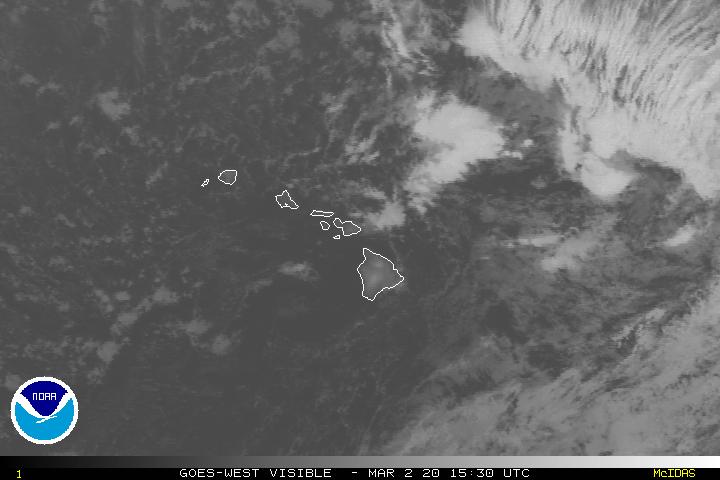
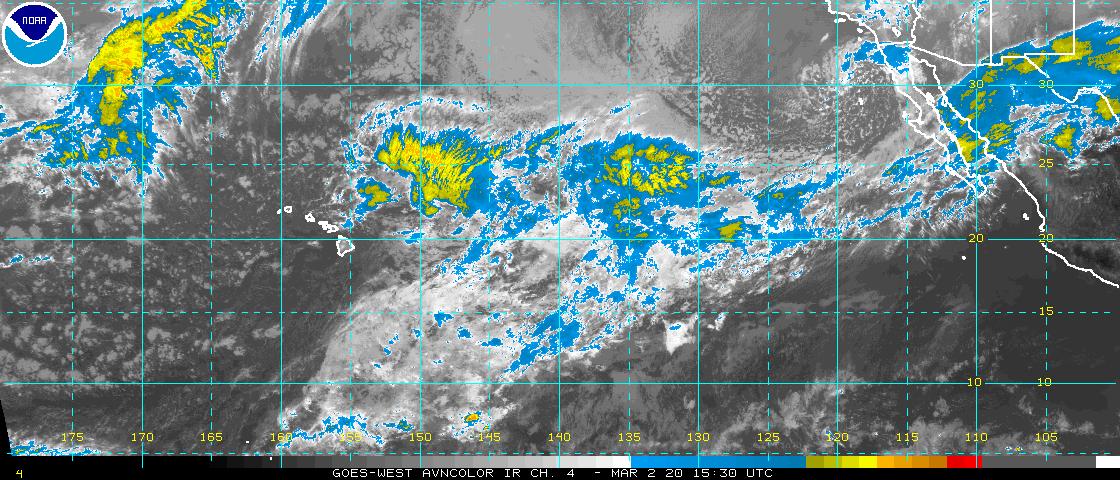
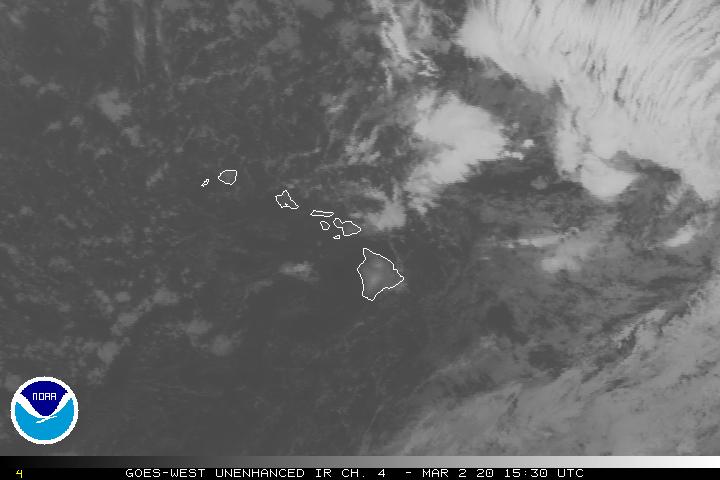
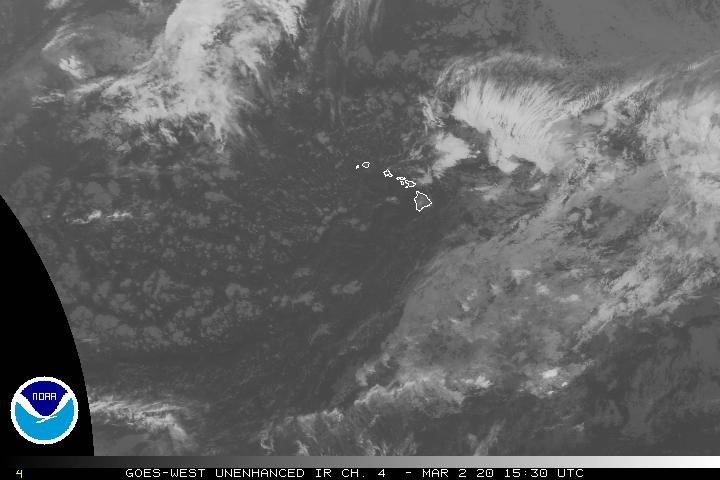
Satellite and Radar Images: To view the cloud conditions we have here in Hawaii, please use the following satellite links, starting off with this Infrared Satellite Image of the islands to see all the clouds around during the day and night. This next image is one that gives close images of the islands only during the daytime hours, and is referred to as a Close-up visible image. This next image shows a larger view of the Pacific…giving perspective to the wider ranging cloud patterns in the Pacific Ocean. Finally, here's a Looping IR satellite image, making viewable the clouds around the islands 24 hours a day. To help you keep track of where any showers may be around the islands, here’s the latest animated radar image.
Hawaii’s Mountains – Here’s a link to the live web cam on the summit of near 14,000 foot Mauna Kea on the Big Island of Hawaii. The tallest peak on the island of Maui is the Haleakala Crater, which is near 10,000 feet in elevation. These two web cams are available during the daylight hours here in the islands…and when there’s a big moon rising just after sunset for an hour or two! Plus, during the nights and early mornings you will be able to see stars, and the sunrise too…depending upon weather conditions.
Tropical Cyclone activity in the eastern and central Pacific – Here’s the latest weather information coming out of the National Hurricane Center, covering the eastern north Pacific. You can find the latest tropical cyclone information for the central north Pacific (where Hawaii is located) by clicking on this link to the Central Pacific Hurricane Center. Here’s a tracking map covering both the eastern and central Pacific Ocean. A satellite image, which shows the entire ocean area between Hawaii and the Mexican coast…can be found here. Of course, as we know, our hurricane season won't end until November 31st here in the central Pacific.
Aloha Paragraphs

Generally nice weather this weekend
Artist Credit…Pierre Bouret
The trade winds remain blustery tonight, although will become lighter this weekend…into the new week ahead. This weather map shows a 1033 millibar high pressure system to the north-northeast of our islands, with a second much weaker 1016 millibar high pressure cell to the east of Hawaii Friday night. Winds will remain locally strong and gusty tonight, and likely into Saturday morning. As we move further into the weekend, they will slow down. There will be an even more evident easing up of the trade winds, and as a matter fact…they will tumble into the light and variable category through next Wednesday.
Thereafter, as a cold front approaches the state, after a slight brush by a weak cold front around mid-week…our winds are projected to become south to southwest Kona winds. Considering climatology, there’s always that chance that we could see cool and brisk northerly or northeasterly breezes arriving, in the wake of the cold frontal passage for a day or two. Then, unless there was another cold front coming right in on the heels of the first, those north to NE winds could become trade winds again by next weekend. Projecting that far out into the future opens the door for lots of changes…and going back to the drawing boards too!
Winds around the state have peaked in strength now, although are still locally blustery…the following numbers representing the strongest gusts early Friday evening:
33 mph Port Allen, Kauai
30 Honolulu, Oahu
24 Molokai
46 Kahoolawe
44 Maalaea Bay, Maui
39 Lanai Airport
16 Honokaa, Big Island
The recent cold front is now to the south and southwest of the state…what’s left of it that is. There were localized showers, some of which were definitely heavy. The 6.32” downpour during the last 24 hours at Mount Waialeale was the most impressive! As this satellite image shows, the cold front is falling apart as it moves into the deeper tropics to our south. Meanwhile, we see lots of clouds to the west through northeast of the islands. If we check out this larger satellite view, we can see that same array of impressive clouds to the west through north of the state, that have been around for several days now. Finally, here’s the looping radar image, so we can keep track of where any leftover showers are falling around the state.
It's Friday evening as I begin writing this last section of today's narrative update. The weather here in the islands has been windy, and actually still is at the time of this writing. These winds won't just all of the sudden stop in their tracks…although are expected to gradually slow down over the next several days. As we move into the new week, we'll go on with little in the way of windiness, as we head into a light and variable wind condition. This typically means that we'll start off our days on the clear and cool side, with afternoon clouds forming over and around the mountains. Later in the new week, we could be looking at Kona winds, prompted by a vigorous cold front…which could produce substantial rains for the islands late in the week. We'll have to discuss this prospect in more detail over the next few days.
~~~ Here in Kihei, it's dark outside as I finish this last section, although it was partly cloudy the last time I looked out. The winds never got into Kihei, nor did the rains from this cold front…as the winds were too easterly to carry over into this south coast, protected by the Haleakala Crater. I'll be back Saturday morning with your next new weather narrative. By the way, before I go, I'm going to see a new film this evening, called The Next Three Days (2010), starring Russell Crowe and Elizabeth Banks…among others. I don't have time to get into this film now, but will describe it further, and give you my impression when I get back online in the morning. I hope you have a great Friday night until then! Aloha for now…Glenn.
Interesting: As leaders from around the world convene this week in Cancun, Mexico, to figure out steps to help curb the emission of planet-warming gases, a group of experts urges them to take seriously the health issues at stake. In anticipation of the U.N. climate change conference, taking place Nov. 29 to Dec. 10, the Climate and Health Council, representing an international network of medical professionals, and others published their arguments emphasizing the importance of a healthy planet for healthy inhabitants in a series of comments online Nov. 25 in the journal the Lancet.
The goal of the organization is to advocate the "health benefits of more sustainable lifestyles and the urgency of addressing climate change," and its message is simple: "What's good for the climate is good for health." Greenhouse pollutants are associated with a reliance on cars for transportation and a sedentary lifestyle, which in turn are linked to obesity, heart disease, cancer, diabetes, stroke and depression, said Council member Ian Roberts, a professor of epidemiology and public health at the London School of Hygiene and Tropical Medicine who co-authored one of the journal comments.
Interesting2: At 300 million years ago, global warming brought about an abrupt collapse of tropical rainforests. According to a new study, it is now believed that this event spawned the evolutionary burst of reptiles. It gave rise to the dinosaurs, which dominated the globe for over 150 million years.
Over its lifetime, the Earth has been through a number of dramatic extinction events, such as the extinction of the dinosaurs 65 million years ago and the extinction of 95% of all life 250 million years ago. These traumatic events are all generally followed by a period of growth in diversity, led by survivors of the global catastrophe.
The event that occurred 300 million years ago occurred in the Carboniferous Period, a time known for glaciation, low sea levels, and mountain building. It is named Carboniferous from the Latin word for coal, carbo, because it is believed that many coal beds were laid down during this period.
At the time, Europe and North America lay along the equator and were homes to massive rainforests, known as coal forests. Global warming triggered by unknown reasons caused the collapse of these equatorial forests. A new study published in the journal, Geology, suggests that this collapse gave rise to an explosion of diversification among reptiles in Europe and America.
The reptiles were better adapted to handle the drier conditions caused by global warming and more readily adjusted to new feeding patterns. Ecologically, these early reptiles, also known as tetrapods, were well suited for the ensuing habitat fragmentation and resource restriction.
Dr. Howard Falcon-Lang of Royal Holloway, University of London and co-author of the study explained, "Climate change caused rainforests to fragment into small 'islands' of forest. This isolated populations of reptiles and each community evolved in separate directions, leading to an increase in diversity."
The researchers examined fossils of reptiles before and after the rainforest collapse. The fossil records showed reptiles become more diverse as they struggled with a changing environment. Over millions of years, their numbers grew as well as their diversity.
They would not dominate the landscape until the reign of the dinosaurs in the Triassic period (230 million years ago). But the events at 300 million years ago lay the groundwork for their rise.
Interesting3: Bamboo, a wild grass that grows in Africa, Asia and Latin America, could help tackle climate change and provide income for local communities, a conference has heard. It can sequester carbon faster than similar fast-growing tree species such as Chinese fir and eucalyptus when properly managed, said Coosje Hoogendoorn, director-general of International Network for Bamboo and Rattan (INBAR), based in Beijing, China. She was speaking today (2 December) at the launch of 'Bamboo and Climate Change Mitigation' — a report on bamboo's potential role in adaptation, mitigation and sustainable development — in a press conference held during the UN Climate Change Conference (COP 16), in Cancun, Mexico.
Bamboo is the fastest growing plant on the planet — with a growth rate of up to 1.2 metres a day. It is stronger than steel, weight for weight, and its roots can reduce soil erosion by up to 75 per cent. "Although botanically bamboo is a woody grass and not a tree, bamboo forests have comparable features to other types of forest regarding their role in the carbon cycle," the report said. "They sequester carbon through photosynthesis, and lock carbon in the fibre of the bamboo and in the soil where it grows."
Interesting4: Acidification of the seas linked to climate change could threaten fisheries production and is already causing the fastest shift in ocean chemistry in 65 million years, a U.N. study showed. Production of shellfish, such as mussels, shrimp or lobsters, could be most at risk since they will find it harder to build protective shells, according to the report issued on the sidelines of U.N. climate talks in Mexico.
It could also damage coral reefs, vital as nurseries for many commercial fish stocks. "Ocean acidification is yet another red flag being raised, carrying planetary health warnings about the uncontrolled growth in greenhouse gas emissions," said Achim Steiner, head of the U.N. Environment Program (UNEP). "Whether ocean acidification on its own proves to be a major or a minor challenge to the marine environment and its food chain remains to be seen," he said in a statement. A UNEP booklet reviewing scientific findings about ocean acidification, caused by water soaking up greenhouse gases from the atmosphere, said that it adds to threats to food security that already include overfishing and pollution. "It's the speed of change … that is the cause of concern," said Carol Turley, of the UK Ocean Acidification Research Program.
Interesting5: When doctors want their patients asleep during surgery, they gently turn the gas tap. But anesthetic gasses have a global warming potential as high as a refrigerant that is on its way to be banned in the European Union. Yet there is no obligation to report anesthetic gasses along with other greenhouse gasses such as carbon dioxide, refrigerants and laughing gas.
One kilogram of anesthetic gas affects the climate as much as 1,620 kilos of CO2. That has been shown by a recent study carried out by chemists from University of Copenhagen and NASA in collaboration with anesthesiologists from the University of Michigan Medical School. The amount of gas needed for a single surgical procedure is not high, but in the US alone surgery related anesthetics affected the climate as much as would one million cars.
Interesting6: When will production of oil and coal peak? After the peak, production will decline because supplies are being depleted and no new sources are to be found. Peak oil is the point in time when the maximum rate of global petroleum extraction is reached, after which the rate of production enters terminal decline.
Optimistic estimations of peak production forecast the global decline will begin by 2020 or later, and assume major investments in alternatives will occur before a crisis, without requiring major changes in the lifestyle of heavily oil-consuming nations. These models show the price of oil at first escalating and then retreating as other types of fuel and energy sources are used.
Pessimistic predictions of future oil production operate on the thesis that either the peak has already occurred, that oil production is on the cusp of the peak, or that it will occur shortly.
The most recent edition of the respected science journal Nature contemplates the end of cheap coal with an analysis of the decline of global coal supplies by Post Carbon Institute Fellows David Fridley and Richard Heinberg.
The estimates for global peak coal production vary wildly. Many coal associations suggest the peak could occur in 200 years or more, while scholarly estimates predict the peak to occur as early as 2010. Research in 2009 by the University of Newcastle in Australia concluded that global coal production could peak sometime between 2010 and 2048.
 Email Glenn James: