











December 28-29, 2010
Air Temperatures – The following maximum temperatures were recorded across the state of Hawaii Tuesday afternoon:
Lihue airport, Kauai – 79
Honolulu airport, Oahu – 81
Kaneohe, Oahu – 79
Molokai airport – 82
Kahului airport, Maui – 83
Kona airport – 83
Hilo airport, Hawaii – 80
Air Temperatures ranged between these warmest and coolest spots near sea level – and on the highest mountain tops…as of 5pm Tuesday evening:
Kailua-kona – 79F
Hilo, Hawaii – 76
Haleakala Crater – 45 (near 10,000 feet on Maui)
Mauna Kea summit – 32 (near 14,000 feet on the Big Island)
Precipitation Totals – The following numbers represent the largest precipitation totals (inches) during the last 24 hours on each of the major islands, as of Tuesday afternoon:
1.07 Mount Waialeale, Kauai
3.96 Palehua, Oahu
0.30 Molokai
0.08 Lanai
0.00 Kahoolawe
0.37 Oheo Gulch, Maui
0.36 Kealakomo, Big Island
Marine Winds – Here’s the latest (automatically updated) weather map showing that we have a dissipating trough of low pressure to our west and northwest. At the same time we have a high pressure system to our northeast, with its high pressure ridge located to the northeast as well. Our winds will gradually become trades late Wednesday or by Thursday.
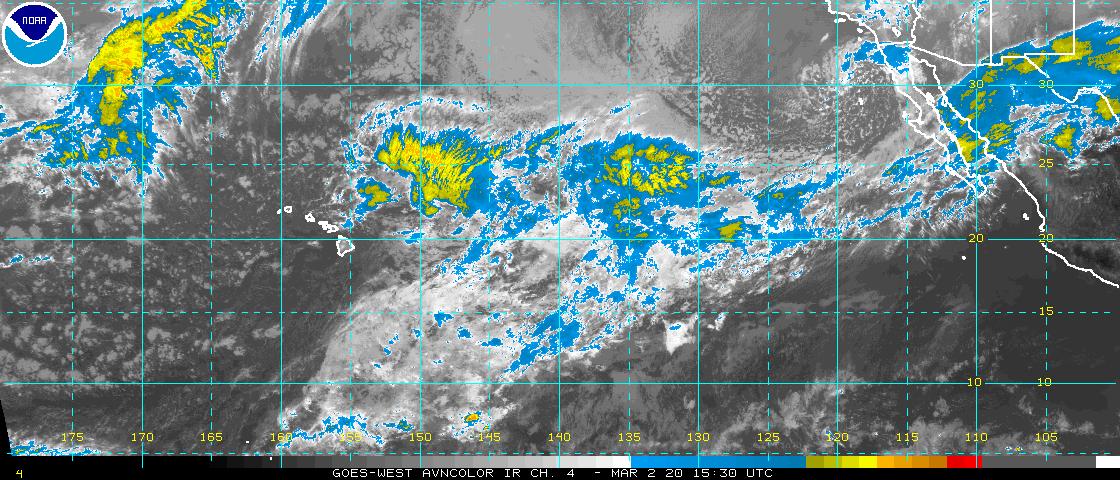
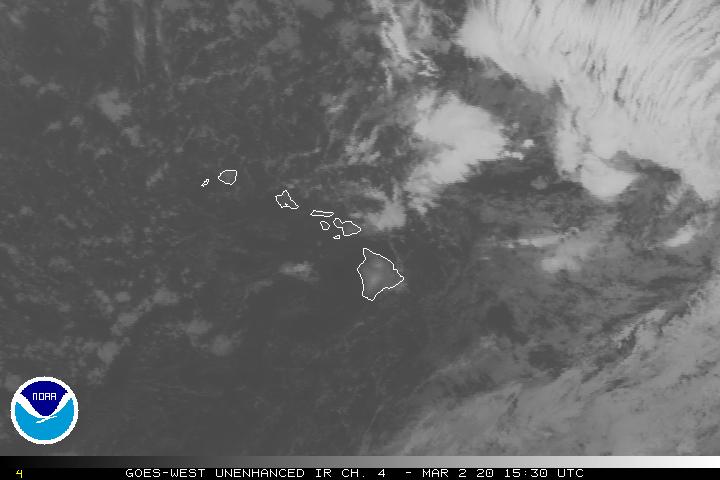
Satellite and Radar Images: To view the cloud conditions we have here in Hawaii, please use the following satellite links, starting off with this Infrared Satellite Image of the islands to see all the clouds around during the day and night. This next image is one that gives close images of the islands only during the daytime hours, and is referred to as a Close-up visible image. This next image shows a larger view of the Pacific…giving perspective to the wider ranging cloud patterns in the Pacific Ocean. Finally, here's a Looping IR satellite image, making viewable the clouds around the islands 24 hours a day. To help you keep track of where any showers may be around the islands, here’s the latest animated radar image.
Hawaii’s Mountains – Here’s a link to the live web cam on the summit of near 14,000 foot Mauna Kea on the Big Island of Hawaii. The tallest peak on the island of Maui is the Haleakala Crater, which is near 10,000 feet in elevation. These two web cams are available during the daylight hours here in the islands…and when there’s a big moon rising just after sunset for an hour or two! Plus, during the nights and early mornings you will be able to see stars, and the sunrise too…depending upon weather conditions.
Tropical Cyclone activity in the eastern and central Pacific – Here’s the latest weather information coming out of the National Hurricane Center, covering the eastern north Pacific. You can find the latest tropical cyclone information for the central north Pacific (where Hawaii is located) by clicking on this link to the Central Pacific Hurricane Center. Here’s a tracking map covering both the eastern and central Pacific Ocean. A satellite image, which shows the entire ocean area between Hawaii and the Mexican coast…can be found here. Of course, as we know, our hurricane season won't end until November 31st here in the central Pacific.
Aloha Paragraphs

Gradually improving weather conditions across the Aloha state
South to southeast winds continue to blow across the islands Tuesday…although the trade winds will arrive soon. This weather map shows a 1028 millibar high pressure system well to our east-northeast, with a weaker 1027 millibar high pressure system located to the north-northeast of the islands. At the same time, we also have the tail end of a cold front to the north of the islands, along with troughs of low pressure to our west and southwest. The placement of these high and low pressure features will keep our winds coming at us from the south and southeast for the time being. The forecast continue to suggest that we’ll see trade winds returning late Wednesday or by Thursday…lasting into the New Year’s holiday weekend and beyond.
Winds remain generally light, although locally stronger…the following numbers represent the strongest breezes Tuesday evening, along with the directions:
29 mph Barking Sands, Kauai – SE
23 Waianae, Oahu – SSW
05 Molokai – SE
30 Kahoolawe – ESE
16 Hana, Maui – SE
14 Lanai Airport – SE
31 South Point, Big Island – NE
Our weather is on the mend now, with the unsettled weather gradually giving way to a fair weather trade wind weather pattern. This large satellite image shows a large, although dissipating area of clouds to our west, overlapping the islands from Kauai to the Big Island. At the same time, we find an intense area of thunderstorms due south of the Big Island. Looking at this next satellite picture, less cloudiness is over the state now, compared to the last several days, with even some sunny periods beginning to break out Tuesday afternoon. Checking out this looping radar image we see far fewer showers streaming through the islands at the time of this writing…the most of which are to the south of Maui and the west of the Big Island. It looks like Kauai and Oahu are finally taking a break from the wet weather…with the threat of heavy showers much diminished.
Here in Kihei, Maui, skies are still mostly cloudy, although they are generally of the high cirrus variety. There is still a fair amount of volcanic haze in our atmosphere, which will likely still be around during the day Wednesday. As the trade winds return late Wednesday or Thursday, this vog will be swept down stream. The main thing now, is that the flash flood watch over Niihau, Kauai and Oahu has been discontinued. This pretty much erases the threat of heavy showers, although a few could still pop up over or around parts of Maui and the Big Island. Things are looking up, with improving weather conditions right around the corner. I'd bed that we see more sunshine on Wednesday, and even more than that on Thursday…right on into the upcoming New Years holiday. ~~~ I'll be back early Wednesday morning with your next new weather narrative from paradise. I hope you have a great Tuesday night until then! Aloha for now…Glenn.
Looping radar image
Interesting: Between May and July each year, millions of sardine move northward along the East coast of South Africa to reach spawning sites where they release their eggs. This is the spectacular Sardine Run. The migrating fish come under relentless attack from dolphins, sea lions, whales, tuna, birds and fishermen during their headlong, even suicidal race.
Why do the sardine brave such formidable dangers? How did this dogged migration arise? A great event, it has been stimulating scientists' imagination for many decades. Many hypotheses have been put forward, often contradictory ones. IRD researchers and their partners reviewed these different theories and tested them by comparing and combining a range of biological, acoustic, oceanographic and satellite data.
Inevitable return to their hatching place
Only a variably-sized proportion of the population of the South African sardine, Sardinops sagax, undertakes this long voyage, from the Agulhas Bank to grounds further North off Durban, in KwaZulu-Natal province. Like Emperor penguins in Antarctica, salmon in the rivers or indeed antelope across the African deserts, a single objective drives them: perpetuation of the species.
Their reproductive instinct takes precedence over that for survival and pushes them along to overcome the many challenges in their way to return to their native area to scatter their eggs in the spawning grounds.
The logic is unyielding: if this homing strategy has worked for them, it will also succeed for their descendants. The resulting population balance justifies their efforts in the end. Great reproductive success wins out against the high mortality suffered during the migration.
Releasing eggs further North, upstream of the ocean currents, ensures a better yield. Eggs, then larvae, thus have enough time to develop before they reach the Agulhas Bank. This bank is an extremely dispersive environment, where eggs or larvae become exposed to a high risk of being carried out to the open ocean, beyond the continental waters, and therefore lost to the species.
Permeation: the sixth sense of the sardine
How do the sardine manage to arrive each year exact at their own hatching site? Exchange mechanisms across its membrane allow permeation of the egg with components characteristic of the local marine ecosystem and with the terrestrial input from rivers. Then the same happens to the larvae.
Olfactory processes are probably involved. Once adult, demonstrating exceptional sensory ability, the sardine pick up chemical stimuli coming from the local environment to guide themselves to their exact hatching site, in the KwaZulu-Natal.
In-bred heritage or loss of direction?
How have the sardine become fixed on an area so far North, near Durban, an environment so hostile to them? The research team decided on two hypotheses as being the most plausible. The first suggests that this migration is a relict behavior, probably inherited from the Last Ice Age.
These sardine prefer sea temperatures of between 18 and 22°C. In those cold times they lived further North, off KwaZulu-Natal, where the ocean was colder than it is now. Then, the last deglaciation, brought on an overall warming of the seas.
The fish therefore had to migrate towards the South, nearer the Pole. However, each year, in the reproductive season, they continued to come to the same place to spawn. That is why this ancient seasonal migration continues.
The second theory postulates that at a particular moment a shoal strayed off its normal migration route. Following some unusual oceanic conditions or a fault developed in the sardine's direction-finding system, their drift off-course led them to KwaZulu-Natal and resulted in an exceptional reproductive success.
Two years later, the numerous descendants of this shoal, in their mature stage, repeated this epic voyage. From year to year, the population then grew, until it generated the enormous shoals we see today.
Interesting2: Last week the US Senate passed the Shark Conservation Act, which bolsters the prohibition of shark-finning in US waters and puts the US at the forefront of shark conservation. Finning involves catching a live shark, cutting off its fins, then dumping it back into the water where it suffers a slow death of asphyxiation on the ocean floor.
The fins are frozen or dried and then most are shipped to Asia where shark fin soup, a thin and gelatinous concoction, is a delicacy. Globally, an estimated 73 million sharks are killed every year, primarily to support the shark fin trade. With 30 percent of all shark species threatened with extinction, the practice of finning is leading to crashes in many populations.
For instance, scalloped hammerheads and dusky sharks off the eastern US coast have dropped by 80 percent since 1970. Even under strict regulations, it will take centuries for dusky shark populations to rebound to normal numbers.
Sharks are one of the oldest groups of vertebrates and have persisted through many extinction events, including the Cretaceous-Tertiary Extinction which killed off the dinosaurs and the earlier Permian Extinction which resulted in the loss of 90-95% of life on earth.
The fact that many species are dwindling points to the fact that humans are changing the world in magnitudes that haven't been experienced for millions of years. For example, the great white shark which has been in existence for at least 16 million years is today listed as Vulnerable by the IUCN.
Many shark species inhabit small areas and are extremely prone to overfishing. One of these is the smoothtooth blacktip shark which exists only in the Gulf of Aden, near Yemen and is caught as by catch by local fisheries. The Shark Conservation Act was introduced by Reps. Madeleine Bordallo, D-Guam, Eni Faleomavaega, D-American Samoa, and Sen.
John Kerry, D-Mass, and creates a comprehensive fins-attached policy for all shark catches in US waters by amending flaws in previous legislation and working to elicit similar measures in other countries.
 Email Glenn James: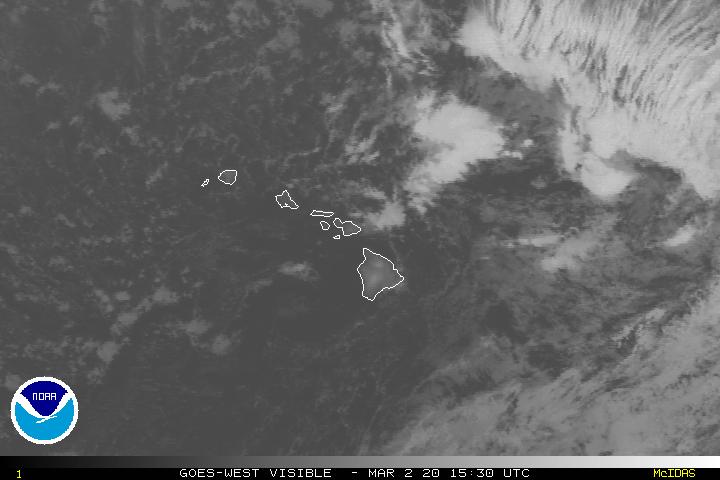


peter mac Says:
Aloha Glenn – stay brave with your pertinent info on the bioshpere. Civilization seems dangerous to life on Earth.~~~Staying brave as I can Peter, I agree we as a civilization are hard on the environment…no doubt about it. Aloha, Glenn.
chris Says:
Your reports are hands down THE BEST. Yahoo weather, Weather Bug and others are useless in their predictions. Thank you so much.
LOVE the info on sea urchins too.~~~Hi Chris, that remark helped to make this weatherman’s day…thanks! Aloha, Glenn
leslie Says:
It is important to note that not all urchins are borers. The ones found in Hawaii that are rock borers are these: Echinometra mathaei. They also contribute to the death of the coral they are boring into and subsequently the destruction of the reef they are located on similar to beetles that bore into trees in a forest. In Australia they are considedered similar to a noxious weed and have accelerated the death of the great barrier reef and hence are gathered and destroyed by the hundreds wherever they are found. Interesting to note the long spined urchins that people are so afraid of getting stung by-if you gently lift them with a dive knife and let them float down onto your bare skin they wont sting. They just think they have come to rest on another rock.~~~Hi Leslie, thanks for the further information on Urchins, interesting stuff. Aloha, Glenn