











December 25-26, 2010
Air Temperatures – The following maximum temperatures were recorded across the state of Hawaii Saturday afternoon:
Lihue airport, Kauai – 80
Honolulu airport, Oahu – 80
Kaneohe, Oahu – 81
Molokai airport – 79
Kahului airport, Maui – 83
Kona airport – 83
Hilo airport, Hawaii – 83
Air Temperatures ranged between these warmest and coolest spots near sea level – and on the highest mountain tops…as of 4pm Saturday afternoon:
Port Allen, Kauai – 82F
Molokai airport – 74
Haleakala Crater – 48 (near 10,000 feet on Maui)
Mauna Kea summit – 34 (near 14,000 feet on the Big Island)
Precipitation Totals – The following numbers represent the largest precipitation totals (inches) during the last 24 hours on each of the major islands, as of Saturday afternoon:
1.23 Mount Waialeale, Kauai
3.20 Ahuimanu Loop, Oahu
0.20 Molokai
0.29 Lanai
0.00 Kahoolawe
0.56 Ulupalakua, Maui
1.68 Pahala, Big Island
Marine Winds – Here’s the latest (automatically updated) weather map showing that we have two cold fronts approaching from the northwest, with a weak high pressure system to the northeast…moving eastward. The placement of these weather features will turn our winds south to southwest Sunday into Monday, becoming stronger.
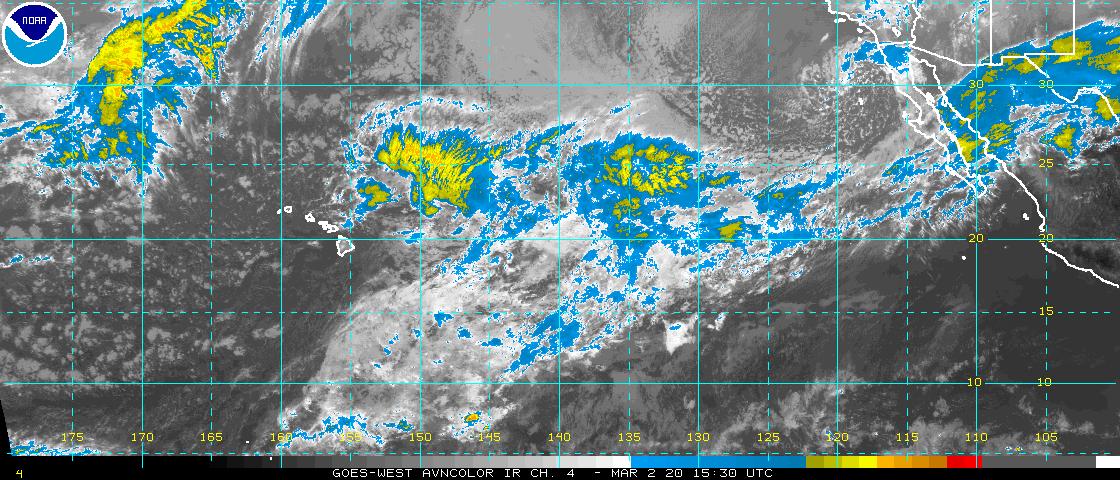
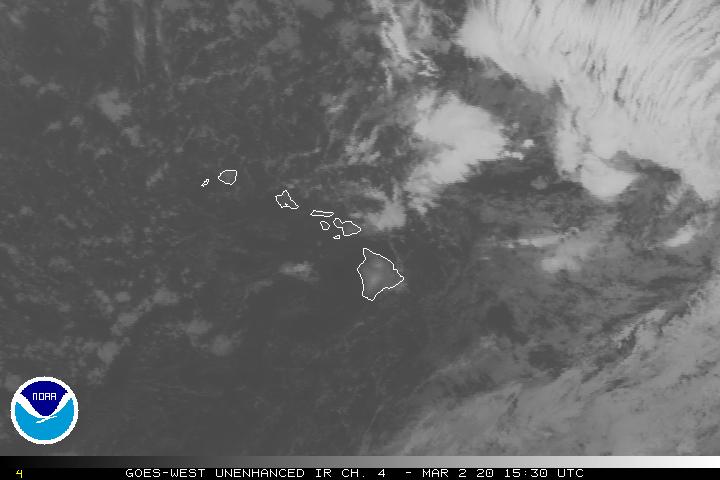
Satellite and Radar Images: To view the cloud conditions we have here in Hawaii, please use the following satellite links, starting off with this Infrared Satellite Image of the islands to see all the clouds around during the day and night. This next image is one that gives close images of the islands only during the daytime hours, and is referred to as a Close-up visible image. This next image shows a larger view of the Pacific…giving perspective to the wider ranging cloud patterns in the Pacific Ocean. Finally, here's a Looping IR satellite image, making viewable the clouds around the islands 24 hours a day. To help you keep track of where any showers may be around the islands, here’s the latest animated radar image.
Hawaii’s Mountains – Here’s a link to the live web cam on the summit of near 14,000 foot Mauna Kea on the Big Island of Hawaii. The tallest peak on the island of Maui is the Haleakala Crater, which is near 10,000 feet in elevation. These two web cams are available during the daylight hours here in the islands…and when there’s a big moon rising just after sunset for an hour or two! Plus, during the nights and early mornings you will be able to see stars, and the sunrise too…depending upon weather conditions.
Tropical Cyclone activity in the eastern and central Pacific – Here’s the latest weather information coming out of the National Hurricane Center, covering the eastern north Pacific. You can find the latest tropical cyclone information for the central north Pacific (where Hawaii is located) by clicking on this link to the Central Pacific Hurricane Center. Here’s a tracking map covering both the eastern and central Pacific Ocean. A satellite image, which shows the entire ocean area between Hawaii and the Mexican coast…can be found here. Of course, as we know, our hurricane season won't end until November 31st here in the central Pacific.
Aloha Paragraphs

Yet another rainy period coming up over the next few days
Winds will be south and southwest…increasing in strength Sunday into Monday. This weather map shows a weak trough of low pressure just to the south of the state Christmas Day evening. At the same time we see two cold fronts approaching from the northwest, along with a high pressure system to our northeast…moving away towards the east. The locations of these various weather features will trigger stronger winds, coming in from the south today…with some further increase in speeds from the southwest Sunday into the new week ahead.
Winds will gradually become stronger going into Sunday…the following numbers represent the strongest breezes late Christmas afternoon:
10 mph Lihue, Kauai
23 Waianae, Oahu
20 Molokai
17 Kahoolawe
12 Kahului, Maui
08 Lanai Airport
24 Hilo, Big Island
Our weather will become cloudier and more shower prone as we move through the next several days…leading to potential flood conditions on Kauai and Oahu. This large view satellite image shows areas of clouds to our west through north, and in the area to our east and southeast. Looking at this next satellite picture, shows clouds starting to take aim on our area again now, which will be on the increase for many days going forward. The air mass remains shower prone, and will become even more so as we get later into Sunday and the first half of the new work week coming up. This will be especially true on the Kauai end of the state, although the other islands will find showers falling at times too. Checking out this looping radar image we see that our winds are definitely coming up out of the deeper tropics, from the south now…carrying showers into our islands…with localized heavy thunderstorms.
The recent NWS issued Hydrologic Outlook Statement, forecasting heavy rains again into Tuesday, has been discontinued…with a flash flood watch issued in its place. This watch covers only the islands of Niihau, Kauai, and Oahu at the time of this writing. An approaching cold front has already triggered strengthening south Kona winds. These freshening winds are carrying moisture from the deeper tropics to our south, up into the state already, at least in some places…according to that radar image in the paragraph above. The islands of Maui County and the Big Island aren't covered by the flood watch, although these islands too will eventually get overlapped by heavier rains as we move into the new work week. The rains on Kauai and Oahu are apt to be the heaviest, which as the watch implies, may lead to flooding conditions. We need to know that our weather will be turning wet again, and plan to drive very carefully when it arrives. ~~~ I hope everyone has had a wonderful Christmas, either here in the islands, or elsewhere. As most of you know President Obama and family are vacationing on the windward side of Oahu, which will find heavy rains arriving with time, likely curtailing his golfing excursions. I'll be back Sunday morning with your next new weather narrative. I just got woken up out of a sound sleep by thunder and lightning here on Maui, at 1215am Sunday morning! Aloha for now…Glenn.
Interesting: They'll drill through four ice ages, epic sandstorms, humankind's migration from Africa to the New World, and the biggest droughts in history. Tel Aviv University is heading an international study that for the first time will dig deep beneath the Dead Sea, 500 meters (about a third of a mile) down under 300 meters (about a fifth of a mile) of water.
Drilling with a special rig, the researchers will look back in time to collect a massive amount of information about climate change and earthquake patterns. The study, led by Prof. Zvi Ben-Avraham of Tel Aviv University's Minerva Dead Sea Research Center, "aims to get a complete record in unprecedented resolution — at one year intervals — of the last 500 thousand years," says Prof. Ben-Avraham.
A crazy sandstorm 365,250 years ago?
Looking at the core sample to be dug about five miles offshore near Ein Gedi, the researchers hope to pinpoint particular years in Earth history to discover the planet's condition. They'll be able to see what the climate was like 365,250 years ago, for instance, or determine the year of a catastrophic earthquake.
This is by far the largest Earth sciences study of its kind in Israel. The evidence will help the world's climatologists calibrate what they know about climate change from other geological samples — and may lead to better predictions of what's in store for Middle East weather.
For example, are currently increasing dry and hot periods in the region something new, or are they part of some larger cyclical pattern? What they find should also shed light on earthquake patterns — important information for Israelis, Jordanians and Palestinians who live on or around the fault line that passes through the Dead Sea region.
Slicing through a geological cake
"The sediments provide an 'archive' of the environmental conditions that existed in the area in its geological past," Prof. Ben-Avraham says. While the sample being collected isn't as deep as oil explorers drill to look for oil, the core will be something special: it will be kept in an unbroken piece so that records can be traced more accurately.
The study is being supported by the Israel Sciences Academy and includes dozens of scientists from America, Germany, Switzerland, Norway, Japan, and Israel. Scientists from Jordan and the Palestinian Authority are also cooperating on this unique event. The researchers come from a variety of disciplines, from environmental science to chemistry, and each will get different parts of the core to analyze.
Prof. Ben-Avraham himself is particularly interested in chemical changes to the sediment in the Dead Sea over the last half million years. The study, he adds, will shed light on human migration patterns through the region. At 423 meters, or a quarter of a mile, below sea level, the Dead Sea is the lowest place on earth. Today it draws millions of tourists from around the world to enjoy its legendarily healing properties.
Interesting2: Six years after the tsunami disaster of 26/12/2004, the set-up of the German-Indonesian Tsunami Early Warning System for the Indian Ocean (GITEWS) has been completed. The project ends on 31 March 2011. After that, Indonesia accepts the sole responsibility for the overall system.
"The innovative technical approach of GITEWS is based on a combination of different sensors, whose central element is a fast and precise detection and analysis of earthquakes, supported by GPS measurements," says Professor Reinhard Hüttl, Scientific Director of the GFZ German Research Centre for Geosciences.
"The GFZ-developed evaluation of Seismology via the SeisComP3 system proved to be so fast and reliable that it has now been installed in over 40 countries." A tsunami warning takes place no more than five minutes after a submarine earthquake, based on all the available information from the 300 stations that were built throughout Indonesia in the past 6 years.
These include seismometers, GPS stations, tide gauges and buoy systems. Via a tsunami-simulation system, the information is converted into a situation map providing the appropriate warning levels for the affected coastline. A key outcome of GITEWS project is, however, that the buoy systems do not contribute to this process that occurs in these first few minutes.
There are therefore considerations to shift the GITEWS buoys further into the open ocean and to use them to verify an ocean-wide tsunami that could threaten other countries bordering the Indian Ocean. The Mentawai quake on 25 October this year, however, also showed the limits of any tsunami warning.
The tsunami caused by the earthquake strongly affected the upstream Pagai islands in the Sunda Arc. The first waves arrived around the same time as the triggered tsunami alert, 4 minutes 46 seconds after the quake, and demanded some 500 lives. Several teams of tsunami experts from Japan, Indonesia, Germany and the USA noted in a follow-up analysis that the warning had arrived on the islands, but there had been no time to react.
For the main island of Sumatra with the larger cities of Padang and Bengkulu, the time between the warning and the arrival of the first waves amounted to about 40 minutes, but in this case the Pagai Islands acted as a perfect shield against a tsunami reaching the coast of Sumatra.
The important conclusion is that even with the extremely short premonition times off Indonesia, the GITEWS system has proven to be technically and organizationally functional. Since September 2007, four tsunami events were detected and warnings were issued for each. Especially the inhabitants of the off-shore islands, however, need to receive intensified and improved training on how to act when threatened.
This includes not only the correct response during a tsunami alert, but also the correct behavior before, during and after earthquakes. Immediately after the disaster of 26 December 2004, the Federal Government of Germany contracted the Helmholtz Association, represented by the Helmholtz Centre Potsdam — GFZ German Research Centre for Geosciences, to develop and implement an early warning system for tsunamis in the Indian Ocean.
The funds to the amount of 45 million euros are a contribution of the Federal Government from the aid-for-flood-victims pool. A natural phenomenon like the tsunami of 2004 cannot be prevented, and such disasters will continue to claim victims, even with a perfectly working alarm system. But the repercussions of such a natural disaster can be minimized with an early warning system. This is the aim of GITEWS.
Interesting3: Using gene sequencing tools, teams from Harvard, the University of Illinois and the University of York in Britain have shown that instead of being the same species — as scientists have long believed — the African savanna elephant and the smaller African forest elephant are distant cousins, having been largely separated for 2 million to 7 million years. "What our study suggests is forest and savanna elephants are very distantly related to each other and not just subspecies or populations of the same species," said Alfred Roca of the University of Illinois, who worked on the study published in the Public Library of Science journal PLoS Biology.
The teams compared the genetic code of modern elephants from Africa and Asia to DNA taken from two extinct species — the woolly mammoth and the American mastodon. "The surprising finding is that forest and savanna elephants from Africa — which some have argued are the same species — are as distinct from each other as Asian elephants and mammoths," David Reich of Harvard Medical School in Boston, who worked on the study, said in a statement. Africa's forest and savanna elephants are vastly different in size.
The savanna elephant is roughly double the weight of the forest elephant at six to seven tons and measures about 11.5 feet tall at the shoulder — about 3 feet (1 meter) taller than the forest elephant. Even so, many scientists had thought the two populations of elephants came from the same species, in part because they mated and produced offspring.
Not so, says Professor Michi Hofreiter, an expert in ancient DNA from York. "The divergence of the two species took place around the time of the divergence of the Asian elephant and woolly mammoths," Hofreiter said in a statement.
 Email Glenn James: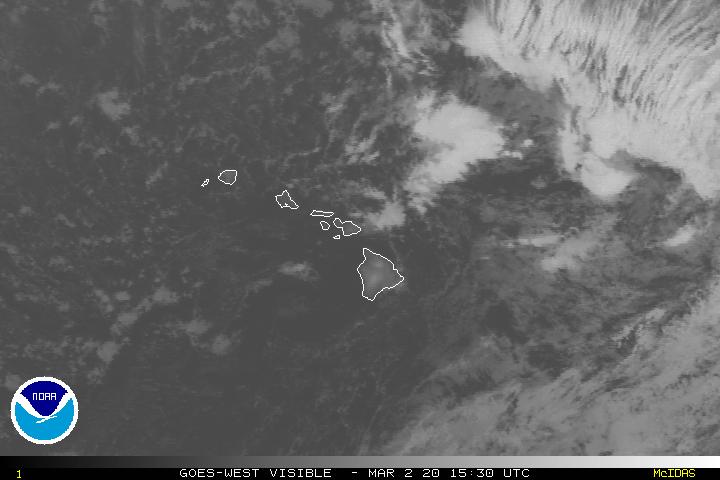


Dawn Says:
Merry Christmas, Glenn! I thought you might take the day off, so was happy to find your weather observations this morning.~~~Hi Dawn, the weather doesn’t take a day off, so how can I? I love the weather, so it’s not really a chore, rather a pleasure to share my interest. Merry Christmas to you too! Aloha, Glenn