











December 21-22, 2010
Air Temperatures – The following maximum temperatures were recorded across the state of Hawaii Tuesday afternoon:
Lihue airport, Kauai – 83
Honolulu airport, Oahu – 75
Kaneohe, Oahu – 79
Molokai airport – 80
Kahului airport, Maui – 82
Kona airport – 80
Hilo airport, Hawaii – 76
Air Temperatures ranged between these warmest and coolest spots near sea level – and on the highest mountain tops…as of 5pm Tuesday evening:
Port Allen, Kauai – 81F
Hilo, Hawaii – 73
Haleakala Crater – 45 (near 10,000 feet on Maui)
Mauna Kea summit – 34 (near 14,000 feet on the Big Island)
Precipitation Totals – The following numbers represent the largest precipitation totals (inches) during the last 24 hours on each of the major islands, as of Tuesday evening:
1.56 Lihue airport, Kauai
0.52 Waimanalo, Oahu
0.13 Molokai
0.24 Lanai
0.36 Kahoolawe
7.82 Oheo Gulch, Maui
3.28 Pohakuloa Keamuku, Big Island
Marine Winds – Here’s the latest (automatically updated) weather map showing a 1026 millibar high pressure cell far to our north-northwest. At the same time, we find a weakening cold front paralleling the windward sides of our islands. Our winds will be light or a bit stronger from the east to southeast Wednesday and Thursday.
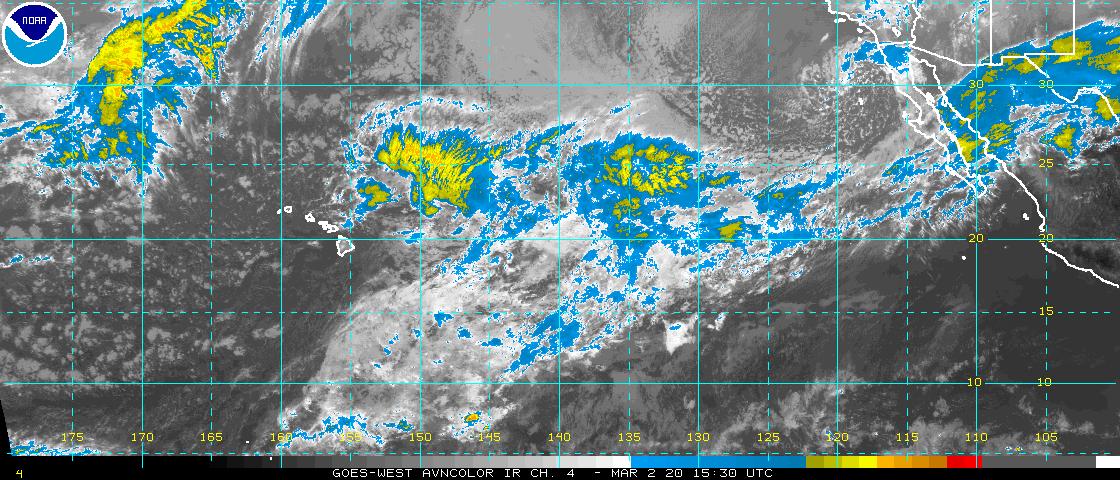
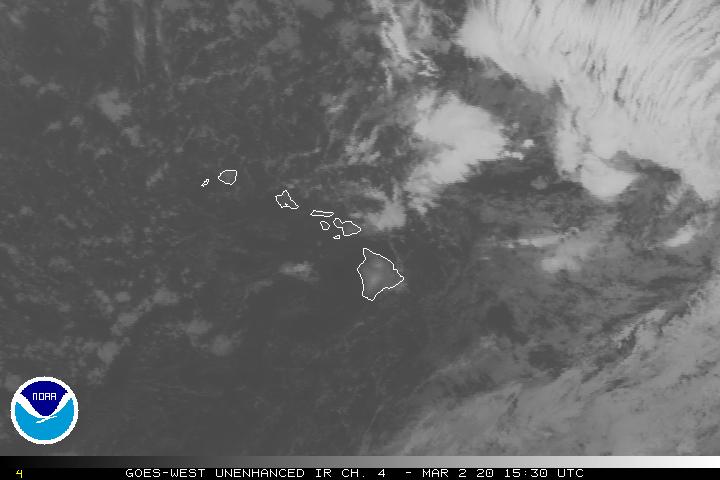
Satellite and Radar Images: To view the cloud conditions we have here in Hawaii, please use the following satellite links, starting off with this Infrared Satellite Image of the islands to see all the clouds around during the day and night. This next image is one that gives close images of the islands only during the daytime hours, and is referred to as a Close-up visible image. This next image shows a larger view of the Pacific…giving perspective to the wider ranging cloud patterns in the Pacific Ocean. Finally, here's a Looping IR satellite image, making viewable the clouds around the islands 24 hours a day. To help you keep track of where any showers may be around the islands, here’s the latest animated radar image.
Hawaii’s Mountains – Here’s a link to the live web cam on the summit of near 14,000 foot Mauna Kea on the Big Island of Hawaii. The tallest peak on the island of Maui is the Haleakala Crater, which is near 10,000 feet in elevation. These two web cams are available during the daylight hours here in the islands…and when there’s a big moon rising just after sunset for an hour or two! Plus, during the nights and early mornings you will be able to see stars, and the sunrise too…depending upon weather conditions.
Tropical Cyclone activity in the eastern and central Pacific – Here’s the latest weather information coming out of the National Hurricane Center, covering the eastern north Pacific. You can find the latest tropical cyclone information for the central north Pacific (where Hawaii is located) by clicking on this link to the Central Pacific Hurricane Center. Here’s a tracking map covering both the eastern and central Pacific Ocean. A satellite image, which shows the entire ocean area between Hawaii and the Mexican coast…can be found here. Of course, as we know, our hurricane season won't end until November 31st here in the central Pacific.
Aloha Paragraphs

More off and on showers…mostly windward
Winds will be generally light through the rest of this week. This weather map shows a 1024 millibar high pressure system located to the north, moving southeast. Then, we also have a dissipating cold front located just to our northeast…paralleling the windward sides of the islands. The placement of these high and low pressure features will keep our winds generally blowing from the east to southeast direction.
Winds will be generally light from the east to southeast tonight…the following numbers represent the strongest breezes Tuesday evening:
13 mph Barking Sands, Kauai
10 Kahuku, Oahu
05 Molokai
10 Kahoolawe
14 Lipoa, Maui
05 Lanai Airport
12 South Point, Big Island
A deep layer of tropical moisture remains over the entire state Tuesday night…keeping showers in the forecast. This large view satellite image shows an area of clouds, some of which are thunderstorms…surrounding the islands in most directions. Looking at this next satellite picture, shows a wide variety of shower producing clouds, most of which are over the ocean to our north through east, and then south Tuesday night. These could easily shift back over the islands, bringing showers or rain in the process. Checking out this looping radar image we see moderately heavy showers still in our vicinity. The threat of showers will prevail, as a cold front remains in our vicinity through mid-week. We'll find off and on showery weather locally through the next several days, mostly along the windward sides…perhaps with a few exceptions. The most generous offshore showers are falling around the Big Island and parts of Maui at the time of this writing. As we move into the second half of this work week, conditions will likely improve some, although the Christmas holiday weekend still doesn’t look like it will have perfect weather…in terms of totally clear skies, with no chance of showers.
The threat of heavy rain continues, with the possibility of flash flooding still around tonight. The overlying atmosphere remains exceptionally moist and shower prone. Checking out the radar images above shows showers falling over the nearby ocean area. At the moment, it appears Maui and the Big Island are most subject to showery weather, although Oahu has some precipitation too. Just about anywhere in the state could find rain falling. As we move into Wednesday, the showers will mostly concentrate over and around the windward sides, and the mountains. Thursday and Friday may actually see some improvement. As we move into the Christmas weekend coming up, another cold front will edge up closer to us, prompting the chance of more showery weather then…or early next week. If all of that wasn't enough, the computer forecast models are starting to show the chance of yet another cold front bringing more wet weather around the middle of next week. I figure that most folks would prefer to have good weather on Christmas Day, so let's keep our fingers crossed for that to happen! I'll be back early Wednesday morning with your next new weather narrative, I hope you have a great first night of winter until then. Aloha for now…Glenn.
Extra: There have been over 84,000+ page impressions of this website during the last 72 hours…with 618 clicks on the google ads. So far this month, in total, there have been 311,590 page impressions…with 2,289 google ad clicks. Thank you all for your readership, and clicks too!
Interesting: What do you get when you add public land in sunny Western states and a federal government that wants to develop renewable energy? The answer: an announcement by the Interior Department last week that it selected about two dozen potential sites for large-scale solar power installations on public lands.
The sites are in six states: California, Arizona, Nevada, Utah, Colorado, and New Mexico. The Bureau of Land Management has 120 million acres in the six states, and 22 million acres could be identified as solar energy zones, but only 214,000 acres will be considered.
Solar energy projects that generate 10 megawatts (MW) or more of power that will be put directly into the transmission grid will be eligible. The solar technologies used will be either concentrating solar power (CSP) or photovoltaic (PV).
The Interior Department released a Programmatic Environmental Impact Statement (PEIS). Public comments will be taken for 90 days and 14 hearings will be held in the impacting states plus Washington, D.C.
The Interior Department limited solar energy development on public lands to just six states because it considered only lands that have "high solar insolation and direct normal radiation values, low slope, and relatively few resource conflicts," according to a press release.
Interesting2: It hasn't happened since 1638! This morning at about 2:30 am in the eastern US, residents were treated to a very rare event. A total lunar eclipse that coincides with the Winter Solstice.
How often can you be a part of something that has not happened in more than 300 years ago and will not happen again until 2094! The combination of a total lunar eclipse and the Winter Solstice means that the moon is very high in the sky, and is easy to observe and photograph.
Skies were perfect over the Mid-Atlantic states (except for the ever present light from cities and towns). The weather was clear and cold, but a little windy. The moon started into the Earth's shadow around 1:30 am and was totally in the Earth's shadow by 2:41am.
The totality phase lasted about 72 minutes and then the moon started emerging from the shadow. During the totality phase, the moon looks coppery or orangish, like the color you see at sunset and sunrise. That is because the light hitting the moon during the totality phase passes through our atmosphere, like the sun's light at sunrise and sunset.
The moon was full, casting moon shadows before the start of the eclipse. During the eclipse, the moon's light is dimmed considerably, and shadows darken or disappear, and the stars shine brighter. While lunar eclipses are safe to view without eye protection, they are more dramatic when viewed with binoculars or a small telescope.
Interesting3: Every year brings new accounts of coral bleaching in the tropical oceans. Even the largest living structure on Earth, the Great Barrier Reef off the coast of Australia, is under threat. According to marine scientist, J.E.N.Veron, in a couple generations coral reefs will no longer exist, unless humans find a different way to live and allow this fragile ecosystem to recover.
Vernon, a former chief scientist at the Australian Insitute of Marine Science is an expert on coral reefs. He has written a three-volume text book, Corals of the World, and has travelled to and observed all major coral reef regions in the world during his 66 expeditions. If any person is qualified to predict the future of coral reefs, it is him. His ominous warning may strike some as a shock, but using logic and his knowledge, he is convinced that it will be so.
It turns out that the symbiotic relationship with the algae, zooxanthellae, which sustains coral reefs is extremely fragile. Over-exposure to light plus above-average temperatures cause the algae to produce toxic levels of oxygen which cause bleaching and ultimately kill the coral. Back in the 1980s, the first mass bleaching of coral occurred, causing a great deal of concern but no clear explanation.
There is no sign that greenhouse gas increases are moderating, therefore, bleaching will continue to increase. Veron puts it this way: "on our present course, the worst bleaching year we have had to date will be an average year by 2030, and a good year by 2050." By 2050, the only corals left on Earth will be those hiding in refuges, not exposed to strong sunlight.
However, Veron points out another problem more dire than bleaching: ocean acidification. Oceans are the world's greatest absorbers of carbon dioxide. With greenhouse gas emissions, the oceans have difficulty in mixing in the CO2 between its different layers, causing it to build up near the surface where corals reside.
The CO2 raises the pH level to make the ocean more acidic. Corals which deposit calcium carbonate, need a certain water chemistry to function. As ocean alkalinity decreases, the deposition of calcium carbonate becomes more difficult and eventually impossible.
The effect of acidification is catastrophic for coral reefs around the world. In the end, coral reef collapse is inextricably linked to global climate change. They are another casualty to mankind's burning of fossil fuels. Only a radical shift in the way we live can save them.
 Email Glenn James: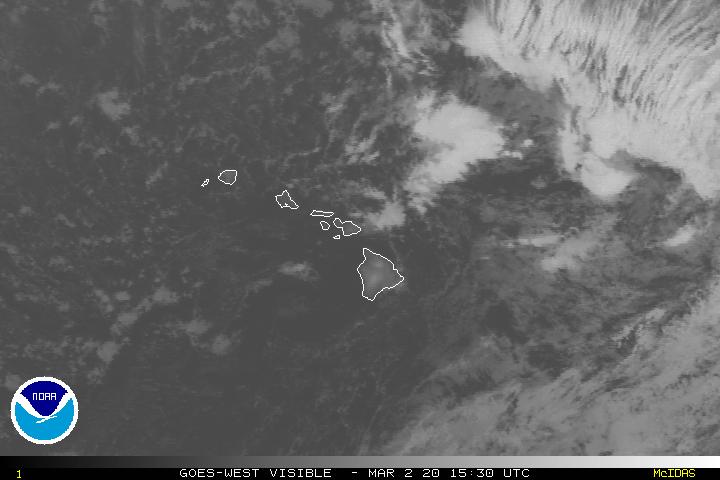


emi Says:
it my husband 50 birthday 2011 whats the best time of year to come to maui or any off the other islands~~~Hi Emi, that’s a tough question, as all the months are wonderful in Hawaii…truly! If you mean driest, then perhaps May and June qualify in that department. Aloha, Glenn