











December 19-20, 2010
Air Temperatures – The following maximum temperatures were recorded across the state of Hawaii Sunday afternoon:
Lihue airport, Kauai – 77
Honolulu airport, Oahu – 75
Kaneohe, Oahu – 75
Molokai airport – 74
Kahului airport, Maui – 83
Kona airport – 83
Hilo airport, Hawaii – 83
Air Temperatures ranged between these warmest and coolest spots near sea level – and on the highest mountain tops…as of 4pm Sunday afternoon:
Kailua-kona – 80F
Honolulu, Oahu – 70
Haleakala Crater – missing (near 10,000 feet on Maui)
Mauna Kea summit – missing (near 14,000 feet on the Big Island)
Precipitation Totals – The following numbers represent the largest precipitation totals (inches) during the last 24 hours on each of the major islands, as of Sunday evening:
3.43 Kapahi, Kauai
9.86 Maunawili, Oahu
0.53 Molokai
0.09 Lanai
0.00 Kahoolawe
0.29 Oheo Gulch, Maui
0.71 Pali 2, Big Island
Marine Winds – Here’s the latest (automatically updated) weather map showing weak 1019 millibar high pressure system located far to the east of the state. Our winds will be light or a bit stronger from the south to southwest Monday…turning southeast Tuesday.
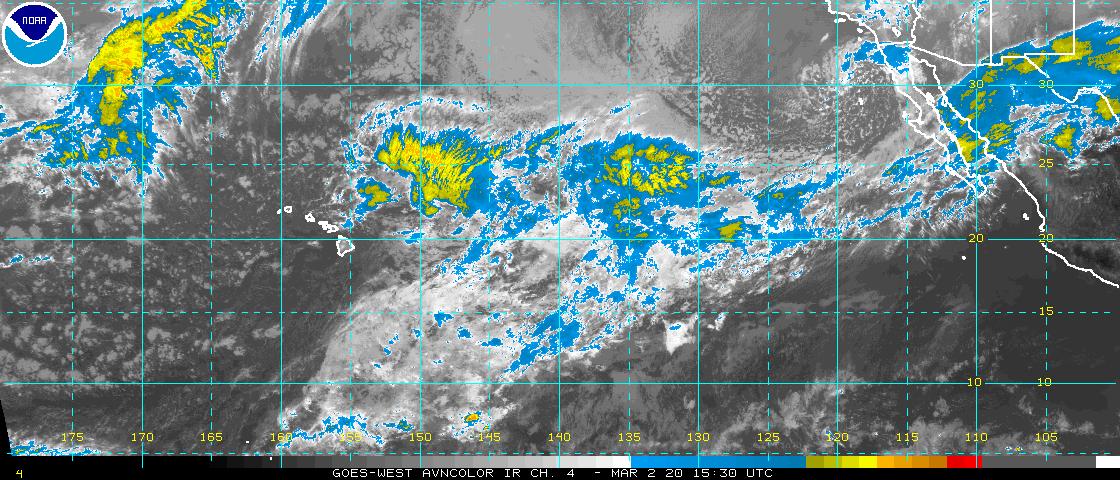
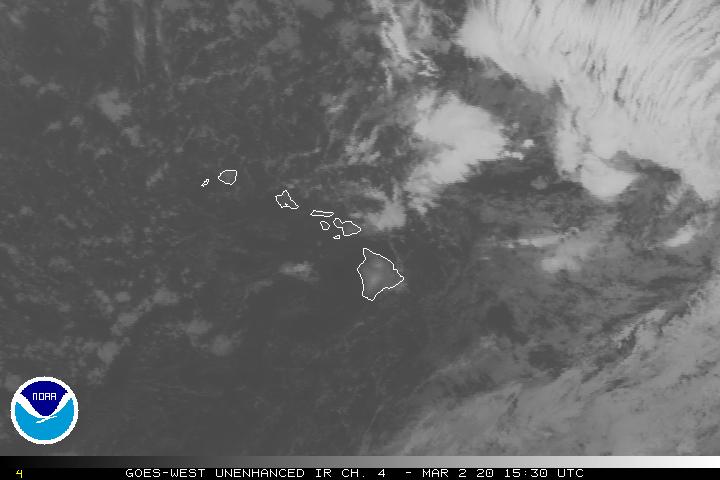
Satellite and Radar Images: To view the cloud conditions we have here in Hawaii, please use the following satellite links, starting off with this Infrared Satellite Image of the islands to see all the clouds around during the day and night. This next image is one that gives close images of the islands only during the daytime hours, and is referred to as a Close-up visible image. This next image shows a larger view of the Pacific…giving perspective to the wider ranging cloud patterns in the Pacific Ocean. Finally, here's a Looping IR satellite image, making viewable the clouds around the islands 24 hours a day. To help you keep track of where any showers may be around the islands, here’s the latest animated radar image.
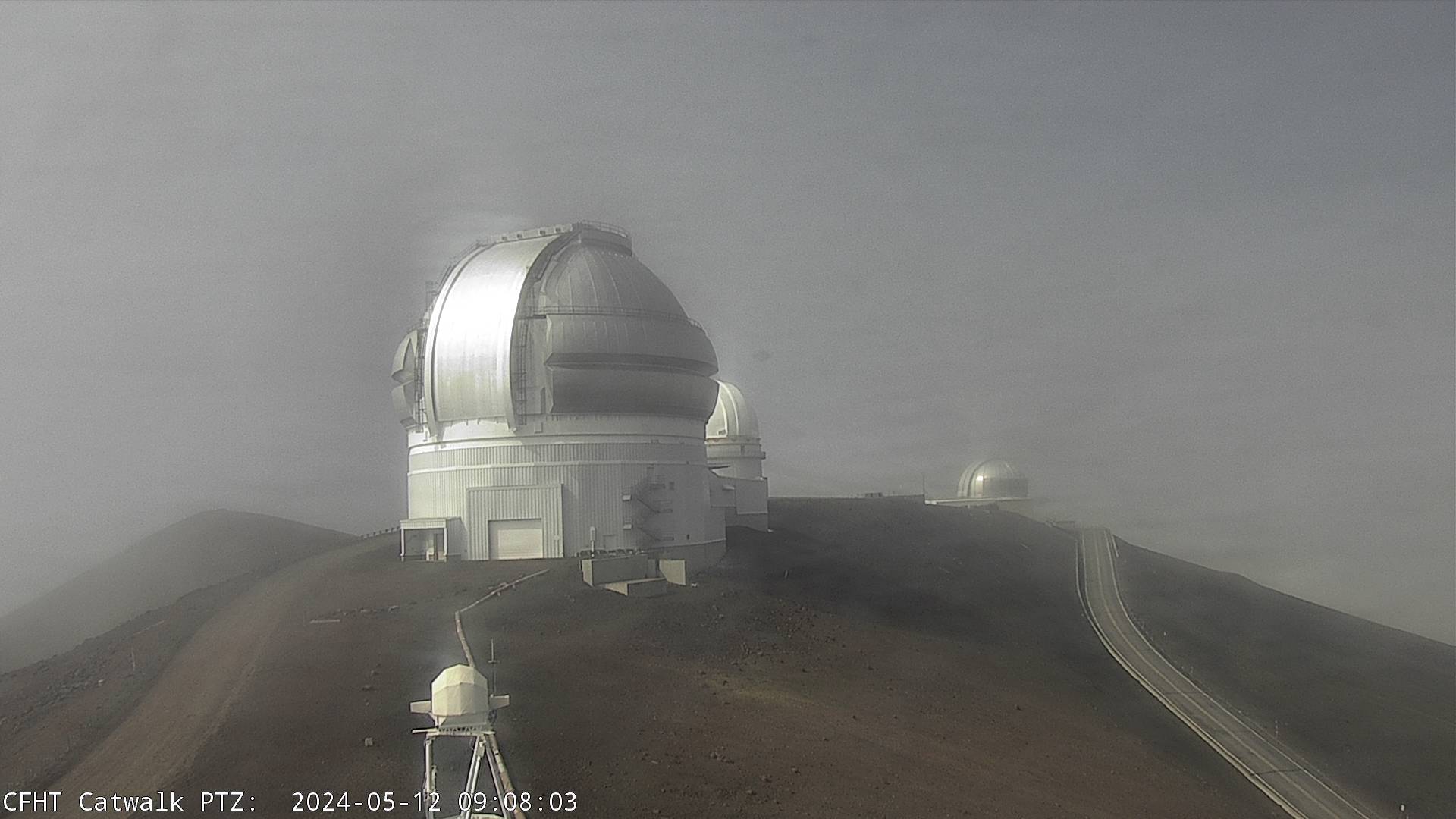
Hawaii’s Mountains – Here’s a link to the live web cam on the summit of near 14,000 foot Mauna Kea on the Big Island of Hawaii. The tallest peak on the island of Maui is the Haleakala Crater, which is near 10,000 feet in elevation. These two web cams are available during the daylight hours here in the islands…and when there’s a big moon rising just after sunset for an hour or two! Plus, during the nights and early mornings you will be able to see stars, and the sunrise too…depending upon weather conditions.
Tropical Cyclone activity in the eastern and central Pacific – Here’s the latest weather information coming out of the National Hurricane Center, covering the eastern north Pacific. You can find the latest tropical cyclone information for the central north Pacific (where Hawaii is located) by clicking on this link to the Central Pacific Hurricane Center. Here’s a tracking map covering both the eastern and central Pacific Ocean. A satellite image, which shows the entire ocean area between Hawaii and the Mexican coast…can be found here. Of course, as we know, our hurricane season won't end until November 31st here in the central Pacific.
Aloha Paragraphs

Rainy weather into Monday…some locally heavy
Winds will be generally light, with a few exceptions…from the south and southwest. This weather map shows a weak 1019 millibar high pressure system located far to the east of the islands Sunday night. These south to southwest winds will last through Tuesday, with a possible temporary return to trade winds perhaps in the wake of a cold front. As we move towards next weekend, our winds will turn southeast again…ahead of a cold front expected to arrive during the Christmas holiday.
Winds will be generally light from the south to southwest, with a few exceptions…the following numbers represent the strongest breezes Sunday evening:
20 mph Port Allen, Kauai
13 Kahuku, Oahu
08 Molokai
12 Kahoolawe
09 Lipoa, Maui
08 Lanai Airport
17 South Point, Big Island
Wet conditions have arrived on Kauai and Oahu, which will extend across the rest of the state Sunday evening into the night…lasting into the new work week ahead. This large view satellite image continues to show an extensive area of rich tropical moisture pushing over the Hawaiian Islands. Looking at this next satellite picture, which provides a closer look at our islands, we can see this threatening area of clouds and showers has moved over the western half of the state Sunday evening…heading towards Maui County and the Big Island. Checking out this looping radar image we see moderate to heavy showers moving over Kauai, and Oahu. Maui and the Big Island were still outside this area of precipitation, although heavy, potentially flooding rainfall is taking aim on those eastern islands now.
Here in Kula, Maui at around 5pm, skies are mostly cloudy and foggy…although the wet weather hadn't arrived quite yet. As noted above, we have a heavy rain event on our hands now, which will prevail through the next several days. Already Niihau, Kauai, and Oahu have received locally heavy rains…with 9.00"+ inch rainfall accumulation in one of the wetter spots on Oahu! A multi-layered canopy of very moist air is flooding into the state from the southwest and west. This has resulted in the NWS office in Honolulu having issued a flash flood watch for the entire state of Hawaii Sunday, with even localized flash flood warnings. ~~~ This is a very slow moving field of rainfall however, and has held off from reaching the entire state. It's just a matter of time before this heavy precipitation reaches all the islands. This wet weather will stretch into Monday at least, and potentially into Tuesday. Thereafter there may begin to be some breaks, although the windward sides will continue to see passing shower activity. There's also a good chance that winter weather conditions (snow) will occur atop the summits on the Big Island with time…viewable during the daylight hours. Looking further ahead, towards the Christmas weekend, we may see more rainy weather, as a cold front approaches the state from the northwest then. ~~~ Just as I'm about to sign off, the first rain drops are starting to fall here in Kula, they're light at the moment, although if you check out that radar image just below, you'll see that we have heavy rain approaching from the southwest! I'll likely log back online a little later this evening, if the heavy rains have arrived before I hit the hay. Otherwise, I'll be back early Monday morning, with your next new weather narrative, I hope you have a good Sunday night until then! Aloha for now…Glenn.
Interesting: Early this Tuesday, the sun and moon will appear at their darkest, as the lunar eclipse and winter solstice coincide for the first time in 456 years. A lunar eclipse takes place when the sun, earth and moon are all perfectly aligned with the Earth in the middle. When the moon passes behind the earth, the sun's rays are blocked from striking the moon.
This can only occur when the moon is full. Unlike a solar eclipse, which can only be seen for a few moments from any specific spot, a lunar eclipse can be viewed for several hours. The eclipse will happen Monday night on the West Coast and during the early hours Tuesday on the East Coast.
According to NASA, although the eclipse is not central, the total phase should last about three and a half hours when it begins as a partial eclipse at 1:33 a.m. ET (8:33 p.m. Hawaiian time) and it will finish at 5:01 a.m. ET (12:01 a.m. Hawaiian time).
The totality phase — when the moon is entirely inside Earth's shadow — will last a little approximately 72 minutes. This year's only lunar eclipse actually coincides with the winter solstice, meaning that the moon will appear high in the night sky, aiding visibility for revelers.
There will be two total lunar eclipses in 2011 — one in June and one in December. North America will miss the June show and witness only a part of next December's eclipse.
 Email Glenn James: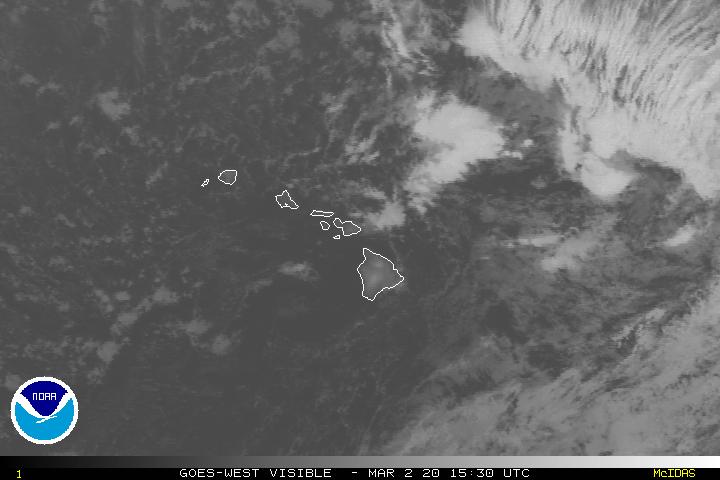


Maui condos Says:
I like you post:-) Thanks Maui Condos, Aloha, Glenn
Frank Says:
WET SUNDAY! Leeward Molokai…2.2 inches of rain as of 6pm…..EVERYTHING is so GREEN!~~~Hi Frank, go to hear from you again. Nice, green on Molokai, especially with another 2.2″ of the wet stuff. The rains didn’t arrive here in Kula until after 5pm…although its still lightly raining as of 810pm. Thanks for your on the spot report. Aloha, Glenn
Dan Says:
Hi Glenn: Is this cloudcover/rain above the summit of Haleakala? (for the eclipse) Mahalo!~~~Hi Dan, unfortunately this is a thick cover of clouds, from the highest cirrus level, all the way down to the stratus level. If this stuff is still over us Monday night, as I expect, we’re going to be out of luck in terms of the lunar eclipse. Aloha, Glenn
Jeff Says:
Aloha Glenn,
What do you think of the CPHC prediction of 90 Percent chance of a tropical cyclone developing…as it turns back to the East and SE from the International Dateline? And, since the hurricane season is over, would it get the first name from next year's season, or this year's? For others reading this message, the link can be accessed at http://www.prh.noaa.gov/cphc/pages/TWO.php. Mele Kalikimaka a meka Hau'oli Makahiki Hou, hoaloha.~~~Hi Jeff, good question. JTWC is giving this area in the western Pacific, a poor chance of developing into a tropical cyclone. Interestingly enough, the NWS is giving this area a high 90% chance of development. As for the naming, it would depend upon whether it took form in the western or central Pacific. Lets wait and see what happens…by the way…it poses absolutely no threat to the Hawaiian Islands. Aloha, Glenn
Connie Says:
So Glenn, will we be able to see the eclipse from here on Maui, and if so, when will it be–from the times listed in the article, I'm calculating about 8pm here–is that right? ……that is, if we'll be able to see anything at all through the clouds & weather, eh? I did see it in 2005 and am really hoping to have such an amazing experience again. Unbelievably surreal! Thanks for your site, I refer to it almost daily, as I do poolside concierge in Wailea. Have a happy Holiday!
Aloha,Connie~~~Hi Connie, good to hear from you, there at the pool side in Wailea. I’m a little nervous about all the clouds that may very well be in our area Monday night too. I’ll do some research and put on my website when the Lunar eclipse will be…look for it soon. Happy Holiday’s to you too! Aloha, Glenn