











December 16-17, 2010
Air Temperatures – The following maximum temperatures were recorded across the state of Hawaii Thursday afternoon:
Lihue airport, Kauai – 75
Honolulu airport, Oahu – 79
Kaneohe, Oahu – 79
Molokai airport – 81
Kahului airport, Maui – 83
Kona airport – 83
Hilo airport, Hawaii – 81
Air Temperatures ranged between these warmest and coolest spots near sea level – and on the highest mountain tops…as of 5pm Thursday evening:
Port Allen, Kauai – 81F
Kaneohe, Oahu – 76
Haleakala Crater – 52 (near 10,000 feet on Maui)
Mauna Kea summit – 36 (near 14,000 feet on the Big Island)
Precipitation Totals – The following numbers represent the largest precipitation totals (inches) during the last 24 hours on each of the major islands, as of Thursday afternoon:
0.02 Waialae, Kauai
0.00 Oahu
0.00 Molokai
0.00 Lanai
0.00 Kahoolawe
0.01 Haiku, Maui
0.02 Kawainui Stream, Big Island
Marine Winds – Here’s the latest (automatically updated) weather map showing weak 1018 millibar high pressure system located just to the east-northeast of the state. At the same time we have a ridge of high pressure running west from its center…to the north of Kauai. Our winds will be light from the southeast Thursday and Friday.
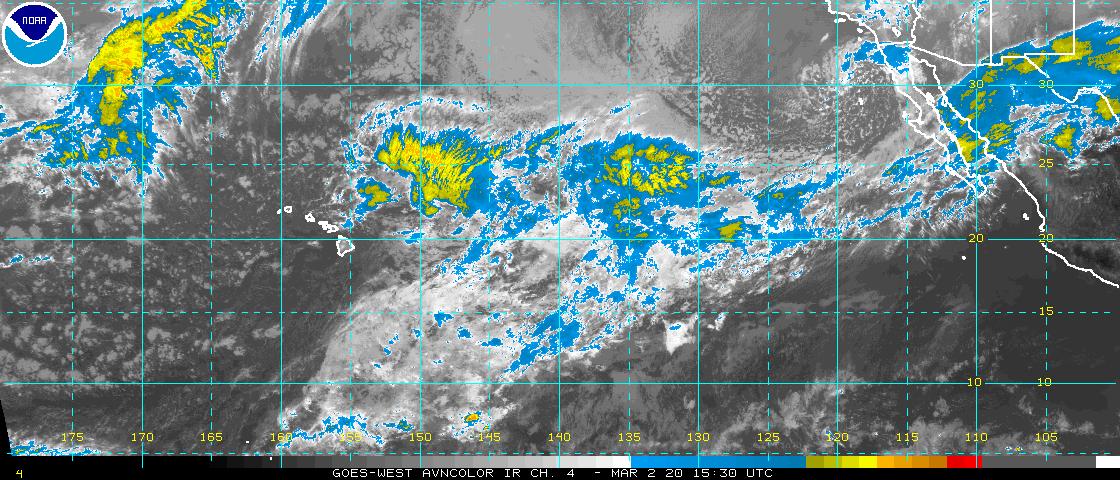
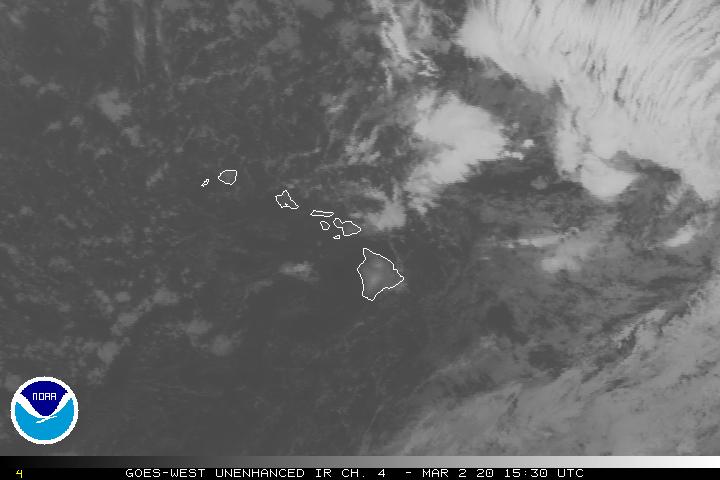
Satellite and Radar Images: To view the cloud conditions we have here in Hawaii, please use the following satellite links, starting off with this Infrared Satellite Image of the islands to see all the clouds around during the day and night. This next image is one that gives close images of the islands only during the daytime hours, and is referred to as a Close-up visible image. This next image shows a larger view of the Pacific…giving perspective to the wider ranging cloud patterns in the Pacific Ocean. Finally, here's a Looping IR satellite image, making viewable the clouds around the islands 24 hours a day. To help you keep track of where any showers may be around the islands, here’s the latest animated radar image.
Hawaii’s Mountains – Here’s a link to the live web cam on the summit of near 14,000 foot Mauna Kea on the Big Island of Hawaii. The tallest peak on the island of Maui is the Haleakala Crater, which is near 10,000 feet in elevation. These two web cams are available during the daylight hours here in the islands…and when there’s a big moon rising just after sunset for an hour or two! Plus, during the nights and early mornings you will be able to see stars, and the sunrise too…depending upon weather conditions.
Tropical Cyclone activity in the eastern and central Pacific – Here’s the latest weather information coming out of the National Hurricane Center, covering the eastern north Pacific. You can find the latest tropical cyclone information for the central north Pacific (where Hawaii is located) by clicking on this link to the Central Pacific Hurricane Center. Here’s a tracking map covering both the eastern and central Pacific Ocean. A satellite image, which shows the entire ocean area between Hawaii and the Mexican coast…can be found here. Of course, as we know, our hurricane season won't end until November 31st here in the central Pacific.
Aloha Paragraphs

The beautiful coasts of Kauai
Winds will be generally light and variable, although probably from the southeast Friday and Saturday…turning more southerly later this weekend. This weather map shows a weak 1018 millibar high pressure system located just to the east of the islands Thursday night. A ridge of high pressure runs generally west to near Kauai, close enough to keep our local breezes light. This orientation of our local winds is likely to bring volcanic haze up from the vents on the Big Island over the next several days. As we move into the weekend, the winds will shift to a more southerly direction. These breezes will stick around until a cold front moves through early next week, around Tuesday. As this front moves away, and a new high pressure system moves into place, we'll see north to northeast breezes returning at some point later next Tuesday or Wednesday, with a relatively cool and dry air mass prevailing for several days.
Winds will be light, with a few exceptions…from the southeast direction generally…the following numbers represent the strongest breezes early Thursday evening:
09 mph Lihue, Kauai
10 Waianae, Oahu
08 Molokai
20 Kahoolawe
14 Hana, Maui
07 Lanai Airport
28 South Point, Big Island
There will be only a few showers in our area through Friday and probably right on into Saturday, shifting to wetter conditions, at least locally…starting Sunday into early next week. This large view satellite image continues to show a large swath of moisture extending up from the deep tropics to our west. Just a bit further west, near the International Dateline, we see two counterclockwise rotating low pressure systems. At the same time, glancing down to our southeast, also in the deep tropics, we find an area of fairly minor thunderstorms…with high cirrus clouds moving north from there. Looking at this next satellite picture, which provides a closer look at our islands, we can see that most of the state is clear with scattered lower level clouds southwest of Oahu. Some of the high cirrus clouds to our west through north however are extending down over Kauai and towards Oahu too. Finally, checking out this looping radar image we see a definite lack of showers being carried along on the current southeast wind flow at the time of this writing.
The weather here in the Hawaiian Islands will continue to be quiet, and remain that way through at least Friday…perhaps longer. The winds will be lighter now, coming out of the southeast. The overlying atmosphere is dry and stable, limiting showers greatly. As the breezes come up from the southeast we should see the volcanic haze concentrating more completely over the islands. It still looks like later Saturday will be a transition period between the favorable weather that we'll have between now and then…with anticipated changes occurring during the second half of the upcoming weekend. There is more than the ordinary amount of uncertainty around just when and where this moisture will deposit itself…stay tuned.
The computer models continue to forecast wetter weather by Sunday, especially on the Kauai end of the state…closest to the area of low pressure to our west. The low pressure center, or trough, is expected to channel a stream of moisture over us, or to our west…which will be the first chance for precipitation. This remains one of the questions at the moment, and may not become clear until Friday or even early Saturday. Meanwhile, a cold front is forecast to sweep down through the state at some point later Monday or Tuesday…bringing a second chance for showery weather. There will be more fine tuning of this reality over the next day or two, although look for precipitation to increase to some degree later this weekend. As the cold front sweeps through around Tuesday it could bring more widespread rainfall to the Aloha state.
Here in Kihei, Maui at around 515pm, skies are totally clear, although there is volcanic haze in all directions. This stuff is not heavy, and more on the light side…although I expect it to thicken up over the next several days. The prevailing weather will continue to be quite nice, with light winds, and that haze too. It wouldn't surprise me to see absolutely no rain for the time being, with moisture finally arriving later this weekend. Here in Kihei, where I work at the Pacific Disaster Center, is having its annual Christmas party this evening. It's taking place at the University of Hawaii, Maui college…where I taught for many years. This should be fun, as the people who work together all year, will have an opportunity to chat, with a glass of beer or wine in hand. I'll be back early Friday morning with your next new weather narrative, I hope you have a great Thursday night until then! Aloha for now…Glenn.
Interesting: Earthquakes tend to create mountains. But the Easter tremor that rocked the Mexico-California border actually lowered one. Using GPS and remote sensing, a cross-border team of scientists found that the northeast side of the 3,000-foot-tall Sierra Cucapah in Mexico sank 5 feet after the April magnitude-7.2 Baja California quake.
Researchers studying earthquake faults in the region say this could mean the fault network is young. Findings were presented Thursday at the American Geophysical Union meeting in San Francisco. The Baja quake has proved to be one of the most complex quakes along the Pacific and North American plates, involving at least six faults that ruptured in two directions. The quake briefly increased pressure on two faults in California. Seismicity on those faults has since gone back to background levels.
Interesting2: A small earthquake has been recorded about 40 miles north-northwest of Los Alamos and 65 miles northwest of Santa Fe, New Mexico. The U.S. Geological Survey says Tuesday morning's earthquake registered 2.9, but the operator of the Los Alamos Laboratory seismic network says it registered closer to 2.3.
An earthquake under a magnitude of 3.0 is considered very minor. According to the modified Mercali Intensity scale, such a quake could be felt indoors by many and outdoors by a few, and could disturb dishes, windows and doors.
Interesting3: Panama's earthquake hazard is far greater than assumed, according to a study that officials have said is raising undue alarm. Contrary to earlier findings, researchers found that the two fault lines in central Panama — Limon and Pedro Miguel — are active and prone to large earthquakes.
The Pedro Miguel fault runs between two of the locks on the Panama Canal, which is undergoing a major widening project. Panama City may also be at particular risk as it is near the two fault lines and its construction codes do not take into account the full extent of the risk, the paper, published in the December issue of the Bulletin of the Seismological Society of America, said.
The damage would be compounded if both faults slipped simultaneously, the paper said. "We have evidence that they both ruptured together in 1621, producing a 3-metre displacement, which we estimate would have been of a magnitude of seven — a major quake," Eldon Gath, one of the authors of the study, told SciDev.Net.
If the strain accumulated since 1621 was released today, the earthquake's magnitude would be about 6.7, Garth added — strong enough to cause widespread destruction. He said that, since the last earthquake on this fault happened almost 400 years ago, the next one is expected soon — but could happen any time in the next 100–200 years.
But the paper's final conclusions, which question the preparedness of Panama's buildings, have angered the Panama Canal Authority (PCA), which operates and maintains the canal — and which commissioned the study as part of the widening project.
"The journal article … provides an erroneous, alarmist and editorialized analysis of the sound research that has been conducted regarding the risk of earthquakes around the canal and Panama City," it said in an open letter to New Scientist.
The authority said it was aware of the risks. Luis Alfaro, vice president of engineering for the authority, told SciDev.Net: "We do not object to the paper's technical findings but there are no grounds for raising alarm".
He said that information from the study was being used in the design of the new facilities in the canal and that Panama City's building codes are being revised to incorporate the new findings. Lloyd Cluff, a member of the Seismic Advisory Board of the PCA, said: "The paper gives compelling evidence for repeated displacements releasing large earthquakes along the two faults". He cautioned that making buildings safer takes a long time.
Interesting4: Ecology is the branch of science that studies the distribution and abundance of living organisms, and the interactions between organisms and their environment. Any ecological group is always in a dynamic equilibrium. If you change one part, some other part will change in response to that change. Changes may come from man, climate, pollution or any other change.
In this case conservationists have been so successful at protecting endangered birds in a Spanish nature reserve that the birds are now killing the reserve's ancient cork oak forest. This may mean some bird colonies will have to be moved to protect the trees, some of which date back to the seventeenth century.
Move is one method. In other cases (for example New Jersey) bears and deer are periodically hunted and killed because the alternative is that they will starve because of a lack of natural predation and food supply as a result of burgeoning populations. In order for ecology to work, it must be balanced.
The trees are the last part of a huge cork oak forest which once covered south-western Spain, and provide food for deer, wild boar and small mammals. The endangered Iberian Lynx often also uses old cork oak trees as breeding dens. With around 70 nests in any one tree, researchers found that the nesting birds produce so much poo it upsets the delicate balance of the soil which nurtures the oaks.
The birds' feces lead to high concentrations of salts in the soil, to which cork oak trees are particularly sensitive – the salt makes it hard for the trees to absorb enough water. The researchers found that cork oaks which are home to birds like the white stork, the spoonbill and the grey heron are in much worse condition than trees with no nesting birds.
"If populations of these birds continue to rise, the effect will increase. The source will still be there," says Cristina Aponte from the Instituto de Recursos Naturales y Agrobiologia de Sevilla, and co-author of the study published in Biological Conservation.
This case of one conservation success leading to the decline of other endangered species isn't as rare as you might think. In Polish forests, cormorants and protected wading birds have harmed ancient trees, elephants destroy endangered plants and trees in parts of South Africa, and the rare chamois in the Pyrenees feeds on the equally endangered larkspur plant.
Problems such as the birds on Spanish cork trees can occur for the best of reasons. Others have happened due to deliberate man made intervention into local ecologies such as rabbits introduced into Australia. Since their introduction from Europe in 1859, the effect of rabbits on the ecology of Australia has been devastating.
Rabbits are suspected of being the most significant known factor in species loss in Australia. The loss of plant species is unknown at this time. Rabbits often kill young trees in orchards, forests and on properties by ring barking them.
For managers of the Spanish reserve, there is clearly a trade-off between maintaining the area for nesting birds and preserving the ancient cork oak forests. One solution to the problem would be to relocate the colony to a region where the trees are not as valuable or rare.
 Email Glenn James: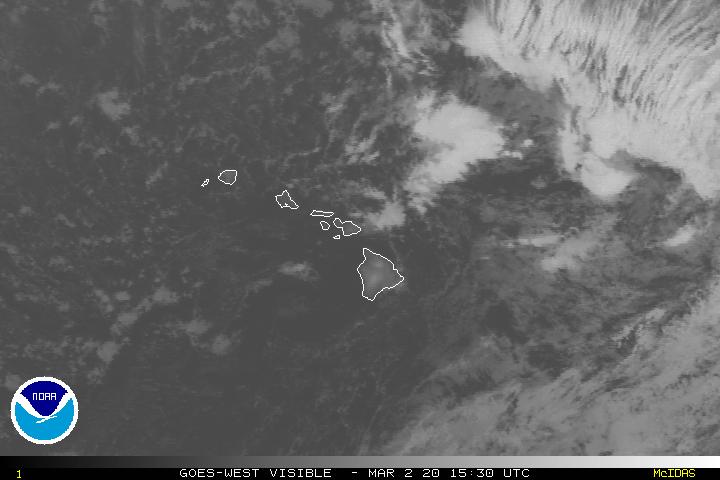


linda Says:
Glenn – love your information! What weather do you see for Christmas Eve and Christmas Day? ~~~Hi Linda, glad you are pleased with the presentation! Too early to know that far ahead, often it is beautiful during the time period. Please check back in about a week or so, I’ll have a much better idea then. Happy Holiday’s, Aloha, Glenn