December 15-16, 2010
Air Temperatures – The following maximum temperatures were recorded across the state of Hawaii Wednesday afternoon:
Lihue airport, Kauai – 84
Honolulu airport, Oahu – 83
Kaneohe, Oahu – 80
Molokai airport – 82
Kahului airport, Maui – 84
Kona airport – 83
Hilo airport, Hawaii – 81
Air Temperatures ranged between these warmest and coolest spots near sea level – and on the highest mountain tops…as of 5pm Wednesday evening:
Port Allen, Kauai – 81F
Hilo, Hawaii – 76
Haleakala Crater – 52 (near 10,000 feet on Maui)
Mauna Kea summit – 36 (near 14,000 feet on the Big Island)
Precipitation Totals – The following numbers represent the largest precipitation totals (inches) during the last 24 hours on each of the major islands, as of Wednesday afternoon:
0.01 Kapahi, Kauai
0.02 Oahu Forest NWR, Oahu
0.01 Molokai
0.00 Lanai
0.00 Kahoolawe
0.02 West Wailuaiki, Maui
0.04 Honaunau, Big Island
Marine Winds – Here’s the latest (automatically updated) weather map showing weak 1015 millibar high pressure system located just to the east-northeast of the state. At the same time we have a ridge of high pressure running west from its center…to the north of Kauai. Our winds will be light from the southeast Thursday and Friday.
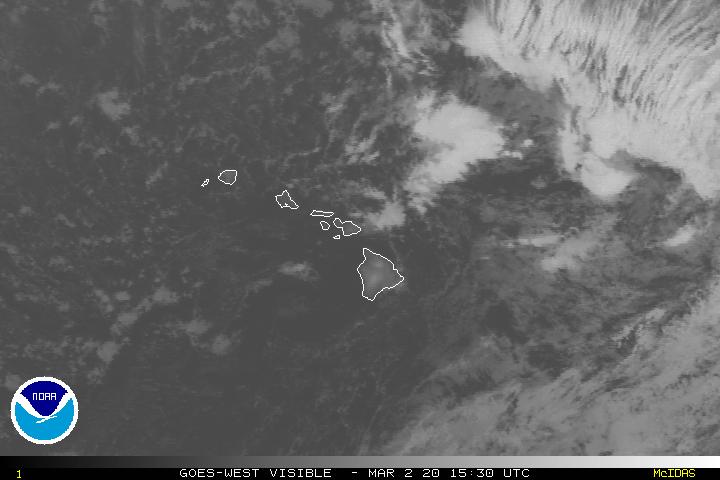
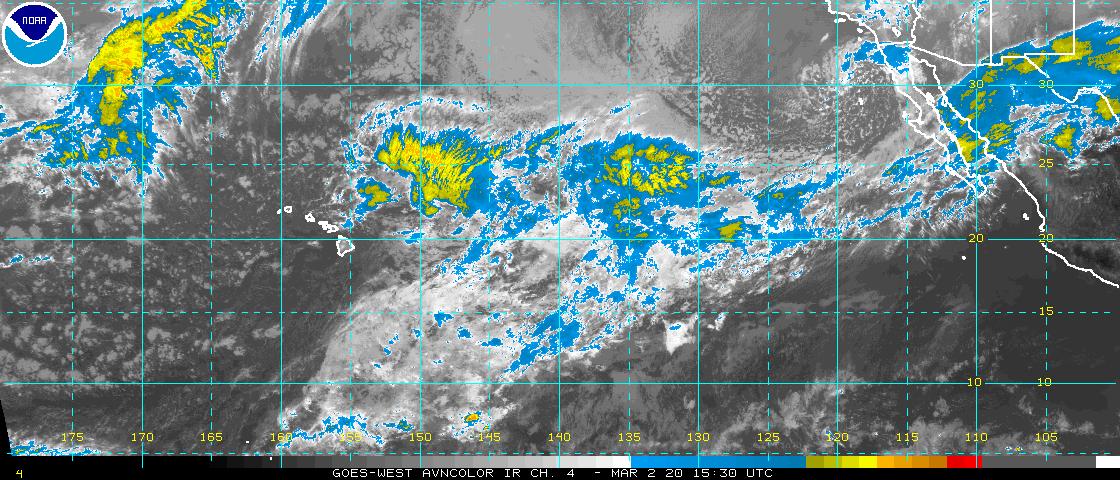
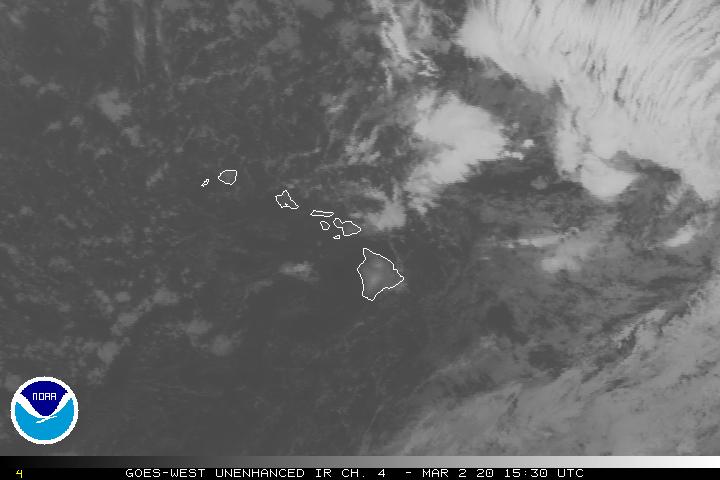
Satellite and Radar Images: To view the cloud conditions we have here in Hawaii, please use the following satellite links, starting off with this Infrared Satellite Image of the islands to see all the clouds around during the day and night. This next image is one that gives close images of the islands only during the daytime hours, and is referred to as a Close-up visible image. This next image shows a larger view of the Pacific…giving perspective to the wider ranging cloud patterns in the Pacific Ocean. Finally, here's a Looping IR satellite image, making viewable the clouds around the islands 24 hours a day. To help you keep track of where any showers may be around the islands, here’s the latest animated radar image.
Hawaii’s Mountains – Here’s a link to the live web cam on the summit of near 14,000 foot Mauna Kea on the Big Island of Hawaii. The tallest peak on the island of Maui is the Haleakala Crater, which is near 10,000 feet in elevation. These two web cams are available during the daylight hours here in the islands…and when there’s a big moon rising just after sunset for an hour or two! Plus, during the nights and early mornings you will be able to see stars, and the sunrise too…depending upon weather conditions.
Tropical Cyclone activity in the eastern and central Pacific – Here’s the latest weather information coming out of the National Hurricane Center, covering the eastern north Pacific. You can find the latest tropical cyclone information for the central north Pacific (where Hawaii is located) by clicking on this link to the Central Pacific Hurricane Center. Here’s a tracking map covering both the eastern and central Pacific Ocean. A satellite image, which shows the entire ocean area between Hawaii and the Mexican coast…can be found here. Of course, as we know, our hurricane season won't end until November 31st here in the central Pacific.
Aloha Paragraphs

A good vantage point…on the Kona coast
Winds will be generally light southeast Thursday and Friday…turning more southerly this weekend. This weather map shows a weak 1021 millibar high pressure system located to the east-northeast of the islands Wednesday night. A ridge of high pressure runs generally west to near Kauai, close enough to keep our local breezes light now. This orientation of our local winds is likely to bring volcanic haze up from the vents on the Big Island over the next several days. As we move into this coming weekend, the winds will likely shift to a more southerly direction, as a trough of low pressure moves into the area to our west. Then, a cold front is forecast to sweep down through the state around next Monday. As this trough and front moves away, and a new high pressure system moves into place, we'll see trade winds returning at some point later next Tuesday or Wednesday, lasting through most of the rest of the week.
Winds will be calming down, and coming in from the southeast direction soon…the following numbers represent the strongest breezes early Wednesday evening:
20 mph Port Allen, Kauai
18 Kahuku, Oahu
07 Molokai
29 Kahoolawe
22 Lipoa, Maui
08 Lanai Airport
22 South Point, Big Island
There will be just a few showers in our area through Friday and perhaps Saturday, shifting to wetter conditions, at least locally…starting Sunday. This large view satellite image continues to show a large swath of moisture extending up from the deep tropics to our west. At the same time, glancing down to our southeast, also in the deep tropics, we find an area of thunderstorms…with high cirrus clouds moving north and northeast from there. Glancing in that same southeast direction, we also see an area of low clouds as well. Looking at this next satellite picture, which shows a closer look at our islands, we can see that most of the state is clear, with just a few scattered clouds…along with high cirrus clouds riding in on the upper winds towards Kauai…and those lower clouds to the southeast of the Big Island too. Finally, checking out this looping radar image, we see a definite lack of showers being carried along on the current southeast wind flow.
The weather here in the Hawaiian Islands will continue to be quite nice tonight, and remain that way likely through the first part of the weekend. The winds will be getting lighter soon, coming out of the southeast. The overlying atmosphere is dry and stable, limiting showers greatly. Our winds will falter Thursday into Friday, and remain light from the southeast into Saturday. This could thicken the volcanic haze locally, which has already been around the last several days in places. Saturday will be a transition day, between the favorable weather that we'll have between now and then…and then changes occurring during the upcoming weekend. The computer models continue to forecast wetter weather by late Saturday or Sunday, especially on the Kauai end of the state…closest to the trough to our west. A cold front is forecast to sweep through the state at some point Monday into early Tuesday, at which point the trade winds will return in its wake, with generally fine weather through the rest of the work week. There will be more fine tuning of this reality over the next day or two, although look for precipitation to increase later this weekend. As the cold front sweeps through around Monday, it could bring a more widespread rainfall event to the Aloha state.
~~~ Here in Kihei, Maui at 530pm, skies are generally clear, along with those clouds that formed along the slopes the Haleakala Crater during the afternoon hours. These low level clouds will dissipate soon, leaving a clear night in most areas…this should apply to the entire state. By the way, along with the clear skies, and light winds, the early morning hours, at least in some of those sheltered leeward spots, will have a chill, perhaps grab that extra blanket for your bed again over the next several nights. I'm heading upcountry now, and will catch up with you early Thursday morning, I hope you have a great Wednesday night until then! Aloha for now…Glenn.
Interesting: Tidal power, also called tidal energy, is a form of hydropower that converts the energy of tides into electricity or other useful forms of power. The first large-scale tidal power plant (the Rance Tidal Power Station) started operation in 1966. Harnessing the power of ocean tides has long been imagined, but countries are only now putting it into practice.
A demonstration project planned for Puget Sound will be the first tidal energy project on the west coast of the United States, and the first array of large-scale turbines to feed power from ocean tides into an electrical grid. University of Washington researchers are devising ways to site the tidal turbines and measure their environmental effects.
Brian Polagye, UW research assistant professor of mechanical engineering, will present recent findings this week in an invited talk at the American Geophysical Union's annual meeting in San Francisco. Tidal power is the only form of energy which derives directly from the relative motions of the Earth—Moon system, and to a lesser extent from the Earth—Sun system.
Tidal forces produced by the Moon and Sun, in combination with Earth's rotation, are responsible for the generation of the tides. Other typical sources of energy originate directly or indirectly from the Sun, including fossil fuels, conventional hydroelectric, wind, biofuels, wave power and solar.
Polagye and colleagues are involved in environmental monitoring before and during a planned deployment of two 30-foot-wide turbines in Admiralty Inlet, the main entrance to Washington state's Puget Sound. Although European countries have more experience with tidal energy devices, they are not as far ahead on environmental monitoring, Polagye said.
He believes the Pacific Northwest installation will have the most comprehensive environmental monitoring of any tidal project so far. The Snohomish County Public Utility District, just north of Seattle, received a $10 million grant from the Energy Department for the tidal project now in the final phase of obtaining permits.
The turbines would generate an average of 100 kilowatts of electricity, enough to power 50-100 Washington homes during the pilot phase. "We want to monitor the effects of this particular project, but also understand the processes so we can apply the findings to other potential tidal energy sites," Polagye said.
"There's surprisingly little known about the oceanography of these very fast waters," said collaborator Jim Thomson, a UW assistant professor of civil and environmental engineering and an oceanographer in the UW's Applied Physics Laboratory. "These kinds of tidal channels where water is going very fast only happen in a few areas, and have not been well studied.
The currents are so fast that it's hard to operate vehicles and maintain equipment. And it's too deep for conventional scuba diving." The pilot site lies roughly 200 feet below the surface of Admiralty Inlet, where the UW team has measured currents of up to 8 knots, or 9 miles per hour.
One area of concern is how underwater noise generated by the turbines could affect marine mammals that use auditory cues to navigate and communicate with each other. Strong currents complicated the task of measuring how sound travels in the channel. "When currents were more than about 2 knots the instruments are hearing considerable self-noise," Polagye said.
"It's similar to when you're bicycling downhill and the air rushes past your ears." Chris Bassett, a UW doctoral student in mechanical engineering, is testing approaches that would allow underwater microphones to work in fast moving water. UW researchers used sound from a Washington state ferry to learn how turbine noise would spread from the project site.
The data suggest that Admiralty Inlet tends to lessen sound. This reduces the effect on animals' hearing, which is good, but it also means less noise for marine mammals to detect turbines and avoid them. The monitoring tripod that is to be used holds instruments to track water quality, ambient noise, currents, temperature and salinity, and to record marine mammal calls and electronic tags on passing fish.
This observational data will help determine precisely where to put the tidal turbines, and establish potential environmental effects once they are in the water. So far, researchers say, the data support the notion that the Admiralty Inlet is well suited for a tidal energy installation from an engineering perspective.
Once the turbines are in the water, likely in 2013, researchers will monitor any potential environmental effects. The Washington state deployment is among three U.S. tidal energy pilot projects now in the works (the others are in Maine and Alaska). An array of smaller turbines was operated during another pilot project in New York City's East River.
The first tidal power site (Rance Tidal Power Station)is located on the estuary of the Rance River, in Brittany, France. It is currently operated by Électricité de France, and is the largest tidal power station in the world, in terms of installed capacity. With a peak rating of 240 Megawatts, it supplies 0.012% of the power demand of France. The annual output is approximately 600 GWh.
Interesting2: The holidays are here and the nation's airports are busier than ever — thousands of airplanes taking off and landing. Passengers and people living around airports are reminded that the airplane is not the quietest mode of transportation; certainly not as quiet as a sleigh pulled by eight tiny reindeer.
Fear not, because even while travelers are heading home, NASA continues working with others in industry and academia on technologies that will create a more silent night (and day) around airports.
One of the most recent noise-reducing technologies shepherded through the research process by NASA and now making a difference on commercial jet engines is chevrons. Chevrons are the sawtooth pattern seen on the trailing edges of some jet engine nozzles.
As hot air from the engine core mixes with cooler air blowing through the engine fan, the shaped edges serve to smooth the mixing, which reduces turbulence that creates noise. "Successes like chevrons are the result of a lot of different, hard-working people and are the result of a lot of very small efforts that all come together, often across many scientific disciplines," said James Bridges, the associate principal investigator responsible for coordinating aircraft noise research at NASA.
The new Boeing 787 is among the most modern jets relying on chevrons to reduce engine noise levels. It sports chevrons on the nacelles, or fan housings. The Boeing 747-8 has chevrons on both the nacelles and inner core engine nozzles. At first glance chevrons appear to be an elegant solution, but the simplistic-looking design masks years of experimentation that relied on an ever-evolving set of research tools to correct mistakes along the way.
"Early on, we didn't have the advanced diagnostics, instrumentation and insight to know what we had done to make it worse instead of better," Bridges said. "You have an idea and then you cut out a piece of metal and try it. Sometimes the kernel of the idea might have worked out, but the way you did it wound up causing more noise."
NASA is exploring another noise-reducing technology — this one for helicopters — that is going through a process of discovery similar to that for the chevron. Helicopters are notoriously loud because of the turbulence caused by their blades spinning through the air. Before specific solutions can be tested, NASA must first collect data on how the rotor blades interact with air under a variety of operating conditions.
A series of tests to do that were conducted on a UH-60A Blackhawk helicopter rotor in a NASA wind tunnel from January to May 2010. But even before the tests could be run, new techniques for making measurements over the large area covered by the whirling blades had to be invented and tested. Three different data-gathering methods using lasers, light and high-speed photography were modified for use in the wind tunnel.
It's exactly this kind of methodic, detailed effort — where a critical measurement may first require thorough tests to make sure the data collection is even possible — that defines the foundational research necessary to solve the problems of flight in general, and noise in particular, Bridges said.
"Until somebody works on the details that make the measurement work or validates the computer code in the first place, we wouldn't realize the insights we need to make progress," Bridges said. "Sometimes it's hard to make a direct connection between all of this preliminary work and the ultimate goal," he said, "but when you have enough of these things going you will have breakthroughs and successes."
Noise reduction research is just one of several key investigations underway by NASA's Aeronautics Research Mission Directorate in Washington. These include efforts to improve the intrinsic safety of current and future aircraft, to improve air traffic control procedures for the Next Generation Air Transportation System, and to develop technologies that will enable more fuel efficient aircraft with reduced emissions.
Interesting3: The northernmost mummified forest ever found in Canada is revealing how plants struggled to endure a long-ago global cooling. Researchers believe the trees — buried by a landslide and exquisitely preserved 2 to 8 million years ago — will help them predict how today's Arctic will respond to global warming.
They also suspect that many more mummified forests could emerge across North America as Arctic ice continues to melt. As the wood is exposed and begins to rot, it could release significant amounts of methane and carbon dioxide into the atmosphere — and actually boost global warming.
Joel Barker, a research scientist at Byrd Polar Research Center and the School of Earth Sciences at Ohio State University and leader of the team that is analyzing the remains, will describe early results at the American Geophysical Union meeting in San Francisco on Dec. 17.
Over the summer of 2010, the researchers retrieved samples from broken tree trunks, branches, roots, and even leaves — all perfectly preserved — from Ellesmere Island National Park in Canada. "Mummified forests aren't so uncommon, but what makes this one unique is that it's so far north.
When the climate began to cool 11 million years ago, these plants would have been the first to feel the effects," Barker said. "And because the trees' organic material is preserved, we can get a high-resolution view of how quickly the climate changed and how the plants responded to that change."
Barker found the deposit in 2009, when he was camping on Ellesmere Island for an unrelated research project. He followed a tip from a national park warden, who had noticed some wood sticking out of the mud next to a melting glacier. This summer, he returned with colleagues for a detailed study of the area.
Analysis of the remains has only just begun, but will include chemical and DNA testing. For now, the researchers have identified the species of the most common trees at the site — spruce and birch.
The trees were at least 75 years old when they died, but spindly, with very narrow growth rings and under-sized leaves that suggest they were suffering a great deal of stress when they were alive. "These trees lived at a particularly rough time in the Arctic," Barker explained.
"Ellesmere Island was quickly changing from a warm deciduous forest environment to an evergreen environment, on its way to the barren scrub we see today. The trees would have had to endure half of the year in darkness and in a cooling climate. That's why the growth rings show that they grew so little, and so slowly."
Colleagues at the University of Minnesota identified the wood from the deposit, and pollen analysis at a commercial laboratory in Calgary, Alberta revealed that the trees lived approximately 2 to 8 million years ago, during the Neogene Period. The pollen came from only a handful of plant species, which suggests that Arctic biodiversity had begun to suffer during that time as well.
The team is now working to identify other mummified plants at the site, scanning the remains under microscopes to uncover any possible seeds or insect remains. Now that the forest is exposed, it's begun to rot, which means that it's releasing carbon into the atmosphere, where it can contribute to global warming.
Team member David Elliot, professor emeritus of earth sciences at Ohio State, said that the mummified forest on Ellesmere Island doesn't pose an immediate threat to the environment, though. "I want to be clear — the carbon contained in the small deposit we've been studying is trivial compared to what you produce when you drive your car," he said.
"But if you look at this find in the context of the whole Arctic, then that is a different issue. I would expect other isolated deposits to be exposed as the ice melts, and all that biomass is eventually going to return to carbon dioxide if it's exposed to the air." "It's a big country, and unless people decide to walk all across the Canadian Arctic, we won't know how many deposits are out there," he added.
Interesting4: Food borne illnesses kill 3,000 Americans every year and make 48 million sick, and most are never identified, U.S. health officials reported on Wednesday as Congress prepared a major food safety overhaul. Norovirus is by far the most common disease-causing germ, accounting for 5.5 million infections a year, or 58 percent of diagnosed illnesses, the federal Centers for Disease Control and Prevention said.
Salmonella, which has caused a number of high-profile nationwide outbreaks of illness, comes second, causing 1 million infections a year, or 11 percent of the total. "CDC estimates that each year roughly 1 out of 6 Americans (or 48 million people) gets sick, 128,000 are hospitalized, and 3,000 die from food borne diseases," the agency said.
Outbreaks of food borne illness have killed hundreds of Americans in recent years and forced large-scale recalls of foods ranging from ground beef and eggs to peanut butter. Congress hopes to pass a major overhaul of the U.S. food safety system this week before the session ends. The legislation would give the government the power to order a food recall and processing plants would be inspected more frequently.
The bill covers processed foods, fruit and vegetables but not meat. Previously, CDC has said that food borne diseases cause 76 million illnesses, 325,000 hospitalizations and 5,000 deaths in the United States each year. The CDC says the new numbers are more accurate and cannot be compared to past estimates.
CDC experts went through hospital reports and their own food safety program that registers food borne illnesses and extrapolated the numbers to the total U.S. population for new estimates of how serious the problem is. They identified 31 major pathogens that caused 9.4 million episodes of food borne illness and killed 1,600 people.
The symptoms caused by most are similar — diarrhea, nausea, vomiting and sometimes fever. Some can cause organ failure — pathogenic E. coli, for instance, can severely damage the kidneys.
After norovirus, sometimes called Norwalk virus, and Salmonella, the three most common causes of illness are bacteria: Clostridium perfringens, Campylobacter and Staphylococcus aureus, the CDC team reports in the journal Emerging Infectious Diseases.
The U.S. Food and Drug Administration called the numbers unacceptable because the illnesses and deaths could have been prevented. "We must, and can, do better by intensifying our efforts to implement measures that are prevention-oriented and science-based.
We are moving down this path as quickly as possible under current authorities but eagerly await passage of new food safety legislation that would provide us with new and long overdue tools to further modernize our food safety program," it said in a statement. Food safety is regulated by a number of agencies including FDA, the U.S. Department of Agriculture and others.
Interesting5: Climate change is affecting the breeding cycles of toads and salamanders, researchers reported, in the first published evidence of such changes on amphibians. They documented that two species were breeding later in the autumn than in years past, and two others were breeding earlier in the winter.
Their study, published in the Proceedings of the Royal Society B, adds to a growing body of evidence that climate change is affecting animals. Other studies have shown some birds in North America and Europe are moving northwards as temperatures rise.
Brian Todd of the University of California, Davis and colleagues set up a net around a wetland in South Carolina starting 30 years ago, and trapped the animals that came and went. "We analyzed 30 years of data on the reproductive timing of 10 amphibian species … and found the first evidence of delayed breeding associated with climate change," they wrote in their report.
"We also found earlier breeding in two species. The rates of change in reproductive timing in our study are among the fastest reported for any ecological events," they added. The changes coincided with a 2.16 degrees F warming in average overnight temperatures at the site.
 Email Glenn James: