











December 14-15, 2010
Air Temperatures – The following maximum temperatures were recorded across the state of Hawaii Tuesday afternoon:
Lihue airport, Kauai – missing
Honolulu airport, Oahu – 84
Kaneohe, Oahu – 79
Molokai airport – 83
Kahului airport, Maui – 86
Kona airport – 83
Hilo airport, Hawaii – 80
Air Temperatures ranged between these warmest and coolest spots near sea level – and on the highest mountain tops…as of 5pm Tuesday evening:
Lihue, Kauai – 82F
Hilo, Hawaii – 76
Haleakala Crater – 50 (near 10,000 feet on Maui)
Mauna Kea summit – 34 (near 14,000 feet on the Big Island)
Precipitation Totals – The following numbers represent the largest precipitation totals (inches) during the last 24 hours on each of the major islands, as of Tuesday afternoon:
0.02 Lihue, Kauai
0.24 Kamehame, Oahu
0.00 Molokai
0.00 Lanai
0.00 Kahoolawe
0.20 Oheo Gulch, Maui
0.01 Kahua Ranch, Big Island
Marine Winds – Here’s the latest (automatically updated) weather map showing weak 1023 millibar high pressure system located to the northeast of the state. At the same time we have a ridge of high pressure running southwest near Kauai. Our winds will be generally light from the southeast to southeast Wednesday...lighter Thursday.
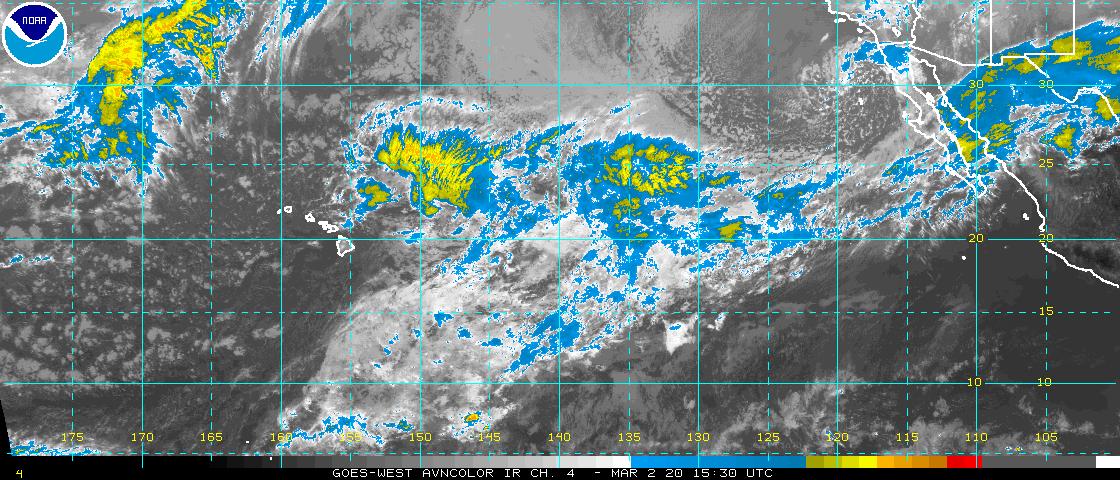
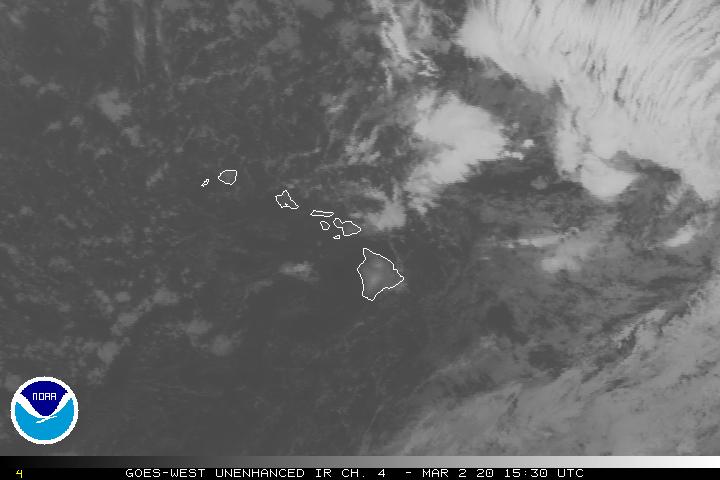
Satellite and Radar Images: To view the cloud conditions we have here in Hawaii, please use the following satellite links, starting off with this Infrared Satellite Image of the islands to see all the clouds around during the day and night. This next image is one that gives close images of the islands only during the daytime hours, and is referred to as a Close-up visible image. This next image shows a larger view of the Pacific…giving perspective to the wider ranging cloud patterns in the Pacific Ocean. Finally, here's a Looping IR satellite image, making viewable the clouds around the islands 24 hours a day. To help you keep track of where any showers may be around the islands, here’s the latest animated radar image.
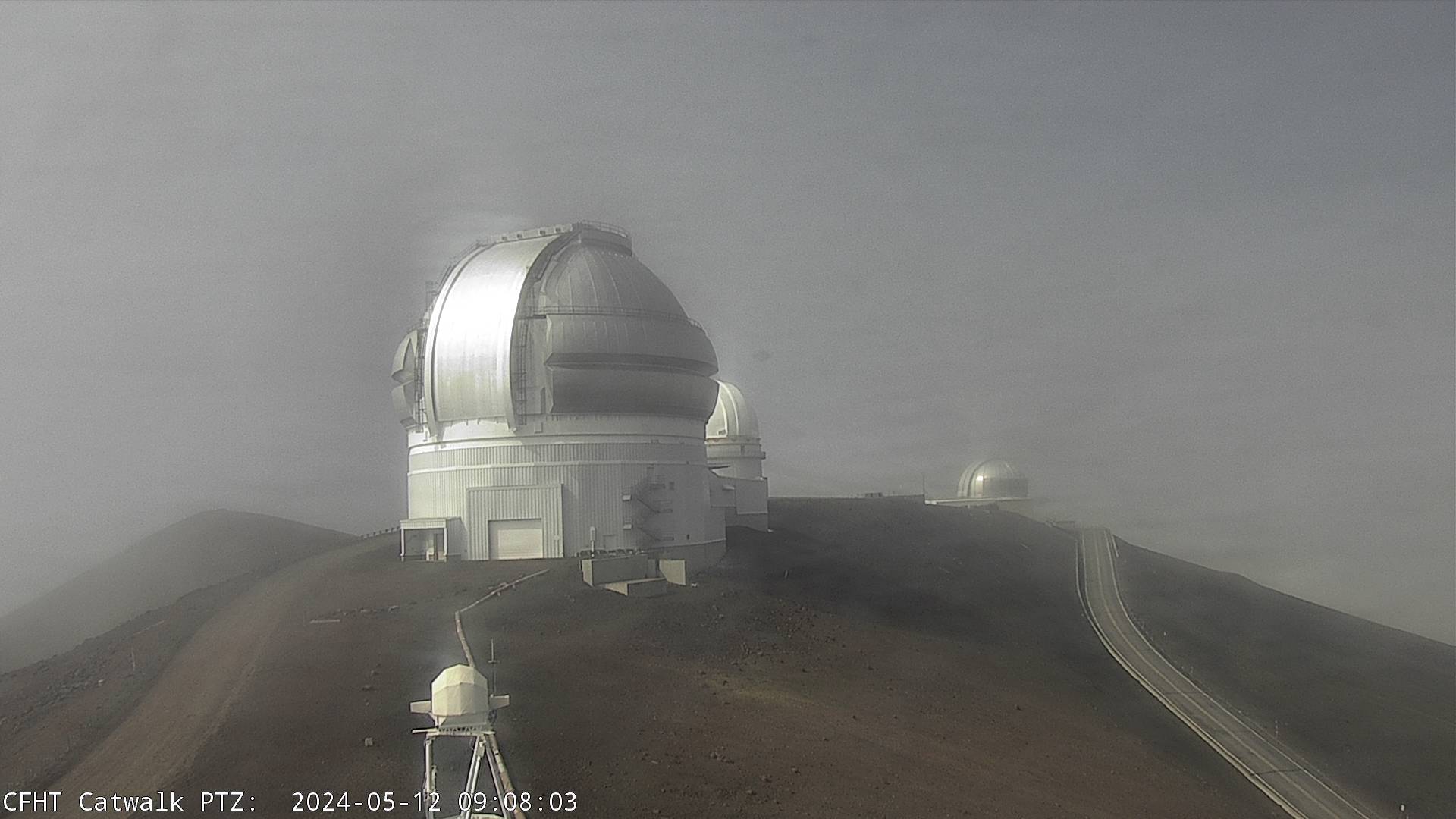
Hawaii’s Mountains – Here’s a link to the live web cam on the summit of near 14,000 foot Mauna Kea on the Big Island of Hawaii. The tallest peak on the island of Maui is the Haleakala Crater, which is near 10,000 feet in elevation. These two web cams are available during the daylight hours here in the islands…and when there’s a big moon rising just after sunset for an hour or two! Plus, during the nights and early mornings you will be able to see stars, and the sunrise too…depending upon weather conditions.
Tropical Cyclone activity in the eastern and central Pacific – Here’s the latest weather information coming out of the National Hurricane Center, covering the eastern north Pacific. You can find the latest tropical cyclone information for the central north Pacific (where Hawaii is located) by clicking on this link to the Central Pacific Hurricane Center. Here’s a tracking map covering both the eastern and central Pacific Ocean. A satellite image, which shows the entire ocean area between Hawaii and the Mexican coast…can be found here. Of course, as we know, our hurricane season won't end until November 31st here in the central Pacific.
Aloha Paragraphs

Kona coffee plantation
Winds will be generally light to moderately strong this week, ranging from east to southeast, then perhaps south this weekend. This weather map shows a weak high pressure system located to the northeast of the islands Tuesday night. A ridge of high pressure runs southwest close to Kauai, close enough to keep our local breezes light to moderate…although slightly stronger locally. This orientation of our local winds has been bringing up volcanic haze from the vents on the Big Island…at least locally. This vog will come and go this week, depending on the wind direction. As we move into this coming weekend, the winds will likely shift to the south direction, as a trough of low pressure moves towards the state from the west. As this trough moves away, and a new high pressure system moves into place, we'll see trade winds returning next Monday, lasting for several days.
Winds are moderately strong, from the east direction for the most part…the following numbers represent the strongest breezes around early evening Tuesday:
21 mph Port Allen, Kauai
21 Kahuku, Oahu
24 Molokai
35 Kahoolawe
25 Kaupo Gap, Maui
18 Lanai Airport
30 South Point, Big Island
These first two days of the week have continued to see a few showers locally, although certainly not everywhere…with dry weather in most places through Wednesday and Thursday. This very large satellite image shows a conveyor belt of moisture extending up from the deep tropics to our southwest, taking an abrupt right turn…then from there into the west coast! Extending our glance down to the southeast, also in the deep tropics, we find a large area of thunderstorms…with high cirrus clouds moving north and northeast from there. Looking at this next satellite picture, we can see that most of the state is clear, with just a few showers moving into the Big Island…with high clouds stretched out from northwest of Kauai, and northeast of Oahu down through the Big Island. Glancing over to this looping radar image, we can see light showers being carried our way on the current easterly wind flow…although the majority seem to be moving more or less towards the Big Island at the time of this writing.
The big question of the week revolves around what will happen this coming weekend, into next Monday. The computer models seem to be paralleling each other for the most part, although there is still enough difference on their take of the matter…that the forecast for that period isn’t a slam dunk just yet. The primary rainfall shield may remain to the west of the state this weekend, although could shift over to the east, into our area. This outlook remains the wild card at this point, although the computer models seem to be painting a wetter picture. As always, time will tell, and this chance of rainfall will become more clear, or wet as the case may be…over the next several days. Since this is the rainy season, we would like to take advantage of rainfall. At the same time of course, we’re moving into the last couple of weekends before Christmas, when local businesses would like to see throngs of people out and about shopping! The economy has obviously been shaky, so the money would like to flow…right along with the rate of rainfall.
It's Tuesday evening as I begin writing this last section of today's narrative update. The weather here in the Hawaiian Islands will remain favorably inclined, at least in most areas. The radar loop above shows a few showers around, although not many. Skies will remain quite clear, although the afternoon heating of the islands will bring some clouds over and around the mountains. The main thing this week will be the light winds, at least at times, and likely the hazy conditions that will prevail when the winds return to southeast. As we get into the later part of this work week, the winds will become even lighter than they are now. This will give us clear cool mornings, with those afternoon clouds around in the upcountry areas. This weekend looks like it will have more showers arriving, along with more Kona winds. There's still that chance that some of this precipitation will be on the heavy side, although I don't expect thunderstorms. Then, early next week we'll find moderately strong trade winds returning for several days. Thereafter, if we use climatology for a guide, we could see another cold front approaching from the northwest during the second half of the week…although its too early to know anything for certain just yet.
~~~ Here in Kihei, Maui, at 530pm, the skies were clear for the most part. The volcanic haze that was around this morning has been cleared out quite a bit by the returning easterly trade winds. This may be a temporary clearing of the vog however, as I expect to see it back more broadly Thursday and Friday. Then there's this weekend, when we may get into some wet weather again…more about that on Wednesday. Speaking of which, I'll be back early in the morning with your next new weather narrative. By the way, Wednesday should be a good day weatherwise. Aloha for now…Glenn.
Webcam atop Mauna Kea…on the Big Island – beautiful snow – viewable during the daylight hours
Interesting: Hawaiians can now worry less about finding stray yellowjackets living in their Christmas trees shipped from the mainland United States, partly due to research by a U.S. Department of Agriculture (USDA) scientist and his university and state cooperators. Every year, fir trees from the Pacific Northwest are shipped to Hawaii for use as Christmas trees.
Although yellowjackets usually nest in the ground, mated queens who haven't yet built their nests sometimes make fir trees their home during winter. So, when the trees are harvested in November for shipment to Hawaii, the yellowjacket queens get rounded up right along with them.
The western yellowjacket, Vespula pensylvanica, is considered an invasive insect in Hawaii, competing with native birds for insect prey and greatly reducing native insect populations.
In an effort to keep more yellowjackets from reaching the islands, Hawaii officials required a percentage of trees to be either manually or mechanically shaken to dislodge insect pests.
But there is no precise specification for how long the trees should be shaken, which makes a big difference in whether insects remain on trees. Entomologist Robert Hollingsworth, who works for USDA's Agricultural Research Service (ARS), teamed with university and state collaborators to examine the efficacy of the tree-shaking program and found that both methods failed to remove all yellowjacket queens from the trees, although mechanical shaking was significantly more effective than manual shaking.
Hollingsworth is based at the ARS Pacific Basin Agricultural Research Center in Hilo, Hawaii. ARS is USDA's principal intramural scientific research agency. The scientists also tested pre-harvest insecticide sprays as a supplement to the shaking treatment.
They found mist applications of an insecticide in the pyrethroid chemical class were 100 percent effective in killing yellowjacket queens, and remained effective even after heavy rainfall.
Details of the study were published in the Journal of Economic Entomology.Hawaii officials now require all fir trees destined for the islands to be shaken, regardless of shaking method. Future research plans include making shaking treatments more effective in the absence of an insecticide treatment.
Interesting2: When you tell a loud-mouth friend that they "really like the sound of their own voice," there may be more truth in that than you realize. According to a neuroscience study from the University of California (UC) Berkeley, the brain selectively hears one's own voice while dimming all surrounding sounds.
In their own heads, people will silence other noises while amplifying themselves speak. Neuroscientists from UC Berkeley, UCSF, and Johns Hopkins University, led by doctoral student Adeen Flinker, examined the electrical brain signals of hospital patients. The discovered that certain neurons lit up when they talked while others dimmed.
Previous studies have made this connection concerning monkey mating, food, and danger calls, but up to this point, none have focused on humans. "We used to think that the human auditory system is mostly suppressed during speech, but we found closely knit patches of cortex with very different sensitivities to our own speech that paint a more complicated picture," said Flinker.
"We found evidence of millions of neurons firing together every time you hear a sound right next to millions of neurons ignoring external sounds but firing together every time you speak. Such a mosaic of responses could play an important role in how we are able to distinguish our own speech from that of others." There is the question of why humans have evolved to more closely track their own speech.
Finkler suggests that it is important for language development, and monitoring our own speech. It is also important for adjusting our speech to match the environment. In a noisy bar, people must be aware of their own speech so they know it is loud enough to hear.
Conversely, it allows us to adjust our volume down in a quieter environment. A man's ability to more closely listen to himself speak is important because it lets him know that it is really his voice and not someone else's. This is not the case for people with schizophrenia, who have trouble distinguishing their own internal voice from voices of others.
This neural condition suggests a dysfunctional selective auditory mechanism. The UC Berkeley study can be helpful in understanding aspects of auditory hallucinations suffered by schizophrenics. The researchers examined patients who were being treated for seizures, because they already had electrodes implanted in their heads. They were asked to repeat words and vowels that they heard.
he scientists watched the neural electrical activity as the patients' brains had to transfer from listening mode to speaking mode. They found that some areas of the auditory cortex fired less during speech, while others fired more, demonstrating how incredibly complex and sensitive the human brain is hearing ourselves speak.
Interesting3: Water scarcity in the western U.S. has long been an issue of concern. Now, a team of researchers studying freshwater sustainability in the U.S. have found that the Southeast, with the exception of Florida, does not have enough water capacity to meet its own needs. Twenty-five years ago, environmentalist Marc Reisner published Cadillac Desert: The American West and Its Disappearing Water, which predicted that water resources in the West would be unable to support the growing demand of cities, agriculture and industry.
A paper co-authored by a University of Georgia researcher and just published in a special issue of the journal Proceedings of the National Academy of Sciences offers new support for most of Reisner's conclusions, using data and methods unavailable to him in 1986.
Although the paper focuses on freshwater sustainability in the Southwest, co-authors Tushar Sinha, a postdoctoral scientist at North Carolina State University; John Kominoski, a postdoctoral associate at the UGA Odum School of Ecology; and William Graf, a professor of geography at the University of South Carolina, said that the findings have important implications for the Southeast as well.
"It turns out that the Southeast has a relatively low capacity for water storage," said Graf. In order for water supply to be considered sustainable, the researchers calculated that no more than 40 percent of freshwater resources can be appropriated for human use, to ensure that streamflow variability, navigation, recreation and ecosystem use are accommodated.
They also determined how much water a region would need to meet all its municipal, agricultural and industrial needs — its virtual water footprint. The VWF includes the water needed if a region were to grow enough food to support its own population. The researchers found that neither the Southwest nor the Southeast have enough water capacity to meet all their own needs; both these regions virtually import water from other parts of the country, in the form of food.
"The Southeast has virtually no positive, inland VWFs," said Kominoski, who earned his doctoral degree from the Odum School. "The largest population centers in southeastern states, with the exception of Florida, are inland. Piedmont cities such as Atlanta, Charlotte and Birmingham rely on small watersheds, which may be why our VWFs are negative."
Study lead author John Sabo, associate professor at Arizona State University, added that the Southeast's municipal and industrial water demands are higher than supported by locally generated stream flow. Reisner also predicted the loss of reservoir capacity. The researchers found that both eastern and western reservoirs have lost storage capacity to sedimentation, although not at the rate predicted by Reisner.
"The good news is that the minimum life span of most of the dams in the Southeast is greater than two centuries, which is much longer than what Reisner anticipated," said Graf. The researchers also found that reservoirs lose enormous amounts of water to evaporation each year, resulting in a drop in reliable water yield.
"The Eastern U.S. has a higher density of reservoirs, but similar water losses as the West," Graf said, adding that although there are more reservoirs in the East, they are smaller than their Western counterparts. The researchers found that smaller reservoirs are more susceptible to evaporation losses than larger ones are.
Sinha added that most of these smaller reservoirs in the Southeast are designed to capture precipitation that falls within a year, as opposed to larger western reservoirs which carry water surplus or deficit over multiple years. Furthermore, changes in precipitation in the Southeast rapidly influence reservoir water levels.
"The recent droughts in the Southeast during the summers of 2002, 2005 and 2007 clearly indicate severe water shortages due to very low rainfall, and water supply is dependent upon precipitation, which is likely to be more uncertain in the near future," said Sinha. Loss of storage capacity and lack of enough water to support human needs is not the only freshwater sustainability issue in the Southeast.
"The fragmentation of river networks threatens the level of aquatic biodiversity of the Southeast, which is the highest in North America, in terms of both native and non-native species," Kominoski said. "Our current system doesn't support the needs of people, let alone ecosystems." The authors also cautioned that the paper's estimates are conservative. "The data we used is from 1950-99," Sinha said.
"The last decade, which had some of the highest recorded temperatures and most extreme droughts, as well as higher population figures, was not included. Also, the estimates don't take climate change into account. We expect to have less precipitation in the summer, during the growing season, and more severe droughts." Kominoski agreed, and added that the 2000 Census predicts continuing population growth in the sunbelt.
"As population grows, so does demand for water," he said. The paper's conclusion that the Southwest is near its limit in terms of water capacity holds true for the Southeast as well. "We need a new strategy for water storage and conservation in the U.S., including the Southeast," said Kominoski. "Because we have mostly inland metropolitan areas in small watersheds, we need to use less water.
Less water comes to us, and our ability to store water is challenged by our climate and geographic location." Graf added that demand for water is already an issue of major disagreement among Southeastern states. "We hope that these findings and recommendations will inform the debate and help lead to workable solutions," he said.
Interesting4: An unprecedented combination of heat plus decades of drought could be in store for the Southwest sometime this century, suggests new research from a University of Arizona-led team. A 60-year drought like that of the 12th Century could be in our future. To come to this conclusion, the team reviewed previous studies that document the region's past temperatures and droughts.
"Major 20th century droughts pale in comparison to droughts documented in paleoclimatic records over the past two millennia," the researchers wrote. During the Medieval period, elevated temperatures coincided with lengthy and widespread droughts.
By figuring out when and for how long drought and warm temperatures coincided in the past, the team identified plausible worst-case scenarios for the future. Such scenarios can help water and other resource managers plan for the future, the team wrote.
"We're not saying future droughts will be worse than what we see in the paleo record, but we are saying they could be as bad," said lead author Connie A. Woodhouse, a UA associate professor of geography and regional development.
"However, the effects of such a worst-case drought, were it to recur in the future, would be greatly intensified by even warmer temperatures." The team's paper is part of the special feature, "Climate Change and Water in Southwestern North America," scheduled for publication Dec. 13 in the Early Online edition of the Proceedings of the National Academy of Sciences.
The paper by Woodhouse and her colleagues is titled, "A 1,200 year perspective of 21st century drought in the southwestern North America." Co authors are Glen M. MacDonald of the University of California, Los Angeles; Dave W. Stahle of the University of Arkansas in Fayetteville; and Edward R. Cook of Lamont Doherty Earth Observatory of Columbia University, Palisades, N.Y.
The analysis in the current paper includes previous research by Woodhouse, co-author David M. Meko and others that documented past droughts that lasted several decades. Moreover, some of those droughts occurred during times of relatively warm temperatures.
Within the last 2,000 years, there have been several periods of severe and sustained drought that affected much of western North America. Droughts that are accompanied by warm temperatures have more severe impacts on ecosystems, said Meko, an associate research professor in the UA's Laboratory of Tree-Ring Research.
During the Medieval period, temperatures were about 1.8 degrees Fahrenheit (1 C) above the long-term average. Average temperatures in the Southwest have been warmer than that since 1990 and are projected to increase at least another 3.6 F (2 C) by 2100, Woodhouse said.
The most severe warm-climate drought in the Southwest within the last 1,200 years was 60 years long and occurred during the mid-12th century, according to research by Meko and others. That drought covered most of the western U.S. and northern Mexico.
For a 25-year period during that drought, Colorado River flow averaged 15 percent below normal, according to the tree-ring-based reconstruction of stream flow at Lees Ferry. For every 1.8 degree Fahrenheit (1 C) of warming in the future, Colorado River flow is projected to decrease between two and eight percent, Woodhouse and her co-authors wrote.
The Colorado River supplies water for cities and agriculture in seven western states in the U.S. and two states in northwestern Mexico. Los Angeles, Las Vegas, Denver, Phoenix, Tucson and Albuquerque are among the many cities dependent on Colorado River water.
"Even without warming, if you had one of those medieval droughts now, the impact would be devastating," she said. "Our water systems are not built to sustain us through that length of drought." Noting that the Colorado River flows recorded at Lees Ferry from 2000 to 2009 are the lowest on record, Woodhouse said the current drought could be part of a longer dry period.
The instrumental record from Lees Ferry goes back to 1906. "As this drought unfolds you can't really evaluate it until you're looking back in time," she said. In recent decades, temperatures have been higher than during the previous 1,200 years, and future temperatures are predicted to be even warmer, Woodhouse said.
In addition, other research predicts that changes in atmospheric circulation will reduce the amount of winter precipitation the Southwest receives in the future, she said. "The bottom line is, we could have a Medieval-style drought with even warmer temperatures," Woodhouse said.
 Email Glenn James: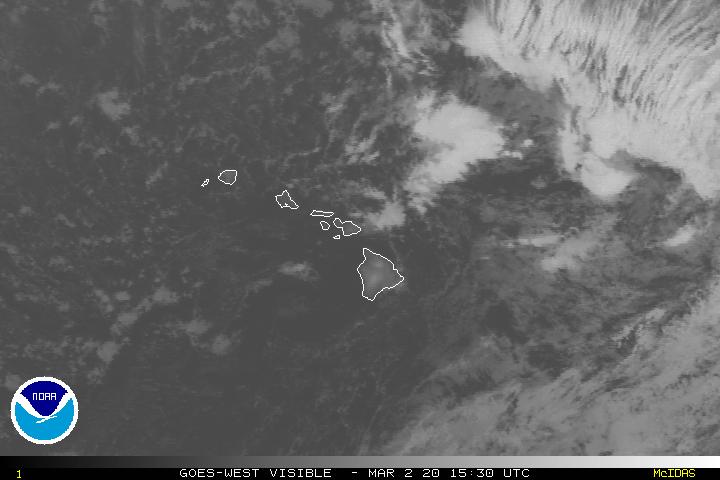


Blair Thorndike Says:
Meteor shower was super good in Waikapu, too, especially after mahina set over the West Maui Mtns~~~Hi Blair, glad you got an eyeful of those streaking meteors too! Aloha, Glenn