











December 13-14, 2010
Air Temperatures – The following maximum temperatures were recorded across the state of Hawaii Monday afternoon:
Lihue airport, Kauai – missing
Honolulu airport, Oahu – 81
Kaneohe, Oahu – 80
Molokai airport – 83
Kahului airport, Maui – 84
Kona airport – 83
Hilo airport, Hawaii – 83
Air Temperatures ranged between these warmest and coolest spots near sea level – and on the highest mountain tops…as of 5pm Monday evening:
Kailua-kona – 81F
Hilo, Hawaii – 77
Haleakala Crater – 50 (near 10,000 feet on Maui)
Mauna Kea summit – 36 (near 14,000 feet on the Big Island)
Precipitation Totals – The following numbers represent the largest precipitation totals (inches) during the last 24 hours on each of the major islands, as of Monday afternoon:
0.97 Mount Waialeale, Kauai
0.98 Punalulu Pump, Oahu
0.00 Molokai
0.00 Lanai
0.00 Kahoolawe
1.24 West Wailuaiki, Maui
1.02 Waiakea Uka, Big Island
Marine Winds – Here’s the latest (automatically updated) weather map showing a weak 1022 millibar high pressure system located to the northeast of the state. At the same time we have a ridge of high pressure from the high…running down near Kauai. Our winds will be generally light from the southeast, coming back around to the east Tuesday and Wednesday.
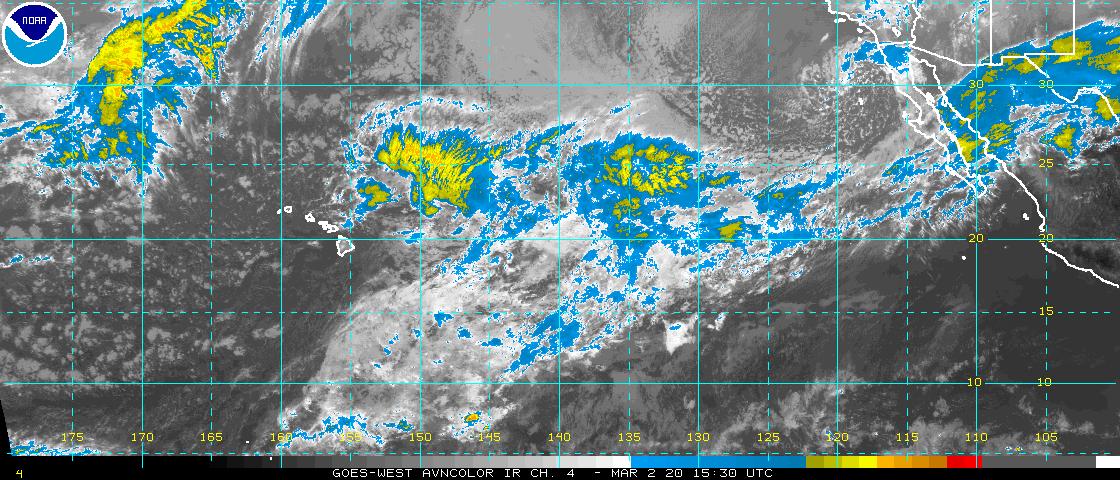
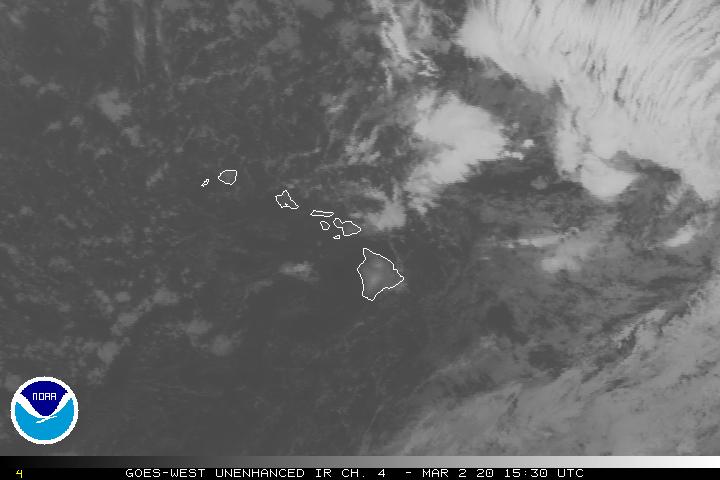
Satellite and Radar Images: To view the cloud conditions we have here in Hawaii, please use the following satellite links, starting off with this Infrared Satellite Image of the islands to see all the clouds around during the day and night. This next image is one that gives close images of the islands only during the daytime hours, and is referred to as a Close-up visible image. This next image shows a larger view of the Pacific…giving perspective to the wider ranging cloud patterns in the Pacific Ocean. Finally, here's a Looping IR satellite image, making viewable the clouds around the islands 24 hours a day. To help you keep track of where any showers may be around the islands, here’s the latest animated radar image.
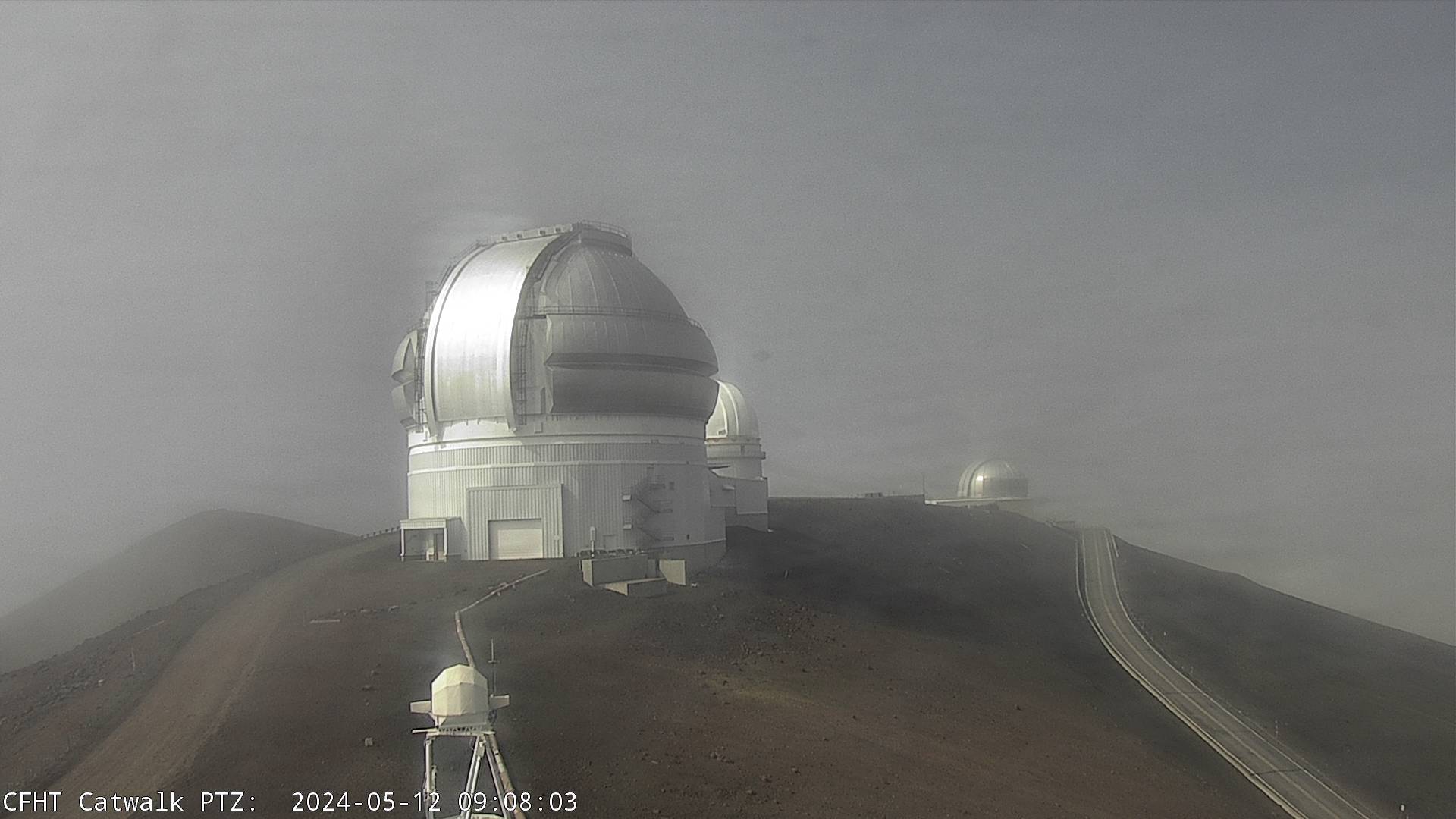
Hawaii’s Mountains – Here’s a link to the live web cam on the summit of near 14,000 foot Mauna Kea on the Big Island of Hawaii. The tallest peak on the island of Maui is the Haleakala Crater, which is near 10,000 feet in elevation. These two web cams are available during the daylight hours here in the islands…and when there’s a big moon rising just after sunset for an hour or two! Plus, during the nights and early mornings you will be able to see stars, and the sunrise too…depending upon weather conditions.
Tropical Cyclone activity in the eastern and central Pacific – Here’s the latest weather information coming out of the National Hurricane Center, covering the eastern north Pacific. You can find the latest tropical cyclone information for the central north Pacific (where Hawaii is located) by clicking on this link to the Central Pacific Hurricane Center. Here’s a tracking map covering both the eastern and central Pacific Ocean. A satellite image, which shows the entire ocean area between Hawaii and the Mexican coast…can be found here. Of course, as we know, our hurricane season won't end until November 31st here in the central Pacific.
Aloha Paragraphs

Geminid Meteor Shower tonight…best of the year!
Winds will range between light southeast…to light to moderate trade winds during this work week. This weather map shows a 1022 millibar high pressure system located to the northeast of the islands Monday night. The trade winds return Tuesday into Wednesday, and then fade away again Thursday and Friday, The volcanic haze will come and go, depending on the wind direction. The winds will be lightest during the southeast episodes, gaining strength when the trade winds return. As we move into this coming weekend, the winds will likely shift back to the south to southwest Kona direction, as a trough of low pressure moves towards the state from the west.
Winds are generally light from the southeast direction…the following numbers represent the strongest gusts early Monday evening:
10 mph Port Allen, Kauai
17 Waianae, Oahu
06 Molokai
10 Kahoolawe
15 Hana, Maui
07 Lanai Airport
24 South Point, Big Island
The first half of this week will continue to see some showers at times…with drier weather everywhere during the second half of the work week. The wild card remains in place for this coming weekend, at which point we could easily see rainy weather returning…this is looking more and more likely as a matter of fact. This very large satellite image shows that most of the state is now clear, with with some clouds in the central part of the state, moving west. At the same time, we are still to the southeast of a cold front. Looking at this next satellite picture, we can see that old cold front still somewhat active near Maui to Oahu…with some high clouds approaching Kauai from the northwest too. Glancing over to this looping radar image, we can see just a few light showers being carried our way on the south winds.
It's Monday evening as I begin writing this last section of today's narrative update. The weather here in the Hawaiian Islands is generally quite nice. As mentioned above, the winds will return to trade winds Tuesday and Wednesday, then recede back into the light southeast mode Thursday and Friday. We may see the return of volcanic haze again then. The mornings will be generally clear and cool, with some clouds forming over and around the mountains during the afternoons. The air mass will be especially dry then, so I expect very few showers. This weekend still looks like it will turn rainy again, with perhaps the best bet for rain being Sunday into early next week. This prospect still needs some fine tuning as we move through the week.
~~~ Here in Kihei, Maui, at 530pam, skies were still hazy, or what we call voggy here in the islands. There are still lots of clouds around too, which should dissipate at some point tonight. I'm hoping that they will be gone in time to see the famous Geminid meteor shower early Tuesday morning…or after midnight tonight. I'll be up, and will get myself outside on my weather deck for the viewing. I'm hearing that this display will be the best of the year! I'll let you know what I found early Tuesday morning when I'll be back with your next new weather narrative. I hope you have a great Monday night until then! Aloha for now…Glenn.
Webcam atop Mauna Kea…on the Big Island – beautiful snow – viewable during the daylight hours
Interesting: A spectacular night show will pass through the Hawaiian sky on Monday night. The Geminid meteor shower can be seen until Dec. 19, but its peak is the evening of Monday, Dec. 13 to the early hours of Tuesday, Dec. 14.
The best viewing for the shower will be after the moon sets at 12:05 a.m. Tuesday. The shower will stream across the sky at speeds of up to 60 miles per hour. The Geminid meteor shower is a rarity because it is caused by debris from an asteroid rather than from a comet.
Interesting2: Ohio State University researchers have found a new way to gauge the depth of the magma chamber that forms the Hawaiian Island volcanic chain, and determined that the magma lies much closer to the surface than previously thought. The finding could help scientists predict when Hawaiian volcanoes are going to erupt. It also suggests that Hawaii holds great potential for thermal energy.
Julie Ditkof, an honors undergraduate student in earth sciences at Ohio State, described the study at the American Geophysical Union Meeting in San Francisco on December 14. For her honors thesis, Ditkof took a technique that her advisor Michael Barton, professor of earth sciences, developed to study magma in Iceland, and applied it to Hawaii.
She discovered that magma lies an average of about 1.9 to 2.5 miles beneath the surface of Hawaii. "Hawaii was already unique among volcanic systems, because it has such an extensive plumbing system, and the magma that erupts has a unique and variable chemical composition," Ditkof explained.
"Now we know the chamber is at a shallow depth not seen anywhere else in the world." For example, Barton determined that magma chambers beneath Iceland lie at an average depth of 20 kilometers. While that means the crust beneath Hawaii is much thinner than the crust beneath Iceland, Hawaiians have nothing to fear.
"The crust in Hawaii has been solidifying from eruptions for more than 300,000 years now. The crust doesn't get consumed by the magma chamber. It floats on top," Ditkof explained. The results could help settle two scientific debates, however.
Researchers have wondered whether more than one magma chamber was responsible for the varying chemical compositions, even though seismological studies indicated only one chamber was present.
Meanwhile, those same seismological studies pegged the depth as shallow, while petrologic studies — studies of rock composition — pegged it deeper. There has never been a way to prove who was right, until now.
"We suspected that the depth was actually shallow, but we wanted to confirm or deny all those other studies with hard data," Barton said. He and Ditkof determined that there is one large magma chamber just beneath the entire island chain that feeds the Hawaiian volcanoes through many different conduits.
They came to this conclusion after Ditkof analyzed the chemical composition of nearly 1,000 magma samples. From the ratio of some elements to others — aluminum to calcium, for example, or calcium to magnesium — she was able to calculate the pressure at which the magma had crystallized.
For his studies of Iceland, Barton created a methodology for converting those pressure calculations to depth. When Ditkof applied that methodology, she obtained an average depth of 3 to 4 kilometers. Researchers could use this technique to regularly monitor pressures inside the chamber and make more precise estimates of when eruptions are going to occur.
Barton said that, ultimately, the finding might be more important in terms of energy. "Hawaii has huge geothermal resources that haven't been tapped fully," he said, and quickly added that scientists would have to determine whether tapping that energy was practical — or safe. "You'd have to drill some test bore holes. That's dangerous on an active volcano, because then the lava could flow down and wipe out your drilling rig."
Interesting3: Butterflies are one of the few insects on Earth that people actually like and admire. Unfortunately, mankind's beloved butterfly has fallen on hard times on the continent of Europe. According to a new study from Butterfly Conservation Europe, grassland butterfly populations have declined by 70 percent in the last 20 years.
Butterfly decline is also a problem in other parts of the world. Examples include the giant swallowtail of Jamaica, the Atewa dotted border from Ghana, and the Oregon silverspot in the Pacific Northwest.
In Europe, a "Red List of Butterflies" has been created to identify and keep track of all species of butterflies from Iceland in the west to the Ural Mountains in the east, and from Franz Josef Land in the north, and south to the Canary Islands.
The "Red List" takes account of the 482 butterfly species in Europe. Nine percent are considered threatened, and a further 10 percent are near threatened. Only four percent of species are actually increasing their populations.
The recent study from Butterfly Conservation Europe used data from 3,000 sites in 15 countries. Researchers concluded that the main cause of population decline was the switch from small sustainable agriculture was being replaced by industrial farming.
Large-scale industrial farming does not leave any open spaces along the periphery which contain flower-filled meadows where butterflies thrive. When people first cleared land for hay production and raising livestock, the butterfly population flourished.
This is how most of Europe's grasslands were formed. Now, with the abandonment of these traditional practices and overgrazing by livestock, butterflies have suffered. Areas of most concern are Eastern Europe, where small-scale agriculture has fallen, and mountainous regions such as the Pyrenees, which are traditionally home to large butterfly populations.
The researchers attributed most of the losses to the decline in grasslands on the continent. They also say this can be linked to declines in bees, spiders, birds, and several types of plants. Butterflies require very specific foods and habitats to flourish. Being so sensitive, they make good indicators of a healthy ecosystem.
Losing them would be horrible for mankind, not only because we think they look nice. They also play important roles in their ecosystem through their pollination activities.
Interesting4: A centuries-old astronomical mystery may be finally solved. A scientist says she has figured out how Saturn's spectacular rings formed. The dramatic process could help explain other solar system mysteries as well. Saturn's rings have mystified scientists since they were discovered in the mid-1600s.
In particular, none of the hypotheses about their origin explain why individual ring particles, which range in size from hailstones to small boulders, average between 90% and 95% ice. If a moon disintegrated in Saturn's orbit, as some astronomers have suggested, the rings should be about half ice and half rock.
That's the composition of most moons this far from the sun. The new theory, set forth by planetary scientist Robin Canup of the Southwest Research Institute in Boulder, Colorado, and published online today in Nature, explains the ice-rich composition of the rings and accounts for the odd characteristics of some of Saturn's smaller moons.
Canup created detailed computer simulations, which suggest a violent origin for Saturn's rings. As the planet coalesced during the birth of the solar system more than 4.5 billion years ago, the swirling disk of gas surrounding it included several moons about the size of Titan, Saturn's largest remaining satellite, which is about 50% larger than Earth's moon.
But gravitational interactions with the gas caused the moons' orbits to shrink, and one by one the satellites entered death spirals and plunged into the planet. Before each moon collided, immense tidal forces produced by Saturn's gravity stretched and contracted it, stripping off much of its ice.
Subsequent moons gravitationally captured this ice, but they were eventually stretched and contracted until they too shed their ice and plunged into Saturn. Today's ring system is the fossil remains of the last moon to fall prey to Saturn's immense gravity, Canup contends.
This moon was basically a giant ice ball with a rocky center. After its ice-rich veneer was stripped away in large chunks, its rocky core disappeared beneath the saturnian clouds.
 Email Glenn James: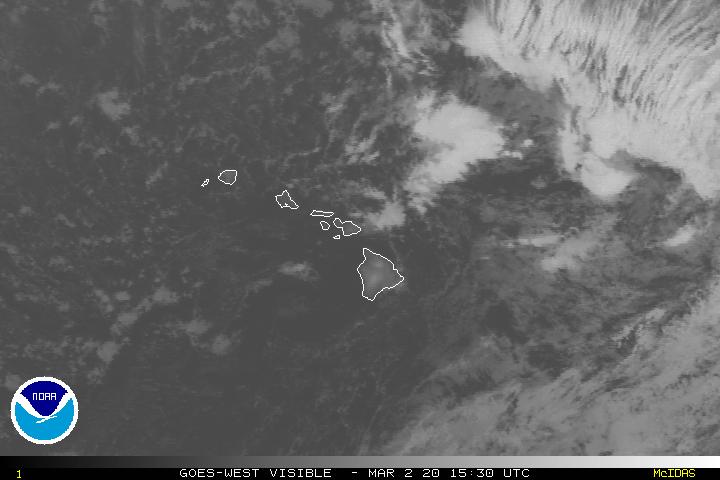


peter mac Says:
A friend recently used the term 'Vaze' instead of 'Vog'. I quess technically more accurate.
In any case there is so much right now in the big island sky very few stars appear.
maybe when the moon goes down we can see some meteors~~~Hi Peter, there is a lot of volcanic haze here on Maui too, plus quite a few clouds. I’m hoping that later it will clear, at least the clouds. Good luck, if you see some shooters, let us know. Aloha, Glenn
Matt Says:
Glenn,
Where is Lipoa, Maui? I know of Lipoa Road in Kihei, but I don't think that is what you are referring to in the section of the narrative where you mention the wind speeds.
Matt~~~Hi Matt, Lipoa Point is on the upper west side…up near Kapalua. Aloha, Glenn