











December 10-11, 2010
Air Temperatures – The following maximum temperatures were recorded across the state of Hawaii Friday afternoon:
Lihue airport, Kauai – 73
Honolulu airport, Oahu – 78
Kaneohe, Oahu – 79
Molokai airport – 76
Kahului airport, Maui – 78
Kona airport – 78
Hilo airport, Hawaii – 76
Air Temperatures ranged between these warmest and coolest spots near sea level – and on the highest mountain tops…as of 5pm Friday evening:
Barking Sands, Kauai – 75F
Hana airport, Maui – 66
Haleakala Crater – 37 (near 10,000 feet on Maui)
Mauna Kea summit – 28 (near 14,000 feet on the Big Island)
Precipitation Totals – The following numbers represent the largest precipitation totals (inches) during the last 24 hours on each of the major islands, as of Friday evening:
6.42 Puu Opae, Kauai
3.58 Punaluu Stream, Oahu
3.39 Molokai
3.23 Lanai
1.37 Kahoolawe
2.47 Puu Kukui, Maui
2.74 Kaupulehu, Big Island
Marine Winds – Here’s the latest (automatically updated) weather map showing a high pressure ridge near the Big Island of Hawaii…moving slowly northward. Our winds will come in from the trade wind direction Saturday into Sunday.
Satellite and Radar Images: To view the cloud conditions we have here in Hawaii, please use the following satellite links, starting off with this Infrared Satellite Image of the islands to see all the clouds around during the day and night. This next image is one that gives close images of the islands only during the daytime hours, and is referred to as a Close-up visible image. This next image shows a larger view of the Pacific…giving perspective to the wider ranging cloud patterns in the Pacific Ocean. Finally, here's a Looping IR satellite image, making viewable the clouds around the islands 24 hours a day. To help you keep track of where any showers may be around the islands, here’s the latest animated radar image.
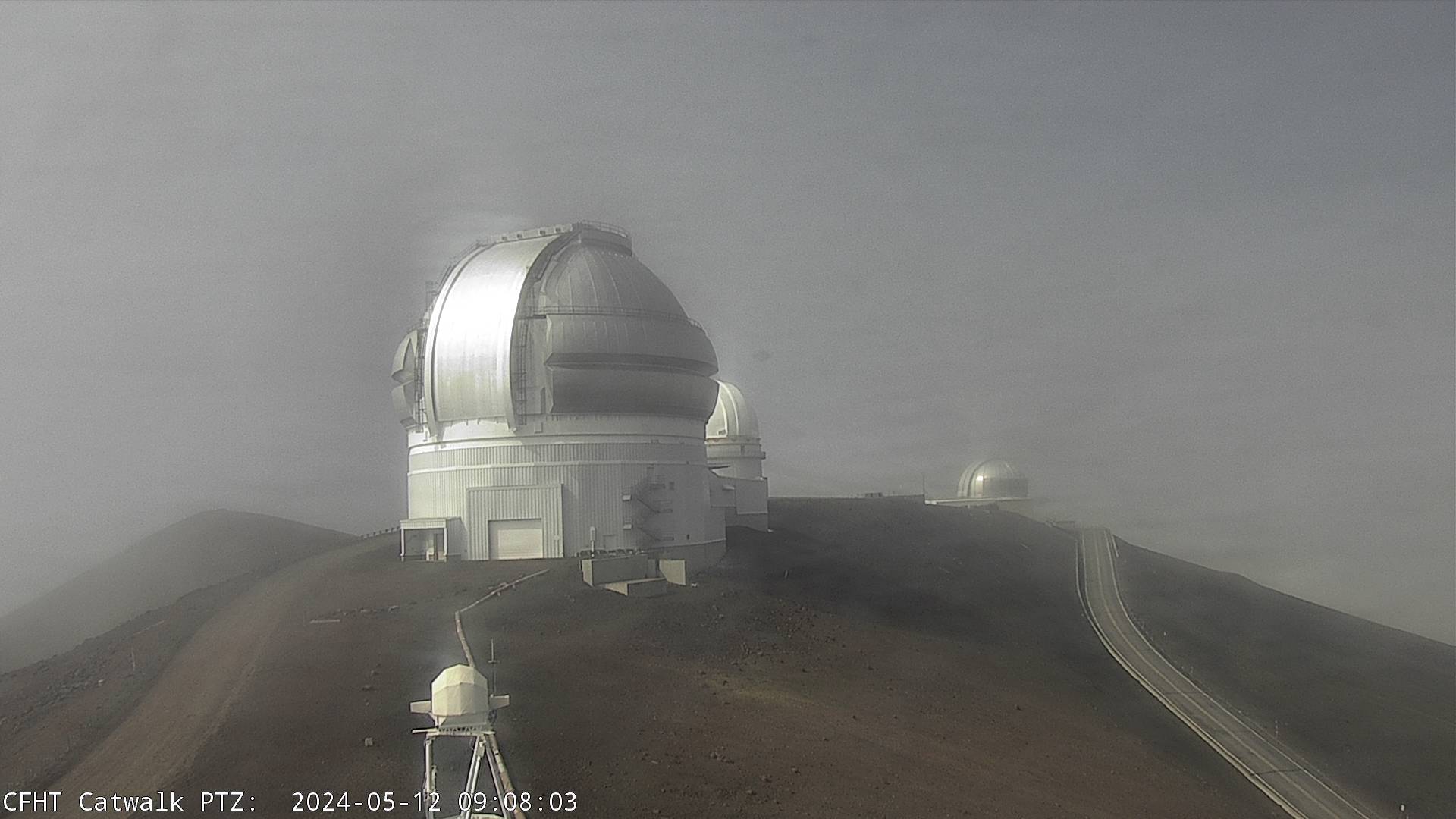
Hawaii’s Mountains – Here’s a link to the live web cam on the summit of near 14,000 foot Mauna Kea on the Big Island of Hawaii. The tallest peak on the island of Maui is the Haleakala Crater, which is near 10,000 feet in elevation. These two web cams are available during the daylight hours here in the islands…and when there’s a big moon rising just after sunset for an hour or two! Plus, during the nights and early mornings you will be able to see stars, and the sunrise too…depending upon weather conditions.
Tropical Cyclone activity in the eastern and central Pacific – Here’s the latest weather information coming out of the National Hurricane Center, covering the eastern north Pacific. You can find the latest tropical cyclone information for the central north Pacific (where Hawaii is located) by clicking on this link to the Central Pacific Hurricane Center. Here’s a tracking map covering both the eastern and central Pacific Ocean. A satellite image, which shows the entire ocean area between Hawaii and the Mexican coast…can be found here. Of course, as we know, our hurricane season won't end until November 31st here in the central Pacific.
Aloha Paragraphs

Improving weather this weekend…still some showers tonight
Our winds will turn to the trade wind direction later Saturday into Sunday, then be replaced by lighter southeast breezes on Monday…through much of the new week ahead. This weather map shows a 1026 millibar high pressure system to our northeast, with its associated ridge located near the Big Island Friday night. Meanwhile, a weakening cold front is approaching from the northwest, moving slowly in our direction. Winds will remain locally breezy from the southwest…as the front edges in closer. Trade winds fill back into our area Saturday, which should support improving weather conditions…especially along the leeward beaches. Looking further ahead, another low pressure system, with its cold front…will knock our trade winds down by Monday into Tuesday, if not sooner. The outlook now calls or light southeast winds through much of the new week ahead…bringing volcanic haze back into our area.
Winds are lighter now, and will come in from the trade wind direction later Saturday into Sunday…the following numbers represent the strongest gusts Friday evening:
15 mph Moloaa Dairy, Kauai
16 Honolulu airport, Oahu
12 Molokai
15 Kahoolawe
16 Kapalua, Maui
13 Lanai Airport
12 Kawaihae, Big Island
The area of prefrontal clouds and showers brought heavy rains to much of the state Thursday and Friday, and is now off to the southeast and east of the Big Island Friday night. A low pressure system, as shown in the weather chart above, will move quickly by to our east and northeast, dragging its dissipating cold front into the state overnight into Saturday. This cold front may bring some rainfall with it, although will be less of a rainfall producer…than the strong band of prefrontal showers that we saw recently. We aren't out of the woods just yet, as a flash flood watch remains in effect over the entire state, at the time of this writing. As a matter of fact, there are several advisories that are active Friday night. One of those is for a Winter Weather Warning on the summits of the Big Island…wanna take a look at the snow on the camera lens? It only shows up through the daylight hours however, so you will have to wait until Saturday morning for the next peek at that fresh white stuff up there.
The heavy rain is over now, although there's still that outside chance of a few showers, maybe enough a couple of heavy ones tonight into Saturday morning…associated with the cold front. This satellite image shows the nature of all this tropical moisture that has been, and continues to be brought over the islands. Looking at this weather situation, using this tighter focus, we can see that this cloudiness is gradually shifting eastward. Glancing over to this looping radar image, we can see that rainfall continues to move away, right along with the departing cloud cover. Kauai, Oahu, and most of Maui County have moved out from under this conveyor belt of deep tropical moisture…at least for the moment.
It's Friday as I begin writing this last section of today's narrative update. The weather here in the Hawaiian Islands is becoming drier now, at least for the moment. We still have this trough and cold front to go through tonight into Saturday however, with the amount of rain it may bring…still a bit unknown. Essentially we're on the drier side of this wet weather now, moving into better weather ahead. You may have noticed that Friday was a cool day, our coolest since last spring as a matter of fact. High temperatures remained in the 70F's at sea level, with not one 80 degree reading for a change.
~~~ Meanwhile, as it's Friday night, I'm going to see a film, this one called The Warrior Way, starring Geoffrey Rush, Tony Cox, Danny Huston, Kate Bosworth…among others. The synopsis: a warrior assassin struggles to find peace, contentment and perhaps love, in a forgotten western town, on the edge of the desert. I must admit that after a big week of weather work, this sounds like a good film to me. This film is actually getting B+ grades, which is good enough to draw me into the theatre. I'll let you know what I thought Saturday morning, when I'll be back with your next new weather narrative. Here's a trailer for this film, just in case you were curious what type of film this was. I hope you have a great Friday night! Aloha for now…Glenn.
Webcam atop Mauna Kea…on the Big Island – by the way, that's snow on the camera lens! The next view will be on Saturday morning, when the sun comes up.
By the way: I was curious how many of you folks used this website on Thursday, to keep track of this December wet weather event…here in the islands. I checked, and found the number to be 22,525. For those first nine days of this month, there have been 106,074 views. Thank you so much for being a participating reader! >>> So far today, as of 630pm Friday evening, there had been 28,317 views of this website, with 180 clicks on the google ads…which is one of the ways that I make a few bucks for keeping this site going each day. Let's see, that's about 51,000 page views in two days.
Interesting: A wave of reptile extinctions on the Greek islands over the past 15,000 years may offer a preview of the way plants and animals will respond as the world rapidly warms due to human-caused climate change, according to a University of Michigan ecologist and his colleagues. The Greek island extinctions also highlight the critical importance of preserving habitat corridors that will enable plants and animals to migrate in response to climate change, thereby maximizing their chances of survival.
As the climate warmed at the tail end of the last ice age, sea levels rose and formed scores of Aegean islands that had formerly been part of the Greek mainland. At the same time, cool and moist forested areas dwindled as aridity spread through the region.
In response to the combined effects of a shifting climate, vegetation changes and ever-decreasing island size, many reptile populations perished. To gain a clearer understanding of the past consequences of climate change, Johannes Foufopoulos (foo FOP oo los) and his colleagues calculated the population extinction rates of 35 reptile species — assorted lizards, snakes and turtles — from 87 Greek islands in the northeast Mediterranean Sea.
The calculated extinction rates were based on the modern-day presence or absence of each species on islands that were connected to the mainland during the last ice age. Foufopoulos and his colleagues found a striking pattern to the island extinctions. In most cases, reptile populations disappeared on the smallest islands first — the places where the habitat choices were most limited.
Especially hard hit were "habitat specialist" reptiles that required a narrow range of environmental conditions to survive. In addition, northern-dwelling species that required cool, moist conditions showed some of the highest extinction rates. The study results appear in the January edition of American Naturalist.
The researchers conclude that a similar pattern of extinctions will emerge at various spots across the globe as the climate warms in the coming decades and centuries. In addition to adapting to a changing climate, plants and animals will be forced to traverse an increasingly fragmented natural landscape.
In many places, small chunks of natural habitat are now surrounded by vast, inhospitable expanses of agricultural and urbanized land, just as those newly formed Aegean islands were surrounded by rising seas thousands of years ago.
"The widespread fragmentation of natural habitats greatly exacerbates the effects of climate change and undermines the ability of species to adapt to the new conditions," said Foufopoulos, an associate professor at the U-M School of Natural Resources and Environment and the Department of Ecology and Evolutionary Biology.
In addition to Foufopoulos, the paper's authors are Anthony Ives of the University of Wisconsin and A. Marm Kilpatrick of the University of California, Santa Cruz. "The lessons learned from the wave of reptile extinctions suggest that if species are to survive the global climate shift already underway, not only do humans have to set significantly more land aside for conservation, but these protected areas will also need to be connected through a network of habitat corridors that allow species migration," Foufopoulos said.
Over the last several decades, global warming has resulted in a poleward shift in the range of many birds, butterflies and other creatures. This shift to cooler climes — northward in the Northern Hemisphere and southward in the Southern Hemisphere — is expected to continue in the future as organisms seek out places where temperature and moisture levels permit their survival.
Funding for the project was provided through the University of Wisconsin's Department of Zoology, the University of Michigan, the Princeton Environmental Institute, the Cleveland Dodge Foundation and the U.S. National Science Foundation.
Interesting2: Talks on a 190-nation deal to slow global warming were on a "knife edge" early on Friday as Brazil and Japan expressed guarded hopes of ending a dispute between rich and poor about curbing greenhouse gas emissions. Negotiators were set to work well into the early hours of the morning seeking to end a standoff over the future of the U.N.'s Kyoto Protocol, which binds almost 40 rich nations to curb emissions until 2012, before the final day of the two-week talks on Friday.
"Time is running out," Mexico's Foreign Minister Patricia Espinosa, who is serving as the president of the talks being held at the Caribbean beach resort Cancun, told negotiators. If the negotiators fail to reach an agreement by Friday night they must face the reality of explaining that to their societies, she reminded them.
Some of the negotiators broke into groups in an attempt to hash out issues like financing for poor countries, technology transfers, and stopping deforestation. "Intensive consultations are taking place. We are engaging heavily with other parties. And it is a good sign," Brazil's negotiator Luiz Figueiredo said earlier at the talks.
"I am very hopeful we will have a good outcome." Brazil and Britain are leading talks on the Kyoto pact. Japan reiterated that it will not extend cuts under Kyoto beyond 2012, a position that has angered developing nations. Tokyo insists that all major emitters including China, India and the United States must instead sign up for a new treaty.
Interesting3: The ice sheet consists of layers of compressed snow and covers roughly 80 per cent of the surface of Greenland. Since the 1990s, it has been documented to be losing approximately 100 billion tons of ice per year — a process that most scientists agree is accelerating, but has been poorly understood. Some of the loss has been attributed to accelerated glacier flow towards ocean outlets.
Now a new study, published in the journal Nature, shows that a steady melt water supply from gradual warming may in fact slow down glacier flow, while sudden water input could cause glaciers to speed up and spread, resulting in increased melt.
"The conventional view has been that melt water permeates the ice from the surface and pools under the base of the ice sheet," says Christian Schoof, an assistant professor at UBC's Department of Earth and Ocean Sciences and the study's author.
"This water then serves as a lubricant between the glacier and the earth underneath it, allowing the glacier to shift to lower, warmer altitudes where more melt would occur."
Noting observations that during heavy rainfall, higher water pressure is required to force drainage along the base of the ice, Schoof created computer models that account for the complex fluid dynamics occurring at the interface of glacier and bedrock.
He found that a steady supply of melt water is well accommodated and drained through water channels that form under the glacier.
Interesting4: New rounds of arctic cold and snow are in store for the United Kingdom and portions of Europe in the days leading up to Christmas, causing fears of cancellations of celebrations for the holiday. The jet stream will plunge once again, allowing arctic cold to return late next week across the U.K. and much of Europe. The cold air will lay the tracks for an active snowstorm path across the region.
One or two of these storms leading up to Christmas could end up strengthening into major, travel-halting storms. Temperatures will plummet below zero degrees Celsius across portions of the U.K. next Thursday into Friday behind a round of rain and high-elevation snow. Gale-force winds will make it feel even colder than actual temperatures.
It is not entirely out of the question that rain may change to snow for a bit in London late next week. "Germany will take the brunt of the cold, while the U.K. is getting a brief break from the cold," according to Expert Senior Meteorologist and Climate Expert Joe Bastardi. Bastardi adds, even when the cold builds back into the U.K. next week, the worst of it will be focused over Germany.
The temperature will be below lower the 20’s F in Berlin for much of next week. The high at Paris should fall to zero degrees Celsius by Thursday. People may notice how wintry it has felt in Paris, following a round of record snow that shut down the Eiffel Tower.
Interesting5: On the evening of 13 and the morning of 14 December, skywatchers across the northern hemisphere will be looking up as the Geminid meteor shower reaches its peak, in one of the best night sky events of the year. And unlike many astronomical phenomena, meteors are best seen without a telescope (and are perfectly safe to watch).
At its peak and in a clear, dark sky up to 100 'shooting stars' or meteors may be visible each hour. Meteors are the result of small particles entering the Earth's atmosphere at high speed, burning up and super-heating the air around them, which shines as a characteristic short-lived streak of light.
In this case the debris is associated with the asteroidal object 3200 Phaethon, which many astronomers believe to be an extinct comet. The meteors appear to originate from a 'radiant' in the constellation of Gemini, hence the name Geminid. By 0200 GMT on 14 December the radiant will be almost overhead in the UK, making it ideally placed for British observers.
By that time the first quarter Moon will have set so the prospects for a good view of the shower are excellent. Meteors in the Geminid shower are less well known, probably because the weather in December is less reliable. But those who brave the cold can be rewarded with a fine view.
In comparison with other showers, Geminid meteors travel fairly slowly, at around 22 miles per second, are bright and have a yellowish hue, making them distinct and easy to spot. This year the peak of the Geminids meteor shower occurs at around 1100 GMT on 14 December, but the highest level activity is spread over a period lasting a day or more.
This means that if conditions are clear it is worthwhile observing at any time between Sunday night and Wednesday morning. As with most astronomical events, the best place to see meteors is at dark sites away from the light pollution of towns and cities. In good weather, rural sites such as Galloway Forest Dark Sky Park in Scotland (where a planned meteor watch will take place on 13-14 December) are potentially excellent locations to see the Geminid shower.
 Email Glenn James:


Denise Viesta Says:
Glenn, Love your site! Do you have any plans to get onto Twitter or Facebook?
Mahalo for keeping us informed. Malama pono!~~~Hi Denise, thanks for your positive feedback…no real plans to twitter or Facebook yet. Aloha, Glenn
Eliza Says:
Aloha Glenn –
Rains started in upper Pukalani about 5am today. Backed off and have been at a steady drizzle since then. Just recently (noon:30) it has kicked up a notch in intensity. Looking at the satellite map, we're in for some increased precipitation.
@ Sandy – Unfortunately, Haiku is a big area and some sections are more prone to flooding than others. The windy dirt road may be a difficult traverse if you are in a normal car. May want to trade in for a jeep-like vehicle till this storm passes. Still, follow your normal instructions – turn around, don't drown. Good luck!
Malama pono ~
Eliza~~~Excellent post Eliza, thanks for your wise remarks about flash flooding…I totally agree! Stay dry my friend, Aloha, Glenn
sandy Says:
OK this is probably be a lame question, but coming from sunny california, I have never seen so much rain, and from all the talk, its only started. So here is the question, when you all say flash floods, do we get any hint on where these are going to be? Like is there a logically guess, like widen streams or something, like on TV. Here is the thing I am renting a place off a very long-long windy dirt road in haiku, I am picking my girlfriend up at the airport tonight, should I just go rent a canoe? Sandy, this is an excellent question, rather than a lame one. Knowing where flash floods take place is a NWS job…24/7. If you wanted to keep up on where they were going to happen yourself, it would be good to use the looping radar product…here: http://radar.weather.gov/Conus/hawaii_loop.php
Best of luck, Glenn
Joe Says:
Glenn, I've enjoyed this web site for several years now. It's my opportunity to take a 5 minute vacation to the tropics on an otherwise dreary winter day! My favorite thing about HWT however is how informative it is, and how educational. You really do a quality job each day with your updates. It's also interesting how from time to time the weather we're getting in Oregon comes from Hawaii. Our predicted (warm) downpour tomorrow is coming directly from what you're getting yesterday and today. For once I, and the skiers here in Oregon, wish you'd keep your weather to yourself ;)~~~Hi Joe, thanks so much for your sincere praise, I take it in fully! Yes, this pineapple express will delivery lots of rain and snow to you folks…sorry about that! Aloha, Glenn