











November 29-30, 2010
Air Temperatures – The following maximum temperatures were recorded across the state of Hawaii Monday afternoon:
Lihue airport, Kauai – 79
Honolulu airport, Oahu – 83
Kaneohe, Oahu – missing
Molokai airport – 81
Kahului airport, Maui – 85
Kona airport – 82
Hilo airport, Hawaii – 81
Air Temperatures ranged between these warmest and coolest spots near sea level – and on the highest mountain tops…as of 5pm Monday evening:
Honolulu, Oahu – 82F
Kapalua, Maui – 75
Haleakala Crater – 43 (near 10,000 feet on Maui)
Mauna Kea summit – 33 (near 14,000 feet on the Big Island)
Precipitation Totals – The following numbers represent the largest precipitation totals (inches) during the last 24 hours on each of the major islands, as of Monday afternoon:
2.04 Mount Waialeale, Kauai
0.30 Moanalua RG, Oahu
0.03 Molokai
0.00 Lanai
0.08 Kahoolawe
0.61 Puu Kukui, Maui
0.58 Kawainui Stream, Big Island
Marine Winds – Here’s the latest (automatically updated) weather map showing high pressure systems to the north-northwest and far to the northeast of the Hawaiian Islands. At the same time, we find a trough of low pressure just to the east of the state..moving west. Our winds will become softer through Tuesday, with returning trade wind strength beginning later Wednesday.
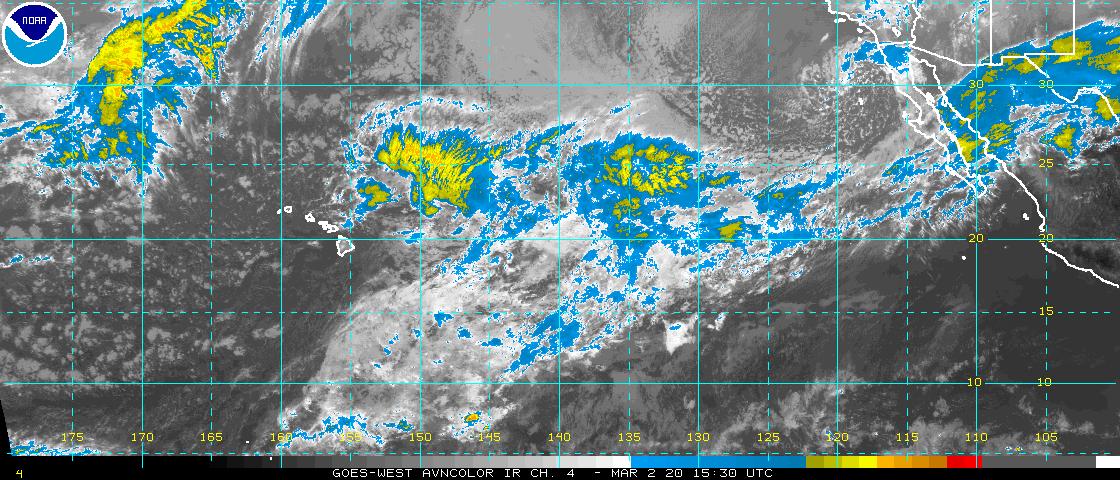
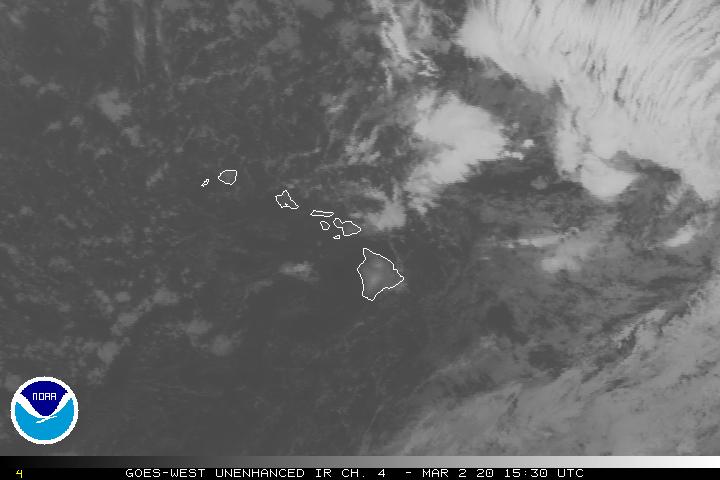
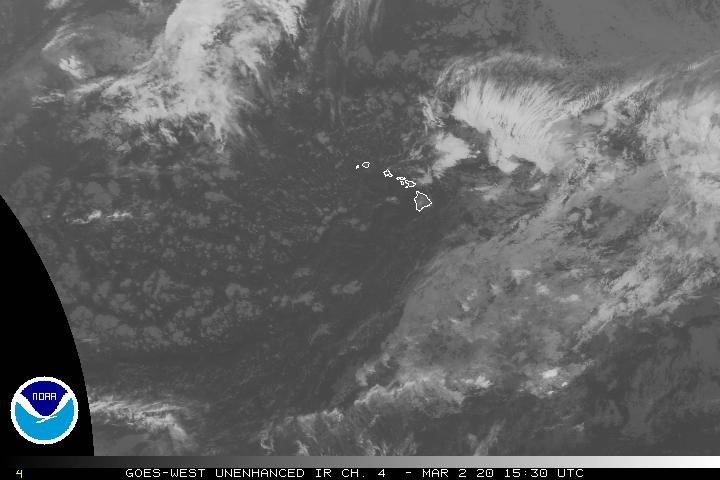
Satellite and Radar Images: To view the cloud conditions we have here in Hawaii, please use the following satellite links, starting off with this Infrared Satellite Image of the islands to see all the clouds around during the day and night. This next image is one that gives close images of the islands only during the daytime hours, and is referred to as a Close-up visible image. This next image shows a larger view of the Pacific…giving perspective to the wider ranging cloud patterns in the Pacific Ocean. Finally, here's a Looping IR satellite image, making viewable the clouds around the islands 24 hours a day. To help you keep track of where any showers may be around the islands, here’s the latest animated radar image.
Hawaii’s Mountains – Here’s a link to the live web cam on the summit of near 14,000 foot Mauna Kea on the Big Island of Hawaii. The tallest peak on the island of Maui is the Haleakala Crater, which is near 10,000 feet in elevation. These two web cams are available during the daylight hours here in the islands…and when there’s a big moon rising just after sunset for an hour or two! Plus, during the nights and early mornings you will be able to see stars, and the sunrise too…depending upon weather conditions.
Tropical Cyclone activity in the eastern and central Pacific – Here’s the latest weather information coming out of the National Hurricane Center, covering the eastern north Pacific. You can find the latest tropical cyclone information for the central north Pacific (where Hawaii is located) by clicking on this link to the Central Pacific Hurricane Center. Here’s a tracking map covering both the eastern and central Pacific Ocean. A satellite image, which shows the entire ocean area between Hawaii and the Mexican coast…can be found here. Of course, as we know, our hurricane season won't end until November 31st here in the central Pacific.
Aloha Paragraphs

Fun underwater…Hawaiian style
Our winds will remain fairly light now through early Wednesday, then become stronger Thursday and Friday…before easing off some again during the weekend. This weather map shows high pressure systems located far to the north-northeast, and far to the northeast of Hawaii Monday night. Our winds generally on the light side today, and will remain that way through Tuesday into early Wednesday. The latest computer model information confirms that the trade winds return later Wednesday into Friday, becoming quite blustery. Those gusty trade winds will ease up some again by the weekend…going into early next week.
Winds around the state are lighter now, with a few exceptions…the following numbers representing the strongest gusts early Monday evening:
22 mph Port Allen, Kauai
16 Kahuku, Oahu
04 Molokai
24 Kahoolawe
25 Maalaea Bay, Maui
10 Lanai Airport
10 Honokaa, Big Island
We'll see some increase in localized showers over the next several days…beginning Wednesday. Here's a satellite image, showing lots of clouds in most directions. We saw clouds gathering over and around the mountains during the afternoons today, with showers falling locally…which may happen again on Tuesday. As we move into mid-week onwards, we'll likely see the windward sides becoming quite wet. If we shift our gaze to a larger satellite view, we can see those whiter and brighter clouds, the high level cirrus, moving over the southern part of state from the west. There are still those pockets of heavier rain out to the east and northeast, out over the ocean at the time of this writing. The models continue to show a trough of low pressure moving towards the state from the east. This in turn should bring in additional moisture to fuel increased showers through much of the rest of this work week…starting Wednesday.
It's Monday evening as I begin writing this last section of this morning's narrative update. The current weather pattern shows that the trade winds are still present across our islands. A trough of low pressure, just to the east of the state at the time of this writing, will migrate towards the Big Island and Maui. This will keep the winds down through Tuesday. At the same time our overlying atmosphere will become less stable, by mid-week, and as a consequence…more shower prone. ~~~ As we get into the middle of the week onwards, we'll see the trough losing its influence, with the trade winds returning with more strength. This would bring showery clouds to our windward sides. This could lead to a period of perhaps two days, around Thursday and Friday, when we would see locally heavy rains on the windward coasts and slopes…perhaps stretching into Saturday.
~~~ Here in Kihei Maui, the clouds that were packed up along the leeward slopes of the Haleakala Crater, are dissipating quickly. There were some good rains up that way, as there were during the afternoon around mountain on Sunday. I expect a clear morning on Tuesday. As the winds will remain light on Tuesday, and with the trough of low pressure moving closer, I would expect more of those upcountry showers again then. As we get into Wednesday, the winds will return into Thursday, and in the process likely drag lots of moisture into towards the windward sides for several days.
~~~ I'll be back early Tuesday morning with your next new weather narrative from paradise. I hope you have a great Monday night until then! Aloha for now…Glenn.
Interesting: Fishing nations agreed on Saturday to a slim reduction in quotas for catching giant Atlantic bluefin tuna, whose stocks have plunged as fishermen strive to meet demand from sushi lovers. Ignoring calls from conservation groups for deep cuts, the International Commission for the Conservation of Atlantic Tunas (ICCAT) said its 48 member states, meeting in Paris, had set a 2011 quota of 12,900 tones, down 600 from this year.
An Atlantic bluefin can grow to the size of a horse and fetch as much as $100,000 in markets such as Japan, but stocks have plunged by more than 80 percent since 1970s, according to western scientists. Environmental groups said the quota fell short of what was needed to sustain healthy stock levels, noting that illegal fishing and under-reporting of catches might mean stock estimates were over-optimistic.
"Greed and mismanagement have taken priority over sustainability and common sense," WWF Mediterranean fisheries head Sergi Tudela said. "This measly quota reduction is insufficient to ensure the recovery of bluefin tuna in the Mediterranean Sea."
The warm-blooded bluefin tuna can weigh up to 1,433 lb and is found in the North Atlantic, the Gulf of Mexico and the Mediterranean, where big commercial fishing operations fatten captured fish in enclosures. France, Italy and Spain catch most of the Atlantic bluefin consumed in the world and 80 percent of the haul goes to Japan. While environmental groups lamented the cut as too little, the fishing industry said it was too much.
Interesting2: Research from the University of Gothenburg (Sweden) shows that people in China — the number one consumers of plastic bags in the world — reduced their consumption of plastic bags by half when stores were forced to charge consumers for the bags. Use of plastic bags is a growing global environmental problem. As a result, the bags are becoming subject to various regulations in an increasing number of countries, with mixed results.
An environmental-economic evaluation of the Chinese ordinance against free plastic bags from June 2008 shows that people in China — the number one consumers of plastic bags in the world — reduced their consumption of plastic bags by half when stores were forced to charge consumers for the bags. 'Our results show that this is an effective policy instrument that can be used to benefit the environment.
But we also found that there is further room for improvement. What's most important is to make sure that the ordinance is complied with,' says Haoran He, who studied the effect of the Chinese ordinance as part of his doctoral thesis in environmental and behavioural economics.
In his thesis, Haoran He refers to several other countries that have implemented similar regulations aimed to reduce the consumption of plastic bags, for example Ireland and South Africa. Yet, he stresses that his study concerns only the effects observed in China.
'A general reflection based on studies in several countries is that if a country wants to reduce the consumption of plastic bags in the long term, it seems like repeated public information campaigns on environmental problems linked to plastic bags are very important,' says He.
The Chinese ordinance allows store owners to price their own plastic bags and then keep the profit. However, the price may not be lower than the acquisition value, which is the equivalent of .10-.60 SEK/bag depending on size and quality. As competition is fierce in China, many stores choose not to comply with the new ordinance. Haoran He says that four months after the implementation of the ordinance, 60 percent of all plastic bags were still given away at no charge.
'One alternative would be for the government to price the shopping bags, convert the fee to a tax and then use the revenues to finance various environmental measures,' says He. His study is based on consumer surveys conducted both before and after the regulation went into force.
A total of 3000 consumers in Beijing and Guiyang responded to questions about their consumption habits and use and re-use of plastic shopping bags. Prior to the ordinance, the subjects used an average of 21 new plastic bags per week. They rarely used the same bag twice. Following the implementation of the ordinance, the consumption of bags was reduced by 49 percent and almost half of them were re-used.
Economists rarely encounter a good chance to compare how much consumers claim to be willing to pay in a certain situation with how they actually end up behaving in the same situation. Haoran He therefore ceased the opportunity to address the question: How reliable is it to base predictions of reactions to environmental regulations on surveys and interviews?
His results suggest a relatively strong link between what the consumers said they would do and what they actually did, so the method seems to be effective at least in the context of everyday consumption items. Ireland is a country that has been remarkably successful at reducing people's consumption of plastic bags.
In 2002 the country implemented a plastic bag tax in combination with long-term informational campaigns. When the Irish consumers were forced to pay 1.50 SEK per bag, they reduced their consumption by an astonishing 90 percent. Since they eventually got used to the price and the consumption consequently went up again, the government increased the price to 2.20 SEK/bag after five years.
This clever move made the consumption fall back to a very low level again. People in Ireland now use about 20 bags per year as compared to 330 bags per year when they were given away for free.
Interesting3: A new 11-country survey from The Commonwealth Fund finds that adults in the United States are far more likely than those in 10 other industrialized nations to go without health care because of costs, have trouble paying medical bills, encounter high medical bills even when insured, and have disputes with their insurers or discover insurance wouldn't pay as they expected. According to the report, the findings highlight the need for Affordable Care Act reforms that will ensure access to health care, protect people from medical debt, and simplify health insurance.
The U.S. stands out for the most negative insurance-related experiences. One third (33%) of U.S. adults went without recommended care, did not see a doctor when sick, or failed to fill prescriptions because of costs, compared to as few as 5 percent to 6 percent in the Netherlands and the U.K., according to the study published as a Health Affairs Web First article.
In addition, one-fifth of U.S. adults had major problems paying medical bills, compared to 9 percent in France, the next highest country, 2 percent in the U.K., 3 percent in Germany, and 4 percent in the Netherlands. Uninsured and insured U.S. adults reported equally high rates of out-of-pocket costs, with one-third (35%) of U.S. adults paying $1,000 or more out-of-pocket in the past year for medical bills, significantly higher than all of the other countries.
The study analyzes findings from the Commonwealth Fund 2010 International Health Policy Survey in Eleven Countries, focusing on insurance and access to health care experiences reported by 19,700 adults from Australia, Canada, France, Germany, the Netherlands, New Zealand, Norway, Sweden, Switzerland, the United Kingdom and the United States. The study reveals widespread disparities by income within the United States.
Lower income U.S. adults were far more likely than those with above average incomes to report difficulty with medical bills and timely access to health care. "We spend far more on health care than any of these countries, but this study highlights pervasive gaps in U.S. health insurance that put families' health and budgets at risk," said Commonwealth Fund Senior Vice President Cathy Schoen, lead author of the article.
"In fact, the U.S. is the only country in the study where having health insurance doesn't guarantee you access to health care or financial protection when you're sick. This is avoidable — other countries have designed their insurance systems to value access and limit out-of-pocket costs."
Interesting4: In a never-ending quest to eliminate human contact with germs, science has given society a number of hygienic chemicals. Among these chemicals are Triclosan, found commonly in anti-bacterial soaps, toothpaste, and many other products, and Bisphenol A (BPA), found in the protective lining of food cans.
A new study from researchers at the University of Michigan (UM) in Ann Arbor suggests that these chemicals may be detrimental to the immune system and cause allergies. Both Triclosan and BPA are classified as endocrine-disrupting compounds. They interfere with the body's natural synthesis, transport, and other processes of hormones.
Researchers from UM used samples from adults in the United States and children over age 6. They compared concentration of these chemicals in the urine with cytomegalovirus antibody levels and diagnosis of allergies or hay fever.
Cytomegalovirus (CMV) antibodies and allergies/hay fever are indicators of alterations of the immune system. "We found that people over age 18 with higher levels of BPA exposure had higher CMV antibody levels, which suggests their cell-mediated immune system may not be functioning properly," said Erin Rees Clayton, research investigator at the U-M School of Public Health and first author on the paper.
They found that children with high levels of triclosan had a higher propensity for allergies and hay fever. This means that overexposing children to antibacterial soap and other "clean" products actually has the opposite effect of making the child sicker.
"The triclosan findings in the younger age groups may support the 'hygiene hypothesis,' which maintains living in very clean and hygienic environments may impact our exposure to micro-organisms that are beneficial for development of the immune system," said Allison Aiello, associate professor at the U-M School of Public Health and principal investigator on the study.
Surprisingly, age played a factor in this study. For example, adults with high levels of BPA also had higher CMV levels, while children under 18 did not. More research needs to be done to establish a definite causal relationship. Are people really sicker from over-using hygienic products? Or do they use these products because they are sicker? Researchers need to study the long-term effects of BPA and Triclosan to see how they affect the immune system.
 Email Glenn James: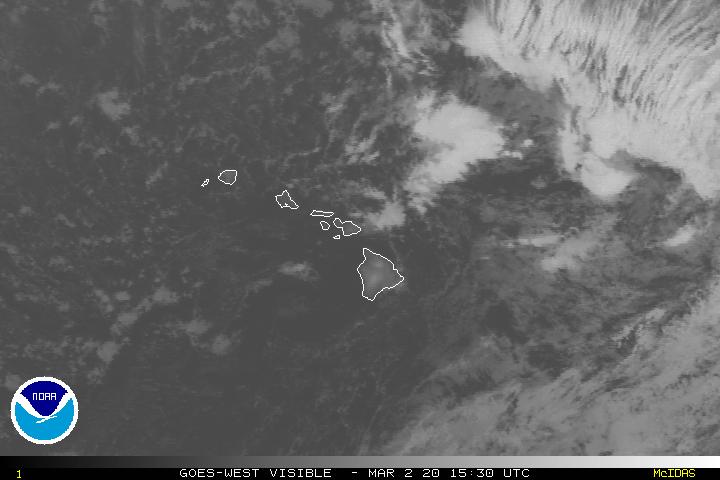


Jean Tappan Says:
Hi Glenn. Are the recent rains helping with the drought of the last couple of years? Things in AK are as expected–snow on the ground, though not much, and colder temps. It is beautiful when you're inside looking out!
Already looking forward to our annual trip next May.
Have a wonderful holiday season!
Jean and Bill Tappan~~~Hi Jean and Bill, good to hear from you way up there in Alaska…with snow on the ground! Yes, the recent rains are turning the grass green again, and taking the edge off the long lasting drought. I’m sure you will be ready for your annual trip to Maui in May, after a cold winter. Thanks for your holiday wishes, and I’m returning warm holiday wishes to you both as well. Aloha, Glenn
margaret ethier Says:
First time back to Maui for 3 years.My husband always used to watch your broadcast around 0745,.But can't find it now.
Are you still on TV ? if so what station what time.?
Margaret Ethier~~~Hello Margaret, welcome back to Maui. I ended my TV show, after 18+ years about two years ago. Sorry, I know it was fun to watch, and fun for me to do as well. As you know, I’m still doing this website though, which offers about the same type of information, only without my having to drive so much to get to the studio. I hope you and your husband have a great vacation this time around! Aloha, Glenn