











November 23-24, 2010
Air Temperatures – The following maximum temperatures were recorded across the state of Hawaii Tuesday afternoon:
Lihue airport, Kauai – 79
Honolulu airport, Oahu – 86
Kaneohe, Oahu – 81
Molokai airport – 83
Kahului airport, Maui – 84
Kona airport – 83
Hilo airport, Hawaii – 82
Air Temperatures ranged between these warmest and coolest spots near sea level – and on the highest mountain tops…as of 5pm Tuesday evening:
Port Allen, Kauai – 82F
Hana, Maui – 75
Haleakala Crater – 46 (near 10,000 feet on Maui)
Mauna Kea summit – 34 (near 14,000 feet on the Big Island)
Precipitation Totals – The following numbers represent the largest precipitation totals (inches) during the last 24 hours on each of the major islands, as of Tuesday afternoon:
0.05 Mount Waialeale, Kauai
0.08 Wilson Tunnel, Oahu
0.10 Molokai
0.00 Lanai
0.24 Kahoolawe
0.28 Puu Kukui, Maui
0.93 Kapapala Ranch, Big Island
Marine Winds – Here’s the latest (automatically updated) weather map showing a strong 1036 millibar high pressure system far to our north-northeast of the Hawaiian Islands. Our trade winds will strengthen into Thursday.
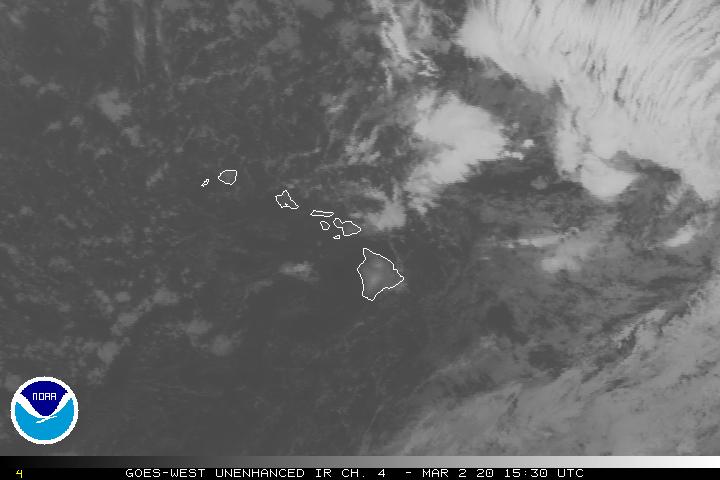
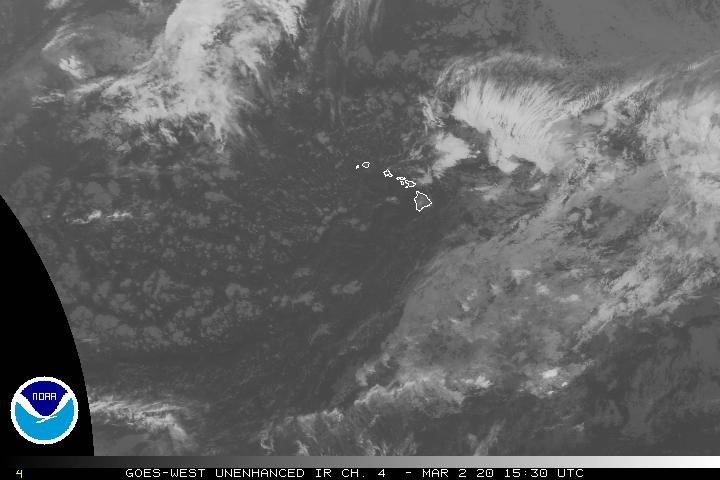
Satellite and Radar Images: To view the cloud conditions we have here in Hawaii, please use the following satellite links, starting off with this Infrared Satellite Image of the islands to see all the clouds around during the day and night. This next image is one that gives close images of the islands only during the daytime hours, and is referred to as a Close-up visible image. This next image shows a larger view of the Pacific…giving perspective to the wider ranging cloud patterns in the Pacific Ocean. Finally, here's a Looping IR satellite image, making viewable the clouds around the islands 24 hours a day. To help you keep track of where any showers may be around the islands, here’s the latest animated radar image.
Hawaii’s Mountains – Here’s a link to the live webcam on the summit of near 14,000 foot Mauna Kea on the Big Island of Hawaii. The tallest peak on the island of Maui is the Haleakala Crater, which is near 10,000 feet in elevation. These two webcams are available during the daylight hours here in the islands…and when there’s a big moon rising just after sunset for an hour or two! Plus, during the nights and early mornings you will be able to see stars, and the sunrise too…depending upon weather conditions.
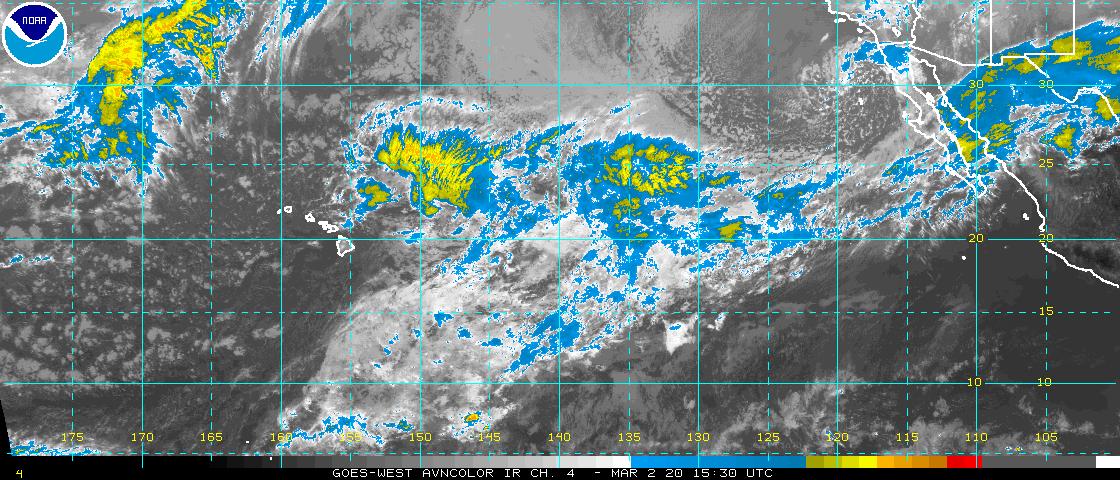
Tropical Cyclone activity in the eastern and central Pacific – Here’s the latest weather information coming out of the National Hurricane Center, covering the eastern north Pacific. You can find the latest tropical cyclone information for the central north Pacific (where Hawaii is located) by clicking on this link to the Central Pacific Hurricane Center. Here’s a tracking map covering both the eastern and central Pacific Ocean. A satellite image, which shows the entire ocean area between Hawaii and the Mexican coast…can be found here. Of course, as we know, our hurricane season won't end until November 31st here in the central Pacific.
Aloha Paragraphs

Strong and gusty trade winds…picking up over the next few days
As we pull out of our recent light wind regime, we’ll integrate back into a stronger trade wind flow…over the next several days. This weather map shows a strong 1036 millibar high pressure system located to the north-northeast of Hawaii Tuesday night. The trough of low pressure, which was out to our east yesterday, that blocked the trade winds…is now gone. This opens the flood gates to quickening trade winds, which are expected to gain quite a bit of strength going forward. We typically gauge these winds by whether or not the NWS forecast office in Honolulu, issues small craft wind advisories…or not.
Already there is a new advisory starting as of Wednesday morning in the coastal and channel waters of Maui and the Big Island…lasting through Friday. Then, if things go according to plan, those could stretch up to the northwest, over the rest of the island chain later this week. Our blustery winds will remain in force through the rest of this work week…although will begin to back down later this coming weekend. As we move into early next week, the winds are expected to back way down again…as a trough of low pressure approaches from the northwest.
Winds around the state are picking up now…with the following numbers representing the strongest gusts at early Tuesday evening:
15 mph Waimea Heights, Kauai
20 Oahu Forest NWR, Oahu
23 Molokai
28 Kahoolawe
31 Maalaea Bay, Maui
14 Lanai Airport
26 Kealakomo, Big Island
Skies remain generally quite clear at the time of this writing, although they are expected to cloud up as we move into Wednesday…especially along the windward coasts and slopes. Here's a satellite image, showing generally clear skies, with clouds starting to gather upwind of all the islands. We will see some increase in showers over the next several days. If we shift our gaze to a larger satellite view, we can see those whiter and brighter clouds, the high and middle level ones, located far to the northand south of the islands. Those bolder looking clouds to our northwest, are the ragged leading edge of a cold front…which isn’t expected to make it down any closer to the islands.
In sum, the trade winds will be on the increase, perhaps we could go so far as to say they will surge…into the strong and gusty realms over the next several days. At the same time, our dry conditions will moisten up, especially along our windward coasts and slopes. This will be prompted by the additional moisture being carried our way on the strengthening trade winds. Those showers will be enhanced by the cold air aloft, although generally on the Big Island end of the chain. Speaking of that cold air, associated with an upper level trough of low pressure to the east of Hawaii, it may trigger some generous showers at times. Given the remote nature of the Big Island, those heavy showers may fall over unpopulated areas…limiting their flood producing capabilities. Drier air arriving this weekend will cut back on the windward showers, into early next week.
It's Tuesday evening as I begin writing this last section of today's narrative update. That is the long and short of the latest weather news. I'm about ready to take the drive back upcountry to Kula, Maui. It's getting dark so early these days, I have to turn my car lights on before even leaving my office here in Kihei. By the time I get home, it's practically dark, although I must say, I enjoy this time of year. The sunrise is so late these day too, which again, doesn't bother me in the least. It will be interesting to see this surge of fresh trade winds arriving soon, and the added moisture that it will bring to our windward sides too. I love it all, can't get enough of these daily weather changes! I'll be back early Wednesday morning with your next new weather narrative, I hope you have a great Tuesday night until then! Aloha for now…Glenn.
Extra: We just had a fairly substantial earthquake here on Maui, and I'm sure in other areas of the islands too! It knocked over several things in my office. I was just starting to make dinner, and as soon as it started I knew it was pretty intense, so ran outside immediately. The house I live in was making all this noise, as it was being jostled around. I'll try and find out the magnitude and let you know in a few minutes. I think I just felt a second aftershock about 15 minutes after the first…although it could have been my nerves! 4.6 on the Richter scale was the number on the original shaker, occurred near the small island of Kahoolawe…just offshore from south Maui.
Interesting: Five related species of tree-dwelling snakes found in Southeast and South Asia may just be the worst nightmares of ophidiophobes (people who have abnormal fears of snakes). Not only are they snakes, but they can "fly" — flinging themselves off their perches, flattening their bodies, and gliding from tree to tree or to the ground.
To Virginia Tech biologist Jake Socha, these curious reptiles are something of a bio-mechanical wonder. In order to understand how they do what they do, Socha and his colleagues recently studied Chrysopelea paradisi snakes as they launched themselves off a branch at the top of a 15-meter-tall tower. Four cameras recorded the curious snakes as they glided.
This allowed them to create and analyze 3-D reconstructions of the animals' body positions during flight — work that Socha recently presented at the American Physical Society Division of Fluid Dynamics (DFD) meeting in Long Beach, CA. The reconstructions were coupled with an analytical model of gliding dynamics and the forces acting on the snakes' bodies.
The analyzes revealed that the reptiles, despite traveling up to 24 meters from the launch platform, never achieved an "equilibrium gliding" state — one in which the forces generated by their undulating bodies exactly counteract the force pulling the animals down, causing them to move with constant velocity, at a constant angle from the horizon.
Nor did the snakes simply drop to the ground. Instead, Socha says, "the snake is pushed upward — even though it is moving downward — because the upward component of the aerodynamic force is greater than the snake's weight."
"Hypothetically, this means that if the snake continued on like this, it would eventually be moving upward in the air — quite an impressive feat for a snake," he says. But our modeling suggests that the effect is only temporary, and eventually "the snake hits the ground to end the glide."
Interesting2: Carbon emissions at sea have received more attention over the last decade. Ports, especially, can have a negative impact on air quality in the populated areas that surround them. The many emissions sources at ports include ships, trucks, trains, and cargo-handling equipment. Harbor-crafts also contribute a significant portion of total port emissions.
These include tugboats, ferries, fishing boats, and dredge vessels. Recently, the Ports of Los Angeles and Long Beach have started using a hybrid electric tugboat. A new study by the University of California (UC) Riverside has shown that this has been effective at reducing emissions. Tugboats are typically powered by marine compression ignition engines.
The engines are built to be extremely powerful relative to the size of the vessel. Larger tugboats used in deeper waters have power ratings up to 27,000 horse power. They can have a power/tonnage ratio of up to 4.5, similar to engines used in locomotives. These engines typically drive the propellers mechanically rather than converting the output through electric motors, as is done on trains. The massive engines can consume large amounts of fuel and produce harmful emissions full of diesel particulates.
This has made the Ports of Los Angeles and Long Beach the largest contributors of air pollution in the South Coast Basin according to the California Air Resources Board (CARB). Pollution from the diesel-powered tugboats and other port emission sources has caused negative health effects on the surrounding population, including cancer and respiratory illnesses.
Now the Ports of Los Angeles and Long Beach, the largest container ports in the nation, are home to the first and only hybrid electric tugboat in the world. Named the Carolyn Dorothy, it runs on four diesel engines and 126 batteries. It was financed by the two ports and the South Coast Air Quality Management District to the tune of $1.35 million.
The vessel was built by Foss Maritime, based in Seattle, and began operational duty in January of 2009. Researchers from UC Riverside's College of Engineering Center for Environmental Research and Technology conducted a study to see how much emissions the new hybrid tugboat saved. They found it decreased emissions of soot by 73 percent, nitrogen oxides (smog forming compounds) by 51 percent, and CO2 (greenhouse gas) by 27 percent.
Their report was completed in October of 2010 and presented to CARB. The widespread adoption of hybrid marine engines would go a long way in reducing emissions at sea and in port. However, it comes with a very expensive price tag, and technical issues resulting in inefficiencies still remain. The UC Riverside researchers are hopeful that there will be further improvements once plug-in hybrid tugboats become available.
Interesting3: Air pollution in major cities in Asia exceeds the World Health Organization's (WHO) air quality guidelines and toxic cocktails result in more than 530,000 premature deaths a year, according to a new report issued on Tuesday. Issued by the U.S.-based Health Effects Institute, the study found that elderly people with cardiopulmonary and other chronic illnesses were especially vulnerable and they tended to die prematurely when their conditions were exacerbated by bad air.
"In general, those susceptible to air pollution are people who are older, who have cardiopulmonary disease, stroke, conditions often related to aging," the institute's vice president, Robert O'Keefe, said by telephone. "In Asia, the elderly will become more susceptible to air pollution and become more frail. The more frail are the ones dying prematurely from COPD (chronic obstructive pulmonary disease), cardiovascular disease," he said.
The study took into account three main pollutants — particulate matter of 10 micrometers and smaller, nitrogen dioxide and sulphur dioxide. Not a single city in Asia had all three pollutants within limits considered acceptable by the World Health Organization. Although sulphur dioxide and nitrogen dioxide in Dhaka were within safety limits, particulates in the capital of Bangladesh were more than five times over WHO guidelines.
Interesting4: Current state-of-the-art global climate models predict substantial warming in response to increases in greenhouse gases such as carbon dioxide. The models, though, disagree widely in the magnitude of the warming we can expect. The disagreement among models is mainly due to the different representation of clouds.
Some models predict that global mean cloud cover will increase in a warmer climate and the increased reflection of solar radiation will limit the predicted global warming. Other models predict reduced cloudiness and magnified warming.
In a paper that has just appeared in the Journal of Climate, researchers from the University of Hawaii Manoa (UHM) have assessed the performance of current global models in simulating clouds and have presented a new approach to determining the expected cloud feedbacks in a warmer climate.
Lead author Axel Lauer at the International Pacific Research Center (IPRC) at UHM notes, "All the global climate models we analyzed have serious deficiencies in simulating the properties of clouds in present-day climate. It is unfortunate that the global models' greatest weakness may be in the one aspect that is most critical for predicting the magnitude of global warming."
To study the clouds, the researchers applied a model representing only a limited region of the atmosphere over the eastern Pacific Ocean and adjacent land areas. The clouds in this region are known to greatly influence present climate, yet current global models do poorly in representing them.
The regional model, developed at the IPRC, successfully simulates key features of the region's present-day cloud fields, including the observed response of clouds to El Nino. Having evaluated the model's simulation of present-day conditions, the researchers examined the response of simulated clouds in a warmer climate such as it might be in 100 years from now.
The tendency for clouds to thin and cloud cover to reduce was more pronounced in this model than in any of the current global models. Co-author Kevin Hamilton concludes, "If our model results prove to be representative of the real global climate, then climate is actually more sensitive to perturbations by greenhouse gases than current global models predict, and even the highest warming predictions would underestimate the real change we could see."
Interesting5: In the first comprehensive global survey of temperature trends in major lakes, NASA researchers determined Earth's largest lakes have warmed during the past 25 years in response to climate change. Researchers Philipp Schneider and Simon Hook of NASA's Jet Propulsion Laboratory in Pasadena, Calif., used satellite data to measure the surface temperatures of 167 large lakes worldwide.
They reported an average warming rate of 0.81 degrees Fahrenheit per decade, with some lakes warming as much as 1.8 degrees Fahrenheit per decade. The warming trend was global, and the greatest increases were in the mid- to high-latitudes of the Northern Hemisphere. "Our analysis provides a new, independent data source for assessing the impact of climate change over land around the world," said Schneider, lead author of the study published this week in the journal Geophysical Research Letters.
"The results have implications for lake ecosystems, which can be adversely affected by even small water temperature changes." Small changes in water temperature can result in algal blooms that can make a lake toxic to fish or result in the introduction of non-native species that change the lake's natural ecosystem. Scientists have long used air temperature measurements taken near Earth's surface to compute warming trends.
More recently, scientists have supplemented these measurements with thermal infrared satellite data that can be used to provide a comprehensive, accurate view of how surface temperatures are changing worldwide. The NASA researchers used thermal infrared imagery from National Oceanic and Atmospheric Administration and European Space Agency satellites.
They focused on summer temperatures (July to September in the Northern Hemisphere and January to March in the Southern Hemisphere) because of the difficulty in collecting data in seasons when lakes are ice-covered and/or often hidden by clouds. Only nighttime data were used in the study. The bodies studied were selected from a global database of lakes and wetlands based on size (typically at least 193 square miles – or larger) or other unique characteristics of scientific merit.
The selected lakes also had to have large surface areas located away from shorelines, so land influences did not interfere with the measurements. Satellite lake data were collected from the point farthest from any shoreline. The largest and most consistent area of warming was northern Europe. The warming trend was slightly weaker in southeastern Europe, around the Black and Caspian seas and Kazakhstan.
The trends increased slightly farther east in Siberia, Mongolia and northern China. In North America, trends were slightly higher in the southwest United States than in the Great Lakes region. Warming was weaker in the tropics and in the mid-latitudes of the Southern Hemisphere. The results were consistent with the expected changes associated with global warming.
The satellite temperature trends largely agreed with trends measured by nine buoys in the Great Lakes, Earth's largest group of freshwater lakes in terms of total surface area and volume. The lake temperature trends were also in agreement with independent surface air temperature data from NASA's Goddard Institute for Space Studies in New York. In certain regions, such as the Great Lakes and northern Europe, water bodies appear to be warming more quickly than surrounding air temperature.
 Email Glenn James: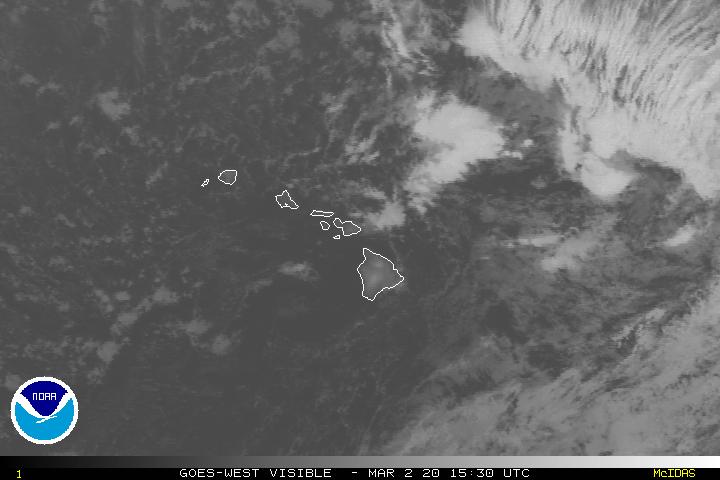


Karin Says:
Aloha Glenn-Wasn't your nerves-I live in Kihei and felt earthquake at 6:34 PM and then a second twitch at 6:51 PM-things rattled a bit but nothing damaged. Read your website everyday and really appreciate great job you do keeping us informed about Maui weather. Mahalo, Karin~~~Hi Karin, yes, that was an interesting evening of quaking. I woke up again over night to a very slight moving, which woke me up. Thank you so much for your positive feedback! Aloha, Glenn