











November 18-19, 2010
Air Temperatures – The following maximum temperatures were recorded across the state of Hawaii Thursday afternoon:
Lihue airport, Kauai – 79
Honolulu airport, Oahu – 81
Kaneohe, Oahu – 84
Molokai airport – 82
Kahului airport, Maui – 84
Kona airport – 83
Hilo airport, Hawaii – 82
Air Temperatures ranged between these warmest and coolest spots near sea level – and on the highest mountain tops…as of 5pm Thursday evening:
Port Allen, Kauai – 81F
Hana, Maui – 75
Haleakala Crater – 46 (near 10,000 feet on Maui)
Mauna Kea summit – 34 (near 14,000 feet on the Big Island)
Precipitation Totals – The following numbers represent the largest precipitation totals (inches) during the last 24 hours on each of the major islands, as of Thursday afternoon:
1.49 Kalaheo, Kauai
0.13 Wilson Tunnel, Oahu
0.00 Molokai
0.00 Lanai
0.00 Kahoolawe
0.00 Maui
0.20 Saddle Quarry, Big Island
Marine Winds – Here’s the latest (automatically updated) weather map showing a weak 1019 millibar high pressure system to the northeast of our islands. Our local winds will remain generally light, from the southwest to southeast directions…through Friday into Saturday.
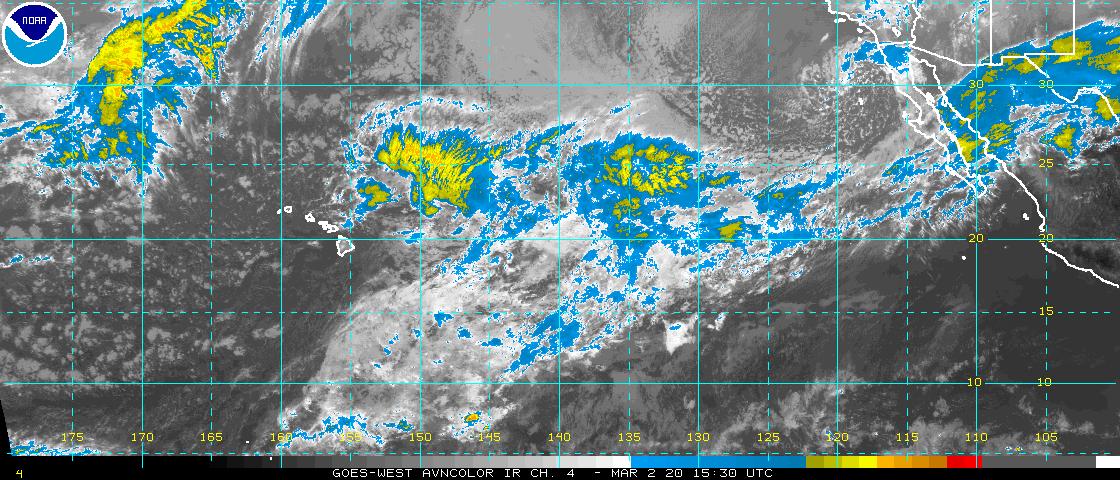
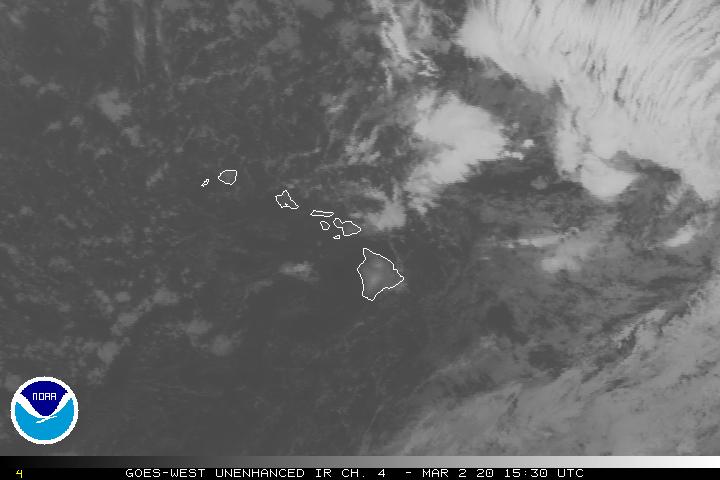
Satellite and Radar Images: To view the cloud conditions we have here in Hawaii, please use the following satellite links, starting off with this Infrared Satellite Image of the islands to see all the clouds around during the day and night. This next image is one that gives close images of the islands only during the daytime hours, and is referred to as a Close-up visible image. This next image shows a larger view of the Pacific…giving perspective to the wider ranging cloud patterns in the Pacific Ocean. Finally, here's a Looping IR satellite image, making viewable the clouds around the islands 24 hours a day. To help you keep track of where any showers may be around the islands, here’s the latest animated radar image.
Hawaii’s Mountains – Here’s a link to the live webcam on the summit of near 14,000 foot Mauna Kea on the Big Island of Hawaii. The tallest peak on the island of Maui is the Haleakala Crater, which is near 10,000 feet in elevation. These two webcams are available during the daylight hours here in the islands…and when there’s a big moon rising just after sunset for an hour or two! Plus, during the nights and early mornings you will be able to see stars, and the sunrise too…depending upon weather conditions.
Tropical Cyclone activity in the eastern and central Pacific – Here’s the latest weather information coming out of the National Hurricane Center, covering the eastern north Pacific. You can find the latest tropical cyclone information for the central north Pacific (where Hawaii is located) by clicking on this link to the Central Pacific Hurricane Center. Here’s a tracking map covering both the eastern and central Pacific Ocean. A satellite image, which shows the entire ocean area between Hawaii and the Mexican coast…can be found here. Of course, as we know, our hurricane season won't end until November 31st here in the central Pacific.
Aloha Paragraphs

Approaching heavy rainfall…localized downpours
Flash flood watch for all islands
Artist…Robert Donaghey
Winds will remain on the light side through most of the rest of this week, perhaps approaching almost moderately strong in a few gusts…especially around any active thunderstorm cells. This weather map shows a weakening 1019 millibar high pressure system being pushed eastward, located far east-northeast of the islands Thursday night. At the same time, we see two far away low pressure systems near the International Dateline, with their associated cold fronts to our northwest and west. Our winds will remain generally light as the cold front and associated trough behind it…crawls through our islands into Friday. The computer models have now latched onto the fact that the trade winds could return later this weekend…or by early next week, perhaps even becoming moderately strong into the mid-week period.
Winds around the state remain generally light now…with the following numbers representing the strongest gusts Thursday evening:
16 mph Port Allen, Kauai
15 Waianae, Oahu
06 Molokai
18 Kahoolawe
23 Maalaea, Maui
07 Lanai Airport
10 Hilo, Big Island
An area of rainy clouds, some of which looks heavy to very heavy, are congregating near Kauai and Oahu…and to the west and north from there. Here's the big picture, showing the tail-end of this cold front and associated trough, digging down from the north Pacific. There are definitely thunderstorms in this mix, which look likely to do some fairly serious business here in the islands over the next day or two. A closer look at this situation shows up well, shifting over to this tighter view. At the time of this writing, here are showers edging towards, or over the islands of Kauai and Oahu. This looping radar image shows heavy rain pushing deeper into the state. These intense prefrontal showers will arrive over Oahu soon, while the precipitation heading towards Kauai…is almost there. At the end of the day, we’re going to find locally heavy rain falling first on Kauai and Oahu…with the chance of thunderstorms into Friday. The other islands will have to wait a while before this precipitation arrives, probably at some point late Thursday night or Friday.
These unsettled circumstances will prevail through Friday, and perhaps even into Saturday morning…before conditions improve later Saturday into Sunday. The trough of low pressure that is bringing the instability with it, and the associated thunderstorms, should be moving away by the weekend. At the same time, our winds will begin to veer back around to the easterly trade wind direction. This typically puts an end to the inclement weather conditions, or at least it will this time around…probably. The computer models have been back and forth with the trades returning, and then again not. If in fact the trade winds do return, we should see whatever showers that are left in the wake of the departing front/trough, migrating back over towards the windward sides Sunday into early next week. This is the time of year however, that the trade winds don’t hold sway for very long, with another cold front, or some sort of other “weather maker”…likely not too far behind.
It's Thursday evening as I begin writing this last section of today's narrative update. As noted above, we have an area of unsettled weather moving into the Aloha state now. This area of rainfall, some of which will be locally heavy, has been looming just to the west of Kauai recently. Oahu can expect increasing clouds, with showers. There are embedded cumulonimbus clouds, or thunderstorms not far to the west and north of Kauai as well. These will lead to localized flooding when they arrive…thus the NWS office in Honolulu has extended the flood watch for all the islands into Friday. This area of precipitation will gradually work its way down towards Maui and the Big Island later tonight into Friday. It this inclement weather pattern develops to its full capacity, we could see the flash flood watch, upgraded into a flash flood warning…please be careful when out driving around!
~~~ Here in Kihei, Maui, at 515pm, everything seems to be setting up in such a way, that we're going to see lots of precipitation falling from our overlying clouds. This looping radar image, that I posted above, will keep us in touch with where the heaviest stuff is occurring. I'll be back again early Friday morning with your next new weather narrative, and I'm sure there will be lots more to be talking about then, in reference to the heavy rain taking aim on our islands! One final note, as I was driving back upcountry, it was just light enough for me to see what looked like some volcanic haze starting to arrive. As I got back into Kula, I ran into thick fog, which made for a nice walk once I got home. I hope you have a great Thursday night until we reconnect in the morning. Aloha for now…Glenn.
Interesting: Scientists have mapped a previously unknown and active seismic fault in the northern Rockies capable of unleashing an earthquake with a magnitude as high as 7.5. The newly discovered fault in central Idaho does not lie in a densely populated area.
But Glenn Thackray, chairman of Idaho State University's geosciences department, said the 40-mile-long fracture in the Earth's crust at the base of the Sawtooth Mountains near the tiny mountain town of Stanley is cause for some concern.
"There's a chance in the next few decades there will be an earthquake on this fault, and if it does happen it will be a rather large earthquake," he said. A 7.5 tremor is considered a major earthquake, capable of widespread heavy damage.
Laser-equipped airplanes
Such a temblor would be most keenly felt at an epicenter near Stanley, home to about 100 year-round residents, with moderate shaking expected to extend from the resort community of Sun Valley to the capital city of Boise, Thackray said.
Scientists located the fault with a remote sensing technique that relies on laser-equipped airplanes. They were able to gather data about its history by analyzing sediment cores lifted from Redfish Lake, a mountain lake on the fault line famous for its historic sockeye salmon runs.
Thackray said researchers believe the fault triggered two earthquakes over the past 10,000 years, one some 7,000 years ago and another 4,000 years ago, suggesting significant seismic activity occurs at the site every several thousand years.
"Predicting when a fault might rupture is a real uncertainty of science," he said. "The problems with earthquakes and faults are they don't follow reliable patterns." Given the findings, it may be prudent for towns like Stanley to revamp building codes and emergency preparedness plans, Thackray said.
A fault at Idaho's tallest mountain caused a 6.9 magnitude earthquake in 1983. The Borah Peak earthquake killed two children when a storefront collapsed in the central Idaho town of Challis and damaged buildings within a 50-mile radius. Other active faults in central Idaho lie in the Beaverhead, Lemhi and Lost River mountain ranges.
Interesting2: In the headlines lately has been news of China's monopoly of rare earth elements (REE), adding to China's growing clout. It would increase their leverage should they choose to reduce exports, causing REE prices to soar. The United States imports almost all of its REE from China, putting it in a position of geopolitical weakness.
In light of this circumstance, the US Geological Survey (USGS) has conducted a study to map out the presence of REE found domestically. It turns out that rare earth elements in the United States are not so rare.
Rare earth elements are a group of 17 metallic elements that are essential for high technology applications. They all have unique electrical, optical, and thermal properties that distinguish them from more common minerals. REE are composed of Scandium (#21 on the periodic table, Yttrium #39), and lanthanides (#57-71) which include Lanthanum, Promethium, and Europium.
Since most people are not geologists or high-tech engineers, these elements are unfamiliar. Yet without them, many of our current technologies would not exist, such as lasers, color TVs, certain computer components and batteries, and long-distance fiber optic cables.
Newer technologies that require them include electric vehicles and photo-voltaic cells. Rare earth elements are found commonly throughout the Earth's crust, but rarely in economically recoverable concentrations. They are often found in hard-rock deposits.
The USGS study analyzed these deposits as well as placer and phosphorite deposits. They estimate that the United States holds about 13 million metric tons of REE within its borders. At a consumption rate of about 10,000 metric tons annually, these deposits can potentially meet demands for 1,300 years barring any changes.
"This is the first detailed assessment of rare earth elements for the entire nation, describing deposits throughout the United States," commented USGS Director Marcia McNutt, Ph.D. "It will be very important, both to policy-makers and industry, and it reinforces the value of our efforts to maintain accurate, independent information on our nation's natural resources."
The USGS found significant deposits in the following 14 states:
Northeast: New York
Southeast: North Carolina, South Carolina, Georgia, Florida
Midwest: Illinois, Missouri, Nebraska
West: New Mexico, Colorado, Wyoming, Idaho, California, Alaska
The largest deposits were found at Mountain Pass, California; Bokan Mountain, Alaska; and Bear Lodge Mountains, Wyoming. The Mountain Pass REE mine previously supplied the US but it closed down in 2002, due to cheaper REE prices from China and environmental restrictions. In 2008, it was sold by Chevron to Molycorp Minerals LLC which plans to reopen it in 2011.
Now that China's hold on the REE market is clear, the US and other countries such as Australia and Canada are exploring their own reserves. Development of domestic supplies could help meet increasing demands and shield industry from potential cuts in Chinese exports.
In this sense, rare earth elements have become a national security issue. It should then come as no surprise that the USGS study was funded by the US Department of Defense. Thanks to this study, domestic users of REE should feel a little more comfortable to know that they are not completely dependent on overseas supplies.
Interesting3: The accidental discovery of an Ice Age fossil site in Colorado last month is "one of those once-in-a-lifetime finds," the chief curator at the Denver Museum of Nature and Science said today. "Not only will it completely shape our understanding of life in the Rockies during the Ice Age, but it will become forever iconic for the kids of Colorado," said curator Kirk Johnson, as quoted by the Denver Post.
Heavy equipment operators digging a reservoir in Snowmass, Colorado, unearthed a mastodon tusk on October 14. The find prompted a salvage excavation that unearthed hundreds of well-preserved specimens before the operation was shut down for the winter on November 2.
So far, scientists have identified eight to 10 American mastodons, four mammoths, four Columbian mammoths, two Ice Age deer, and four Ice Age bison from the hoard. Start of sidebar. Skip to end of sidebar. End of sidebar. Return to start of sidebar. They also found one Jefferson's ground sloth – the first ever found in Colorado – and a piece of wood with bite marks that provides evidence of Ice Age beavers.
Daniel Fisher, a mastodon expert from the University of Michigan and consultant to the Snowmass excavation told the paper that the high-altitude setting of the site – 2704m – is underrepresented in the Ice Age fossil record.
"There have been suggestions that high-altitude environments might have harbored different communities, or had a different story of change, but since fossils representing them are so rarely found, no one has known for sure," Professor Fisher said. "Now is our chance to see what they are like."
Initial radiocarbon dating showed that the site is more than 43,500 years old, but geologists estimate the site could be as old as 130,000 years, the newspaper said. Further testing should yield a more specific time frame.
Interesting4: Hungry polar bears gathering along the tundra, twice as many record-breaking temperatures and stronger hurricanes are among the latest signs of climate change, scientists say. And we can expect more rain, more drought and fiercer storms in the future if the world continues on its fossil-fuel gobbling track, they said yesterday, discussing the year in global warming.
Michael Mann, a leading US scientist, said he just returned from a trip to Churchill, Manitoba, the Canadian shore town famous for its polar bears, where the sea ice they depend on for hunting seals has not yet formed because of warm temperatures.
"When you go up there you see the bears all along the coast on the tundra awaiting the sea ice to form and it hasn't formed yet," Mr Mann said. "This was for me a very tangible and personal opportunity to see the impacts of climate change firsthand," he said. "The Arctic is in many respects a harbinger of things to come on our planet."
Mr Mann also pointed to research being presented on Capitol Hill by another climate scientist, Jerry Meehl of National Center for Atmospheric Research (NCAR), showing the number of record-breaking hot days is twice as high as the record cold days. "Heat records are outpacing cold records at a factor of two to one now.
That number is expected to increase to 20 to one by late this century if we continue on the course that we are on with fossil fuel burning," Mr Mann said. Some events, such as the 2003 European heat wave which killed about 35,000 people and this year's heat wave in Moscow would be "extremely unlikely to happen in the absence of climate change," he said.
Hurricane expert Greg Holland said the fiercest storms are already showing an uptick in frequency, and more powerful hurricanes lie ahead. "If you just look at the Atlantic in the last 10 years, we have experienced three times as many Category 5 hurricanes as have occurred in previous history on a relative basis," he said.
"We now have consensus statements coming out from the scientists and indeed a lot of regional research is pointing all in the same direction. There is nothing going in the other direction." "And that is the very intense hurricanes, the very intense (Category) fours and fives are going to increase and they could be doubling or tripling." Mr Holland also predicted more rain and drought in the coming years.
"As the earth warms up the atmosphere can hold more water, if there is more water available there will be more rain. Paradoxically of course there is as a result of that more drought because the land dries out quicker." According to Mark Serreze of the National Snow and Ice Data Center, the reduction of sea ice in the Arctic will have a growing impact on temperatures in the rest of the world.
"What we have seen is a rather pronounced reduction in the extent of sea ice. At the end of summer now we have 40 per cent less sea ice than we had say during the 1970s," Mr Serreze said. "We are losing that insulator so what we are seeing now are big fluxes in heat from the ocean to the atmosphere," he said.
"Since everything is connected together in the climate system what happens up there can influence what happens down here and I am talking about in the middle latitudes." The other thing that the scientists said is changing, along with climate, is how they confront skeptics who question the reality of climate change and the extent of humans' role in causing it.
"There are still many of us who like to sit in our office or go into the field and just do our science and not enter into the fray, but I think that is changing," said Mr Serreze. "We have to become more involved," he said. "We have to become better communicators.
Scientists are not always good communicators of the issues but this is part of a learning curve and we have got to face that." Mr Mann, a Nobel-Prize winning scientist who was cleared of allegations of misconduct this year stemming from a series of leaked emails between scientists about climate change, said he too has learned from his experiences.
"One lesson is that if you're a climate scientist and you are willing to play a prominent role in the public discourse on climate change then you'd better have a thick skin," he said.
 Email Glenn James: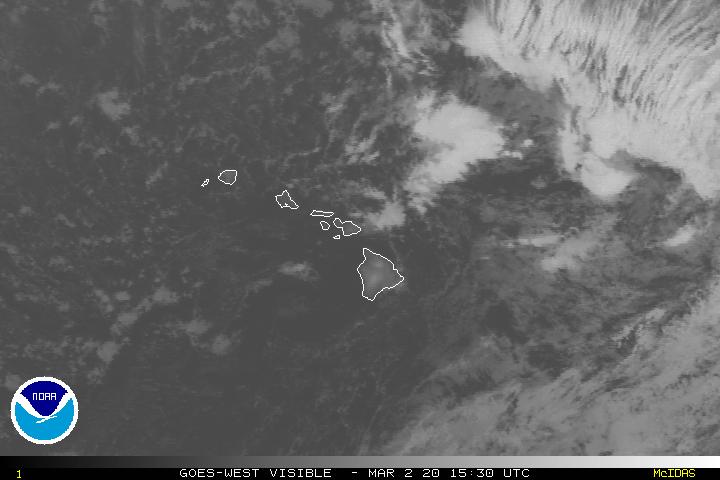


Skip Says:
Hi Glenn…
Nice rain event above Keokea last night. And, it's still coming! Hooray!
You were right on the money!
Aloha, Skip~~~Hi Skip, right…some interesting weather! Aloha, Glenn