











November 15-16, 2010
Air Temperatures – The following maximum temperatures were recorded across the state of Hawaii Monday afternoon:
Lihue airport, Kauai – 80
Honolulu airport, Oahu – 84
Kaneohe MCAS, Oahu – 81
Molokai airport – 84
Kahului airport, Maui – 85
Kona airport – 86
Hilo airport, Hawaii – 73
Air Temperatures ranged between these warmest and coolest spots near sea level – and on the highest mountain tops…as of 5pm Monday evening:
Kailua-kona – 84F
Hilo, Hawaii – 74
Haleakala Crater – 48 (near 10,000 feet on Maui)
Mauna Kea summit – 36 (near 14,000 feet on the Big Island)
Precipitation Totals – The following numbers represent the largest precipitation totals (inches) during the last 24 hours on each of the major islands, as of Monday afternoon:
2.28 Mount Waialeale, Kauai
2.04 Moanalua RG, Oahu
0.07 Molokai
0.00 Lanai
0.00 Kahoolawe
0.75 West Wailuaiki, Maui
2.65 Glenwood, Big Island
Marine Winds – Here’s the latest (automatically updated) weather map showing a still rather strong 1038 millibar high pressure system far to the northeast of our islands, with a ridge extending southwest…to the north and northwest of Hawaii. Our local winds will remain moderately strong…easing up quickly into Wednesday.
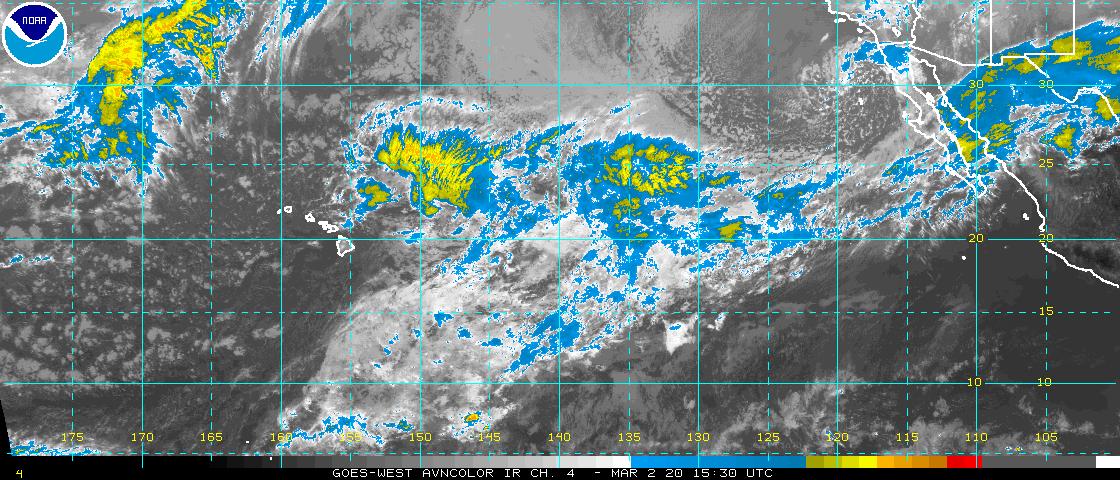
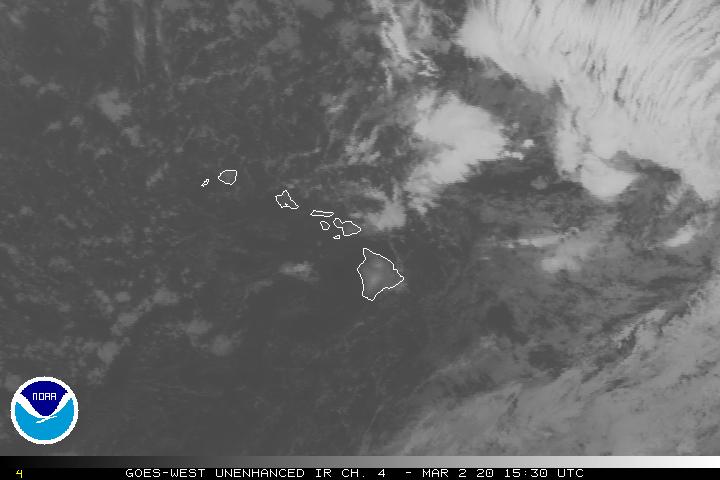
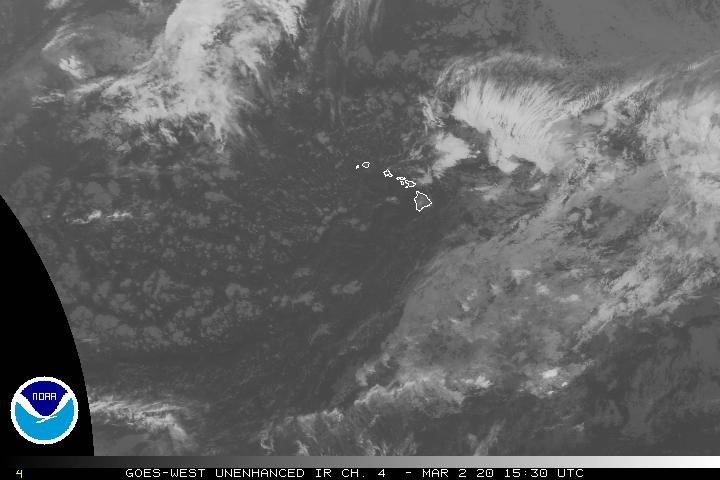
Satellite and Radar Images: To view the cloud conditions we have here in Hawaii, please use the following satellite links, starting off with this Infrared Satellite Image of the islands to see all the clouds around during the day and night. This next image is one that gives close images of the islands only during the daytime hours, and is referred to as a Close-up visible image. This next image shows a larger view of the Pacific…giving perspective to the wider ranging cloud patterns in the Pacific Ocean. Finally, here's a Looping IR satellite image, making viewable the clouds around the islands 24 hours a day. To help you keep track of where any showers may be around the islands, here’s the latest animated radar image.
Hawaii’s Mountains – Here’s a link to the live webcam on the summit of near 14,000 foot Mauna Kea on the Big Island of Hawaii. The tallest peak on the island of Maui is the Haleakala Crater, which is near 10,000 feet in elevation. These two webcams are available during the daylight hours here in the islands…and when there’s a big moon rising just after sunset for an hour or two! Plus, during the nights and early mornings you will be able to see stars, and the sunrise too…depending upon weather conditions.
Tropical Cyclone activity in the eastern and central Pacific – Here’s the latest weather information coming out of the National Hurricane Center, covering the eastern north Pacific. You can find the latest tropical cyclone information for the central north Pacific (where Hawaii is located) by clicking on this link to the Central Pacific Hurricane Center. Here’s a tracking map covering both the eastern and central Pacific Ocean. A satellite image, which shows the entire ocean area between Hawaii and the Mexican coast…can be found here. Of course, as we know, our hurricane season won't end until November 31st here in the central Pacific.
Aloha Paragraphs

Beautiful beach on Kauai
Winds will be on the down swing through the rest of this work week…with possible light trade winds returning this weekend. This weather map shows a weakening 1038 millibar high pressure system northeast of the islands Monday night. This high pressure cell has an associated ridge, which is being forced down close to Kauai now. An approaching cold front is the reason for this shifting of the ridge down over or near us. This in turn will put our islands in a considerably lighter wind flow. The direction, which has been east or east-southeast, will likely become more ESE or even southeast over the next few days. This of course raises the possibility of volcanic hazy coming into play over the next several days as well. The latest outlook shows that the trade winds will likely filter back into the state later this coming weekend, into early next week.
Winds around the state are locally gusty, with the following numbers representing the strongest early Monday evening:
25 mph Port Allen, Kauai
29 Kahuku training area, Oahu
27 Molokai
36 Kahoolawe
30 Kahului, Maui
10 Lanai Airport
30 South Point, Big Island
Our rainfall pattern will become drier through the next several days…although could become wetter on the Kauai end of the island chain later this week. The lighter winds will prompt a convective weather pattern, which typically brings cloudy conditions to the upcountry areas during the afternoons…with a few showers. Here's a satellite picture showing that indeed, the showery clouds of last night into this morning, have moved away. An upper level trough of low pressure has moved away from the state too, taking the prospect of most showers away with it. Looking ahead, a cold front now west and northwest of Kauai, as shown on this satellite image, will not move towards the state for the time being…although could definitely bring increased showers towards Thursday or Friday.
It's Monday evening as I begin writing this last section of today's narrative update. As pointed out above, we still have a rather strong high pressure system to our northeast….although it's weakening quickly. This high is being rated at 1038 millibars, at the time of this writing. At the same time, an area of low pressure with a cold front is evident to our northwest. The alignment of these weather features, is keeping our local winds to the east and east-southeast. As they turn more southeasterly, we may see some form of volcanic haze (vog), moving up the island chain from the Big Island vents. The prospect for drier weather will remain in force through mid-week, with nothing out of the ordinary expected through this period. We'll see increased high cirrus clouds moving overhead soon, which will dim our sunshine for several days.
~~~ Here in Kihei, Maui, at 540pm, skies were mostly clear, and the sun had already set to the west. I anticipate a clear night, continuing into Tuesday as well. Those lighter winds however will start clouds forming over and around the mountains by the afternoon, with a few showers both days into mid-week. I'm getting ready to head back upcountry to Kula now, and will be back online early Tuesday morning with your next new weather narrative then. I hope you have a great Monday night until then! Aloha for now…Glenn.
Interesting: After two weeks of volcanic eruptions, life for people living near Indonesia's Mount Merapi remains dangerous and difficult. The death toll from the eruptions has surpassed 200, and more than a quarter of a million people have evacuated their homes. While vulcanologists believe the eruption is dying down, they can't guarantee it won't flare up again.
On the south side of Merapi, Indonesian army commandos lead a search-and-rescue mission. In the distance, smoke and gray ash billow from Merapi's crater high into the sky. Heat shimmers up from the scorched earth. A burnt and decaying stench hangs in the air. Commandos and rescue workers pick and shovel through an obliterated village. They place a few bones and blackened remains in body bags before heading back to base.
There, battalion commander Lt. Col. Iwan Setiawan reviews his ash-covered troops. The commandos, known as Kopassus, could use some good publicity. Until recently, they were blacklisted by the U.S. for human rights abuses. Setiawan says that seven bodies were found on today's mission. They will be delivered to a nearby hospital. The village lay just four miles from the volcano, well within the 12-mile danger zone delineated by authorities.
He adds that the rescue missions are mandated by the government and will continue until the government tells the commandos to stop. The wind blows the ash from Mount Merapi westward, where it rains down from the sky. It crushes the vegetation, including the tropical fruit trees — mangosteens, rambutans and snake fruit — that farmers here grow.
Interesting2: The International Commission for the Conservation of Atlantic Tunas (ICCAT), a fisheries body that manages approximately 30 species of fish caught in the Atlantic Ocean will meet in Paris, November 17 – 27, to consider measures to protect severely depleted Atlantic bluefin and threatened sharks and to potentially take measures to stop illegal fishing.
The Pew Environment Group, an independent non-profit group based in Washington, DC, is calling on ICCAT to take strong measures to end illegal fishing, to handle fisheries management based on sound science and end the chronic overfishing in the Mediterranean and Atlantic Ocean that continue to threaten the sustainability of Atlantic bluefin tuna and several species of sharks.
A recent report and companion documentary released by the International Consortium of Investigative Journalists called Looting the Seas found that significant decline in Eastern Atlantic bluefin tuna is a result of lack of regulatory oversight, massive fraud, at a $4 billion black market where thousands of tons of fish have been illegally caught and traded.
Looting the Seas appeared online, and as a documentary on BBC on November 6-7, 2010. The report found Eastern Atlantic bluefin tuna, a valuable sushi delicacy that is sold around the world, has been overfished to the point of extinction. For instance, in Japan, bluefin tuna can fetch up to $100,000 per fish.
According to ICCAT figures, over the last four decades, the Eastern Atlantic Bluefin Tuna population has fallen by nearly 75 percent, with half of that loss occurring between 1997 and 2007. PEW is also encouraging ICCAT at its upcoming meeting to develop measures that protect the stocks of oceanic whitetip shark and shortfin mako shark.
In past years, ICCAT has cited these two shark species as being overfished but no formal proposal has been recognized to protect these stocks. Now because of lack of action, species of bluefin tuna, oceanic whitetip shark and shortfin mako shark are on the brink of collapse.
PEW is calling on ICCAT to: 1) call for measures that will end fishing of bluefin tuna, Oceanic whitetip and mako shark species on their spawning grounds in the Gulf of Mexico and Mediterranean; 2) improving data collection on stocks of bluefin tuna in the Atlantic Ocean; and 3) take additional measures to combat unregulated fishing.
Interesting3: Diet, pollution and modern living conditions have been implicated as the factors responsible for cancer, concluded researchers, after analyzing the remains of almost 1,000 individuals from ancient Egypt and Greece. The investigation, conducted by a team from Manchester University, looked into medical literature of the time for descriptions of cancer symptoms as well as examining today's remains for signs of the disease.
They did, for the first time, manage to identify cancer in one Egyptian mummy but this remained the only example in their widespread search. With this in mind, the scientists concluded that cancer was even rarer than previously thought. Professor Rosalie David, who led the study, said: "In industrialized societies, cancer is second only to cardiovascular disease as a cause of death.
In ancient times, it was extremely rare. There is nothing in the natural environment that can cause cancer. So it has to be a man-made disease, down to pollution and changes to our diet and lifestyle."
The research team painstakingly pieced together the development of cancer over the last 3,000 years, much longer than several other scientific papers. They found that cancer only began to emerge as a common disease in the 1700s, and its rate of occurrence dramatically rose during the 20th century.
Interesting4: Armed with pointed tips so sharp that neither cows nor deer will eat it, medusahead (Taeniatherum caput-medusae) is an invasive grass species that seems to have stepped right out of the Little Shop of Horrors. With no enemies, it is spreading rapidly throughout the western United States, outcompeting native grasses and even other grass invaders.
Unless steps are found to control its spread, medusahead is likely to turn millions of hectares of grazing land into worthless fields, say researchers in a study that determined why this grass is so successful.
"It is a devilish species because it is absolutely not of any worth," says Seema Mangla, a plant ecologist at Oregon State University, Corvallis, who led the study. "Every animal avoids it." That's because the medusahead's long, twisting, snakelike seed stems (which give the grass its name) are stiff and pointed like needles.
Any animal that leans in for a snack gets jabbed in the eyes and mouth. The grass is loaded with inedible silica, too, providing few nutrients to would-be grazers. As a result, the grass steadily accumulates, forming mounds of thatch, Mangla says. "It's part of a huge change in vegetation structure," as native grasses are overwhelmed by invaders.
Other studies have shown that medusahead is spreading at a rate of 12% per year in 17 western states. Although it invaded the United States from the Mediterranean in 1880 and is now found only on more than 1 million hectares, Mangla and others worry that it is picking up steam and may be outcompeting not only native grasses, but even cheatgrass (Bromus tectorum), a more nutritious invader.
Measures to control medusahead's spread—mowing or spraying with herbicides—aren't effective, because they only treat the top of the plants, not the thatch beneath, which protects their seeds, Mangla says. "We need to understand its growth dynamics, what makes it such a successful invader, then we can figure out better ways to disrupt it."
Interesting5: Dust storms scour Iraq. Freak floods wreak havoc in Saudi Arabia and Yemen. Rising sea levels erode Egypt's coast. Hotter, drier weather worsens water scarcity in the Middle East, already the world's most water-short region. The Arab world is already suffering impacts consistent with climate change predictions.
Although scientists are wary of linking specific events to global warming, they are urging Arab governments to act now to protect against potential disasters. There are huge variations in per capita greenhouse gas emissions across the region with very high rates for several oil and gas producers.
Qatar recorded the world's highest per capita emissions with 56.2 tons of carbon dioxide in 2006, while Egyptians emitted just 2.25 tons each, U.N. figures show. While the region as a whole has contributed relatively little to historic greenhouse gas emissions, it is among the most vulnerable to climate change, and emissions are surging. Inaction is not an option, said Mohamed El-Ashry, former head of the Global Environment Facility, a fund that assists developing countries on climate and other environmental issues.
"It's human nature to wait until there is a crisis to act," he told Reuters. "But you hate to wait until there is really a huge crisis where large numbers of people suffer needlessly." Measures to tackle the region's environmental woes would also help offset future impacts of global warming.
"Addressing water issues, say, would have the dual benefit of responding to climate change issues, but also addressing the problems that result from population growth, poor management and very weak institutions related to water," Ashry said. The Arab world's population has tripled to 360 million since 1970 and will rise to nearly 600 million by 2050, according to a U.N. Development Program (UNDP) research paper this year.
 Email Glenn James: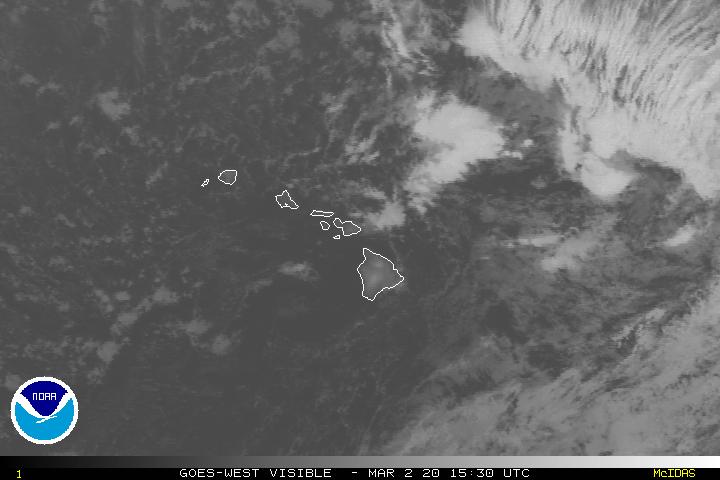


Eliza Says:
Aloha Glenn –
Here's an interesting tid bit for you – found out that today is National "Clean out your refrigerator" Day. LOL!
Have an excellent Monday ~ A hui hou ~ Eliza~~~Hi Eliza, thanks for the heads up! Aloha, Glenn
Tim Says:
Welcome back Glenn! I just returned myself, from an extended stay on the mainland. Great way to charge the batteries and refresh perspectives!! Once again, I'd like to thank you for your efforts!~~~Hi Tim, welcome back to you too. You are very welcome, I enjoy sharing my interest in the weather with you, and everyone else too. Aloha, Glenn